Tribal Environmental Compliance Summit Landing Page
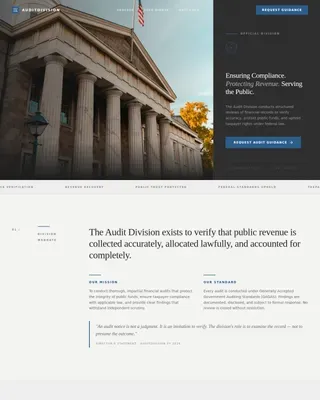
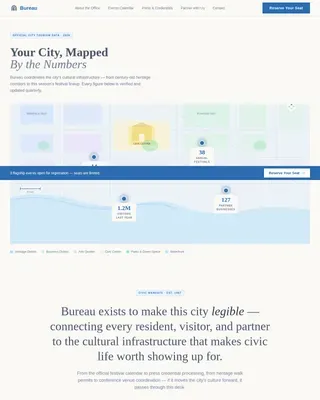
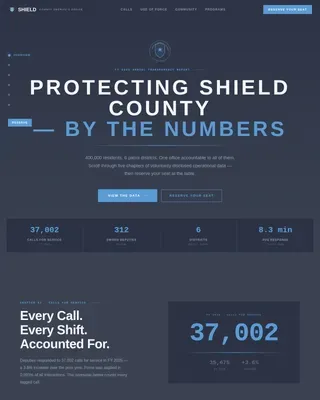
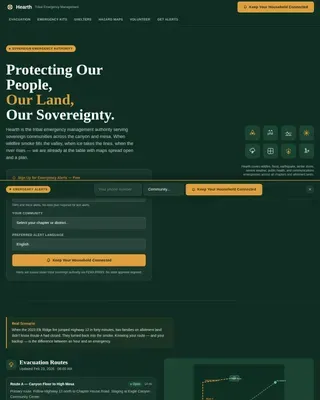
The Sovereign landing page template is built for tribal environmental regulatory bodies hosting compliance summits. It combines a Monochrome Steel design system with an Industry Report structure, delivering verified metric callouts, a scannable agenda timeline, an affiliation-first registration form, and a PDF agenda gate, all in a single-column flow that carries institutional authority from the first scroll.
by Rocket studio
Quick summary
The Sovereign template is a single-column landing page designed for a tribal environmental compliance summit. It opens with an institutional logo bar, moves through typographic metric callouts, a structured agenda timeline, a regulatory context section, and an amber-accented registration form. Every design decision reflects the weight of verified data and the seriousness of environmental enforcement across tribal communities.
Who this template is for
This template serves regulatory staff, elected officials, and compliance professionals who need a credible, information-dense event page. It is not built for general audiences. It is built for people who read compliance reports before breakfast and expect every number on a page to be sourced.
The primary users include:
- Tribal officials, council members, and tribal leaders reviewing annual enforcement data and monitoring station outputs
- Federal agency coordinators cross-referencing attainment status and verifying compliance timelines
- Facility operators tracking permit deadlines and reviewing enforcement actions against extractive industries
- Community members, community health advocates, and staff members monitoring contamination near residential and native villages
What problem this template solves
Tribal governments hosting compliance summits often face a real presentation problem. Their content is rigorous, their mandate is serious, and their audience expects institutional credibility. Generic event page templates introduce decorative elements, warm gradients, and lifestyle imagery that undermine that credibility immediately. The moment a federal official or a tribal council member lands on a page that looks like a wellness retreat, trust collapses.
This template solves that directly:
- It removes decorative noise and replaces it with a structured, data-forward layout that mirrors the visual language of a government briefing document
- It prioritizes institutional identity by centering the tribal authority seal alongside partner insignia, establishing the government-to-government relationship before a single word is read
- It guides three distinct visitor types, registrants, agenda downloaders, and passive researchers, through separate paths without cluttering the primary conversion flow
What you get with this template
The template delivers a complete, ready-to-customize event landing page structured around five core content zones. Each zone is designed to serve a specific job: establish authority, present the agenda, capture registrations, deliver regulatory context, and gate a secondary document. The layout follows a single-column flow so visitors move in one direction, from overview to commitment.
Included sections and components:
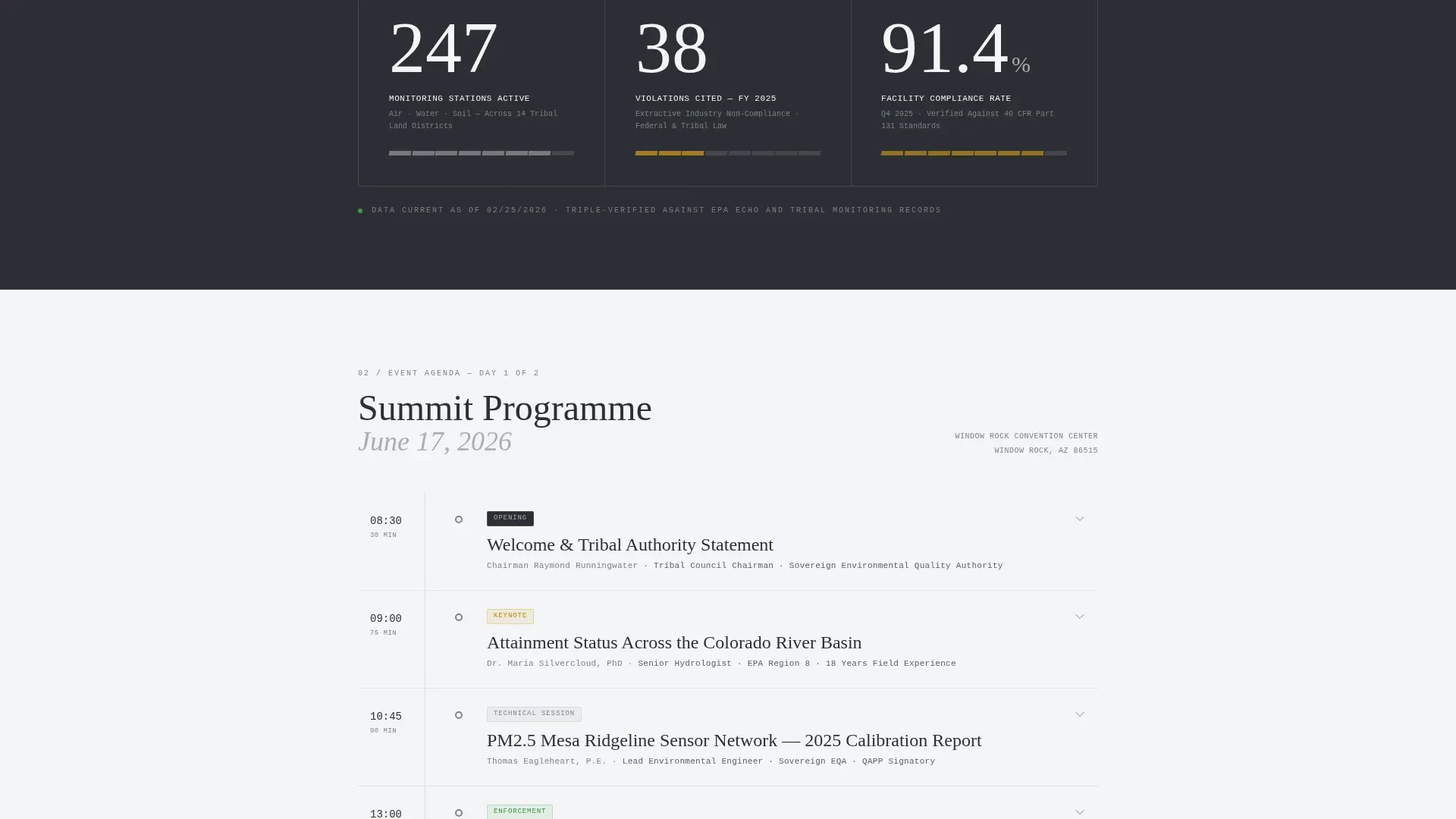
- Hero section with centered institutional logo bar, monospaced event label, and three large typographic metric callouts (monitoring stations active, violations cited, compliance rate)
- Agenda section with a clean timeline layout showing session blocks, speaker credentials, and topic abstracts
- Registration section with an amber call-to-action button and an affiliation-first form collecting name, tribal affiliation or agency, professional role via dropdown, and email
- Regulatory context section presenting recent enforcement actions and policy updates as structured data cards with scroll-reveal behavior
- PDF gate section offering the draft agenda as a secondary email-capture path for interested parties not yet ready to register
- Footer following a minimal developer-style pattern with no decorative elements
Feature list
This section describes the functional components and design capabilities built into the Sovereign template.
Institutional Logo Bar Header
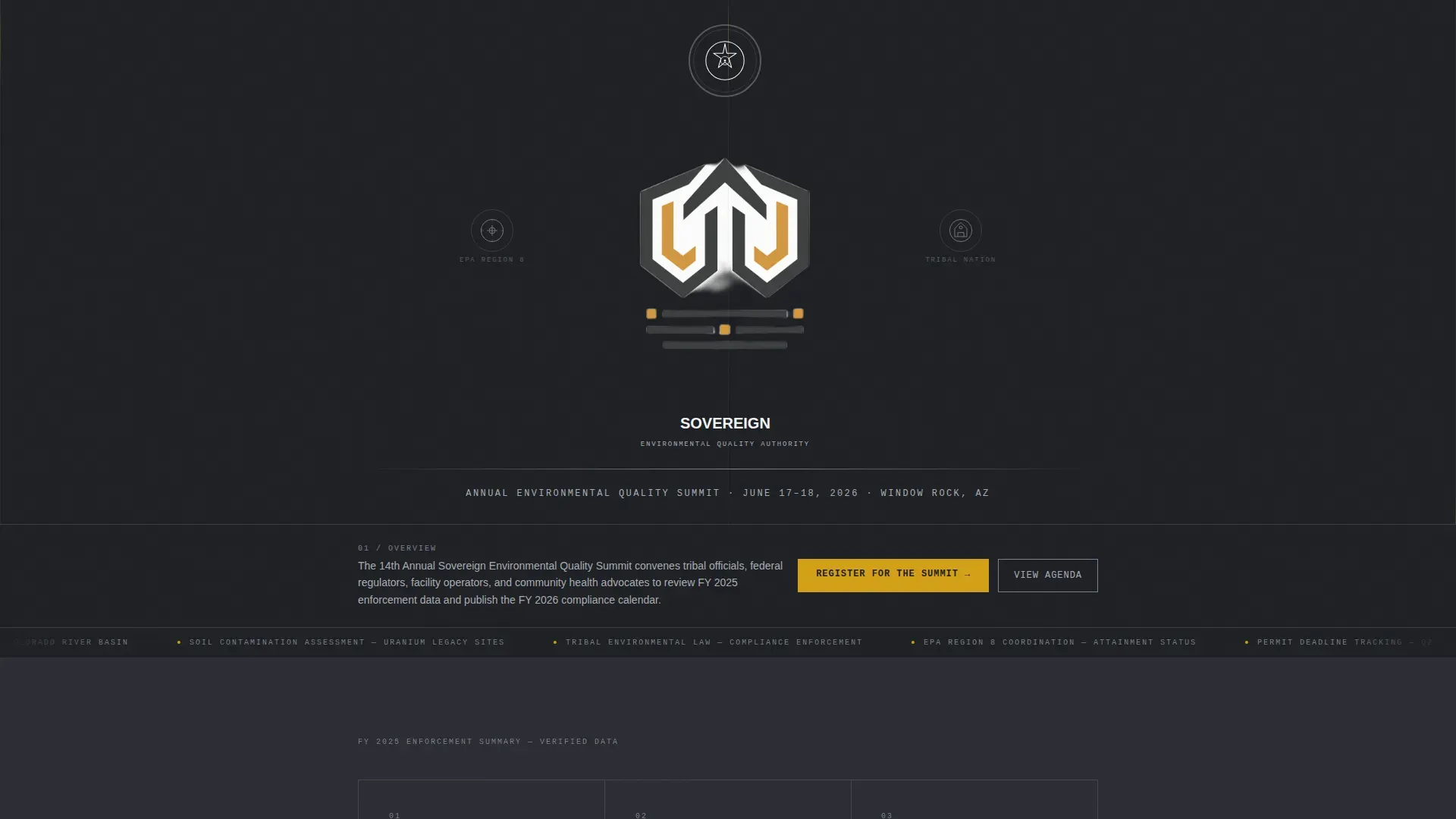
The header centers the tribal authority seal at full desktop width, flanked by partner insignia rendered in single-color grayscale against the structural charcoal field. Below the logo bar, a single line of white monospaced type announces the event name, date, and location. There is no imagery, no gradient, and no motion in this zone. The authority comes from symmetry, stillness, and the institutional gravity of marks that carry legal weight in the context of tribal consultation and government-to-government relationship.
Typographic Metric Callouts
Three large-format data callouts display verified figures directly beneath the header: monitoring stations active, violations cited, and compliance rate percentage. These function as immediate social proof for tribal members, federal officials, and facility operators arriving with specific questions. The monospaced IBM Plex Mono typeface reinforces the precision of every figure, signaling that the data behind this event has been triple-verified before publication.
Structured Agenda Timeline
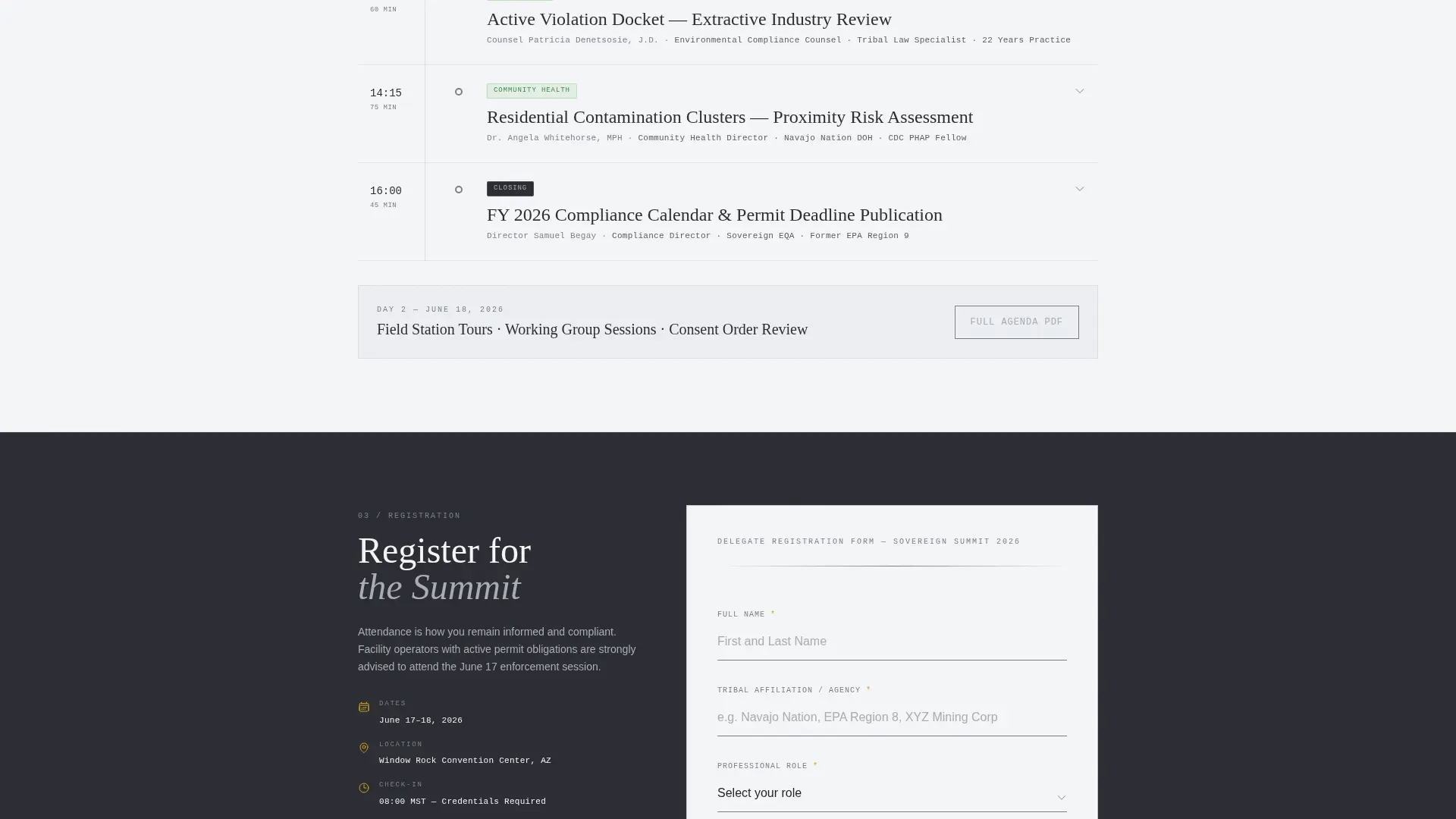
The agenda section presents the full session schedule as a clean vertical timeline. Each block shows the session time, speaker credentials, and a short topic abstract. The format supports sessions covering topics such as the National Environmental Policy Act (NEPA) compliance, Section 106 review under the National Historic Preservation Act, environmental review procedures, and permit enforcement. Visitors can scan the agenda in seconds and confirm whether the content is relevant to their specific compliance role.
Affiliation-First Registration Form
The registration form collects information in a deliberate order: name first, then tribal affiliation or agency, then professional role from a dropdown (tribal official, federal regulator, facility operator, community advocate, or other), and finally email. This sequence reflects how registration data is actually used in a government-to-government consultation context, institutional identity before inbox. The form includes client-side validation and an amber submit button that matches the regulatory accent palette throughout the template.
Regulatory Context Data Cards
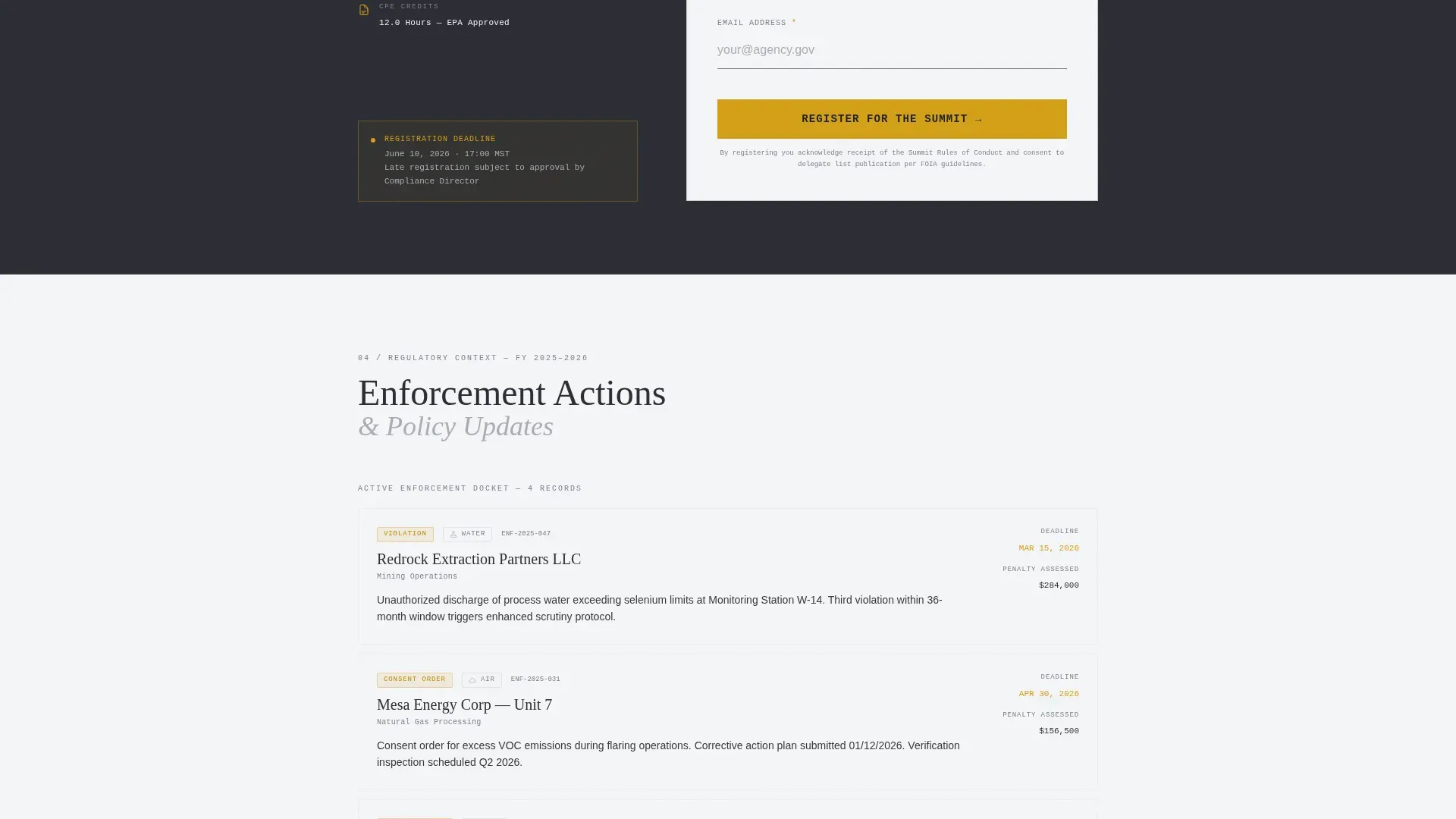
Below the agenda, a section of structured data cards presents recent enforcement actions and policy updates. Each card surfaces key information in a compact format with spotlight hover behavior. This section is where federal policies, executive orders, and enforcement precedents are surfaced as scannable reference material rather than buried in body copy. It reinforces that the summit is not just an event but a live reporting moment for ongoing environmental protection work.
PDF Agenda Gate
A secondary conversion path offers the draft agenda as a downloadable document. This gate requires only an email address, capturing interested parties who are researching the summit but are not yet ready to commit to attendance. It is distinct from the primary registration flow and appears as a clearly labeled secondary action below the main call-to-action zone.
Page sections overview
| Section | Purpose |
|---|---|
| Institutional Logo Bar | Establishes regulatory identity and government partnership context |
| Event Label Line | Announces name, date, and location in monospaced type |
| Metric Callout Block | Displays verified monitoring and enforcement figures |
| Agenda Timeline | Presents session blocks with credentials and abstracts |
| Registration Form | Captures attendee data with affiliation-first field order |
| Regulatory Context Cards | Surfaces enforcement actions and policy update data |
| PDF Agenda Gate | Secondary email capture for draft agenda download |
| Minimal Footer | Closes page with no decorative elements |
Design & branding system
The Sovereign template uses a Corporate Precision visual identity built on a Monochrome Steel color system. The palette is derived from the material language of field monitoring instruments and government-grade hardware. Every color choice has a defined function: no color is decorative, and no surface is warm.
The design system includes:
- Structural charcoal (#2B2D33) for primary backgrounds, enforcing the visual weight of an institutional document at every scroll position
- Brushed aluminum (#A8ADB5) for secondary surfaces, divider lines, and supporting user interface elements, creating clear hierarchy without color contrast that draws attention away from data
- Clean-room white (#F4F5F7) for content panels, ensuring maximum legibility for compliance figures, session details, and form fields
- Regulatory amber (#D4A017) reserved exclusively for action states, deadlines, and registration buttons, the only warm element on the page, making every call to action impossible to miss
- Typography stack of Fraunces for serif display headings, IBM Plex Mono for data labels and event metadata, and DM Sans for body text, a system built for authority and legibility across long-form regulatory content
Mobile & speed optimization
The template is built with a desktop-first layout priority, reflecting its primary audience of tribal council offices and federal agency workstations. However, the layout adapts for mobile use, where community members and tribal youth are increasingly accessing event information on phones. The mobile experience is structured so that registration remains accessible without scrolling through the entire page.
Key mobile and performance considerations include:
- A fixed bottom bar on mobile surfaces the primary "Register for the Summit" call to action at all times, preventing the registration path from being buried beneath agenda and context content
- Static server components handle the logo bar, metric callouts, agenda, and regulatory context sections, while client components manage the form validation and spotlight card interactions
- Low-to-medium animation levels use scroll reveal for content sections and spotlight borders on data cards, keeping the page responsive without introducing visual noise that conflicts with the institutional tone
How this template helps you convert
The Sovereign template is designed around a dual-path conversion model. The primary path drives summit registration. The secondary path captures document requests. Both paths are supported by the content hierarchy and visual system described above.
The conversion structure works in three steps:
- The hero section establishes immediate authority through verified metric callouts and institutional marks, giving tribal officials, federal coordinators, and facility operators a reason to keep reading before they encounter any ask
- The agenda timeline and regulatory context cards build the case that attendance is not optional, it is the mechanism through which compliance professionals stay current on enforcement actions, policy updates, and tribal consultation requirements relevant to their role
- The amber registration button and affiliation-first form appear at the natural decision point after the agenda, reinforced by the fixed mobile bar, so the ask arrives when the visitor's intent is at its peak
Other information about this template
The Sovereign template is purpose-built for the intersection of tribal sovereignty, environmental law, and government event communication. It reflects the specific context of indian tribes operating as federally recognized sovereign nations with inherent rights to self government and self determination over their ancestral lands and resources.
Several additional considerations are relevant for teams customizing this template:
- The template supports the consultation process demands of tribal governments operating under executive orders and presidential memorandum directives that mandate government-to-government consultation on federal policies affecting indian country
- Tribal codes, including green building codes and environmental standards, can be referenced within the regulatory context cards, teams at organizations like the Kayenta Township in the Navajo Nation or agencies serving new mexico tribal communities have used similar structured formats to surface tribal codes alongside federal regulations
- The government-to-government relationship between the united states government and federally recognized indian tribes requires that tribal consultation be conducted on a government-to-government basis, and this template's institutional header and agenda structure reflect that protocol directly
- Sections covering sacred sites, historic preservation entries in the national register, historic places, and cultural resource review under the national historic preservation act can be added to the regulatory context card zone without modifying the template structure
- The review process for environmental impact, including environmental review under the national environmental policy act and follow up consultation requirements, maps naturally to the agenda timeline section
- Federal agencies, executive departments, and participating agencies can all be represented in the partnership insignia zone of the logo bar, supporting multi-agency events where trust responsibility and government-to-government consultation are shared obligations
- The PDF gate section is well-suited for distributing written comments, draft policy documents, or enforcement summaries to tribal members, law students, and community advocates who need detailed information before committing to attendance
- The summit is designed to support raising awareness about contamination, food security threats, and public health impacts affecting tribal communities, native villages, and northwest indians, content that maps directly to the regulatory context card section
- The template's minimalist design removes standard navigation menus to keep visitors focused on registration, consistent with best practices for government event landing pages where meaningful consultation and a good faith effort toward engagement are the stated goals
- Teams can configure the registration dropdown to include roles such as tribal leadership representatives, federal officials, staff members from local governments, and community members, ensuring that individual tribes and other tribes can both be accurately represented in attendance data
- The summit mission field in the hero or agenda abstract zone should clearly state goals such as fostering tribal capacity, building capacity for EPA-Tribal Environmental Plans, and advancing self governance among tribal communities and indigenous peoples
- The template structure supports the sovereign tribal environmental compliance summit landing page template use case directly, as the section order from hero to registration to regulatory context mirrors the information architecture of a compliance briefing document
- Pricing and fee structure information, including any special rates for tribal members, should be added to the registration section so that the cost of attendance is clear before visitors reach the form
- Testimonials or participation statistics from previous summits, such as references to over 50 tribes represented, strengthen the trust signals in the metric callout zone and can be added as a secondary callout row beneath the primary figures
Theme
Corporate Precision
Creative direction
Industry Report
Color system
Monochrome Steel
Style
Single Column Flow
Direction
Event Registration
Page Sections
Institutional Logo Bar with Event Label
Verified Metric Callouts
Agenda Timeline with Session Blocks
Affiliation-first Registration Form
Regulatory Context Data Cards
Secondary PDF Agenda Gate
Related questions
Who is the registration form designed for?
Can the regulatory context cards be updated with new enforcement data?
Does the template support a secondary path for visitors not ready to register?
Is this template optimized for desktop government office environments?
How does the amber accent color work within the Monochrome Steel palette?