US Government Directory Website Template
Sovereign is a single-column tribal government landing page built for nations that need a dignified, organized digital front door. It opens with a searchable service header and six department tiles, then moves through living community stats, a department directory, council news, and a community calendar. The design earns trust before it asks for anything.
by Rocket studio
Quick summary
Sovereign is the sovereign tribal nation community hearth government website template designed for tribal governments that serve enrolled members every day. It delivers a clean, single-column flow covering housing, enrollment, health, education, elders, and employment. Every section is built to prove government competence first, then invite contact. Authority without coldness. Tradition without dust.
Who this template is for
Tribal governments need a website that works as hard as the front-desk staff. Sovereign was designed for nations that govern their own affairs, manage social services, and maintain direct relationships with their citizens. Whether you serve a few hundred community members or several thousand, the structure fits.
- Enrolled tribal members seeking forms, phone numbers, or council meeting dates
- Tribal administration staff publishing department hours, news, and downloadable documents
- Outside agencies and intergovernmental contacts looking for official department leads and jurisdiction information
What problem this template solves
Many tribal communities still rely on out-of-date pages, printed bulletins, or word of mouth to share critical government information. A grandmother tracking per-capita distribution should not have to call three numbers. A veteran filing for tribal housing assistance should not have to dig through unstructured pages. Sovereign removes that friction entirely.
- No organized department directory, so citizens cannot find phone numbers or office hours quickly
- No consistent news or calendar section, so members miss council meetings and community events
- No clear contact path, so inquiries go to the wrong department or fall through entirely
What you get with this template
This template gives you a complete, ready-to-customize landing page that respects your nation's authority and serves your citizens efficiently. Every section is purposeful. Every component earns its place by solving a real government communication problem.
- A navy search header with six icon-linked service tiles covering Housing, Enrollment, Health, Education, Elders, and Employment
- A living stats block displaying enrolled members, tribal lands acreage, students in tribal schools, elders served monthly, and homes built this fiscal year
- A department directory with phone numbers, office hours, and downloadable PDF forms per department, plus a council news section and a filterable community calendar
Feature list
This template was built around the practical realities of how indigenous peoples interact with their government online. Each feature reflects a specific design or content decision rooted in the source brief.
Tribal Seal Search Header
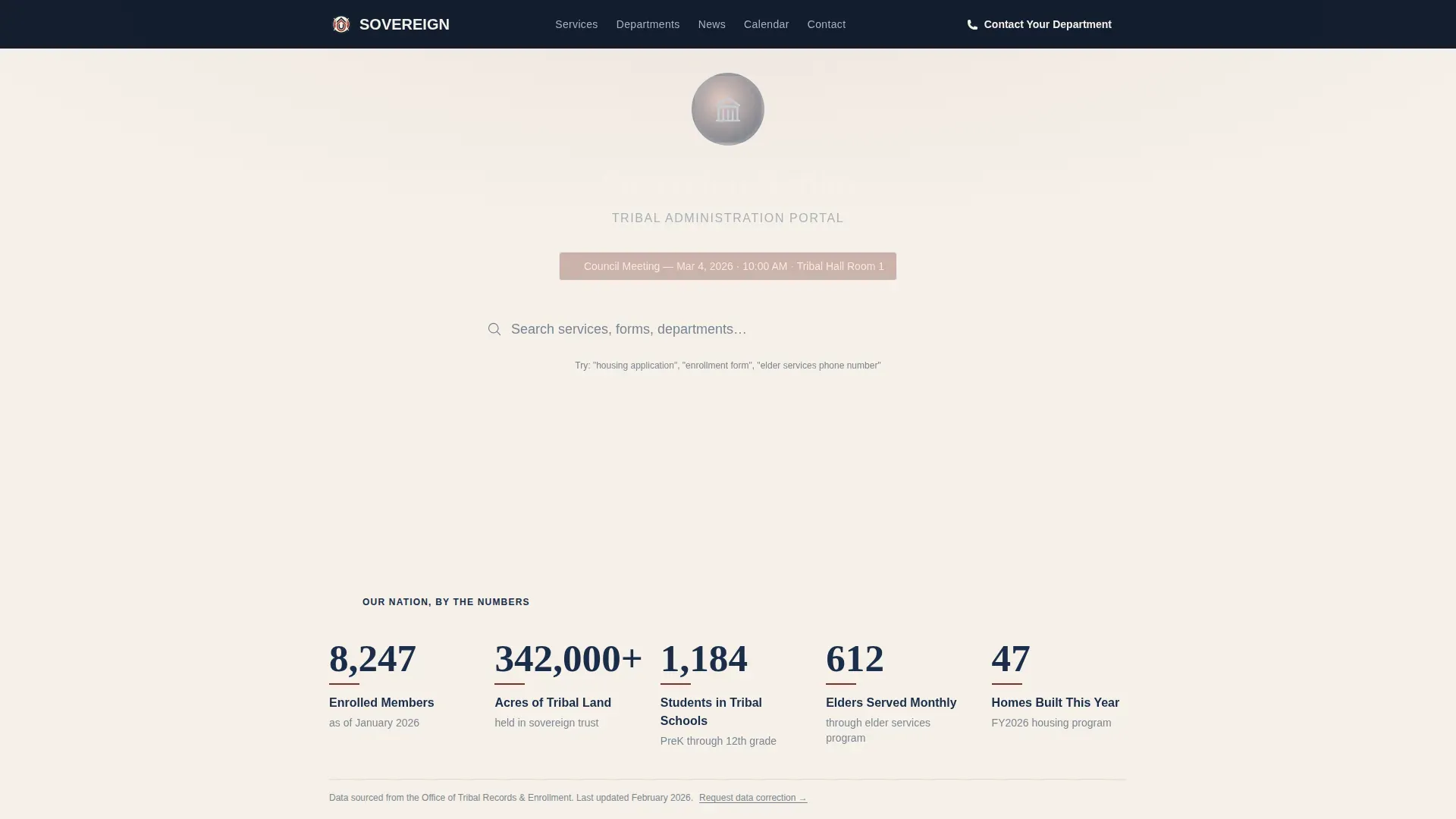
The header centers your nation's seal above a large, prominent search bar on a deep sovereign navy background. Ghost text reads "Search services, forms, departments..." so visitors understand immediately what the tool does. Six hearthstone red service tiles sit below, each carrying a cream icon linked to its department. The composition communicates clarity and respect for the visitor's time.
Living Community Stats Block
Five key numbers open the page below the header: enrolled members, acres of tribal lands, students in tribal schools, elders served monthly, and homes built this fiscal year. Each stat is large-set in navy with a thin red underline. Scroll-reveal counter animation brings the numbers to life as the visitor moves down the page. These numbers demonstrate active governance before any call to action appears.
Department Directory with PDF Downloads
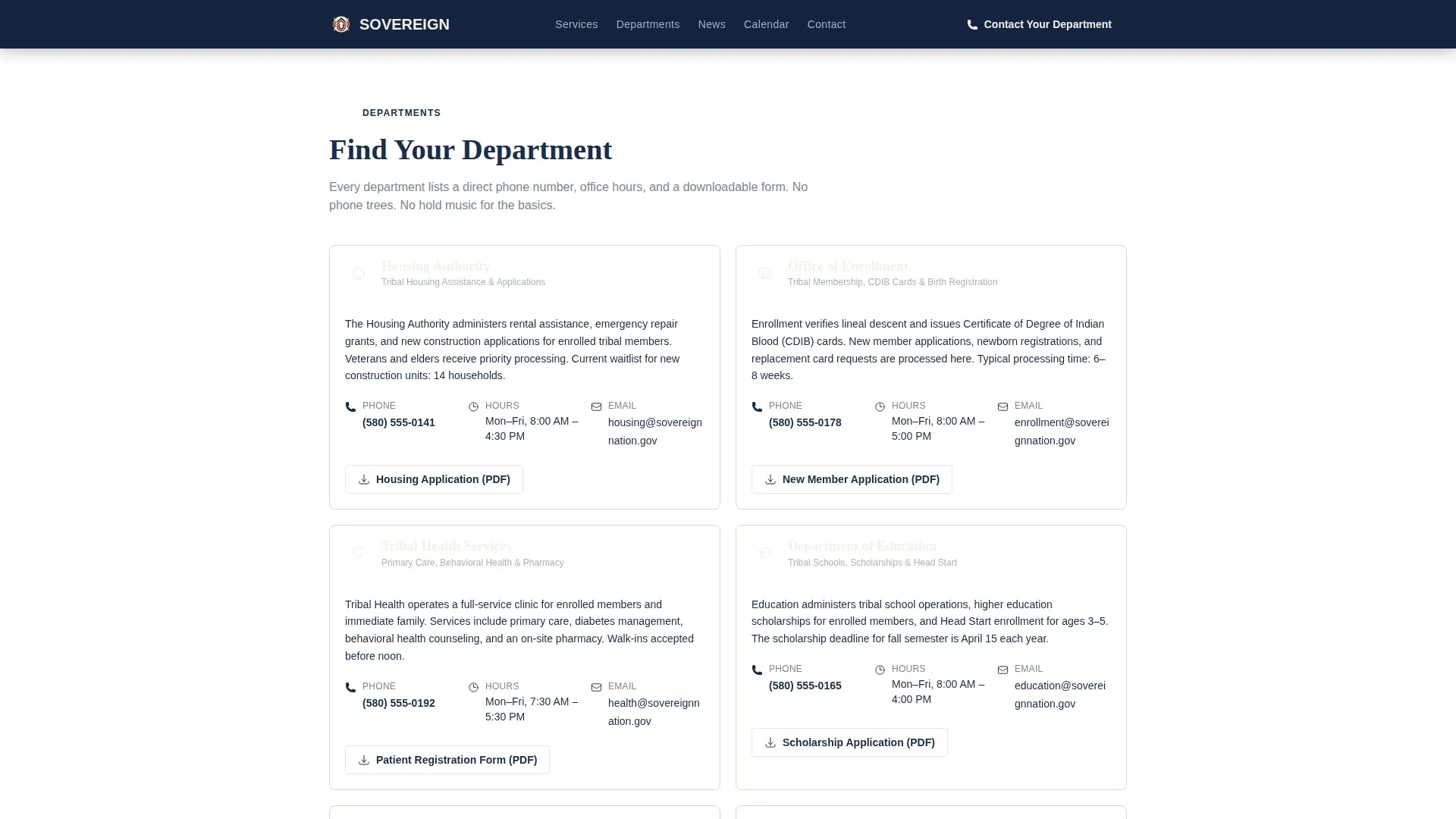
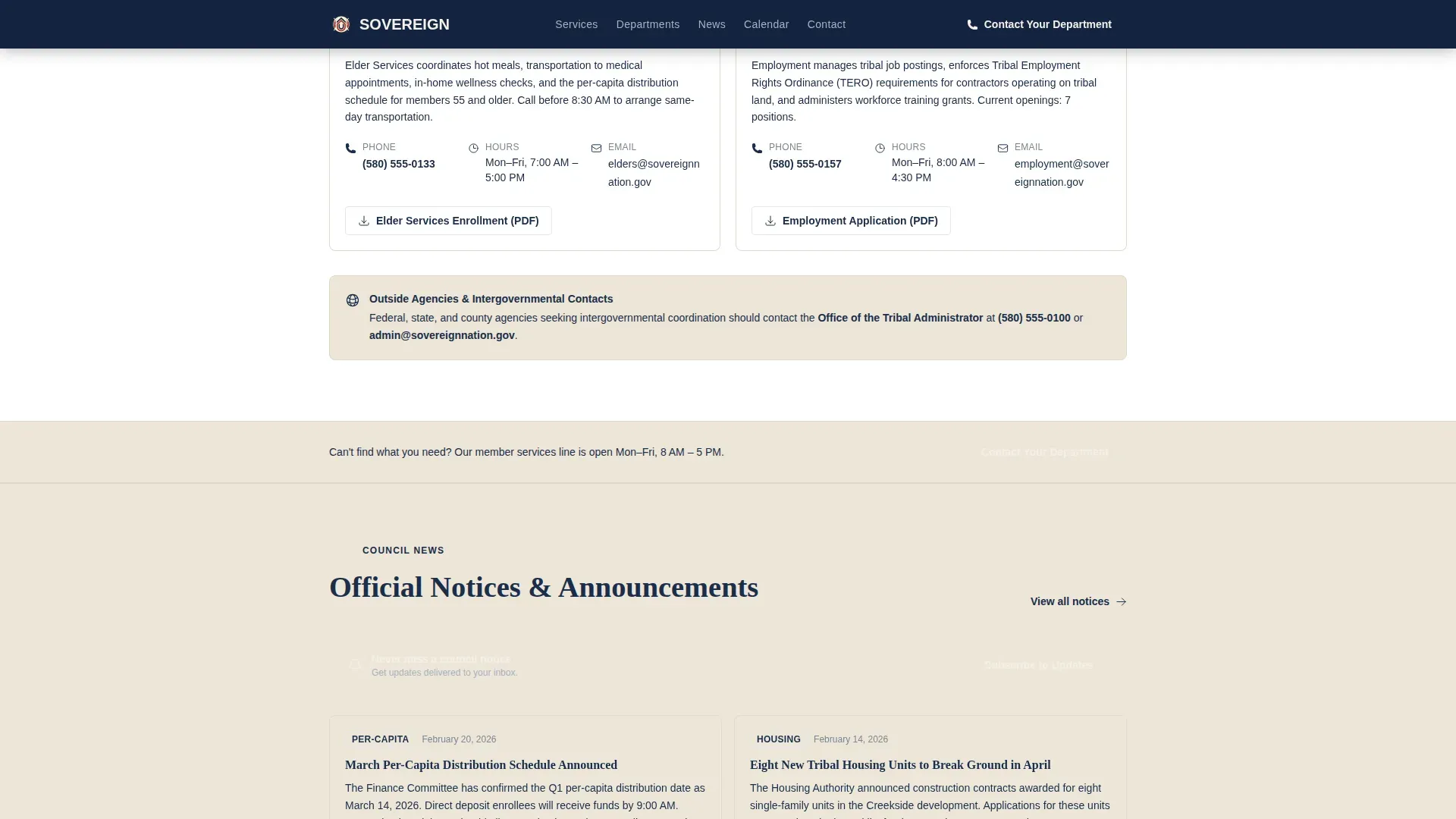
Each department section includes a plain-language paragraph, a direct phone number, office hours, and a downloadable PDF form. Sections expand in FAQ-style accordion interaction, keeping the page uncluttered. This structure helps tribal governments protect their citizens' access to resources without requiring visitors to navigate away. The rhythm is consistent across every department so visitors know what to expect.
Council News and Community Calendar
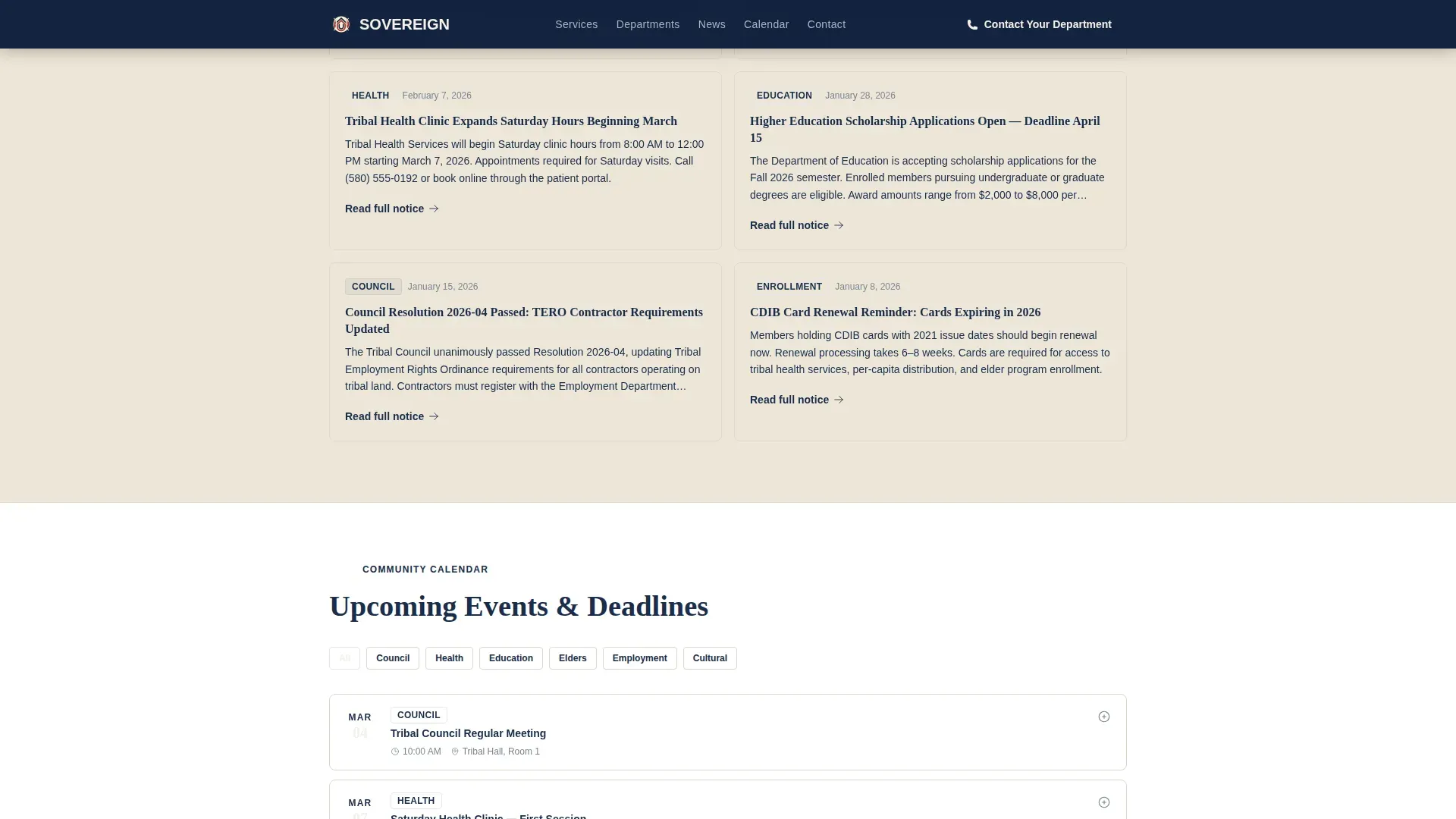
Dated council news entries carry category tags so members can scan quickly. The community calendar supports filterable event categories, letting tribal members find health clinics, enrollment drives, elder programs, or housing meetings by topic. Together these two sections keep the page current and give citizens a reason to return.
Dual-Path Conversion System
The primary call to action, "Contact Your Department," opens an inline form collecting full name, optional enrollment number, department needed via dropdown, and a message field. It sits fixed at the bottom on mobile and repeats after every third section on desktop. The secondary path, "Get Council Updates by Email," asks only for an email address and zip code. Both paths are low-friction by design.
Navy Authority Color and Typography System
Fraunces serif headings carry the authority of official documents. DM Sans handles body text and interface elements with clean readability. The Navy Authority color system uses deep sovereign navy for primary backgrounds, hearthstone red for alerts and action buttons, parchment cream for readable content surfaces, and brushed silver for dividers and secondary text. The palette reflects the dignity of a tribal council chamber.
Page sections overview
| Section | Purpose |
|---|---|
| Navy Search Header | Centers tribal seal, search bar, and six service tiles |
| Community Stats Block | Displays living numbers for enrolled members, lands, students, elders, homes |
| Department Directory | Lists each department with phone, hours, and PDF form download |
| Council News Feed | Shows dated news entries with category tags for quick scanning |
| Community Calendar | Filterable event categories for health, enrollment, housing, and elder programs |
| Department Contact Form | Inline form for name, enrollment number, department, and message |
| Newsletter Signup | Email and zip code subscription for council update emails |
| Page Footer | Linear single-row footer with essential links and contact anchors |
Design & branding system
Sovereign uses the Navy Authority color system to project the weight of real government authority. The palette was chosen to feel like a tribal council chamber: formal, warm, and grounded. Tribal websites must incorporate colors and motifs significant to the specific nation, and this system gives you a strong, respectful foundation to build on.
- Deep sovereign navy (#0B1D3A) for primary backgrounds and headers; warm hearthstone red (#8B2F26) for critical alerts and action buttons
- Parchment cream (#F5F0E8) for content surfaces and readable fields; brushed silver (#A8B2BD) for dividers and secondary text
- Fraunces for serif headings that carry document authority; DM Sans for body text and interface clarity
Mobile & speed optimization
Sovereign was designed mobile-first because many tribal members access government services from a smartphone, often from remote areas with limited connectivity. The fixed mobile call-to-action bar means the contact path is always reachable. Staggered department card animation and scroll-reveal stats are delivered with minimal JavaScript to keep load behavior predictable.
- Fixed-bottom contact bar on mobile keeps the primary action within thumb reach at all times
- Server Components handle static sections so the page delivers content reliably on slower connections
- Staggered card animations and counter effects use minimal JavaScript, keeping interaction smooth without heavy overhead
How this template helps you convert
Government trust is earned before it is requested. Sovereign is structured so every scroll reveals more proof of competence before asking the visitor to act. The dual-path conversion model means different visitors can engage at their own comfort level.
- The stats block, department directory, and downloadable forms demonstrate that this government is organized and accessible, so visitors arrive at the contact form already convinced.
- The fixed mobile contact bar and the repeated desktop form placement ensure the primary call to action is never more than one scroll away, reducing drop-off before submission.
Other information about this template
Sovereign was built with the broader context of tribal governance and indigenous data sovereignty in mind. Tribal sovereignty is the foundation of every design decision here. The essence of tribal sovereignty is the ability to govern and to protect and enhance the health, safety, and welfare of tribal citizens within tribal territory. Federally recognized tribes are treated as domestic dependent nations under federal law, and the united states government has a trust responsibility to support tribal self-government. Tribal members are citizens of three sovereigns: their tribe, the state, and the federal government. Tribal nations have been recognized as sovereign since their first interaction with european settlers, and that recognition shapes every aspect of how tribal governments communicate with their citizens today.
Indigenous data sovereignty is the right of a nation to govern the collection, ownership, and application of its own data. Tribes hold the sovereign authority to manage the collection, ownership, application, and interpretation of their own data. Data sovereignty is not a technical preference; it is a governance right. Indigenous peoples have always been data creators, users, and stewards, embedding data in their cultural practices long before digital systems existed. Tribes exercise indigenous data sovereignty through the interrelated processes of decolonizing data and indigenizing data governance. Data sovereignty requires that tribes carefully weigh how any platform, tool, or third party accesses information about their citizens, lands, and resources.
Tribal governments require access to their own data to protect their citizens and make sound decisions. The lack of access to relevant and appropriate data undermines indigenous research capacity and limits self determination. Tribes may not have ready access to data collected by external agents about their citizens, tribal lands, and resources. Other third parties, including researchers and state agencies, must understand that tribes have the right to informed consent regarding how their data is used or shared with other third parties. Local governments and state recognized tribes face similar barriers, and national congress organizations have continued to advocate for stronger data governance frameworks for american indians and alaska natives across indian country.
This template is designed for use by native nations in any region, including communities in northern california, as well as native american tribes served by federal programs under the bureau of indian affairs. Native peoples across the country, from alaska natives to nations in the southeast, govern differently and serve diverse communities. The diversity of governance structures across indian country means this template is intentionally flexible. A good tribal website should include sections for tribal council, citizen portals, tribal policies, culture, history, and news updates. Effective templates facilitate access to tribal constitutions, codes, and meeting minutes through document repositories.
- Websites should be designed with data ownership in mind, ensuring the nation controls its own data and digital infrastructure
- Role-Based Access Control allows for granular permissions to protect sensitive internal government information
- Templates can support bilingual content to accommodate both English and native tribal languages
- Key elements for tribal websites include secure, mobile-friendly design and support for.nsn.gov domains
- A document repository approach helps tribes share tribal policies, codes, and meeting minutes with community members
- Technical assistance programs are increasingly being developed to help native nations navigate state funding and intergovernmental relationship processes
- Tribal governments are responsible for a broad range of activities including education, law enforcement, and health care across their jurisdiction
- Websites that reflect cultural identity and governance principles help tribal governments build trust with their citizens and with outside organizations
Theme
Community Hearth
Creative direction
Stats-First Impact
Color system
Navy Authority
Style
Single Column Flow
Direction
Lead Generation
Page Sections
Tribal Seal Search Header with Service Tiles
Living Community Stats Block
Department Directory with PDF Forms
Council News and Filterable Calendar
Dual-path Contact and Newsletter System
Navy Authority Color and Type System
Related questions
Can this template be adapted to reflect my nation's specific colors and seal?
Does the department directory support downloadable PDF forms?
Is the contact form suitable for collecting enrollment numbers?
How does the dual-path conversion model work on mobile?
Is this template suitable for both federally recognized tribes and state recognized tribes?