Agricultural Equipment & Supply Reviews Website Template
The Sow heirloom seed heritage landing page template is built for family-run seed companies that lead with story, trust, and roots. It carries visitors from a cinematic split-hero through a decade-by-decade origin timeline, a planting calendar preview, an email capture form, and a season-sorted seed catalog browse, all wrapped in an earthy, field-journal visual identity.
by Rocket studio
Quick summary
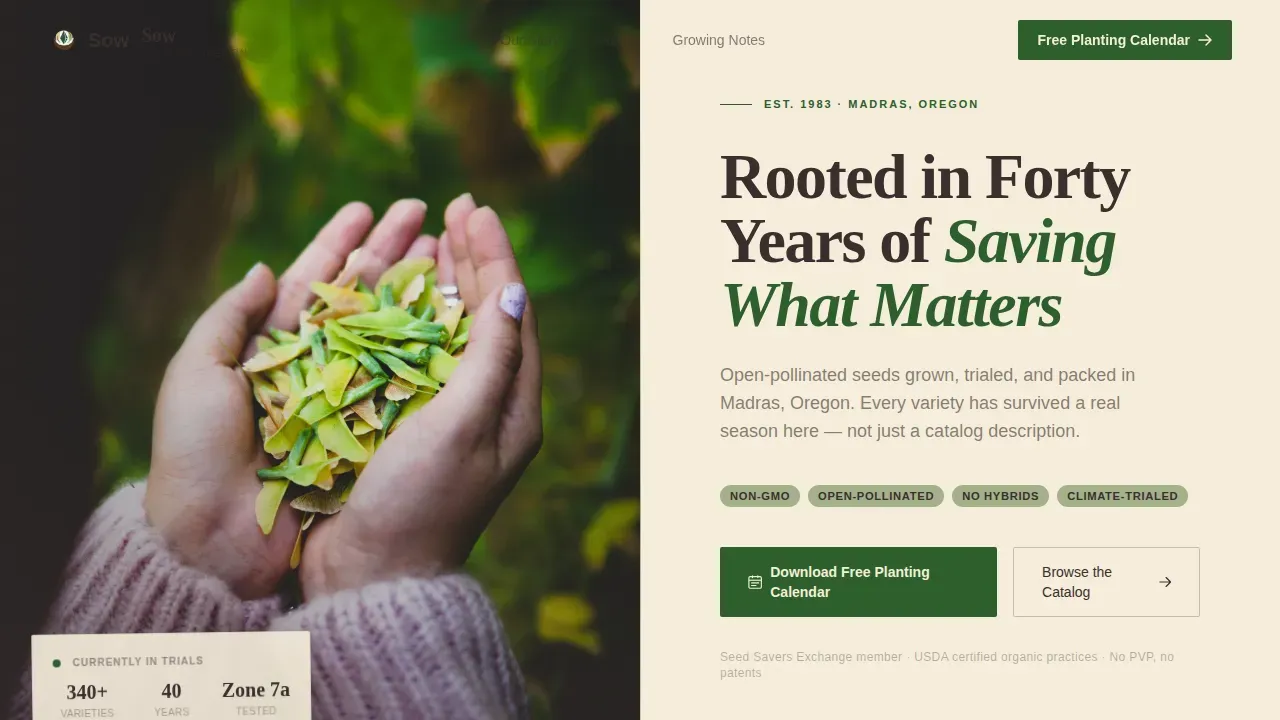
The Sow template is a gallery and detail landing page designed for a seed company with a generational story to tell. It opens with weathered hands and a serif headline, then pulls visitors through forty years of open-pollinated, non-GMO growing history before offering a free planting calendar and a path into the full seed catalog.
Who this template is for
This template fits any seed business that sells trust alongside heirloom seeds. It works especially well when the brand story is older than the internet and the catalog carries varieties that bigger operations dropped long ago.
- Backyard gardeners starting their first raised bed who want guidance they can rely on
- Market farmers and homesteaders rotating crops across multiple acres who value regional specificity
- Seed librarians and preservation advocates committed to keeping rare varieties alive for future generations
What problem this template solves
Most seed company pages look like a warehouse shelf: rows of packets, a cart button, nothing more. That approach fails the growers who love the history behind what they plant and want to trust the source before they order.
- Visitors leave without connecting to the brand's decades of trial-garden commitment
- Garden seeds with real lineage get buried under generic product grids
- The value of a free resource like a planting calendar goes unexplained until it is too late to earn the click
What you get with this template
You get a fully structured, content-rich landing page that earn trust at every scroll. The layout is designed to prove value before it asks for anything in return.
- A cinematic half-page hero with photo and serif headline
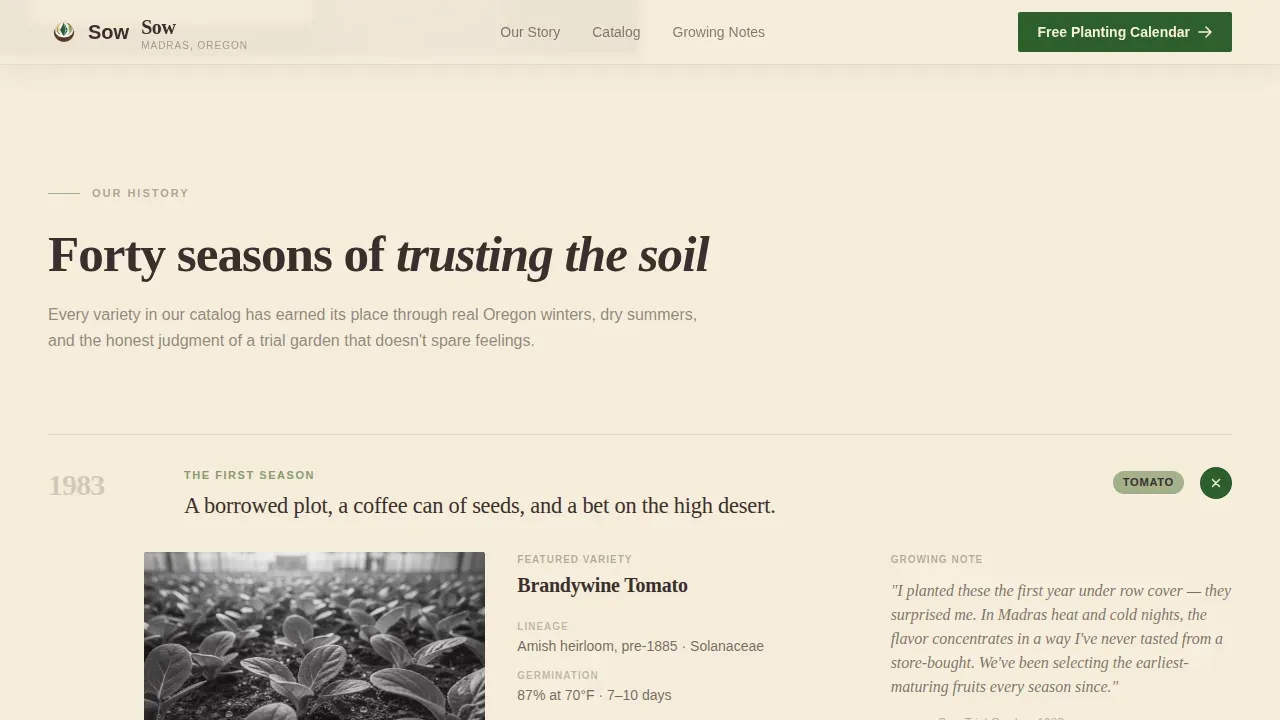
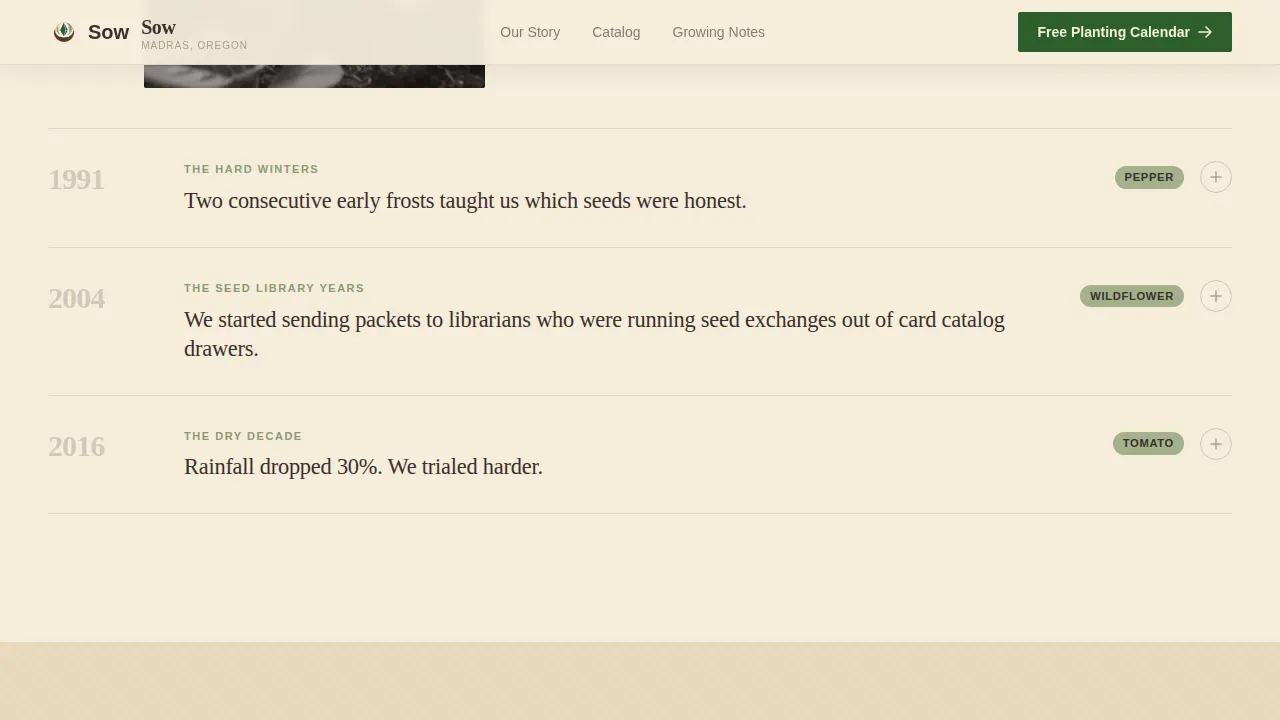
- A scrollable origin timeline that expands into variety detail panels
- A planting calendar preview, email capture form, and season-sorted catalog browse section
Feature list
A single paragraph introduces each capability below. Every feature comes directly from the template structure described in the source brief.
Cinematic Split Hero
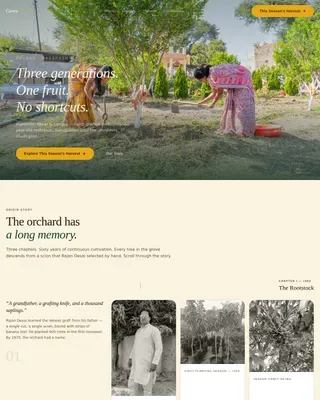
The hero divides the screen between a close-up photograph of seeds in weathered hands and a hand-stamped serif headline. Morning greenhouse light and shallow depth of field set a tone of quiet, honest craft before a word is read.
Decade Origin Timeline
Scroll reveals carry visitors from 1983 to the present through gallery cards. Each card expands into a detail panel showing variety name, lineage, germination data, and a first-person growing note, making the history of each heirloom feel personal, not archival.
Planting Calendar Preview
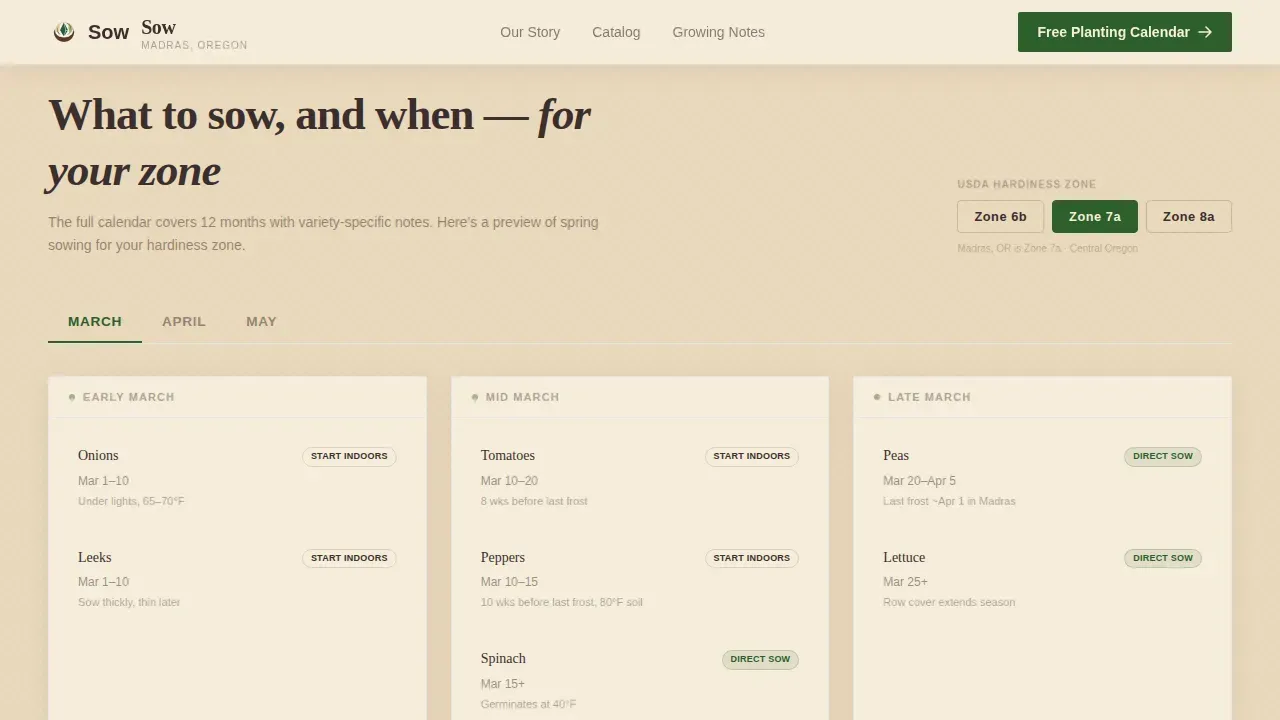
Three months of region-specific sowing dates appear directly on the page before the email form ever shows. Visitors can see real value first. That preview is what earns the click to download the full calendar.
Email Capture Form
A minimal form collects only an email address and a United States Department of Agriculture (USDA) hardiness zone. It is positioned directly after the calendar preview so the ask feels natural and the exchange feels fair.
Season-Sorted Catalog Browse
Below the fold, garden seeds are organized into Spring, Summer, and Fall tabs. Visitors can browse the full catalog by planting season without leaving the page, moving naturally from content to consideration.
Field Journal Design System
Typography pairs Fraunces serif display with DM Sans body text. The Forest Trust color palette, loam brown, evergreen, sun-warmed parchment, and lichen accent, gives the page the texture of a worn field journal left open on a potting bench.
Page sections overview
| Section | Purpose |
|---|---|
| Hero Split | Cinematic photo plus headline sets tone and brand promise |
| Origin Timeline | Decade-by-decade gallery cards with expandable variety detail panels |
| Calendar Preview | Three-month sowing grid proves planting calendar value pre-form |
| Email Capture | Minimal form collects email and USDA zone for calendar download |
| Catalog Browse | Season-tabbed seed cards let visitors explore the full offering |
| Footer Arc Split | Logo and tagline left, navigation links right |
Design & branding system
The visual identity follows a Nature-Inspired theme rooted in the Forest Trust color system. Earthy tones reflect the land these seeds come from and build immediate resonance with growers who spend time outdoors.
- Colors: deep loam brown (#3B2F2F), evergreen canopy (#2D5F2D), sun-warmed parchment (#F5EDDA), lichen accent (#A3B18A) for hover states and category tags
- Typography: Fraunces for display headlines, DM Sans for body, pairing warmth with legibility
- Animations: scroll reveals, beam borders, timeline panel expansion, and staggered card entrance at medium intensity
Mobile & speed optimization
Gardeners often browse on a phone while standing in the garden. This template is built desktop-first with a strong mobile adaptation so the layout holds on any screen size.
- Interactive elements, the origin timeline expansion, zone selector, and catalog filter tabs, use client-side rendering to stay responsive
- Static content sections use server components to ensure fast initial load without sacrificing interactivity
- All layout decisions prioritize readability at arm's length in outdoor light conditions
How this template helps you convert
This template is not a passive brochure. Every section moves visitors closer to a meaningful action, downloading the calendar or exploring the catalog.
- The origin timeline builds generational trust across every scroll, turning history into a reason to buy rather than a footnote
- The planting calendar preview delivers tangible value before the form appears, so the email ask feels earned rather than extracted
- The season-sorted catalog gives visitors a clear next step after the form, extending engagement rather than ending the visit
Other information about this template
This template is a strong fit for homesteaders, community gardeners, and anyone who loves the flavors and beauty of heirloom produce. It is equally useful for brands that want to highlight non-GMO, open-pollinated garden seeds with a genuine story behind every package.
- Heirloom seeds have been passed down across generations; many date back to the 18th century, including historically significant varieties like the Kentucky Wonder bean and Parris Island Cos lettuce
- Open-pollinated heirloom seeds can be saved and replanted so each new generation stays true to its parent plant, supporting self-reliance for growers who want to save seeds year after year
- Heirloom flowers and vegetables often produce more nectar and pollen than modern hybrids, supporting pollinators and promoting genetic diversity that helps food systems thrive
- Heirloom produce may vary in size, shape, and color; some heirloom varieties benefit from practices like crop rotation and companion planting to manage pest pressure compared to hybrids
- Community events like the 2026 Spring Planting Festival and the annual Herb and Garden Faire hosted by Landis Valley Village and Farm Museum celebrate heirloom gardening and draw thousands of growers who love this way of growing
- The Sow heirloom seed heritage landing page template is built without requiring traditional programming skills, no-code tools and AI-powered platforms make it possible to launch a production-ready site from this template and manage it independently
- Shipped seeds are packed with care; nothing sits on a warehouse shelf waiting for demand to catch up with inventory
Theme
Nature-Inspired
Creative direction
Origin Story
Color system
Forest Trust
Style
Gallery + Detail
Direction
Content/Resource
Page Sections
Cinematic Split Hero
Scrollable Decade Origin Timeline
Planting Calendar Preview Grid
Minimal Email Capture Form
Season-sorted Catalog Browse
Forest Trust Design System
Related questions
What types of seeds does this template support showcasing?
Can I use this template if my seed company is newer than forty years old?
How does the planting calendar section work?
Is this template suitable for homesteaders and market farmers as well as backyard gardeners?
What makes this different from a standard e-commerce product page?