Tool & Die Making Professional Website Template
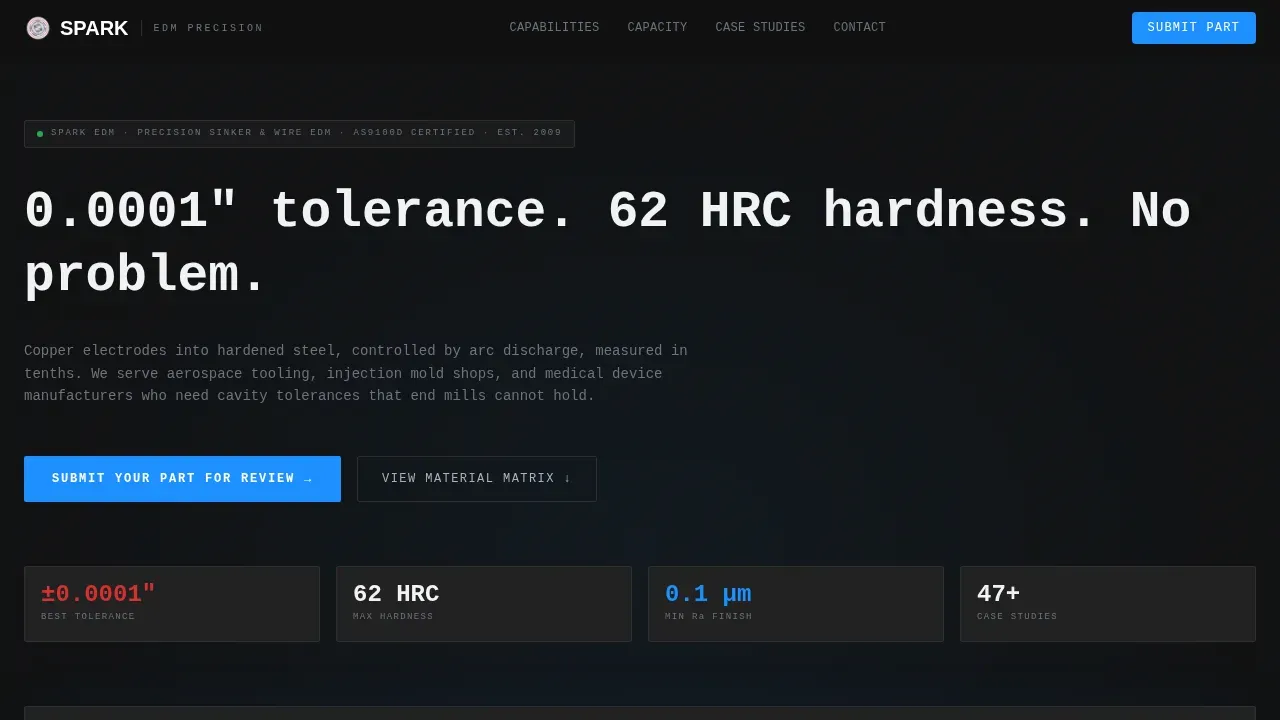
The Spark precision EDM machining landing page template is built for shops that earn trust through data, not decoration. It presents a dashboard-style layout with animated infographic headers, material compatibility tables, a live capacity module, and case study grids, giving aerospace, mold, and medical engineering buyers the hard numbers they need to qualify a vendor fast.
by Rocket studio
Quick summary
Spark is a single-page, data-dense landing page template designed for precision EDM machining services. It leads with an animated cross-section infographic, escalates through material matrices and capacity dashboards, and closes with a streamlined "Submit Your Part for Review" form. Every section is structured to prove competence before asking for contact information.
Who this template is for
This template is built for precision machine shops and EDM service bureaus that serve technically demanding clients. It speaks directly to engineers who evaluate vendors on measured capability, not marketing language.
- Sinker EDM and wire EDM shops serving aerospace, medical, and mold industries
- Precision machining services targeting engineers who submit STEP or IGES files for review
- EDM businesses that need to communicate tight tolerances and material range through data
What problem this template solves
Engineering buyers do not trust vague capability claims. They need specific numbers: tolerances achieved per material, machine count, lead times, and surface finish data. Generic templates cannot present that information in a way that feels credible to a trained engineer.
- Most templates lack the data-module structure needed to display EDM process specifications clearly
- Shops lose qualified leads because their pages do not present machine capacity or material compatibility evidence
- A form-first layout pushes away engineers who have not yet seen proof of capability
What you get with this template
You get a fully structured, single-page layout organized like an inspection report. Each scroll section builds on the last, delivering progressively denser data until the reader is ready to submit a part.
- Animated hero infographic with typewriter headline, spark-gap micro-animations, and staggered callout lines
- Material compatibility matrix, live capacity dashboard, and case study grid sections
- Sticky "Submit Your Part for Review" call-to-action bar and a gated capability sheet download path
Feature list
This section covers the core built-in components included in the Spark template.
Animated EDM Infographic Header
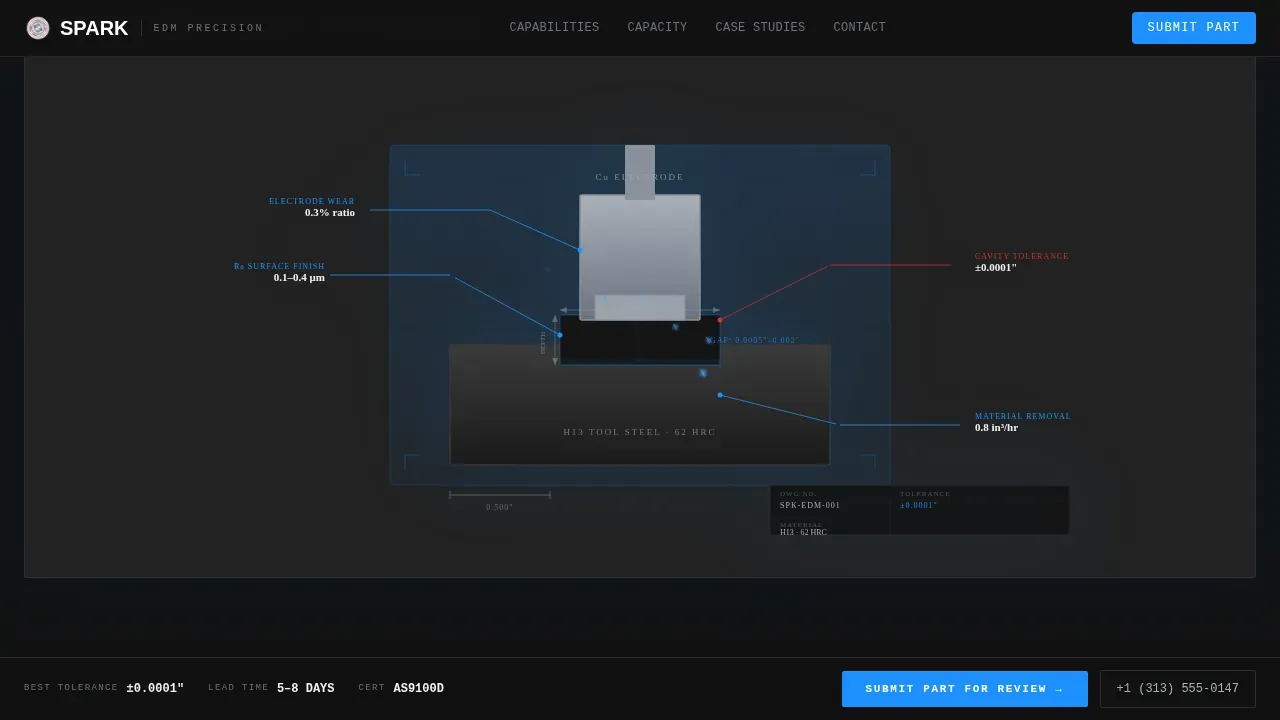
The full-width hero renders a cross-section of a sinker EDM operation. Animated callout lines point to surface finish values, electrode wear ratios, and depth-of-cut rates. A monospace typewriter headline reads live as the page loads, establishing technical credibility in the first three seconds.
Material Compatibility Matrix
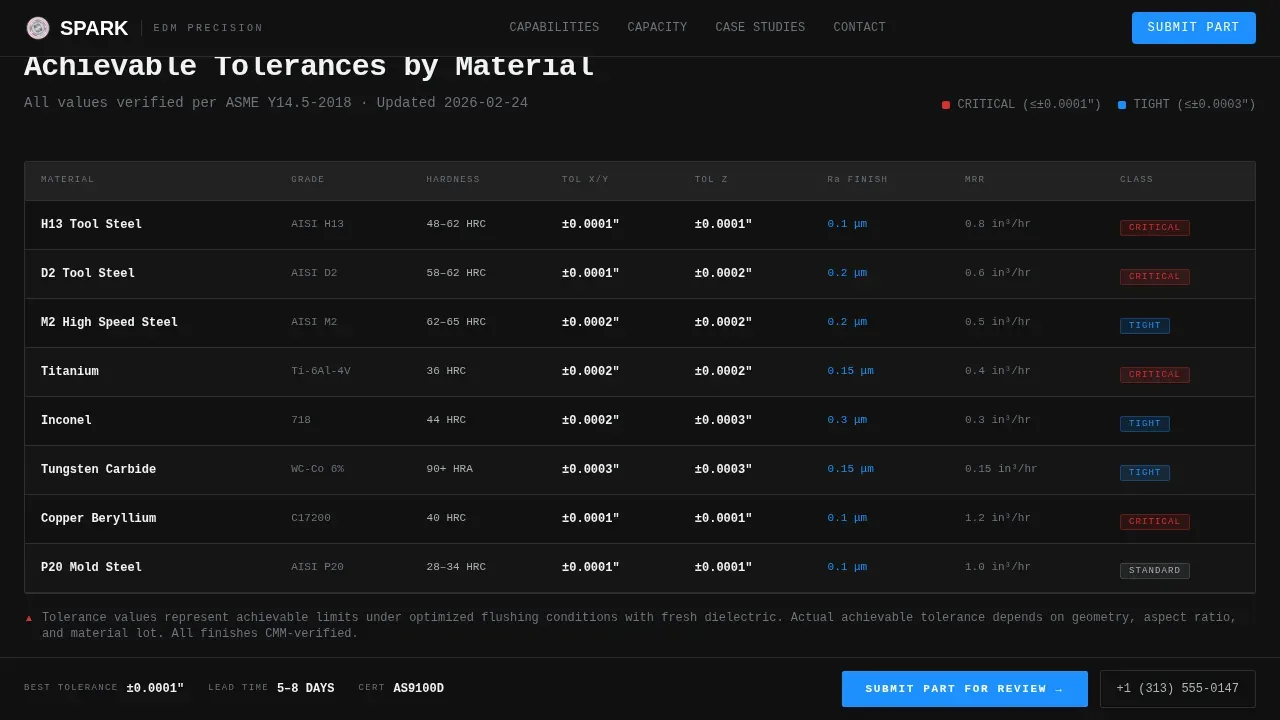
A structured data table displays steel grades, carbides, Inconel, and titanium rows alongside achievable tolerances per material. Engineers can scan the matrix to confirm whether the shop can hold the close tolerances their part requires, without sending a single email.
Live Capacity Dashboard Module
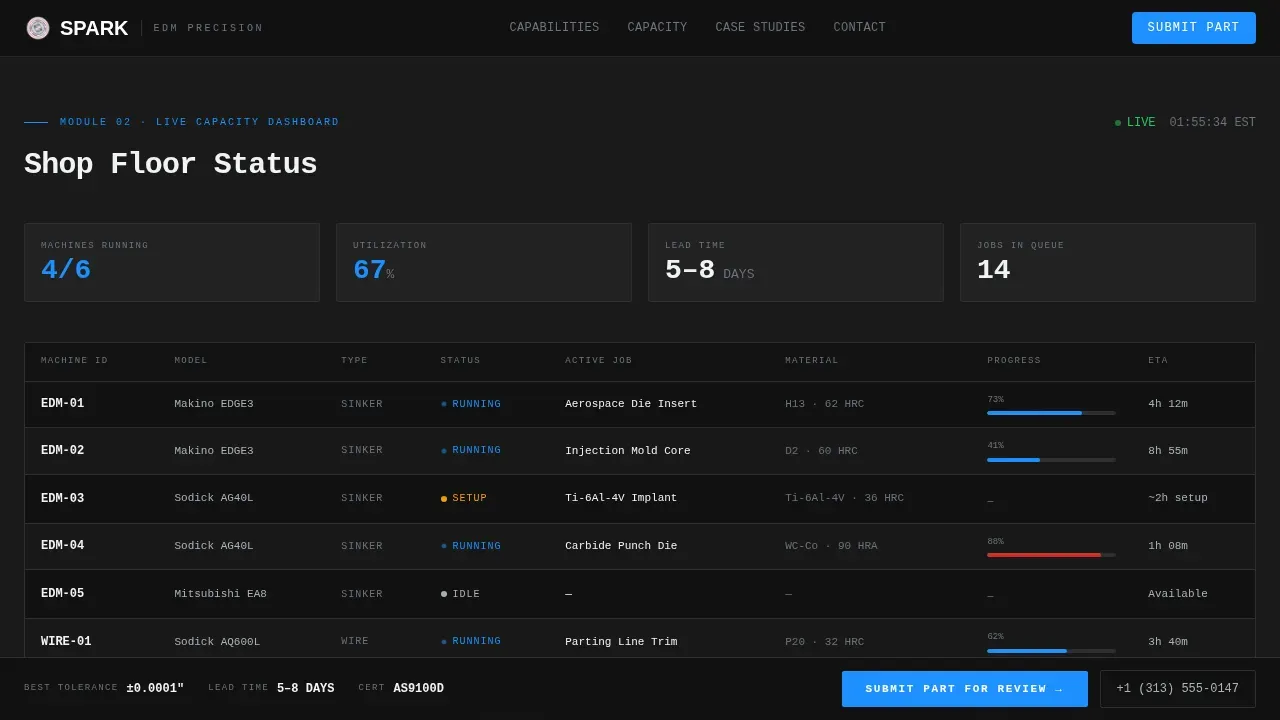
This section presents machine count, current lead times, job queue depth, and shift status in a dashboard layout. The module uses hover states on data cells to keep the experience interactive while giving procurement engineers the production capacity data they need.
Case Study Grid
Part photos, material callouts, tolerances achieved, and cycle times are laid out in a repeating card grid. Each card presents a complete evidence unit. The grid escalates the page's proof density as the reader scrolls deeper into the layout.
Part Submission Form
The call-to-action form collects part material first, then critical tolerance requirement, then a STEP or IGES file upload, then quantity and timeline. A secondary download path captures engineers still in the research phase by gating the capability sheet behind email only.
Sticky Call-to-Action Bar
A sticky bottom bar activates after the first scroll module passes the viewport. It keeps the "Submit Your Part for Review" action accessible at every point in the page without interrupting the data-reading flow.
Page sections overview
| Section | Purpose |
|---|---|
| Hero Infographic Header | Establishes technical credibility with animated EDM cross-section and typewriter headline |
| Material Compatibility Matrix | Displays achievable tolerances per metal grade for engineer qualification |
| Live Capacity Dashboard | Shows machine count, lead times, and job queue data in real time |
| Case Study Grid | Presents part photos, materials, tolerances achieved, and cycle times |
| Part Submission Form | Collects material, tolerance, file upload, quantity, and timeline from the lead |
| Capability Sheet Download | Captures research-phase engineers via email-gated PDF download |
| Footer | Single-row linear footer with essential links and contact information |
Design & branding system
The visual identity follows an Industrial Raw theme. The palette reads like a CNC control screen reflected in a freshly cut tungsten carbide block, technical, unapologetic, and built to communicate reliability through density.
- Deep graphite black (#1A1A1A) as the base, machined aluminum (#A8B0B8) for secondary surfaces, arc-flash electric blue (#1E90FF) for interactive and data elements
- Inspection red (#D63031) reserved exclusively for tolerance warnings and critical callouts
- JetBrains Mono for all numerical data, DM Sans for body copy, and Fraunces for display accents
Mobile & speed optimization
The template is desktop-first by design, reflecting how aerospace and mold engineers typically review vendor pages at a workstation. A mobile fallback layout is included so the page remains functional across all screen sizes.
- Server Components handle static content sections to reduce client-side load on data-heavy modules
- Client-side rendering is scoped to animation layers including SVG sparks, scroll reveals, and staggered blur-in effects
- The sticky call-to-action bar and accordion interactions are built as lightweight client components
How this template helps you convert
The Spark template is structured to earn trust before asking for anything. The scroll sequence is deliberate: capability evidence first, proof second, action last.
- The animated infographic header communicates precision and technical depth within seconds, holding engineers long enough to reach the material matrix and capacity data.
- The sticky form bar and dual-path call to action, part submission for ready buyers, capability sheet download for researchers, capture leads at both stages of the decision cycle.
Other information about this template
The Spark precision EDM machining landing page template is designed around how electrical discharge machining actually works, so the layout reflects the EDM process honestly. Spark machining, also known as EDM, is a machining method used to shape metal through controlled electrical discharges. Sparking occurs when voltage builds across a small gap between two electrodes submerged in dielectric fluid, and the resulting intense heat erodes the workpiece to a desired shape without direct contact. This is spark erosion in practice.
Wire EDM uses a thin brass or copper wire fed continuously from a spool as the tool electrode. The wire cutting process runs the wire through deionized water, which acts as the dielectric liquid and flushes eroded particles away. The wire EDM process achieves tight tolerances that conventional machining methods and even CNC machining cannot reliably reach on hard materials. Wire EDM machining is commonly used in mold making, aerospace tooling, and automotive components production.
- Wire EDM can hold tolerances within ±0.0002 inches, making it more precise than laser cutting or water jet cutting for conductive metal parts
- The EDM process produces low residual stresses because there is no mechanical force applied to the workpiece during material removal
- EDM machines can cut complex shapes including sharp internal edges, small holes, and intricate cavities in high-hardness materials like titanium and tool steel
- Spark machining is a non-conventional technique suited to hard materials such as hardened steel, carbide, Inconel, and other conductive metals where conventional machining fails
- The wire EDM process works only on electrically conductive materials, which covers the full range of metals used in precision manufacturing processes
- EDM is used across aerospace, medical device, mold, and automotive industries because it can produce complex parts without distorting delicate workpiece geometry
- Unlike plastics, glass, and other non-conductive materials, metals are well-suited for all EDM methods, including wire and sinker variants
- Sinker EDM uses a shaped electrode, often copper or graphite, submerged in dielectric fluid to sink a desired shape into the workpiece for mold cavities and die components
- The advantages of EDM over other manufacturing processes include no tool pressure on the workpiece, reliable surface finish quality, and the ability to machine features that milling cannot reach
- Industrial buyers looking for a reliable EDM vendor need machine capacities, precision limits, material compatibility evidence, and production lead time data to make a confident decision
Theme
Industrial Raw
Creative direction
Industry Report
Color system
Carbon Fiber
Style
Dashboard/Data Grid
Direction
Lead Generation
Page Sections
Animated EDM Infographic Hero
Material Compatibility Matrix
Live Capacity Dashboard
Case Study Card Grid
Dual-path Lead Capture
Industrial Raw Dashboard Layout
Related questions
What types of EDM does this template cover?
Can I use this template if my shop also offers CNC machining?
Does the template include a file upload field for part submissions?
Who is the target audience for this landing page template?
What makes this template different from a generic manufacturing landing page?