Expert Textile Testing Landing Page Template
The Weave landing page template is built for precision textile testing laboratories that need to convert industrial buyers into qualified leads. It pairs a metrics-driven hero, five zigzag lab sections, a gated capabilities guide download, and ungated test-method spec sheets into one authoritative, climate-controlled digital presence, designed for textile mill quality managers, sourcing directors, and automotive engineers.
by Rocket studio
Quick summary
Weave is a single-page laboratory landing page template purpose-built for accredited textile testing facilities. It opens with five animated performance metrics on deep charcoal, then walks visitors through five alternating lab sections covering fiber identification, mechanical testing, abrasion resistance, colorfastness, and flammability. Every design decision reinforces one message: your measurements are beyond dispute.
Who this template is for
This template is built for B2B textile testing operations that serve demanding, compliance-driven clients. The layout speaks the language of procurement professionals who evaluate data before they evaluate price.
- Textile mill quality managers chasing ASTM compliance before a shipment clears port
- Fashion brand sourcing directors who need certification documentation before a collection enters production
- Automotive upholstery engineers verifying that woven fabric seat covers will survive ten thousand Martindale abrasion cycles and beyond
What problem this template solves
Most laboratory websites bury their credibility under generic marketing copy. Buyers in the textile industry need proof fast: accreditation numbers, test methods covered, turnaround speed, and measurement certainty. A lab that cannot communicate precision visually loses trust before the first sample is submitted.
- Visitors leave laboratory sites that feel like brochures rather than instruments of authority
- Quality managers and engineers need to quickly determine whether a lab covers the specific test methods and standards their production cycle requires
- The absence of a structured lead-capture path means labs collect no useful contact data from high-intent visitors
What you get with this template
Weave delivers a fully structured, conversion-oriented landing page that doubles as a content resource hub. Every section is pre-built and editable, so a lab manager can update method names, metrics, and copy without redesigning the layout.
- A five-metric animated hero wall, five alternating zigzag lab sections, a gated capabilities guide form, ungated spec-sheet download blocks, and a fixed bottom call-to-action bar
- A Monochrome Steel visual system with compliance-blue accent reserved for interactive elements and data highlights
- Desktop-first construction with complete mobile layout support, keeping the page usable for procurement teams at workstations and in the field
Feature list
This section describes the core built-in components of the Weave template and what each one contributes to the visitor experience.
Animated Metrics Hero Wall
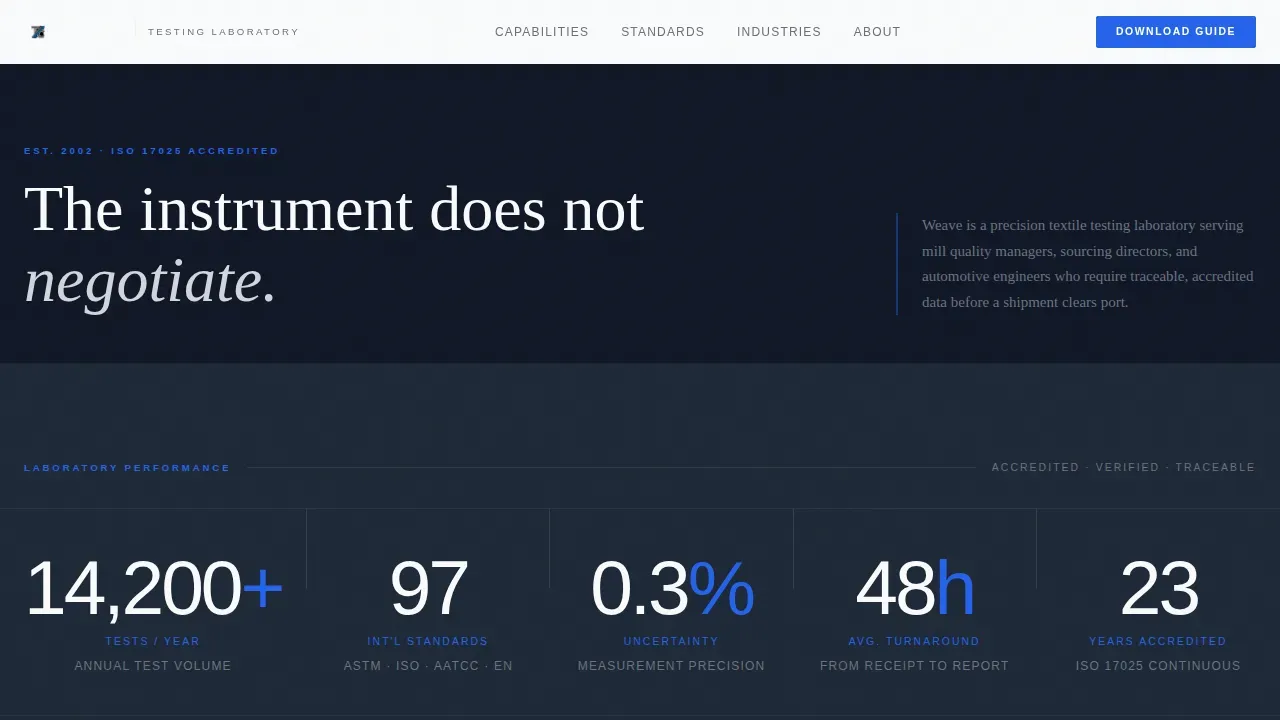
The header presents five oversized performance figures that animate upward on page load: tests completed annually, international standards covered, measurement uncertainty percentage, average turnaround time in hours, and years of accreditation. Each number is set in a thin, wide-tracked sans-serif against deep instrument charcoal, separated by hairline vertical rules. Compliance-blue unit labels appear beneath each figure. The effect lands before a visitor finishes reading the first number, density as credibility. This approach to fabric quality communication replaces photography with pure data authority, which is exactly what textile engineering decision-makers respond to.
Zigzag Lab Section Layout
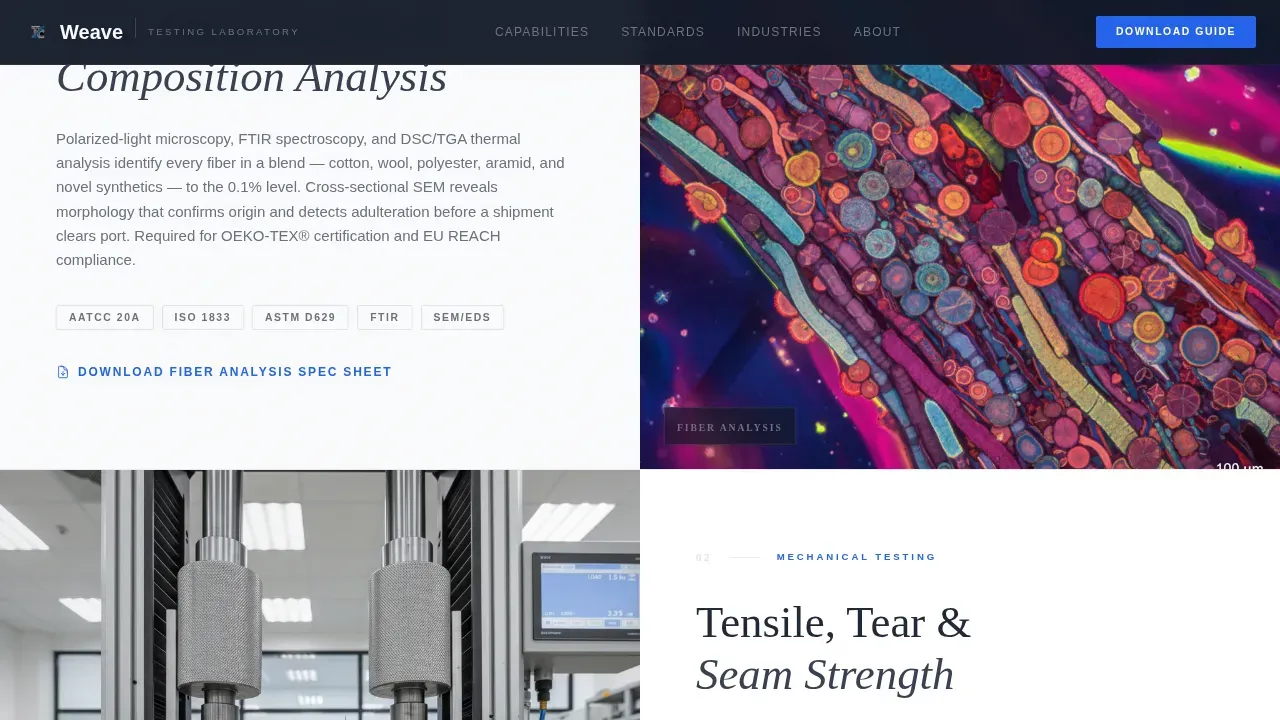
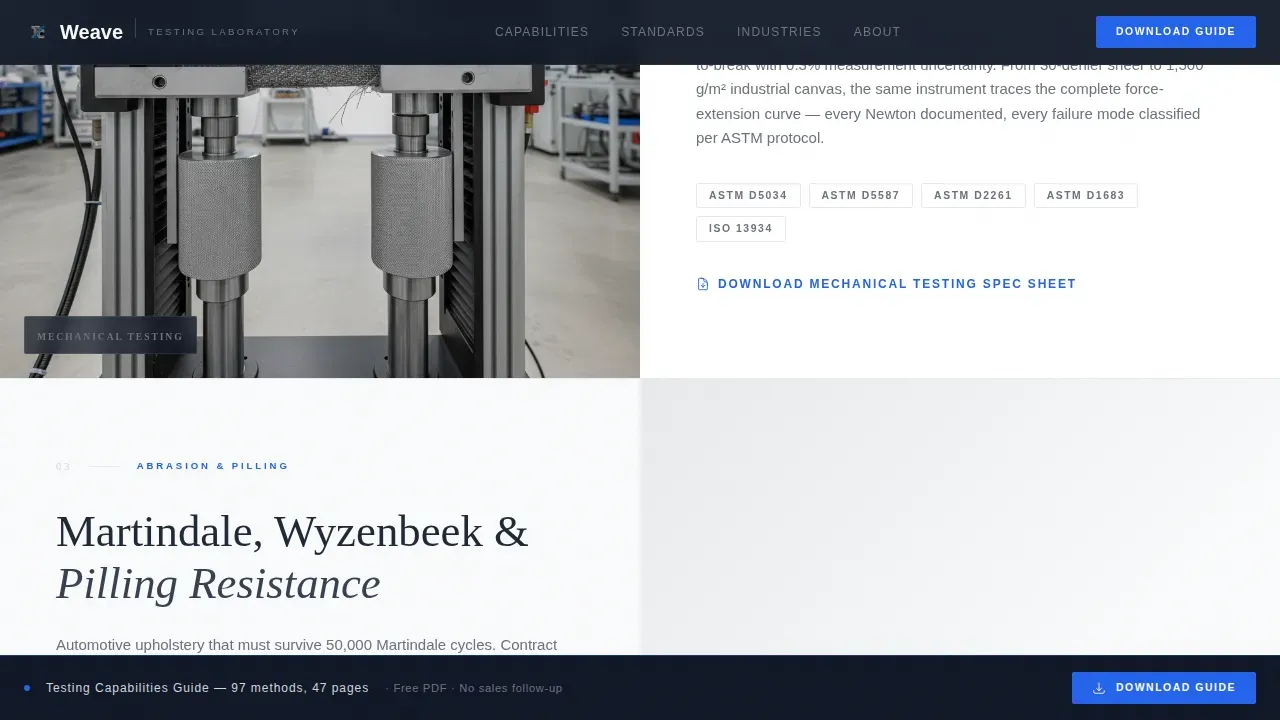
Five alternating content sections guide visitors through the laboratory room by room: fiber identification and composition analysis, mechanical testing and tensile strength evaluation, abrasion and pilling resistance, colorfastness and chemical analysis, and flammability testing. Each section pairs a text panel with a corresponding lab image, left panel text, right panel image, then reversed, creating a spatial rhythm like doors opening down a corridor. The woven fabric samples shown in each image, from cross-sections under polarized light microscopy to fabric pulled taut between pneumatic grips, give buyers a vivid, accurate picture of the testing process. Generous white space between sections is deliberate; it reinforces the precision of what fills it.
Gated Capabilities Guide Download
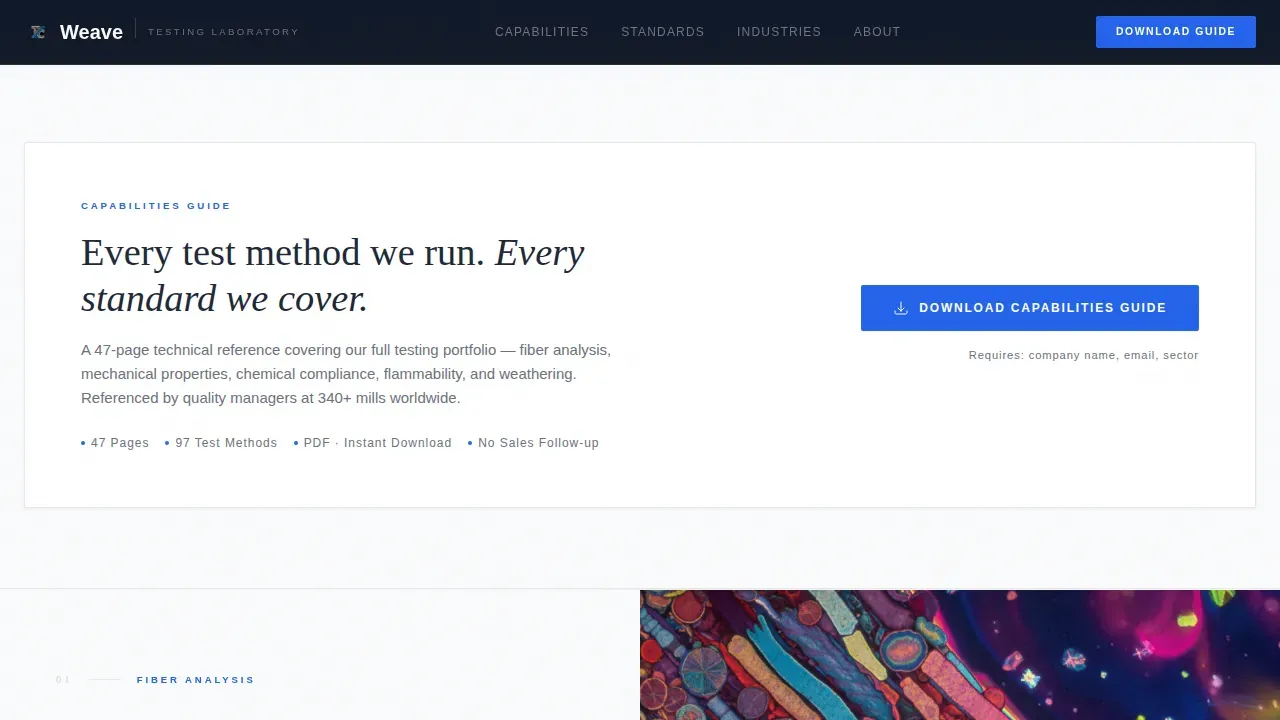
After the metrics hero, a dedicated call-to-action block invites visitors to download the laboratory's full testing capabilities guide. The gated form requires only company name, email address, and textile sector selection: apparel, automotive, home textiles, technical textiles, or personal protective equipment. This light-touch form reduces friction while still capturing qualified lead data. The same call-to-action reappears as a fixed bottom bar once a visitor scrolls past the third lab section, by that point, the depth of methodology on display has already earned the click.
Ungated Spec Sheet Downloads
Beneath each zigzag section, a secondary download block offers the individual test-method specification sheet for that discipline as an ungated download. Visitors can pull the fiber identification spec sheet, the mechanical testing protocol, or the colorfastness methods document without filling out any form. This builds reciprocity: the lab gives useful technical information freely before asking for contact details. It is a proven content strategy for industrial services companies where buyers need to evaluate technical depth before committing to a conversation.
Monochrome Steel Design System
The visual identity uses surgical stainless (#D1D5DB), deep instrument charcoal (#1F2937), calibration-line gray (#6B7280), and laser-marker white (#F9FAFB) for open space. A single functional accent, compliance blue (#2563EB), appears only on interactive elements and data highlights. The palette feels like running a hand along a brushed-steel laboratory benchtop: cold, immaculate, and without ornament. Typography pairs DM Sans for body and interface copy with Fraunces as an editorial serif for section headers, creating a contrast between data clarity and scientific authority.
Fixed Scroll-Triggered call to action Bar
Once a visitor scrolls past the third lab section, a fixed bottom bar appears with the capabilities guide call-to-action. This component is built as a client-side scroll-behavior element, separate from the static server-rendered sections. It keeps the primary conversion path visible without interrupting the reading experience during the first two sections, where the visitor is still forming their impression of laboratory credibility.
Page sections overview
| Section | Purpose |
|---|---|
| Metrics Hero Wall | Opens with five animated oversized numbers establishing laboratory authority instantly |
| Capabilities Guide call to action | Gated PDF download form capturing company name, email, and textile sector |
| Fiber Identification Section | Zigzag block covering fiber composition analysis with microscopy image panel |
| Mechanical Testing Section | Tensile and breaking strength evaluation with pneumatic grip image panel |
| Abrasion and Pilling Section | Martindale abrasion cycle testing and pilling resistance methodology |
| Colorfastness and Chemical Section | Xenon arc lamp colorfastness grading and chemical analysis overview |
| Flammability Testing Section | Burning behavior evaluation across fiber types and fabric constructions |
| Fixed call to action Bar | Scroll-triggered bottom bar repeating the capabilities guide download prompt |
| Footer | Linear single-row footer with lab contact and accreditation references |
Design & branding system
The Weave template uses a Corporate Precision theme translated into what its creators call a Monochrome Steel color system. Every palette decision communicates before a word is read. The absence of decorative color is itself a statement of authority.
- Colors: deep instrument charcoal (#1F2937) as the primary background, laser-marker white (#F9FAFB) for open space and text, surgical stainless (#D1D5DB) for dividers and secondary surfaces, calibration-line gray (#6B7280) for supporting text, and compliance blue (#2563EB) reserved exclusively for interactive elements and data highlights
- Typography: DM Sans for body copy and user interface labels; Fraunces as an editorial serif for section headings, creating a deliberate contrast between scientific rigidity and measured editorial authority
- Creative direction is Spatial and Architectural, each zigzag section is designed to feel like moving through an adjacent room in the laboratory itself, with generous white space acting as the architecture of emptiness between disciplines
Mobile & speed optimization
Weave is built desktop-first, reflecting the reality that B2B procurement decisions in the textile industry are typically made at workstations. However, full mobile layout support is included, because sourcing directors and lab managers also review proposals and laboratory documentation on mobile devices.
- Static lab sections are built as server-rendered components, keeping page load fast for content-heavy sections that do not require interactivity
- The counter animations on the metrics hero and the scroll-triggered fixed call to action bar are built as client-side components, isolated from the static rendering path so they do not delay the initial content load
- The zigzag image-text layout reflows cleanly on smaller screens, maintaining the left-right alternating rhythm at desktop and a stacked single-column layout on mobile
How this template helps you convert
Weave is structured as a content and resource hub, not a simple lead form. It builds trust through depth before it asks for anything in return. The conversion architecture works in three deliberate stages.
- The metrics hero establishes authority in the first three seconds. Five data points, volume, standards coverage, measurement certainty, turnaround speed, and years of accreditation, give technically trained buyers the indication they need that this laboratory operates at a serious level. No photography is required because the numbers carry more weight than any image could.
- The five zigzag sections deepen credibility section by section. Each lab discipline covered, from woven fabric fiber identification through flammability testing, demonstrates the range of test methods available and the scientific rigor behind each one. Ungated spec sheet downloads beneath each section let buyers take something valuable away before committing to a lead form, building genuine reciprocity.
- The gated capabilities guide and fixed call to action bar close the loop. Once a visitor has moved through three or more lab sections, the fixed bottom bar brings the capabilities guide download back into view. At that point, the visitor has already assessed laboratory depth. The form asks for only three fields: company name, email, and textile sector. That is a low enough barrier that motivated buyers will complete it.
Other information about this template
The Weave template is designed for the specific commercial realities of independent laboratories and accredited textile testing facilities. Several practical considerations informed the design and content structure described in this brief.
- The template is designed so that a lab manager can update metric figures, section copy, and downloadable file links without altering the underlying layout structure
- Accreditation badges for ISO 17025 certification, OEKO-TEX, and ASTM standards are positioned as trust signals alongside the metrics hero and within the footer, reflecting best practice for textile testing laboratory websites where such credentials serve as critical indicators of competence
- The gated form is designed to capture textile sector data, apparel, automotive, home textiles, technical textiles, personal protective equipment, so the laboratory's team can segment and qualify inbound leads before following up
- Chemical testing disciplines referenced in the template content include pH testing, formaldehyde detection, and heavy metal screening, all of which form part of a complete textile chemical analysis capability
- Fiber identification test methods shown in the template cover microscopic examination, burning tests conducted under controlled conditions, and chemical dissolution tests, the three core different methods used to determine fiber type in a woven fabric or knitted construction
- The template content acknowledges that testing is conducted at multiple points in the production cycle: raw material intake, in-process quality control, final product assessment, and investigation of faulty material returned from the market
- Dimensional stability tests referenced in the template determine shrinkage or growth of woven and knit fabrics when subjected to domestic washing and drying procedures, a standard evaluation for apparel, home textiles, clothing, and garments intended for consumer use
- Colorfastness tests in the template evaluate the stability of color against fading or bleeding, with grey scale rating used as the standard measurement tool for staining and color change assessment
- Thermogravimetric Analysis (TGA) and Differential Scanning Calorimetry (DSC) are examples of thermal analysis instruments used in textile laboratories to measure weight loss and thermal energy absorption as a function of temperature, relevant context for laboratories expanding into advanced materials characterization
- The goniometer is referenced in the context of liquid contact angle measurement, which provides an indication of whether a fabric surface is hydrophobic or hydrophilic, a key property for technical textiles used in sportswear, footwear, protective clothing, and outdoor apparel
- Performance testing for technical textiles evaluates moisture management, thermal insulation, and waterproofing, properties relevant to apparel worn in demanding environments and to woven fabric used in protective gear and footwear construction
- The Weave precision textile quality testing lab landing page template is available for use by laboratories serving apparel, automotive upholstery, home textiles, technical textiles, and personal protective equipment sectors
- Companies investing in a consistent testing program typically reduce production defects, prevent sub-standard merchandise from reaching end customers, and carry a stronger compliance record into export markets
- The science of textile engineering demands that every measurement be repeatable and traceable; the template is designed to communicate that discipline visually, not just verbally
- Knitting constructions and woven fabric constructions each carry distinct testing requirements, the template content framework is suitable for laboratories that test both, including plain weave, twill, and knit structures as well as yarn-level evaluation
- Warp thread count, yarn count determination, and fabric construction analysis are among the core evaluation services that textile laboratories typically perform and that this template is designed to present clearly
- Footwear and leather goods testing laboratories can adapt the Weave template layout, as the zigzag section structure and gated resource download model apply equally well to footwear upper fabric testing, sole material abrasion analysis, and colorfastness evaluation on dyed leather surfaces
Theme
Corporate Precision
Creative direction
Spatial & Architectural
Color system
Monochrome Steel
Direction
Content/Resource
Page Sections
Animated Five-metric Hero Wall
Five-room Zigzag Lab Sections
Gated Capabilities Guide Lead Form
Scroll-triggered Fixed Call to Action Bar
Monochrome Steel Visual Identity
Desktop-first Layout with Mobile Support
Related questions
Can I update the animated metric numbers to match my laboratory's actual data?
Is the gated capabilities guide form connected to any email platform?
Can I add or remove zigzag sections for different testing disciplines?
Who typically uses this template besides fiber testing labs?
Does the template include the PDF guide or spec sheet files?