Regulatory & Licensing Specialist Privacy Policy Website Template
Spectrum is a hub-and-spoke landing page template built for federal telecommunications regulators. It guides compliance officers, community radio volunteers, and rural internet service providers through six clearly defined filing paths, from spectrum licensing to interference reporting, using a civic amber call-to-action, a progressive disclosure form, and a restrained Monochrome Steel design that communicates authority without bureaucratic friction.
by Rocket studio
Quick summary
Spectrum is a single-page regulatory hub designed for a federal telecommunications authority. The page organizes six core services into anchor-nav spokes, each answering one plain question in three numbered steps. The design system pairs charcoal and warm paper white with civic amber accents, giving the page the feel of a well-run public institution, serious, clear, and genuinely helpful.
Who this template is for
This template is purpose-built for government and civic organizations that manage spectrum allocation, licensing, and enforcement. It speaks directly to the people who interact with a federal commission on a regular basis, professionals who need answers fast and filing paths that make sense on first read.
- Compliance officers at mobile operators filing interference reports and checking commission rulings
- Community radio volunteers applying for low-power FM (LPFM) licenses and related broadcasting services
- Rural internet service providers (ISPs) seeking reliable access to underserved spectrum bands and unlicensed technology deployments
What problem this template solves
Federal spectrum regulators serve an unusually wide range of visitors in a single session. A compliance officer filing an interference complaint has completely different needs from a community broadcaster applying for a television or radio license. Most government pages force every visitor through the same dense navigation, which adds confusion and erodes trust. This template solves that by placing the six most common visitor intents front and center, so no one has to search for the process they came to complete.
- Visitors land on a clear anchor nav listing all six services, so they reach the relevant spoke immediately
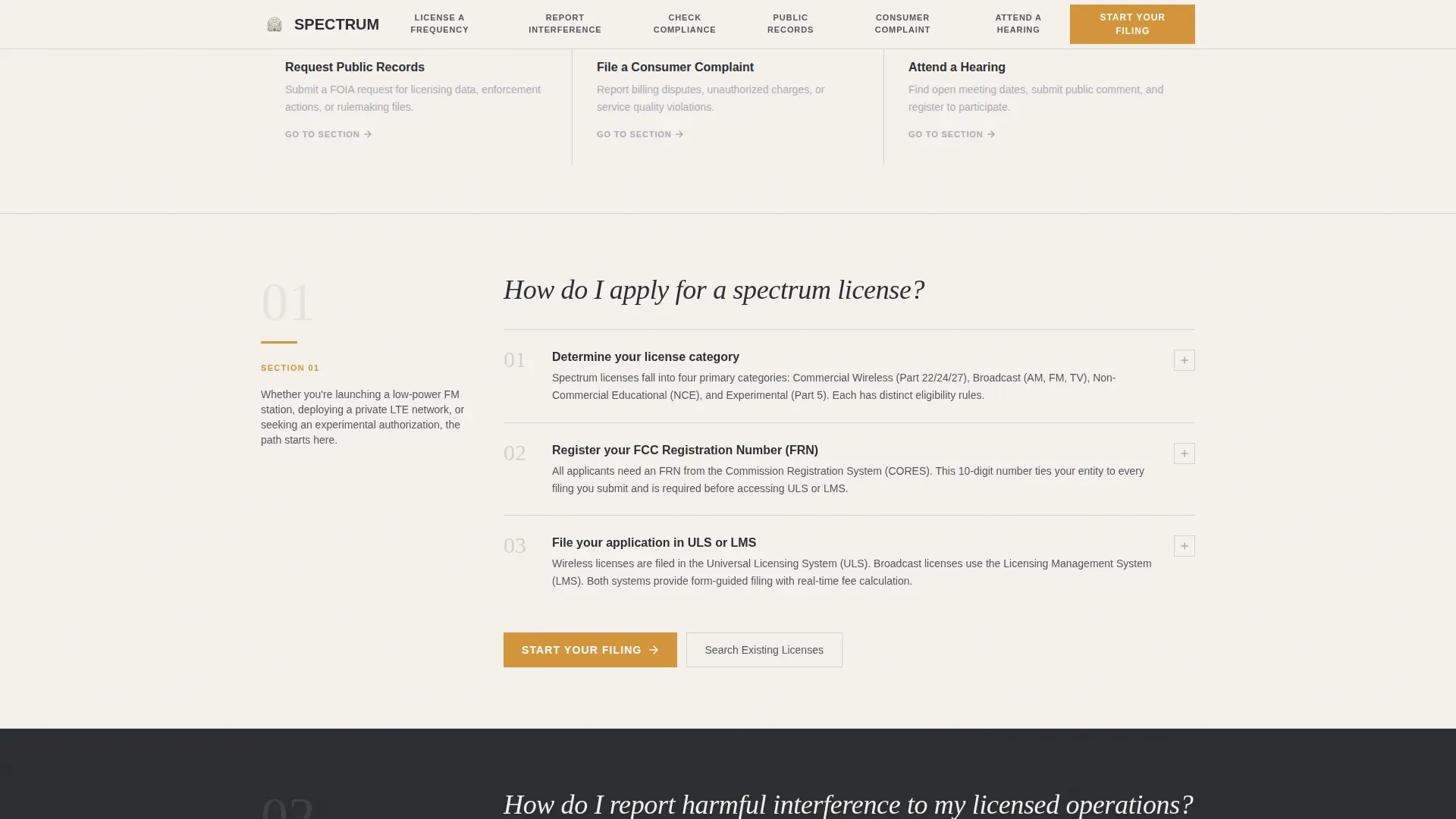
- Each spoke section opens with a plain question, answers it in three numbered steps, and closes with a contextual call-to-action, keeping the process tight and purposeful
- The progressive disclosure form reveals only the fields relevant to the visitor's selected filing type, reducing form abandonment and ensuring only pertinent data is collected
What you get with this template
The template ships as a fully structured, single-page layout with every section pre-built to the brief. You get a functioning hub-and-spoke architecture, a sticky anchor nav with active-state tracking, a progressive disclosure filing form, a secondary email subscription path, and six self-contained spoke sections. The design is production-ready and built around a coherent visual identity that needs only your organization's content to go live.
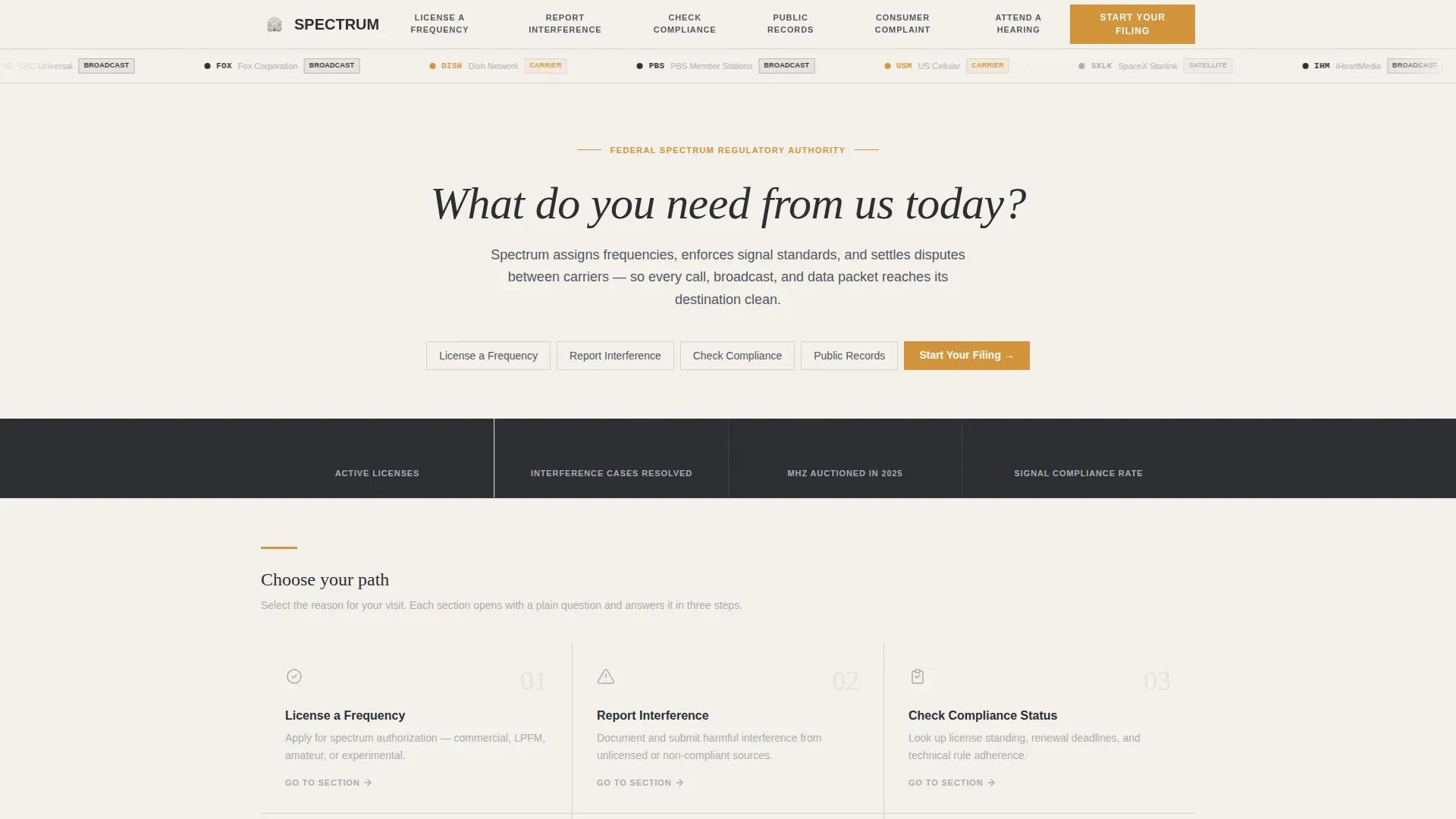
- A logo bar ticker in the hero section displaying carrier and broadcaster seals, followed by the serif prompt "What do you need from us today?"
- Six pre-built spoke sections covering spectrum licensing, interference reporting, compliance status lookup, public records requests, consumer complaints, and hearing attendance
- A progressive disclosure form starting with a single "I need to…" dropdown, then revealing entity name, FCC Registration Number (optional), spectrum band of interest, and a plain-language situation field
Feature list
This section breaks down the core functional and design components included in the template.
Anchor Nav with Active-State Tracking
The sticky navigation bar lists all six filing categories as spoke links. As visitors scroll through the page, the active state updates to highlight the current section. The civic amber color is applied to the active spoke, giving instant orientation without any extra visual noise. This navigation pattern is central to the hub-and-spoke page design and keeps visitors focused on their specific purpose.
Progressive Disclosure Filing Form
The primary lead capture form begins with a single dropdown: "I need to…". Each selection progressively reveals only the fields relevant to that filing type. Possible fields include entity name, FCC Registration Number (marked optional), spectrum band of interest, and a free-text field for a one-sentence situation summary. This modular approach means applicants provide only data relevant to their specific system type, reducing form length and increasing completion rates across the range of visitor profiles.
Six Spoke Sections with Expandable Detail Drawers
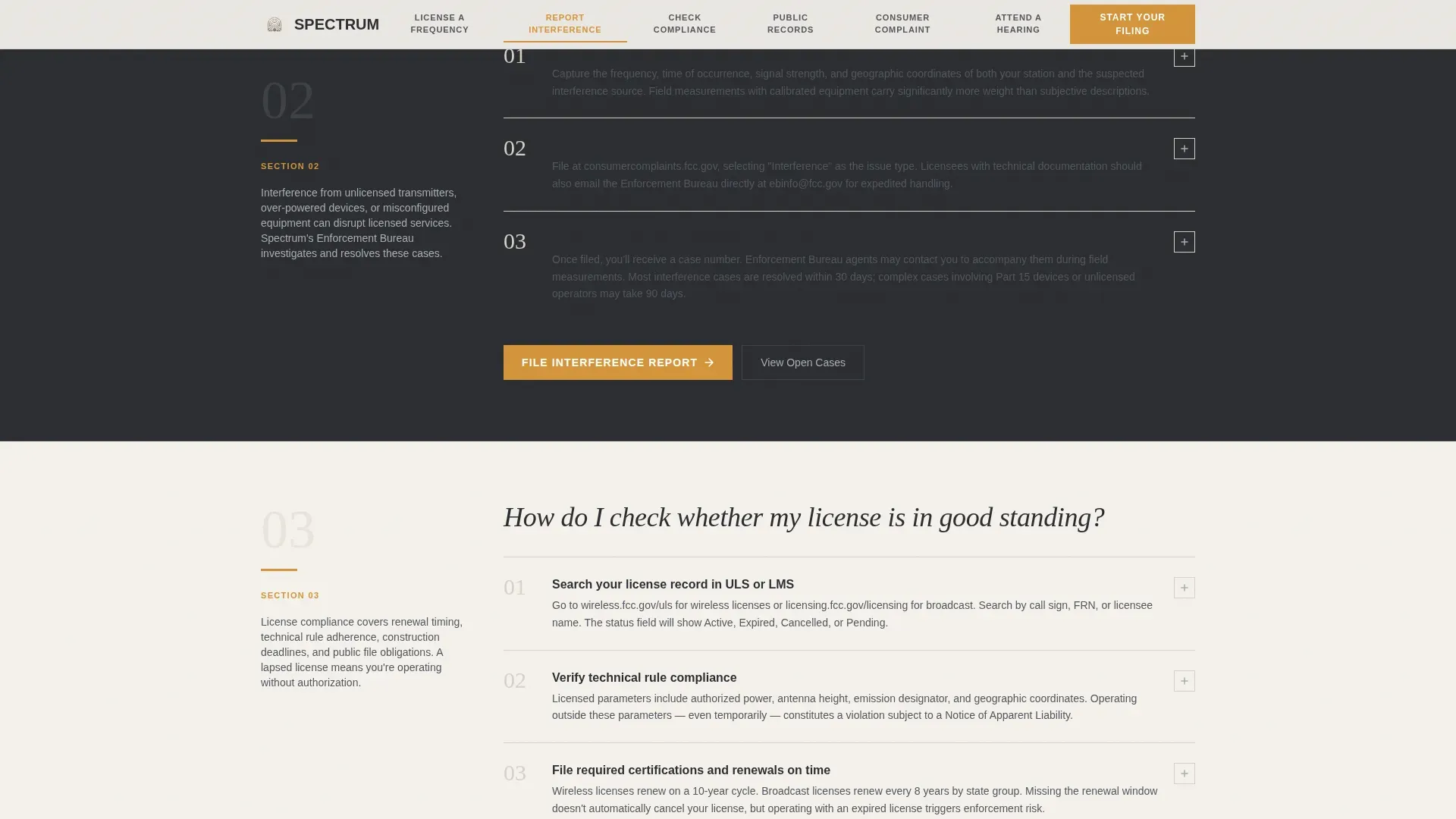
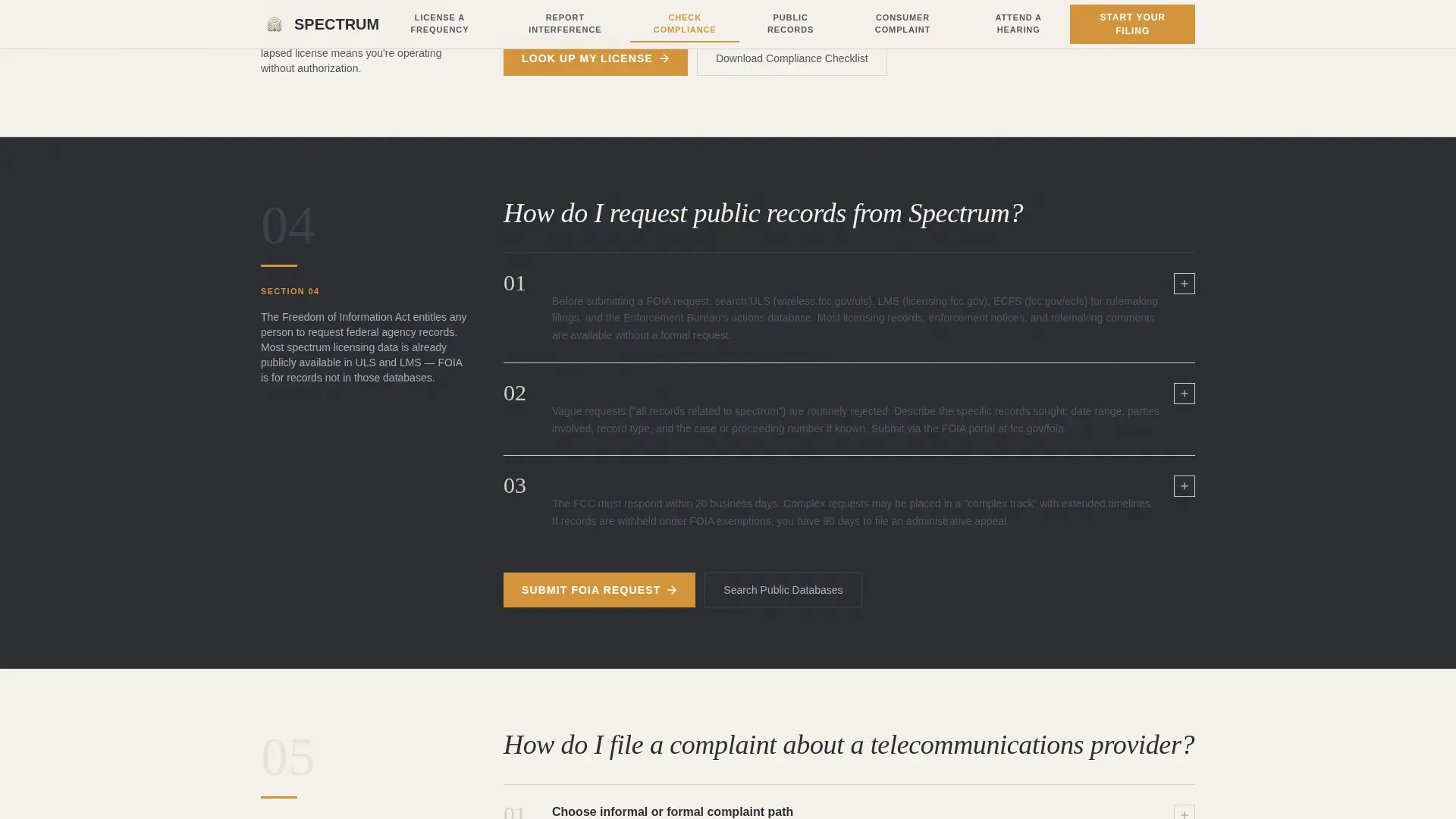
Each of the six service categories, licensing a frequency, reporting interference, checking compliance status, requesting public records, filing a consumer complaint, and attending a hearing, is built as a self-contained page section. Every section opens with the plainest possible question, walks through three numbered steps, and includes expandable detail drawers for applicants who need deeper guidance. Each spoke closes with its own "Start Your Filing" call-to-action, so visitors never need to scroll past their task.
Logo Bar Auto-Scroll Ticker
The hero header features a horizontal strip displaying the regulator's seal alongside the logos of licensed carriers and broadcasters. The strip auto-scrolls like a stock ticker, communicating the breadth of the commission's jurisdiction without requiring a word of supporting text. This social proof element establishes institutional authority immediately and sets the tone for the page's restrained design language.
Secondary Subscription Path
Below the primary filing call-to-action, a lightweight secondary conversion path invites stakeholders to subscribe to commission rulings with a single email field. This path serves compliance officers, legal teams, and policy researchers who are not yet ready to file but want to stay current on spectrum decisions. It captures relevant leads at a lower commitment level without disrupting the primary filing flow.
Scroll-Linked Section Reveals and Staggered Step Animations
The page uses scroll-linked section reveals and staggered animations on the three-step sequences inside each spoke. As a visitor scrolls deeper into a spoke, steps appear in sequence, reinforcing the sense that the process is manageable and ordered. Medium-weight animation keeps the page lively without undermining the institutional tone.
Page sections overview
| Section | Purpose |
|---|---|
| Hero Logo Bar | Display regulator seal and auto-scrolling carrier logos with serif prompt |
| Anchor Nav Spokes | Sticky navigation linking to all six filing service categories |
| License a Frequency | Three-step licensing process with expandable drawers and filing form |
| Report Interference | Guidance on filing interference complaints with portal call-to-action |
| Check Compliance Status | ULS and LMS lookup path with status explainer |
| Request Public Records | Three-step FOIA process with records submission form |
| File a Complaint | Consumer complaint filing and combined civic hearing section |
| Attend a Hearing | Hearing registration guidance within the civic services section |
| Footer Linear Row | Legal links, privacy policy, terms, and contact information |
Design & branding system
The visual identity follows a Community Hearth theme expressed through a Monochrome Steel color palette. The goal is an institution that has been carefully renovated: still serious, still authoritative, but warmer and easier to read than a traditional government page. Typography pairs Fraunces serif headings with Manrope body and user interface text, giving the page a civic formality that still reads cleanly at speed.
- Core palette: foundational charcoal (#2B2D31) for primary text and structure, brushed aluminum (#A8ADB3) for secondary elements and dividers, warm paper white (#F4F1EC) for all background surfaces, and civic amber (#D4943A) reserved strictly for active navigation states, status badges, and the primary call-to-action button
- Typography pairing: Fraunces (serif) for all headings and the hero prompt line; Manrope (sans-serif) for body copy, form labels, step text, and user interface elements across every section of the page
Mobile & speed optimization
The template is built desktop-first to match the primary use case, compliance officers working at their workstations during a filing session. However, every section is fully responsive and adapts cleanly to tablet and mobile viewports, ensuring that community radio volunteers and rural ISP founders can also complete filings from any device. The interactive components, the progressive disclosure form, expandable drawers, and anchor nav, are built as client-side components while all static content uses a server-first rendering approach.
- Responsive layout adapts the anchor nav, spoke sections, and logo ticker to tablet and smartphone screen sizes without losing hierarchy or readability
- Client components are scoped to interactive elements only, the filing form, expandable detail drawers, and nav active-state tracker, keeping the rest of the page statically rendered for fast initial loads
How this template helps you convert
The page is architected around a single conversion principle: get every visitor to the right filing path as quickly as possible, then remove every obstacle between them and the "Start Your Filing" button. Transparency in the process and clear labeling of each step build trust before any data is entered.
- The anchor nav places all six services on screen immediately, so visitors self-select their path within seconds of landing, no searching, no sub-menus, no dead ends.
- Each spoke section closes with its own "Start Your Filing" call-to-action in civic amber, meaning the primary conversion point is never more than one scroll away from wherever the visitor is reading.
- The secondary "Subscribe to Rulings" path captures stakeholders who are not yet ready to file, turning informational visits into future leads without interrupting the primary filing flow.
Other information about this template
This template is a strong fit beyond its core government use case. Any organization that needs to communicate a range of services clearly, and guide different visitor types through different processes on a single page, will find the hub-and-spoke architecture directly transferable. The spectrum trusted regulatory licensing landing page template pattern applies equally well to municipal permitting offices, frequency coordination bodies, and international regulatory entities that follow commission-style governance structures.
The governmental affairs bureau use case is central to this template's identity. A governmental affairs bureau managing spectrum allocation, licensing renewals, and enforcement actions will find every section pre-mapped to its real workflow. The page supports the full breadth of spectrum services that a modern commission handles, from terrestrial television broadcast licensing to satellite coordination filings and telemetry band applications. Satellite services in particular benefit from the expandable detail drawers, where technical parameters, orbital positions, frequency ranges, beam patterns, can be surfaced progressively without overwhelming general visitors.
The commission-style governance model is built into the page's information architecture. The FCC, for example, is responsible for managing and licensing the electromagnetic spectrum for both commercial and non-commercial users. The commission promotes reliable access to spectrum for a variety of innovative uses, from cellular technology to experimental telemetry systems. This template reflects that breadth: licensing paths for commercial mobile operators, community broadcasters, satellite operators, and rural technology providers all have a natural home in the six spoke sections.
The governmental affairs bureau function also extends to public-facing coordination work. When the commission seeks to refresh the record on spectrum allocation for commercial satellite services or new technology bands, the public records and hearing sections of this page provide the relevant civic infrastructure. Visitors who need to participate in a rulemaking process or submit comments to a governmental affairs bureau can find their path through the same anchor nav that serves everyday license filers.
From a design perspective, the template's approach to change is deliberate. The civic amber accent color is the single permitted change from the neutral steel palette, and it is applied only where action is required, active states, badges, and call-to-action buttons. This restraint means visitors always know where to look when they are ready to act. The text hierarchy, driven by Fraunces headings, ensures that the purpose of each section is clear before a single word of body copy is read. Builders who want to add their organization's branding can change the accent color and logo bar assets without restructuring any of the page's underlying order or content layout.
For organizations that need to implement a public-facing compliance portal quickly, this template provides a production-ready starting point. The design supports a range of deployment scenarios, and the modular section structure means teams can add or remove spoke sections to match the exact scope of their licensing and enforcement services. The footer row is pre-configured for legal links, privacy policy, terms and conditions, and a contact address, all of which are standard requirements for any government-adjacent services page.
- The template includes a footer with placeholder slots for Privacy Policy, Terms and Conditions, and contact information
- The progressive disclosure form design supports explicit consent mechanisms for data collection, which teams can implement according to their specific legal requirements
- A downloadable resource slot, such as a spectrum licensing checklist, can be added to any spoke section using the existing expandable drawer component
- The page's social proof blocks are pre-configured for three stats: active rulings count, licensed entities total, and interference cases resolved
Theme
Community Hearth
Creative direction
FAQ-Driven
Color system
Monochrome Steel
Style
Hub & Spoke (Anchor Nav)
Direction
Lead Generation
Page Sections
Anchor Nav with Active-state Tracking
Progressive Disclosure Filing Form
Six Spoke Sections with Expandable Drawers
Logo Bar Auto-scroll Ticker
Secondary Subscription Conversion Path
Scroll-linked Reveals and Step Animations
Related questions
Who is the primary audience for this template?
Can I adapt the six spoke sections to different service categories?
Does the template include a way to capture leads who are not ready to file?
How does the progressive disclosure form work?
Can this template support satellite and telemetry licensing services?