Vehicle Customization & Modification Professional Website Template
Torque is a scroll-reveal landing page template built for hot rod builders and rotisserie restoration shops. It opens with an interactive build configurator, then walks visitors through a stats-first comparison experience, factory baseline versus finished build numbers, using animated dyno graphs, versus columns, and full-bleed cinematic photography. Two clear conversion paths capture both ready buyers and serious researchers.
by Rocket studio
Quick summary
Torque is a dark, cinematic landing page template designed for performance automotive shops that build, restore, and transform muscle cars. The page opens with a three-tier build configurator and carries visitors through a scrolling proof-then-payoff rhythm of factory-versus-finished data, animated engine stats, and full-bleed photography. Every section is built to make the shop's work measurable, not just impressive.
Who this template is for
This template is made for shops where the work speaks in numbers. If your garage tears down matching-numbers muscle cars to bare frames and rebuilds them with purpose-built engine blocks, hand-bent exhaust headers, and dialed-in suspension, this template frames that work correctly. It suits builders who want clients to arrive already convinced by the data, not needing to be sold.
- Hot rod builders and rotisserie restoration shops targeting collectors with matching-numbers muscle cars
- Performance shops chasing weekend drag racers who plan nine-second quarter-mile passes and want documented track results
- Custom fabrication garages serving clients finishing a parent's unfinished project car and needing clear build tier options
What problem this template solves
Most automotive shop pages post a gallery of finished cars and ask visitors to trust the result. The problem is that serious clients, collectors, drag racers, and dedicated enthusiasts who understand what a big-block engine block really costs to build correctly, decided long ago that pretty pictures aren't enough. They want to see the numbers before they pick up the phone.
- Generic shop websites bury their best proof: dyno figures, quarter-mile times, and cam specs that would instantly mark the shop as legitimate to a knowledgeable buyer
- No clear build tier structure forces every visitor to call just to understand what they might spend, slowing the process before it starts
- Weak calls-to-action mean qualified leads bounce before they ever reach a form, leaving the garage with traffic but no conversions
What you get with this template
The template delivers a full scroll-reveal landing page structured around one core idea: proof first, then conversion. Every section is planned so the visitor moves from curiosity to confidence before they ever hit the call-to-action button. The design, layout, and interactive elements all serve that single purpose.
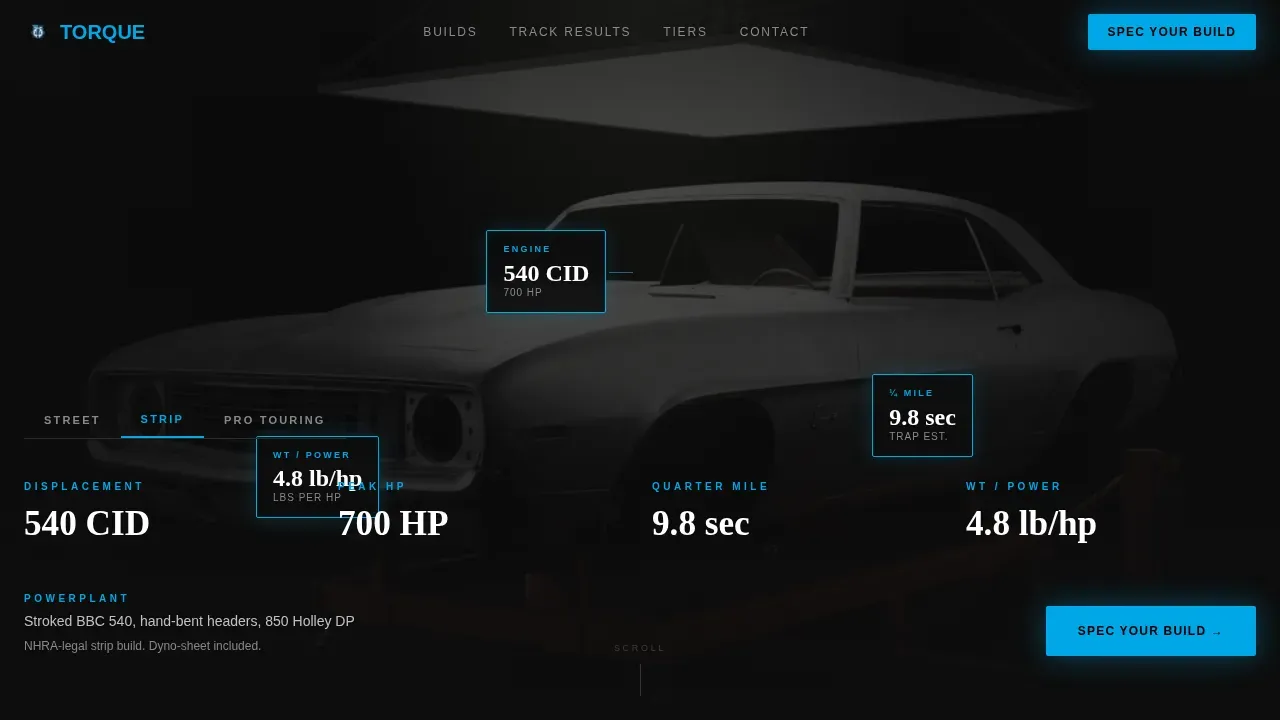
- An interactive build configurator at the top of the page letting visitors toggle between Street, Strip, and Pro Touring build tiers, with HUD-style floating spec overlays on a rotating three-quarter car image
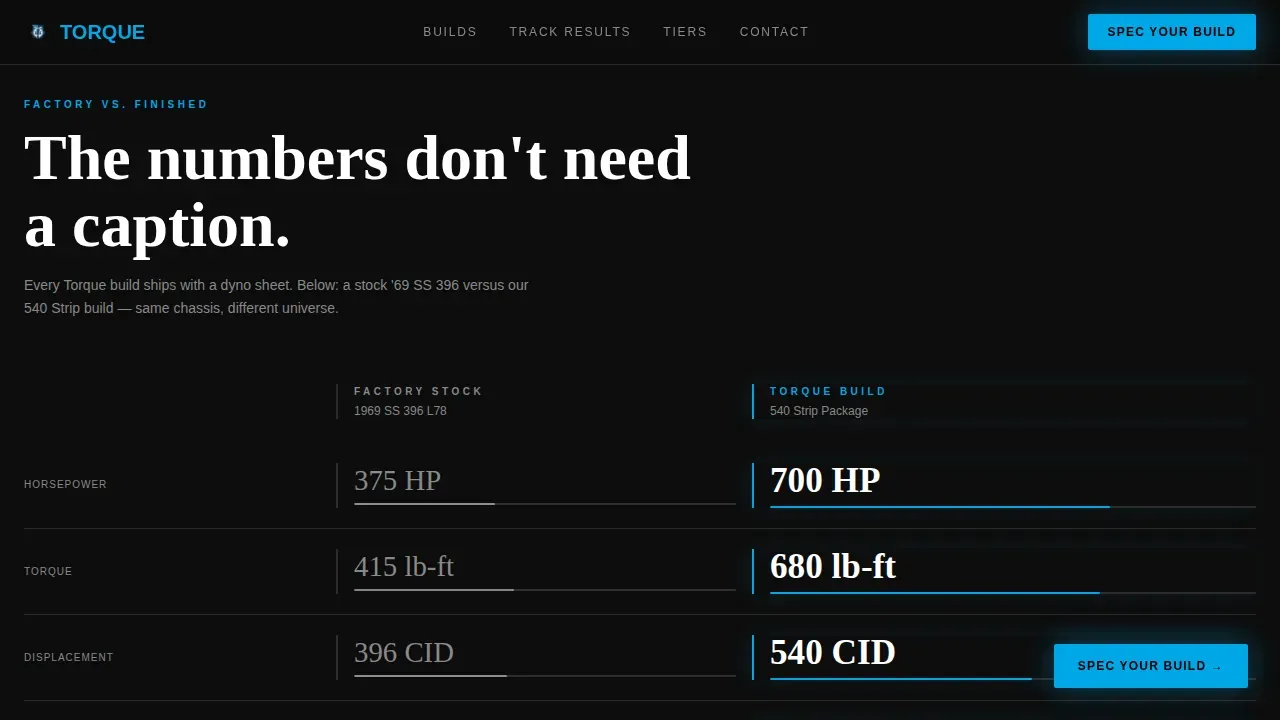
- Animated versus columns that compare factory stock figures against the shop's finished build numbers, including dyno-animated torque curves, brake horsepower comparisons, and quarter-mile track results
- Two conversion paths: a sticky "Spec Your Build" button opening a stepped form, and a "Download the Build Sheet" secondary offer at the footer for visitors who want to study the numbers before committing
Feature list
This template packs a deliberate set of interactive and visual features. Each one earns its place by serving the stats-first, versus-column experience the brief calls for.
Interactive Build Tier Configurator
The header section mounts a dark, cinematic three-quarter view of a car on a rotisserie fixture. Visitors toggle between three build tiers, Street, Strip, and Pro Touring, and the visible spec overlays update in real time. Engine displacement, estimated horsepower, projected quarter-mile times, and weight-to-power ratio appear as floating HUD-style data points pinned to the engine compartment, rear axle, and wheel wells. No headline competes with the machine. The numbers do the talking.
Animated Dyno Graph Versus Columns
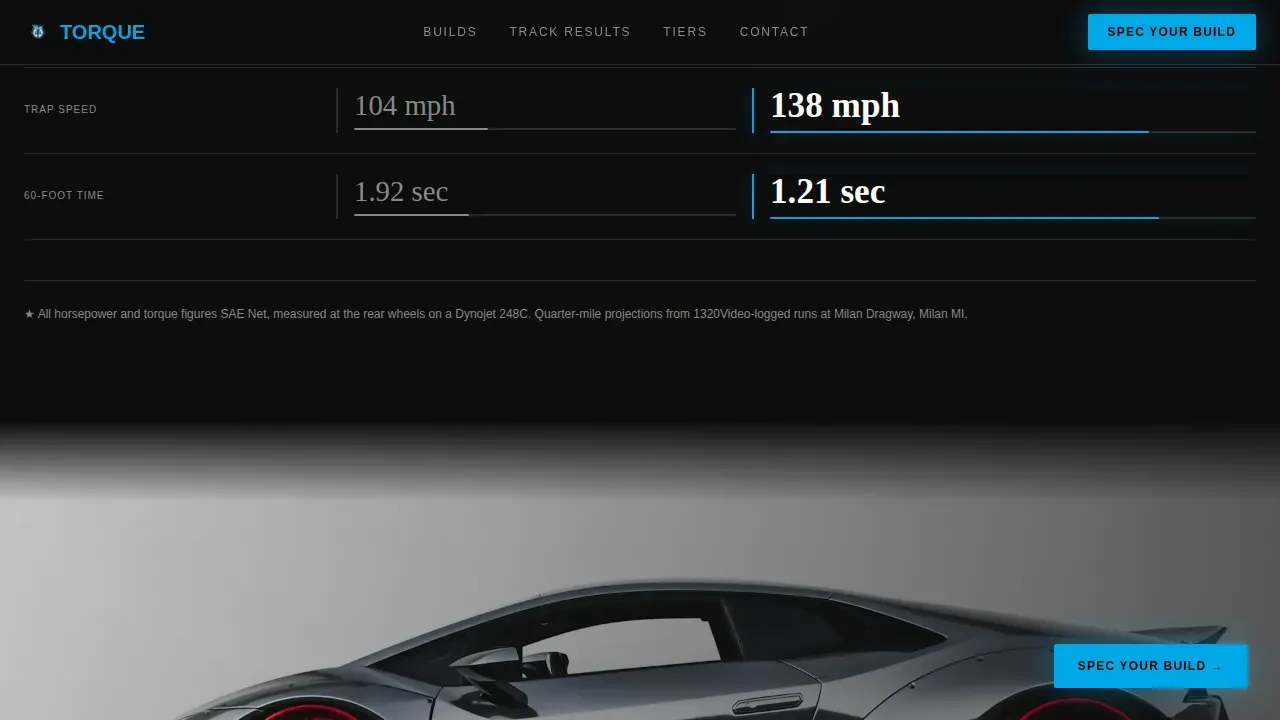
As visitors scroll past the configurator, they hit side-by-side comparison columns framing factory stock data against the shop's finished build. Dyno graphs animate on scroll, torque curves climbing like tachometer needles. Brake horsepower, torque figures, sixty-foot times, and trap speeds stack in stark columns that widen as the visitor scrolls deeper. Associating these torque stats with specific custom components showcases the builder's skill in a way that a photo gallery never could.
Cinematic Full-Bleed Break Sections
Between each data block, the page delivers a full-bleed cinematic still, a hood scoop cutting through rain, a set of tires wrinkling off the line under load. These parallax-driven photography breaks reward the scroll and reset the visitor's attention before the next round of proof hits. The rhythm is deliberate: proof, then poetry, then proof again, escalating from engine specs to chassis data to real-world track results.
Stepped "Spec Your Build" Lead Form
The primary conversion path is a sticky button in nitrous blue that follows the visitor down the entire page. Clicking it opens a stepped modal form: year, make, and model first; then build goal (show, street, drag, or pro touring); then a horsepower target slider; and finally a name and phone number. This structure collects qualified information before the shop's team ever picks up the phone.
"Download the Build Sheet" Secondary Offer
At the bottom of the page, a secondary conversion path offers a PDF comparison of all three build tiers in exchange for an email address. This catches visitors who are not ready to commit but want to study the full specs, cam profiles, rear gear ratios, and pricing anchors from their own garage. It is a deliberate plan for capturing serious researchers who need more time.
Scroll-Reveal Progressive Animation
The entire page is built as a scroll-reveal experience powered by GSAP ScrollTrigger. Versus columns stagger in as the visitor descends. Dyno graphs animate from a flat baseline. Cinematic breaks use parallax offset. GPU-accelerated transforms and opacity changes handle all motion, and reduced-motion support is included so the layout stays usable for visitors who have that preference set in their operating system.
Page sections overview
| Section | Purpose |
|---|---|
| Hero Configurator | Toggle Street, Strip, Pro Touring tiers; display HUD spec overlays on rotating car |
| Versus Data Block | Animate factory versus. finished dyno graphs, torque curves, and brake horsepower columns |
| Cinematic Break One | Full-bleed parallax still of hood scoop or tire wrinkle; visual reward between data sections |
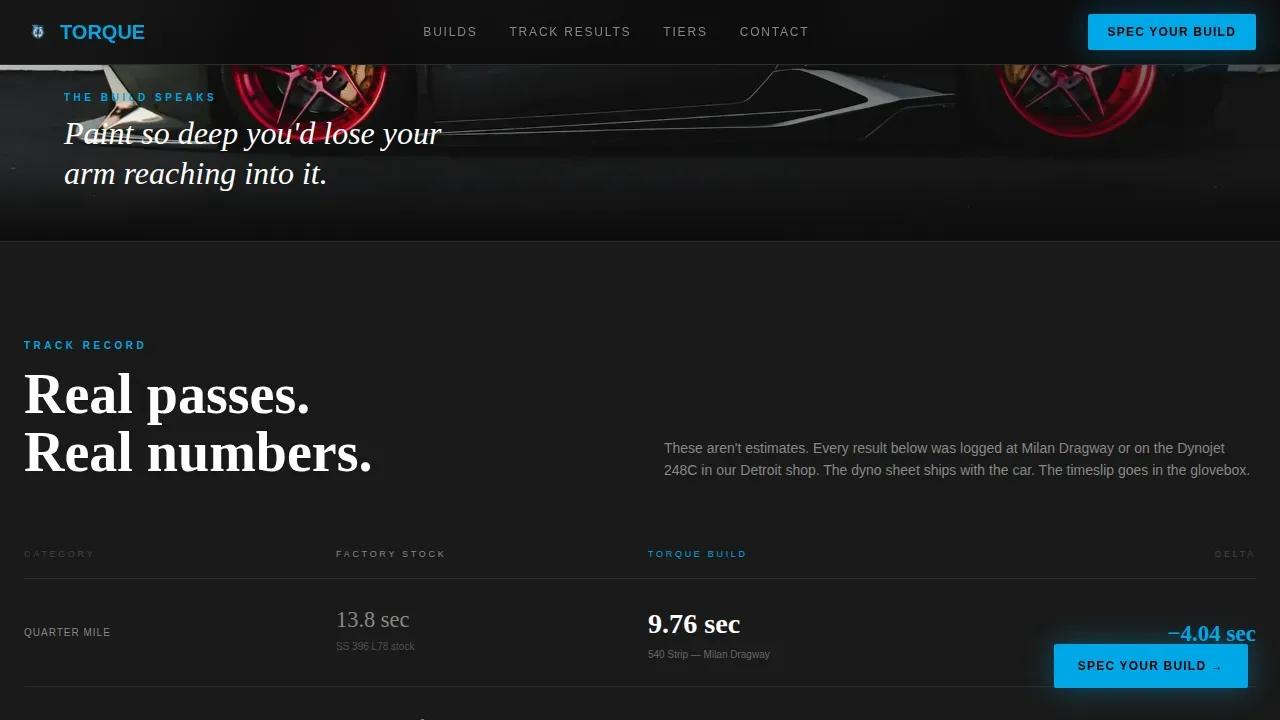
| Track Results | Scroll-reveal quarter-mile times, sixty-foot times, and trap speed comparison columns |
| Build Tiers | Three-card breakdown of Street, Strip, and Pro Touring with pricing anchors and differentiators |
| Footer | Arc Browser Split pattern: logo and tagline left, navigation links right, social icons bottom-left |
Design & branding system
The visual identity is built on a Cinematic Dark color system that feels like the inside of a garage at midnight, deep shop-floor black surfaces broken only by the spark of an electric blue accent. Typography pairs a display face for numbers and headlines with a clean sans-serif for body labels, creating a hard contrast between editorial weight and technical precision.
- Color palette: deep shop-floor black (#0D0D0D) for backgrounds, exhaust-header charcoal (#1A1A1A) for section fills, machined-aluminum silver (#C0C0C0) for body text, and nitrous-oxide blue (#00A8E8) reserved strictly for interactive elements, hover states, and live data callouts
- Section dividers use thin pinstripe lines in a muted gunmetal (#2C2C2C), recalling hand-laid coach lines on a finished car body
- Typography uses Fraunces for display numbers and headlines, and DM Sans for body copy and data labels, keeping the reading experience sharp and on-brand
Mobile & speed optimization
The template is designed desktop-first because the configurator HUD overlays and versus columns demand a wide viewport to read correctly. On smaller screens, the layout degrades gracefully so mobile visitors still get a clear, readable experience without broken columns or overlapping data points.
- GPU-accelerated transforms and opacity changes handle all scroll-driven animation, keeping the motion smooth without taxing the browser
- Passive scroll listeners and reduced-motion support are built into the animation plan so the page stays accessible and responsive across operating conditions
- High-resolution cinematic photography and build imagery are featured prominently throughout; their loading is planned to maintain a fast, smooth visual experience on both desktop and mobile
How this template helps you convert
The entire page is structured as a confidence-building sequence. Visitors who arrive skeptical leave with documented proof. That shift from doubt to conviction is what drives the form fills and email captures this template is built to generate.
- The configurator engages visitors immediately with an interactive build experience, putting them in the driver's seat before any copy asks them to commit. High-quality visual elements capture attention in the hero section while the HUD data overlays deliver the first round of proof, making it absolutely clear this shop builds serious machines.
- The animated versus columns and track result sections stack real numbers, dyno-verified torque curves, brake horsepower figures, quarter-mile trap speeds, in a format that resonates with knowledgeable clients. Presenting dyno-tested figures builds confidence that the builder is honest about their capabilities, and action-oriented calls-to-action placed at each data milestone keep the conversion path visible throughout the scroll.
Other information about this template
This section covers additional details that help you plan, customize, and launch the template with confidence. The template is built for the hot rod and muscle car restoration niche, but the structure, stats-first, versus-column, scroll-reveal, adapts well to any performance automotive service that relies on documented proof rather than aspirational copy.
- The page plan includes a Footer using Pattern 7 (Arc Browser Split): logo and tagline on the left, navigation links on the right, and social icons at the bottom-left, giving the garage a clean, organized close to the page
- Localization is set for the United States market: all measurements use Imperial units, horsepower and torque figures appear in pound-feet (lb-ft), quarter-mile times are in seconds, and pricing anchors are in US dollars
- The build configurator toggles are designed so the shop can post real spec data for each tier, including engine displacement, cam profiles, cylinder heads, rear gear ratios, transmission type, fuel system details, ignition setup, and exhaust configuration
- Keeping a logbook of vital statistics such as clearances, bolt torques, and maintenance records is recommended practice for hot rod owners; the Build Sheet PDF offer gives the shop a natural way to provide that reference document and capture an email in return
- Using indicator marks on critical bolts and maintaining a torque specification log are standard machine shop practices; presenting that level of detail on the page signals to collectors that this garage treats every engine block, every set of castings, and every fastener with the correct level of care
- Precise torque specifications for critical fasteners signal to clients that a builder prioritizes safety; improper torque can lead to mechanical failure, and clients who understand this will respond positively to a shop that posts its standards openly
- Torque specifications vary based on the type of fastener and the application, so the shop's ability to discuss specific bolt torques for heads, flywheel, and frame mounts demonstrates machine shop credibility that collectors and performance buyers recognize immediately
- The template is built without requiring coding knowledge; no-code and low-code development tools enable non-technical users to build production-ready pages and launch them without traditional programming, making this template accessible to shop owners who want a professional result without hiring a developer
- AI-powered platforms can automate backend integrations and deployment processes, and this template is designed to work within those environments so the shop can go from idea to live page efficiently
- The original hot rods were modified Model T and Model A Fords, and formal torque specifications did not exist until the late 1940s; today, presenting dyno-verified torque curves and precise fastener specs is a mark of a serious, professional builder, and this template gives the shop the visual and structural framework to communicate exactly that
Theme
Dark Immersive
Creative direction
Stats-First Impact
Color system
Cinematic Dark
Style
Scroll Reveal (Progressive)
Direction
Comparison/Versus
Page Sections
Interactive Build Tier Configurator
Animated Dyno Versus Columns
Cinematic Full-bleed Break Sections
Stepped Lead Form with Horsepower Slider
Build Sheet PDF Secondary Offer
Scroll-reveal Progressive Animation System
Related questions
Who is this landing page template designed for?
Can I update the build tier specs and data to match my shop's actual numbers?
Do I need coding skills to launch this template?
What are the two conversion paths included in the template?
Is the template designed to work on mobile devices?