Specialist Manufacturing Processes Site Maintenance Website Template
Spindle is a single-column landing page template built for precision spinning equipment manufacturers. It walks maintenance engineers, procurement managers, and plant directors through a structured comparison flow, tolerance tables, lead time audits, and material traceability checklists, using a carbon fiber visual system that communicates technical authority without decoration.
by Rocket studio
Quick summary
Spindle is a focused landing page template for spinning equipment manufacturers supplying textile mills. It combines a technical infographic header, a checklist-and-audit scroll structure, and a comparison-driven conversion flow to help procurement professionals evaluate and switch suppliers with confidence. The design is precise, data-dense, and built entirely around the way industrial buyers actually make decisions.
Who this template is for
This template is designed for manufacturers that machine precision spinning components and need to convert technically informed buyers. The audience does not respond to generic marketing copy. They respond to specifications, tolerances, and verified lead times.
- Spinning component manufacturers supplying ring travelers, spindle inserts, and flyer assemblies to textile mills
- Sales and marketing teams targeting maintenance engineers and procurement managers at multi-mill operations
- Plant-level directors in industrial textile hubs who require one clear document to justify a supplier change
What problem this template solves
Procurement decisions in textile manufacturing move slowly because suppliers rarely present their data in a format that makes direct comparison easy. Engineers comparing vendors at odd hours need clarity, not persuasion. This template removes that friction.
- Budget suppliers hide specification gaps behind vague datasheets; this template surfaces the differences systematically
- Procurement managers building approved supplier lists need a single source of structured, verifiable claims
- Plant directors cannot justify switching suppliers without one clear reference point that covers specs, tolerances, and lead times together
What you get with this template
The template delivers a complete single-column landing page structured around a comparison and audit experience. Every section is pre-organized to guide a technically expert visitor from initial scan to conversion request.
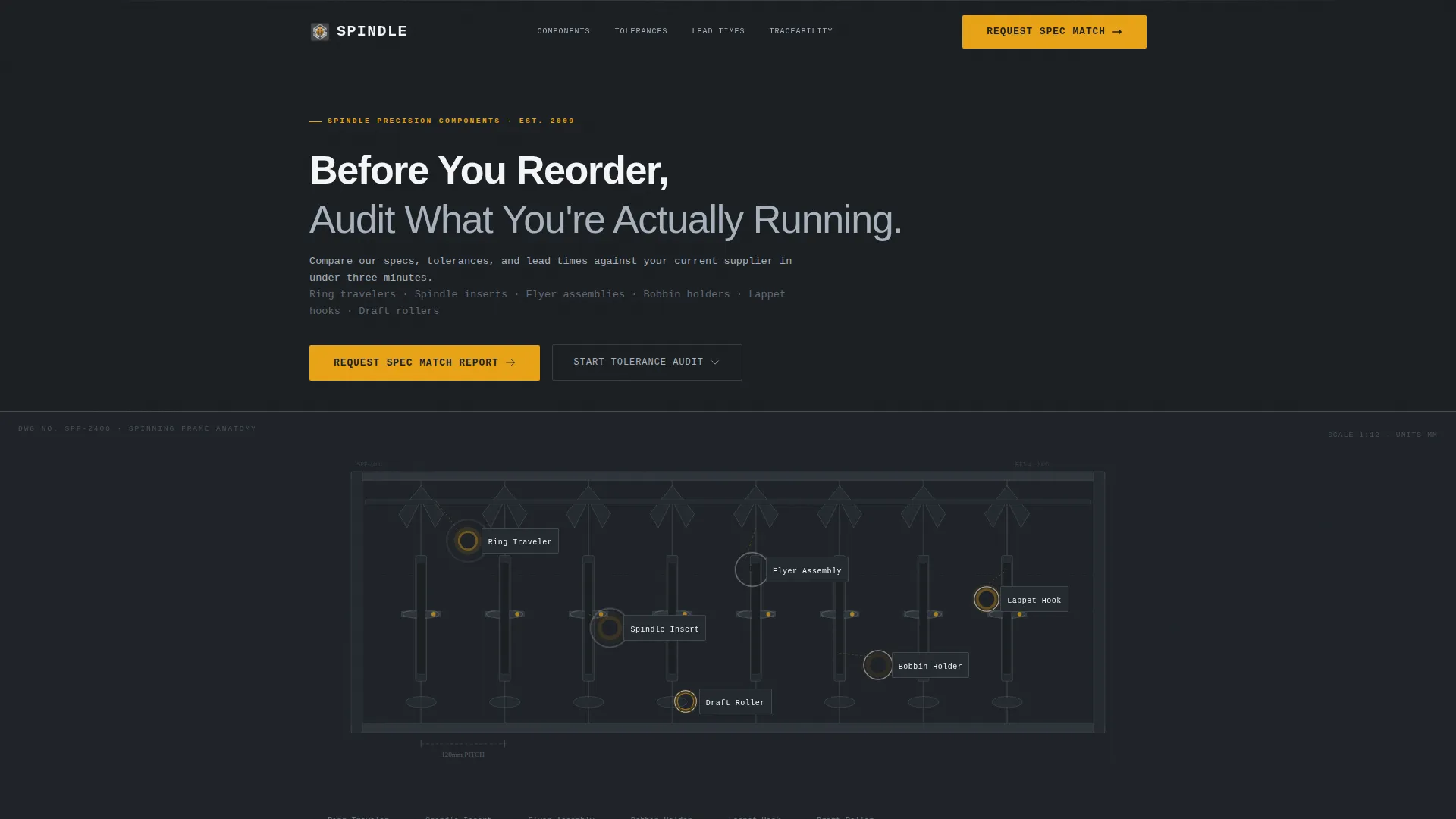
- A full-width technical infographic header that maps every replaceable spinning frame component with numbered callout points
- Three structured audit sections covering tolerance comparison, lead time timelines, and material traceability
- Two conversion paths: a primary spec-match request form and a secondary gated PDF download requiring only an email address
Feature list
This template includes six purpose-built sections and design elements that work together as a complete procurement evaluation tool.
Anatomy Infographic Header
The header is a full-width technical diagram of a spinning frame. Numbered callout points identify every component the manufacturer produces, and each callout pulses subtly on load. The headline and subline frame the entire page as a three-minute comparison exercise, not a marketing pitch.
Tolerance Comparison Table
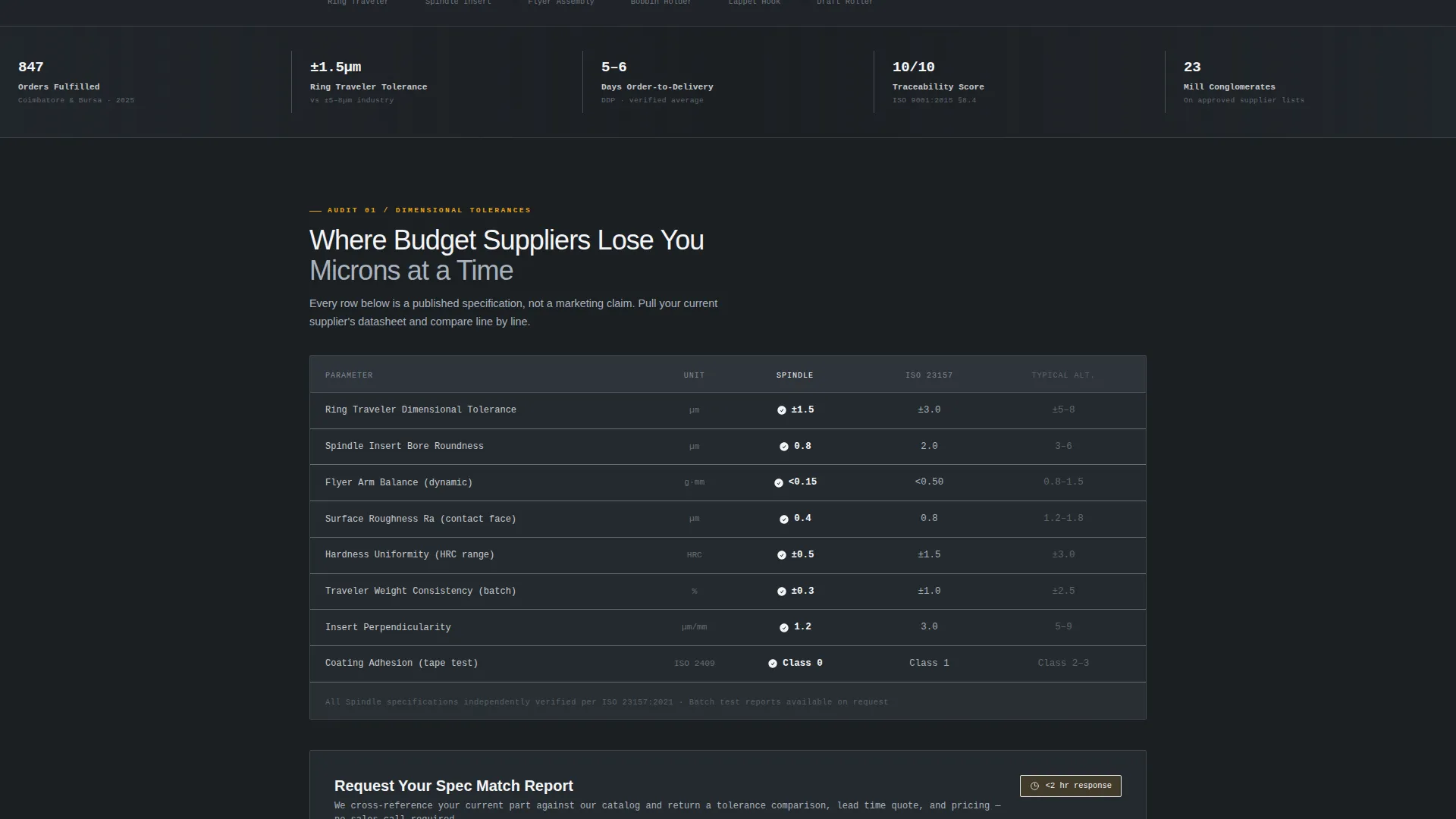
A structured table presents the manufacturer's published specifications alongside ISO benchmarks and a column representing a typical current supplier. Amber checkmarks mark every line where the manufacturer's figures are superior, making advantages immediately visible without requiring interpretation.
Lead Time Audit Timeline
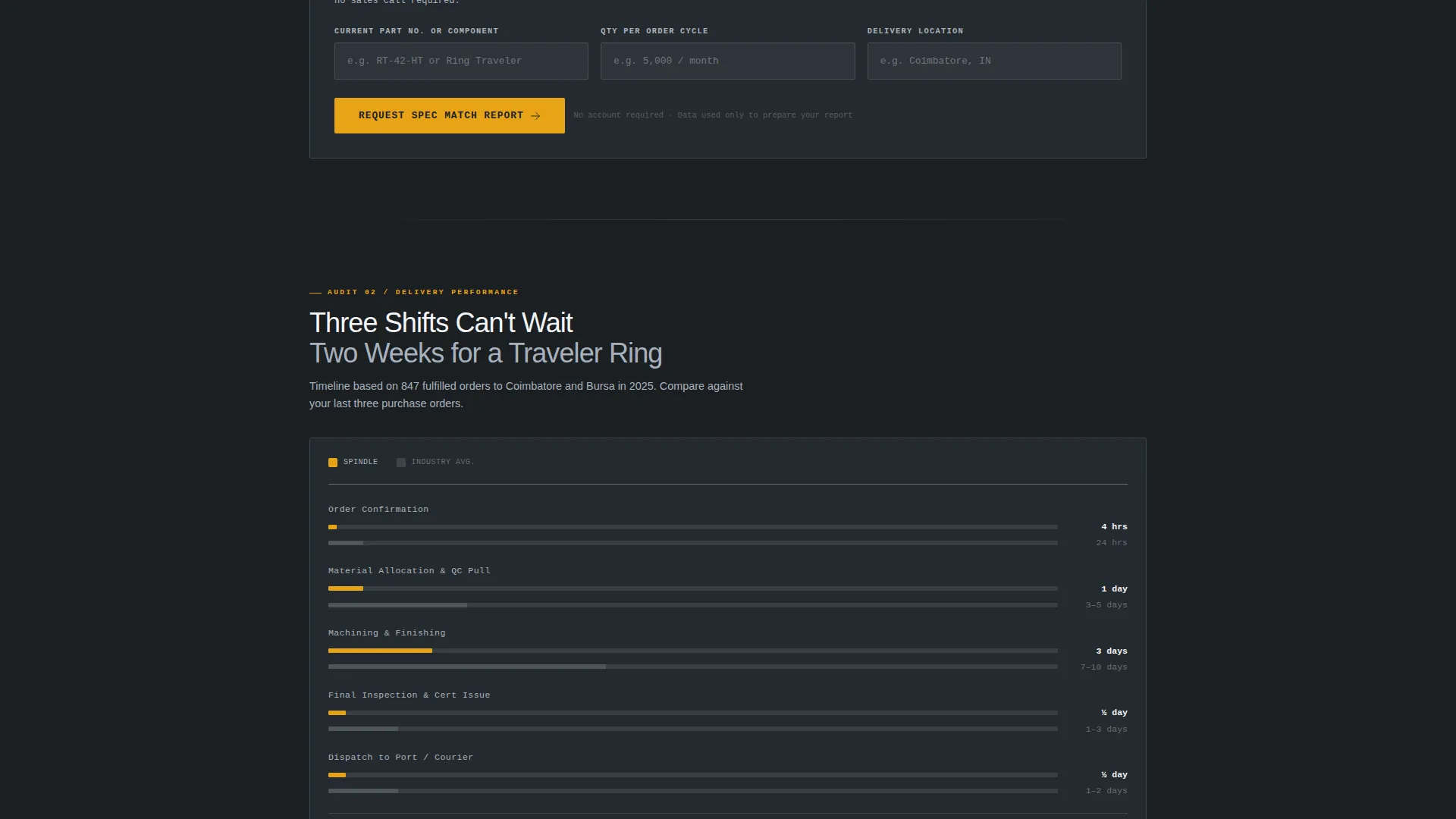
A visual timeline section shows the manufacturer's order-to-delivery cycle against published industry averages. This gives procurement managers a concrete, side-by-side view of scheduling reliability before any conversation begins.
Material Traceability Checklist
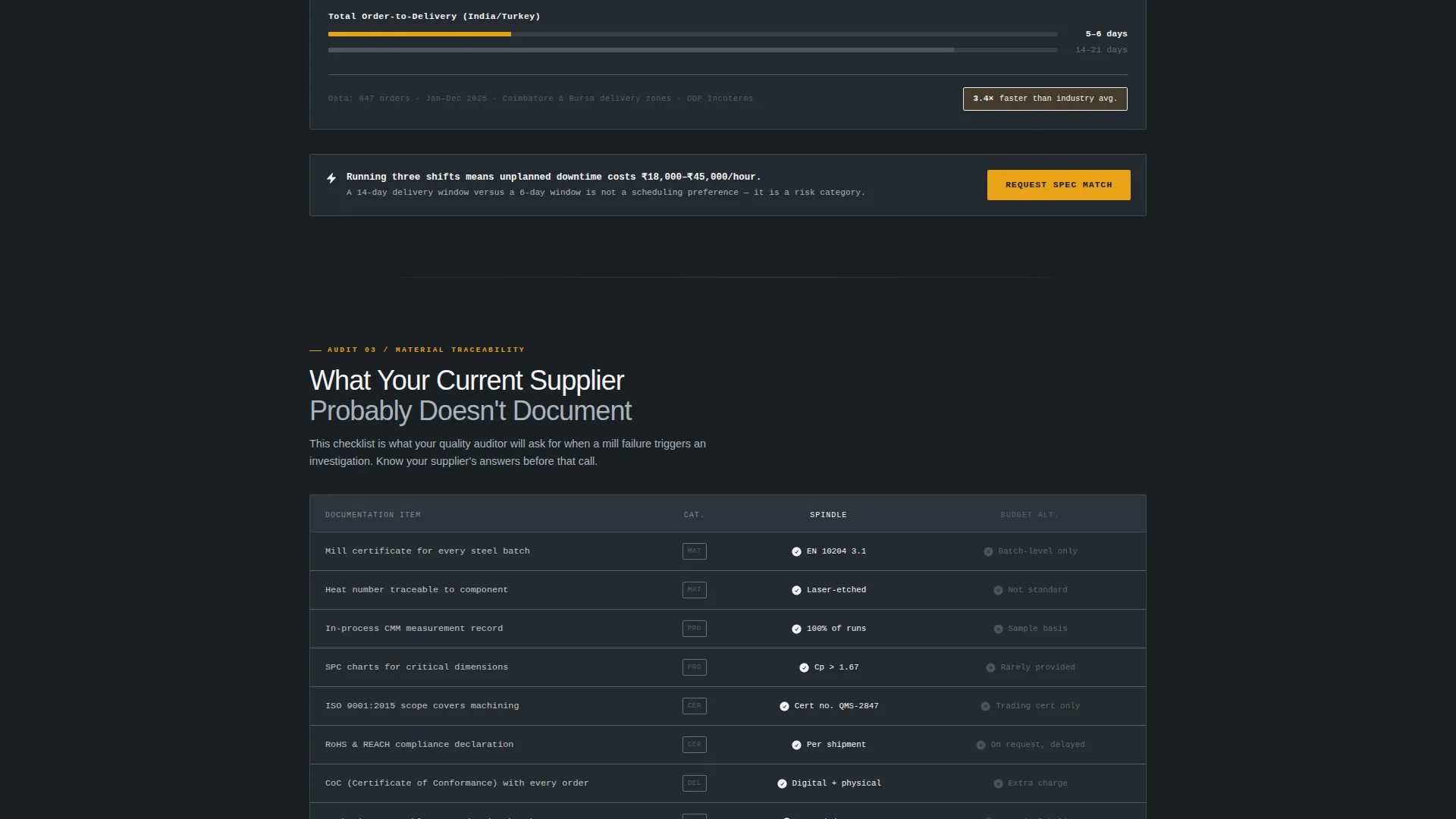
A yes-or-no checklist walks visitors through material sourcing and traceability criteria. Each row implicitly highlights what lower-cost suppliers often omit, letting the data make the case rather than the copy.
Spec Match Request Form
The primary call to action form collects three fields: current part number or component name, quantity per order cycle, and delivery location. The structure mirrors a purchase order, which reduces friction for buyers already in procurement mode.
Gated PDF Download Path
A secondary conversion option offers a full comparison document gated behind a single email field. This path captures engineers who need to share data internally before committing to a direct conversation.
Page sections overview
| Section | Purpose |
|---|---|
| Infographic header | Anchors the full component catalog visually |
| Tolerance comparison table | Shows specification advantages row by row |
| Spec Match call to action | Converts readers after the first data section |
| Lead time audit | Demonstrates scheduling reliability visually |
| Spec Match call to action (repeat) | Re-engages visitors after lead time evidence |
| Traceability checklist | Exposes sourcing gaps in budget alternatives |
| Spec Match call to action (repeat) | Final push after full audit completion |
| PDF download gate | Captures internal-review engineers via email |
Design & branding system
The visual identity follows a Service Utility theme using a Carbon Fiber color system. The palette is designed to read like a CNC control panel, structured, functional, and immediately credible to a technical audience.
- Deep graphite (#1B1F23) as the primary background, machined aluminum (#A8B2BD) for secondary surfaces and divider lines, and indicator white (#F4F5F7) for all body text and data cells
- Safety-signal amber (#E8A317) used exclusively for calls to action, checkmarks, and comparison-winner highlights to direct attention without decoration
- No ornamental elements; every visual choice prioritizes information density and respects the reader's technical expertise
Mobile & speed optimization
The single-column flow layout scales cleanly across screen sizes without requiring layout restructuring. Engineers accessing the page from a tablet on a factory floor or a laptop at 2 a.m. get the same organized experience.
- Single-column structure eliminates horizontal scroll and keeps data tables readable on smaller viewports
- Minimal decorative assets mean the page renders quickly even on industrial-site network connections
- The form's three-field structure keeps mobile completion fast and familiar to buyers already using purchase order formats
How this template helps you convert
The conversion strategy is built around eliminating objections before the visitor forms them. The scroll does not persuade through enthusiasm. It removes reasons not to switch, one verified data point at a time.
- The tolerance table and amber checkmarks deliver visible specification wins early, so buyers have evidence before they reach any call to action
- The repeating spec-match request form appears after each audit section, meeting buyers at the moment their confidence is highest rather than waiting until the page end
- The gated PDF creates a secondary conversion path for engineers who need to circulate data internally, expanding the reach of a single page visit beyond one decision-maker
Other information about this template
This template is part of the Spindle collection and is categorized under Manufacturing and Industrial, with a specific focus on Manufacturing Processes for the Spinning Equipment Manufacturer niche. It is suited for teams that want a ready-to-customize foundation without rebuilding the comparison architecture from scratch.
- The template style is Single Column Flow, making it straightforward to adapt copy, component names, and specification values to match any precision spinning product line
- The Checklist and Audit creative direction and Comparison/Versus landing page direction are baked into the layout, so the persuasion logic does not depend on copywriting alone
- The Carbon Fiber color system and Service Utility theme are consistent across all design elements, ensuring visual coherence even after content customization
Theme
Service Utility
Creative direction
Checklist & Audit
Color system
Carbon Fiber
Style
Single Column Flow
Direction
Comparison/Versus
Page Sections
Anatomy Infographic Header
Tolerance Comparison Table
Lead Time Audit Timeline
Material Traceability Checklist
Spec Match Request Form
Gated PDF Download Path
Related questions
Who is the primary audience for this landing page template?
Can the tolerance table and checklist sections be customized with my own data?
What does the spec-match request form collect from visitors?
Is the PDF download a separate page or part of the same landing page?
What spinning components does the template reference by default?