Manufacturing Processes Pricing & Packages Website Template
Stampforce is a modular card-grid landing page built for stamping equipment manufacturers. It showcases progressive die systems, servo-driven presses, and deep-draw capabilities through a blueprint-styled layout with animated isometric header art and gated resource downloads. The design communicates engineering rigor to tier-one automotive suppliers, appliance OEMs, and metal stamping job shops evaluating new press investments.
by Rocket studio
Quick summary
Stampforce is a precision-built landing page template for stamping equipment manufacturers. It uses an Engineering Blueprint visual theme and a modular card-grid layout to walk technical buyers through every phase of a stamping system, from consultation to aftermarket support. A gated tonnage selection guide drives lead capture, while ungated resource cards build trust before the ask.
Who this template is for
This template is built for manufacturers and suppliers working in high-precision metal forming. It speaks directly to the buyers and decision-makers who evaluate stamping equipment on technical merit, not marketing language.
- Stamping equipment manufacturers presenting servo-driven and mechanical press lines to industrial buyers
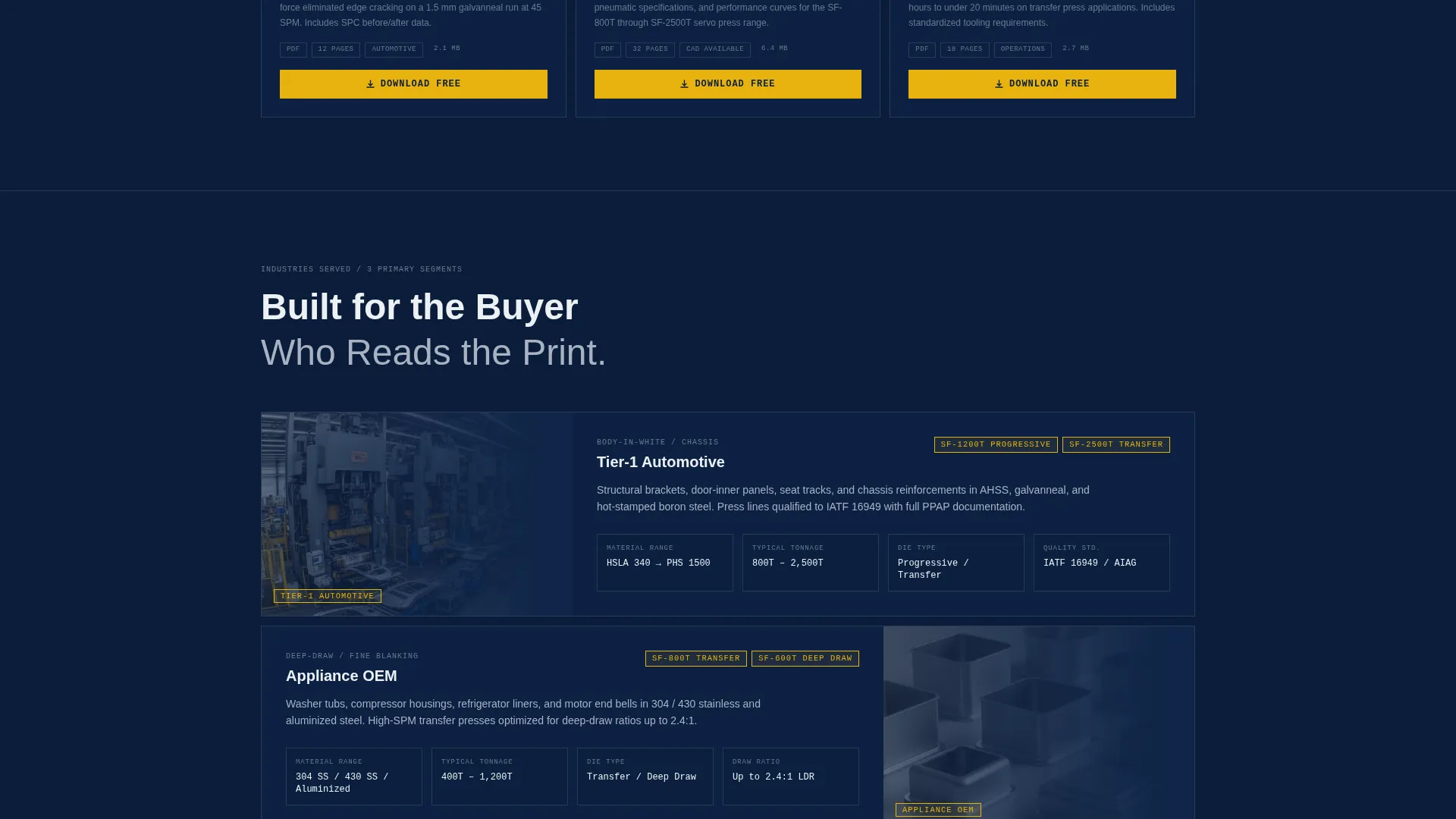
- Tier-one automotive suppliers, appliance original equipment manufacturers, and metal stamping job shops researching progressive die and transfer press systems
- Engineering-led sales teams that need a content-rich page to support complex, long-cycle purchasing decisions
What problem this template solves
Industrial buyers of stamping equipment do not respond to generic marketing pages. They arrive with specific questions about tonnage ratings, die compatibility, simulation depth, and runoff data. A standard promotional layout fails to answer those questions and loses the visitor before they convert.
- There is no structured way to present the full lifecycle of a stamping system, from FEA simulation through installation and aftermarket support, on a single page
- Ungated resources like press comparison charts and die life calculators sit buried or missing, so trust is never built before the lead form appears
- The page has no mechanism to qualify visitors by part type or volume before they download a technical guide
What you get with this template
This template delivers a complete, content-led landing page designed around the stamping equipment buying journey. Every section earns its place the same way a dimension earns its place on an engineering print.
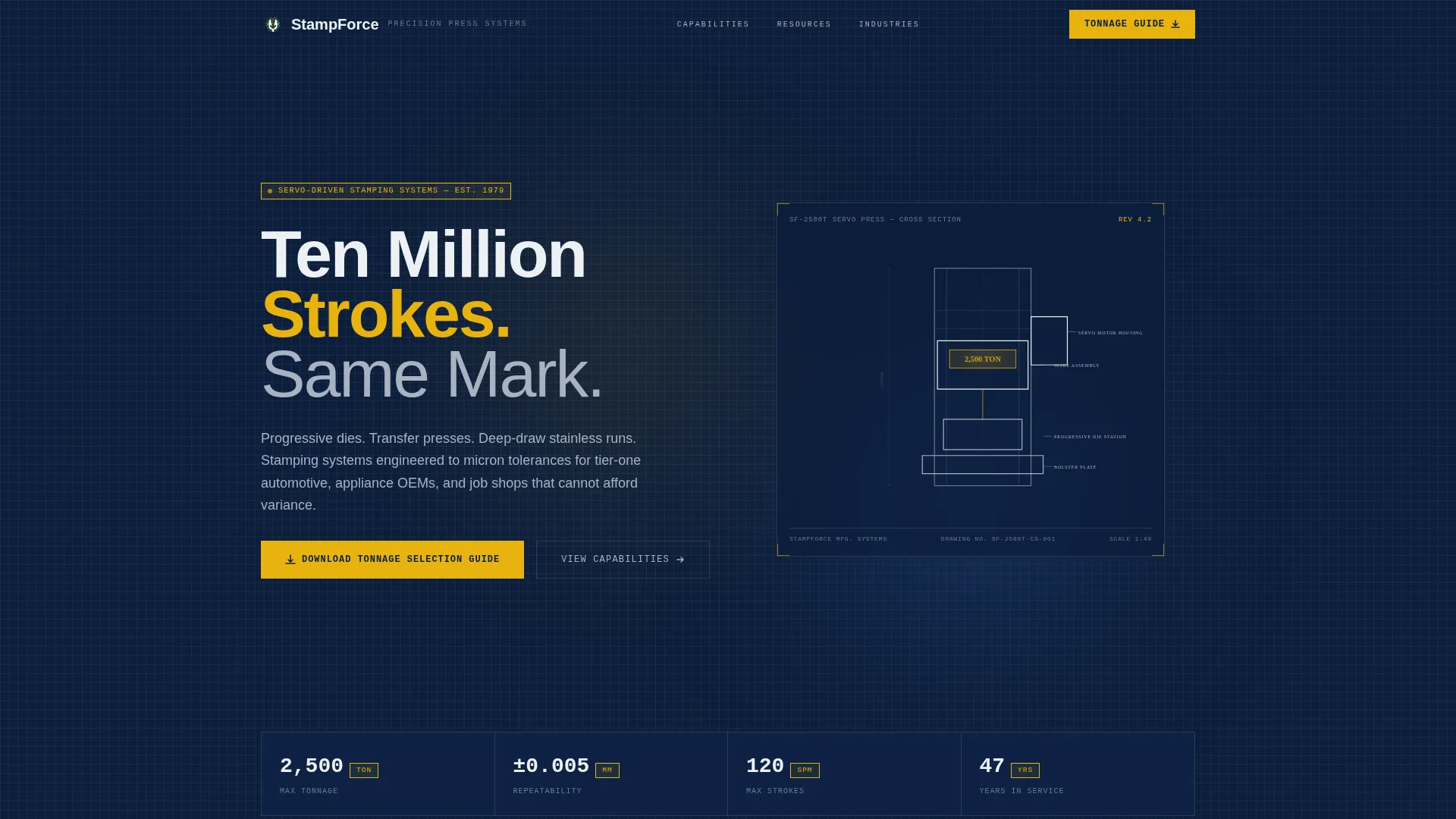
- An animated isometric header illustrating a servo-driven press with labeled subsystems: slide assembly, bolster plate, progressive die station, and servo motor housing
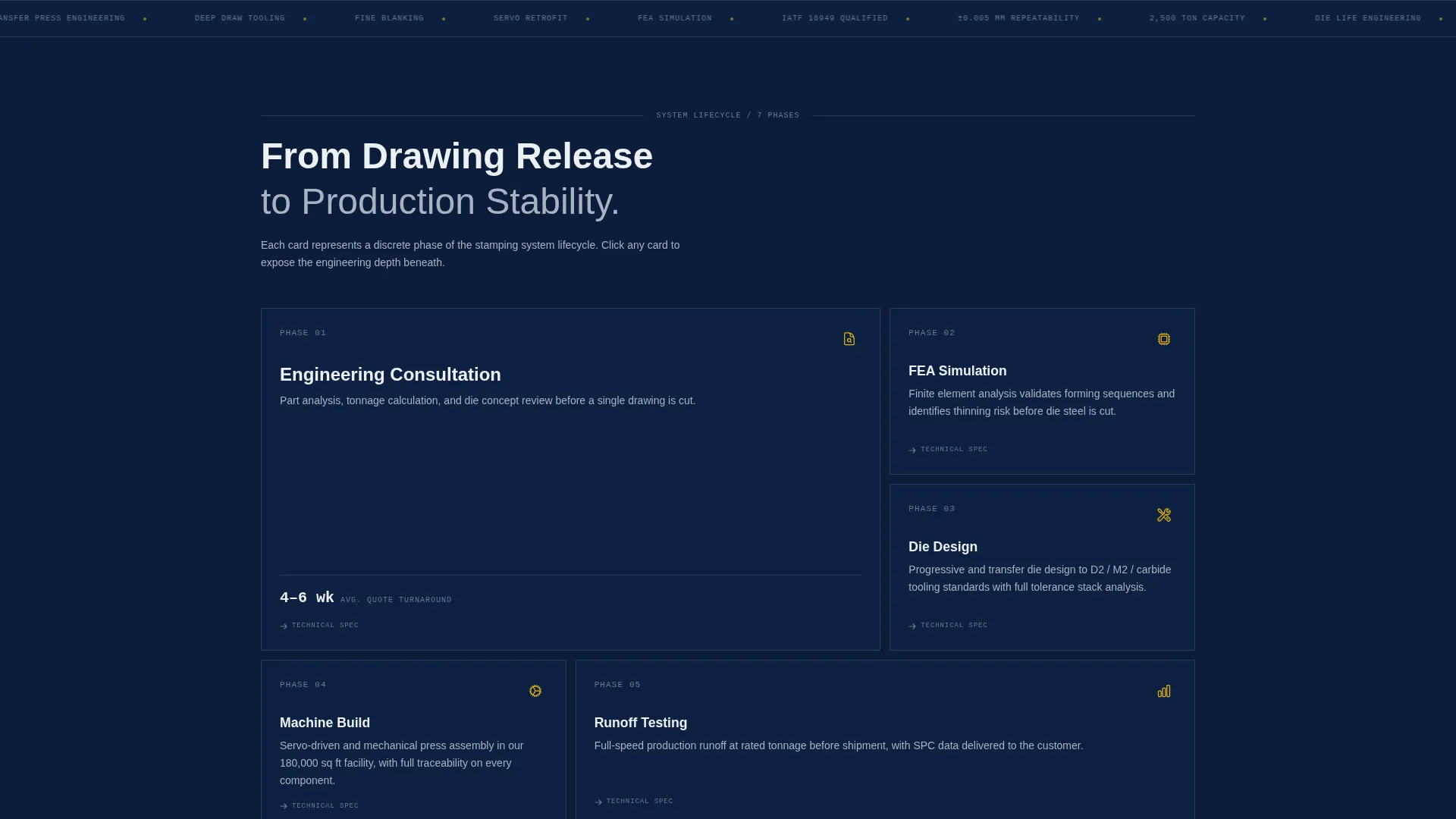
- A modular card grid covering eight lifecycle phases, engineering consultation, finite element analysis simulation, die design, machine build, runoff testing, installation, and aftermarket support, with flip and expand interactions revealing tolerance stacks, simulation heat maps, and runoff statistical process control data
- A gated lead form requiring name, company, part type, and annual volume, plus secondary ungated conversion cards offering press comparison charts, servo versus mechanical white papers, and die life calculators
Feature list
This template ships with purpose-built components matched to the stamping equipment sales process. Each feature is grounded in the technical context buyers expect.
Animated Isometric Header
The header opens with a blueprint-linework illustration of a servo-driven stamping press rendered against deep navy. Subsystems draw in sequence on page load, slide assembly, bolster plate, progressive die station, servo motor housing, and the machinist-yellow tonnage rating pulses at center mass once the sequence completes.
Modular Lifecycle Card Grid
Eight cards map the full stamping system lifecycle in order. Each card flips or expands on interaction to reveal a deeper technical layer: tolerance stack data, finite element analysis simulation heat maps, time-lapse build photography, or runoff statistical process control charts. The grid keeps the page scannable while hiding nothing from buyers who dig deeper.
Gated Tonnage Selection Guide Form
The primary conversion point is a short lead form gating the Tonnage Selection Guide. Visitors provide their name, company, part type (progressive, transfer, deep draw, or fine blanking), and annual volume range. This qualifies the lead at the point of download without friction.
Ungated Resource Conversion Cards
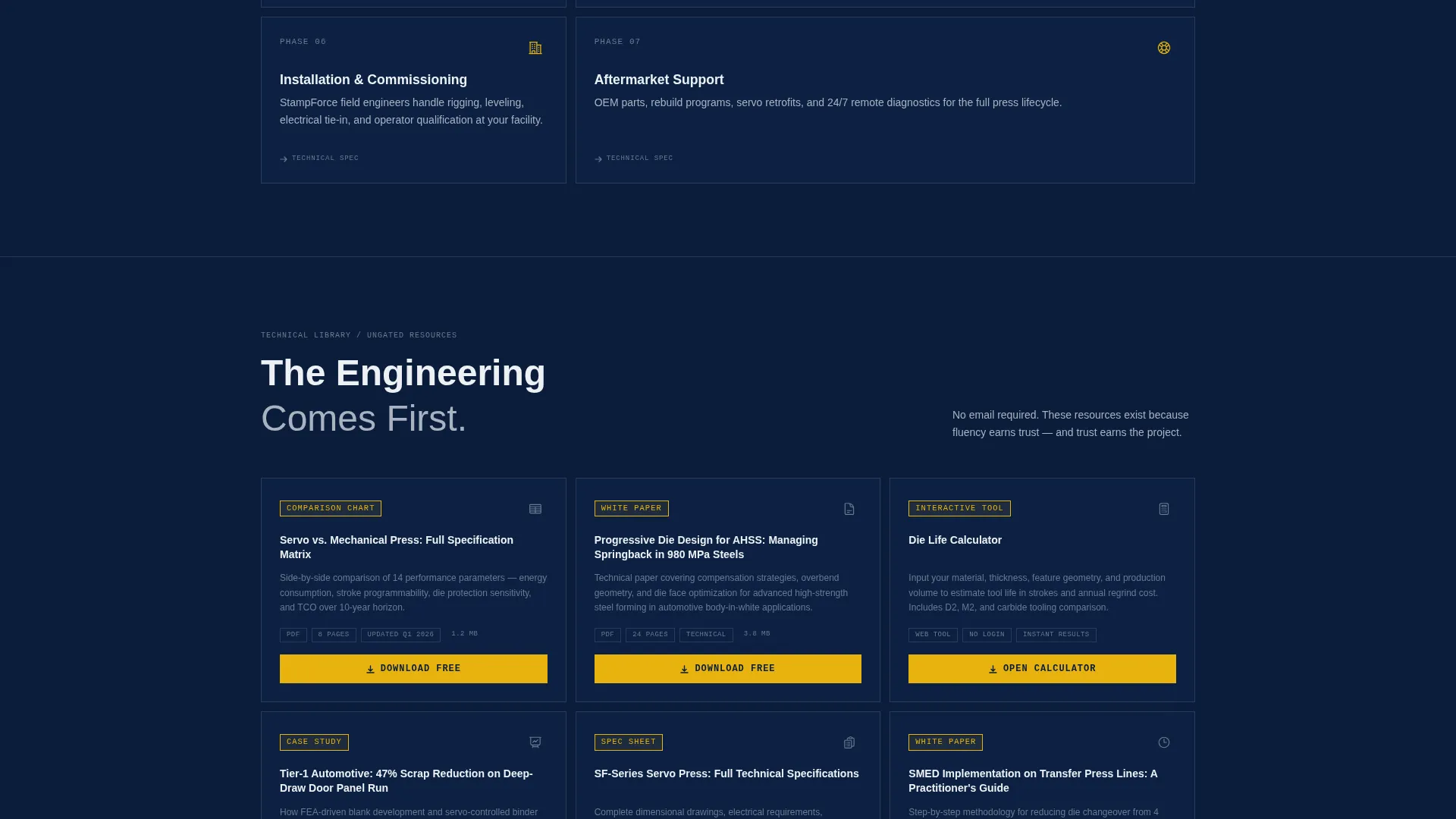
Secondary cards offer three resources with no form required: a press comparison chart, a servo versus mechanical white paper, and a die life calculator. These build credibility and fluency before the visitor reaches the gated guide, making the final conversion feel earned rather than forced.
Engineering Blueprint Color System
The Navy Authority palette uses deep technical navy as the primary background, precision steel for card borders and secondary surfaces, drafting-line white for content areas, and machinist yellow exclusively for calls to action, specification callouts, and interactive highlights. Every color has a defined role, like a dimension on a controlled print.
Transparent Process Scroll Flow
The page is structured as a top-to-bottom evidence trail. Each section adds a new layer of proof, technical depth before emotional appeal. By the time the visitor reaches the lead form, the template has already demonstrated engineering fluency across consultation, simulation, build, and support phases.
Page sections overview
| Section | Purpose |
|---|---|
| Animated Press Header | Introduces the servo press with labeled blueprint linework and animated tonnage callout |
| Lifecycle Card Grid | Walks buyers through eight stamping system phases with expandable technical detail |
| Tonnage Guide Form | Captures qualified leads gated behind part type and volume selection |
| Press Comparison Cards | Offers ungated comparison charts to build trust before the primary ask |
| Servo versus. Mechanical | Delivers ungated white paper content on drive technology trade-offs |
| Die Life Calculator | Provides an ungated interactive tool to support die selection decisions |
| Aftermarket Support Card | Covers post-installation services as the final lifecycle phase in the grid |
Design & branding system
The Engineering Blueprint theme treats every visual decision like a specification. Nothing appears on screen without a defined purpose, mirroring the discipline of a precision tooling print.
- Navy Authority palette: deep technical navy (#0B1D3A) background, precision steel (#A8B2C1) for card borders, drafting-line white (#EDF1F5) for readable content areas, and machinist yellow (#E8B30E) for calls to action and specification highlights only
- Blueprint linework illustration style used in the header, with components drawing in sequence to simulate an engineer constructing a schematic by hand
- Dark, deliberate layout inspired by a control room at third shift, high contrast, minimal decoration, every element lit only where attention is required
Mobile & speed optimization
The modular card-grid layout adapts naturally to smaller viewports without losing the technical hierarchy that industrial buyers rely on.
- Card grid reflows to a single-column stack on mobile, keeping each lifecycle phase readable and the flip or expand interaction accessible by tap
- The isometric header illustration is structured to scale gracefully, keeping labeled subsystems legible at reduced viewport widths
- Ungated resource cards and the gated lead form remain above the fold on tablet-sized screens, preserving the conversion path on any device
How this template helps you convert
The page is architected as a trust-building sequence. Conversion is the result of demonstrated competence, not a single call-to-action moment.
- Ungated resources, the press comparison chart, servo versus mechanical white paper, and die life calculator, deliver immediate value and establish technical authority before any form appears, so the visitor arrives at the gated guide already convinced of its worth.
- The gated Tonnage Selection Guide form qualifies leads by part type and annual volume at the moment of download, giving the sales team structured, actionable context for every inbound contact.
- The lifecycle card grid keeps buyers on the page longer by rewarding curiosity, each expanded card reveals a deeper technical layer, reinforcing the manufacturer's process rigor with every interaction.
Other information about this template
This template was designed specifically for the stamping equipment manufacturing niche within the broader Manufacturing and Industrial category. It sits at the intersection of Manufacturing Processes and capital equipment sales.
- The template style is Card Grid (Modular), suited for content-rich industrial pages where multiple distinct topics must coexist without visual clutter
- The creative direction is Transparent Process, the page sells evidence, not emotion, making it well-suited for long-cycle B2B purchasing decisions in precision metal forming
- The header concept is Isometric, a technical illustration style that communicates engineering precision without relying on stock photography
- The landing page direction is Content and Resource hub, meaning the page earns trust through downloadable tools and technical content before requesting contact details
- This template works within the Engineering Blueprint theme and Navy Authority color system, both of which are designed to resonate with engineers, procurement leads, and operations managers evaluating capital equipment
Theme
Engineering Blueprint
Creative direction
Transparent Process
Color system
Navy Authority
Style
Card Grid (Modular)
Direction
Content/Resource
Page Sections
Animated Isometric Press Header
Modular Lifecycle Card Grid
Gated Tonnage Selection Guide
Ungated Resource Conversion Cards
Navy Authority Color System
Transparent Process Scroll Structure
Related questions
Who is the primary audience for this landing page template?
What makes the card grid layout suitable for stamping equipment sales?
How does the gated lead form qualify visitors?
Can the ungated resource cards be customized?
Is the animated isometric header difficult to adapt?