Corporate & Business Law Directory Website Template
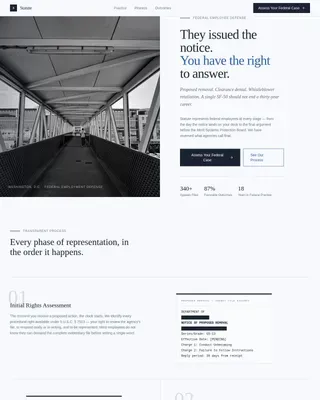
Statute is a single-column landing page template built for boutique antitrust and competition law practices. It pairs an editorial broadsheet aesthetic with a five-question guided exposure assessment quiz, helping general counsel, startup founders, and trade association directors understand their regulatory risk before committing to a consultation. The design leads with oversized serif typography, amber accents, and a transparent, stage-by-stage view of how antitrust matters actually move.
by Rocket studio
Quick summary
Statute is a single-column flow landing page template designed for antitrust and competition law boutiques. It uses an editorial magazine visual identity to communicate authority, then converts visitors through a guided five-question exposure assessment quiz. The result is a page that reads like a longform feature and closes like a precision intake tool.
Who this template is for
This template is built for B2B legal practices that operate in high-stakes antitrust and competition law matters. It speaks directly to the people doing the hiring, not to a general audience.
- General counsel at mid-cap companies responding to Department of Justice second requests or merger reviews
- Startup founders whose distribution access has been foreclosed by a dominant platform operator
- Trade association directors managing European Commission dawn raids or cross-jurisdictional investigations
What problem this template solves
Most law firm landing pages read like a practice area directory. They list credentials, name partners, and hope the visitor connects the dots. That approach fails sophisticated buyers who already understand their problem and need to see that the firm understands it too.
- Visitors leave without feeling confident the firm grasps the specific complexity of their matter
- There is no structured way for the practice to qualify a prospect's situation before a first call
- The design signals generalist, not specialist, which undercuts trust at the most critical moment
What you get with this template
The template delivers a complete single-column editorial landing page with a built-in, interactive quiz system. Every section is pre-structured and ready to customize with your practice's voice and matter history.
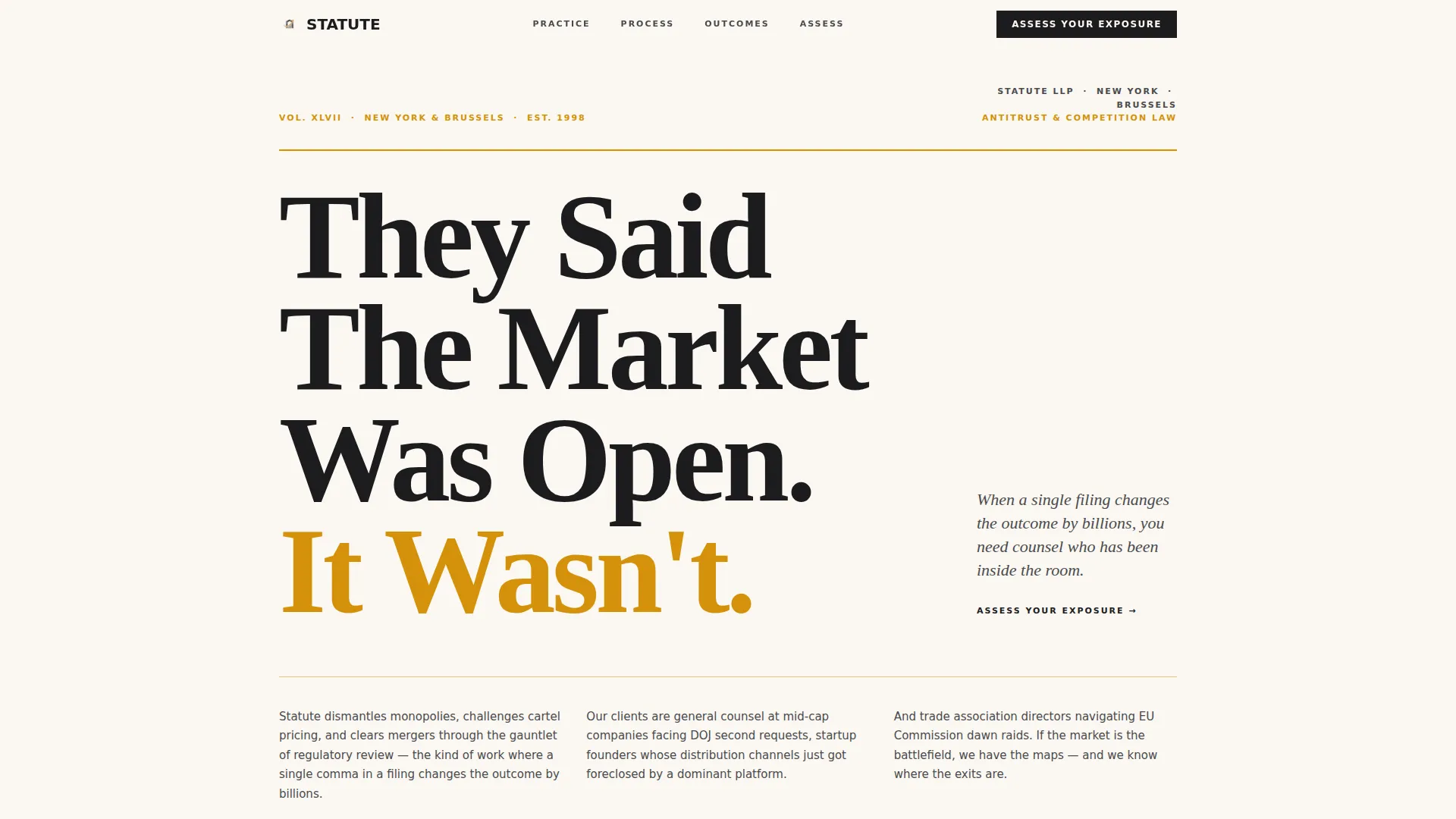
- A hero section with a giant flush-left serif headline, an amber typographic rule, and a dateline-style positioning subhead
- Four editorial scroll sections covering practice verticals, the firm's six-stage process, anonymized outcome pull quotes, and the exposure assessment quiz
- A five-question guided quiz with a thin amber progress bar, one question at a time, and a risk-level result page that links to a calendar embed for consultations
Feature list
A concise paragraph introduces what makes this template function as more than a static page. The features below are built directly into the template structure and described as they appear in the source brief.
Giant Flush-Left Headline Hero
The hero sets the editorial tone immediately. An enormous serif display headline sits flush-left at roughly 15 viewport-width units, stacked across three lines with generous leading and an amber horizontal rule beneath it. A dateline-style subhead in small caps carries the practice name, city, and a one-line positioning statement. No image is used. The typography carries the full visual weight of the section.
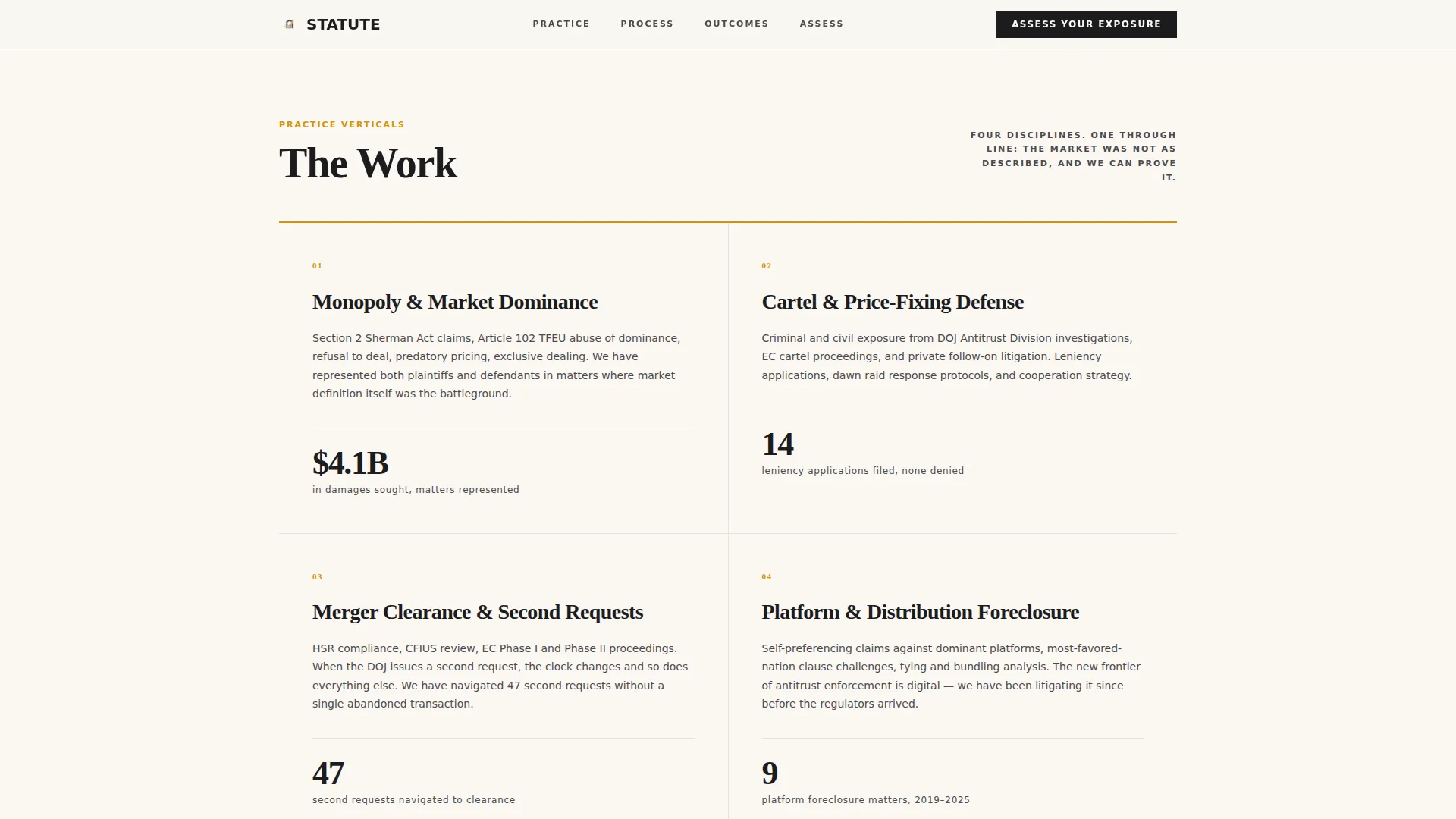
Asymmetric Bento Practice Grid
The practice verticals section uses an asymmetric bento grid layout to present the firm's four core areas: monopoly dismantling, cartel pricing challenges, merger clearance, and dawn raid response. Each cell holds its own weight without competing for attention.
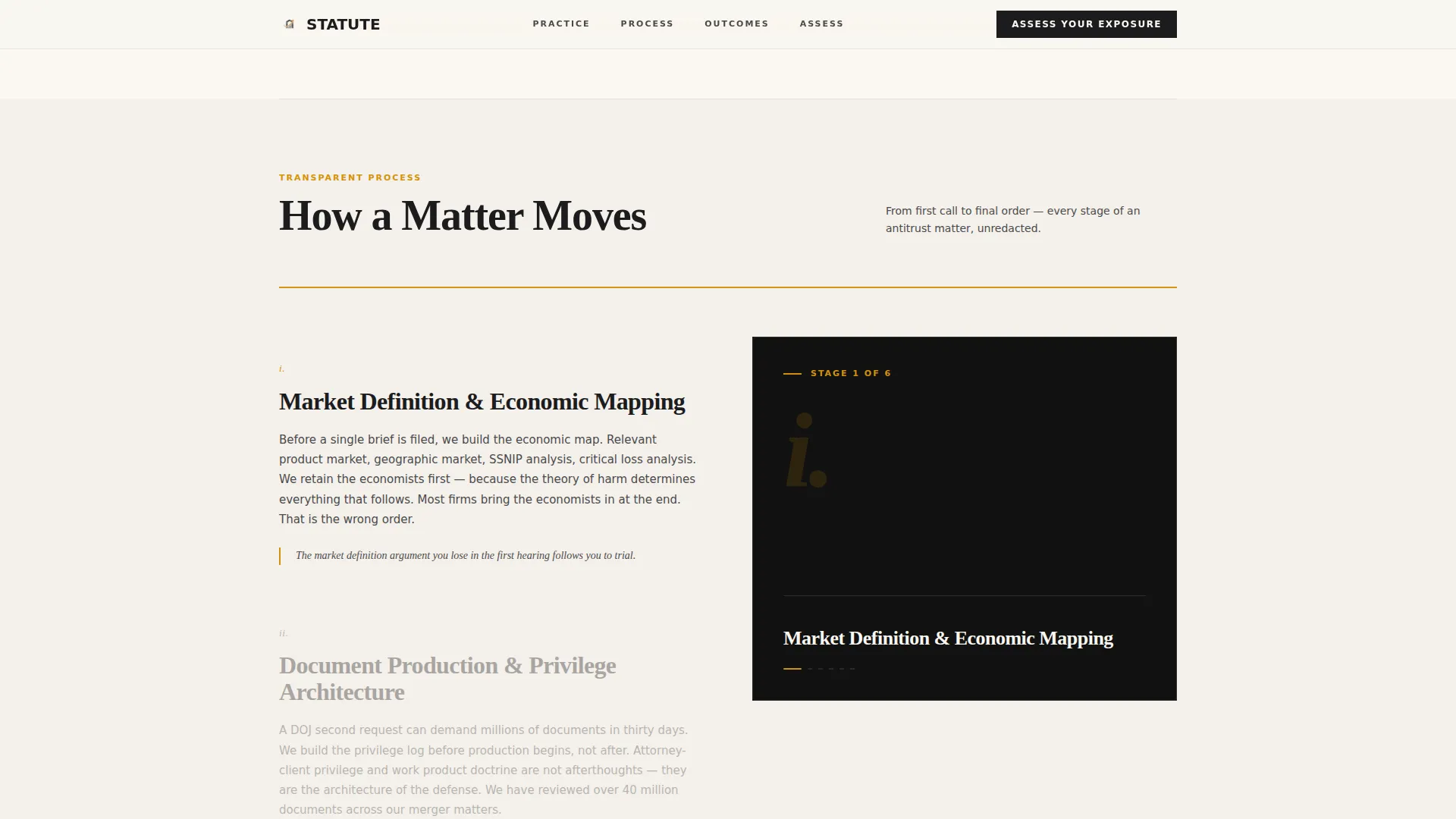
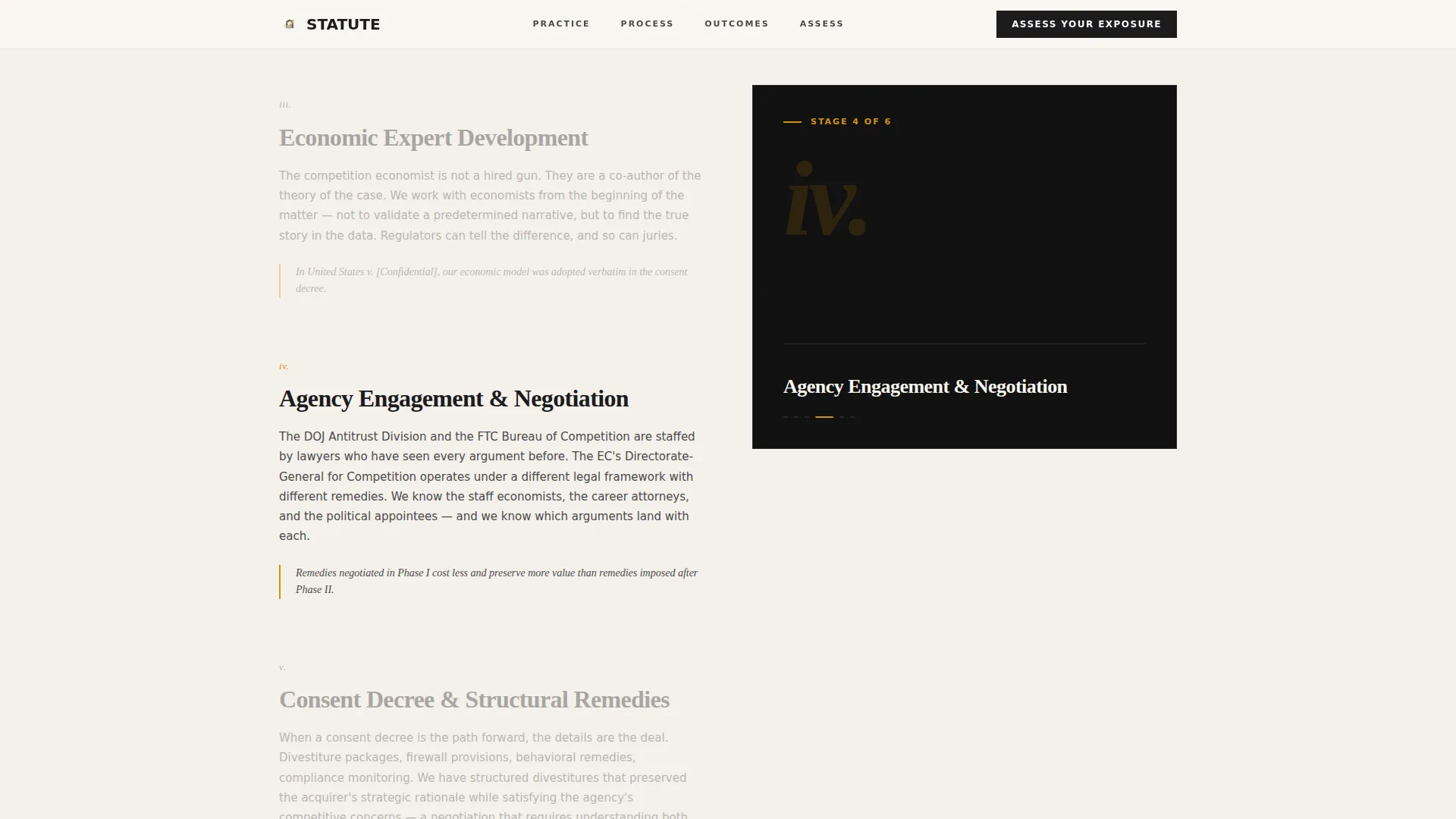
Six-Stage Sticky Scroll Process
The process section uses a sticky scroll editorial format to walk visitors through six stages of an antitrust matter. It moves from initial market analysis through economic modeling, document production, agency negotiation, and trial or settlement. Each stage peels back one layer of how the work actually happens.
Oversized Pull Quote Outcomes
Anonymized case outcome pull quotes appear in oversized italic serif type, breaking the column rhythm at deliberate intervals. Thin amber horizontal rules separate each pull quote block, reinforcing the broadsheet column-break aesthetic and providing social proof without naming clients.
Five-Question Exposure Assessment Quiz
The quiz is the primary conversion engine. It presents five questions one at a time: market position, jurisdiction, trigger event, timeline urgency, and annual revenue band. A thin amber progress bar tracks advancement. The result page delivers a risk-level classification of low, moderate, elevated, or critical, with a brief explanation and a secondary call to action that opens a calendar embed.
Editorial Scroll Animations
Scroll-linked opacity transitions and staggered section reveals are built into the template. These animations support the longform reading experience without interrupting it, allowing content to surface as the visitor moves down the page.
Page sections overview
| Section | Purpose |
|---|---|
| Hero Headline Block | Establish authority with oversized editorial typography and amber rule |
| Practice Verticals Grid | Present four antitrust focus areas in an asymmetric bento layout |
| Six-Stage Process | Walk visitors through the full lifecycle of an antitrust matter |
| Outcomes Pull Quotes | Deliver anonymized case social proof in oversized italic serif |
| Exposure Assessment Quiz | Qualify visitors through five guided questions and return a risk result |
| Linear Single-Row Footer | Close the page with practice identity in a clean, minimal footer |
Design & branding system
The visual identity is built around an editorial broadsheet aesthetic. Every design decision reinforces the authority of print journalism applied to legal practice, which is warm but not soft, serious but not sterile.
- Color palette: broadsheet cream (#FAF7F2) as the primary background, deep newsprint charcoal (#1C1C1E) for body text and section dividers, warm amber (#D4920B) for accent links and pull-quote rules, and muted graphite (#4A4A4D) for secondary type and captions
- Typography: Fraunces serif for all display and headline use, DM Sans for body copy and user interface elements including the quiz
- Section dividers are thin amber horizontal rules styled like newspaper column breaks, maintaining rhythm across the full single-column scroll
Mobile & speed optimization
The template is designed desktop-first, reflecting the reading habits of its primary audience. General counsel and senior legal decision-makers typically review vendor pages on desktop during working hours. The template still scales responsively down to mobile.
- Scroll-linked animations and staggered reveals are set to medium intensity, preserving visual quality without burdening load time
- The five-question quiz runs entirely client-side, meaning no server round-trips are needed between questions or for delivering the risk result
How this template helps you convert
The template earns trust before it asks for anything. By the time a visitor reaches the quiz, they have already read through the firm's process and seen the scale of prior outcomes. That context makes the conversion ask feel like a natural next step.
- The exposure assessment quiz qualifies the visitor's specific situation across five dimensions before requesting any contact detail, which reduces friction and increases the perceived value of the result
- The risk-level result page delivers a personalized classification with a brief explanation, then surfaces the "Schedule a Privileged Consultation" call to action alongside a calendar embed, connecting a qualified lead directly to a booked meeting
Other information about this template
This template is part of a broader collection designed to serve specialized professional services practices that require more than a generic firm homepage. A few additional details worth noting before you build:
- The template style is Single Column Flow, which keeps the reader's attention on one narrative thread from hero to quiz without lateral distraction
- The creative direction is Transparent Process, meaning the design structure itself communicates depth of expertise by showing how the work unfolds stage by stage
- The header concept is Giant Headline Left, a format borrowed from broadsheet newspaper front pages where typographic confidence replaces photography
- The conversion direction is Quiz and Assessment, suited to practices where self-qualification builds more trust than a direct contact form
- The template sits within the Legal and Compliance category, specifically Corporate and Business Law, with a niche focus on antitrust and competition law matters across US and EU jurisdictions
Theme
Editorial Magazine
Creative direction
Transparent Process
Color system
Charcoal & Amber
Style
Single Column Flow
Direction
Quiz/Assessment
Page Sections
Giant Flush-left Editorial Hero
Asymmetric Bento Practice Grid
Six-stage Sticky Scroll Process
Oversized Pull Quote Social Proof
Five-question Exposure Assessment Quiz
Scroll-linked Reveal Animations
Related questions
Who is this landing page template designed for?
Does the exposure assessment quiz need a backend or third-party service?
Can the quiz questions be customized for a specific practice?
What fonts does this template use?
What conversion action does this template support?