Intellectual Property Booking Website Template
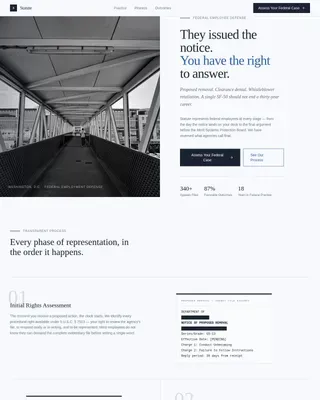
Statute is an editorial-style copyright attorney landing page built for independent creators who have had their work stolen. The layout pairs a persistent sidebar with a scrolling case study column, guiding visitors from the moment they recognize their situation to the moment they book a consultation. It is authoritative, precise, and designed to move angry creators into action.
by Rocket studio
Quick summary
Statute is a sidebar companion landing page for a copyright attorney practice. It uses magazine-weight editorial typography and three narrative case studies to build credibility fast. A sticky sidebar holds a table of contents, attorney credentials, and the primary booking call to action. Every design decision signals authority, and every content section moves a creator closer to scheduling a consultation.
Who this template is for
This template is built for copyright attorneys who represent independent creators in infringement disputes. It speaks directly to clients who have already discovered the theft and are ready to act.
- Independent musicians, software developers, and photographers who found their work used without permission
- Small studios or agencies that need to communicate intellectual property protection services
- Copyright attorneys who want to convert first-time visitors into booked consultations through documented case outcomes
What problem this template solves
Most legal service pages feel cold and generic. They list practice areas without proving outcomes, and they ask for trust without earning it. Creators who arrive after discovering an infringement need to feel understood immediately.
- Visitors leave before booking because the page never connects their specific situation to a real legal result
- Generic contact forms feel low-stakes and easy to ignore, reducing the urgency needed to act
- Without social proof tied to specific cases and statutes, potential clients have no reason to choose one attorney over another
What you get with this template
This template delivers a complete single-page layout structured around editorial credibility and a clear booking path. Every section has a defined purpose in the conversion flow.
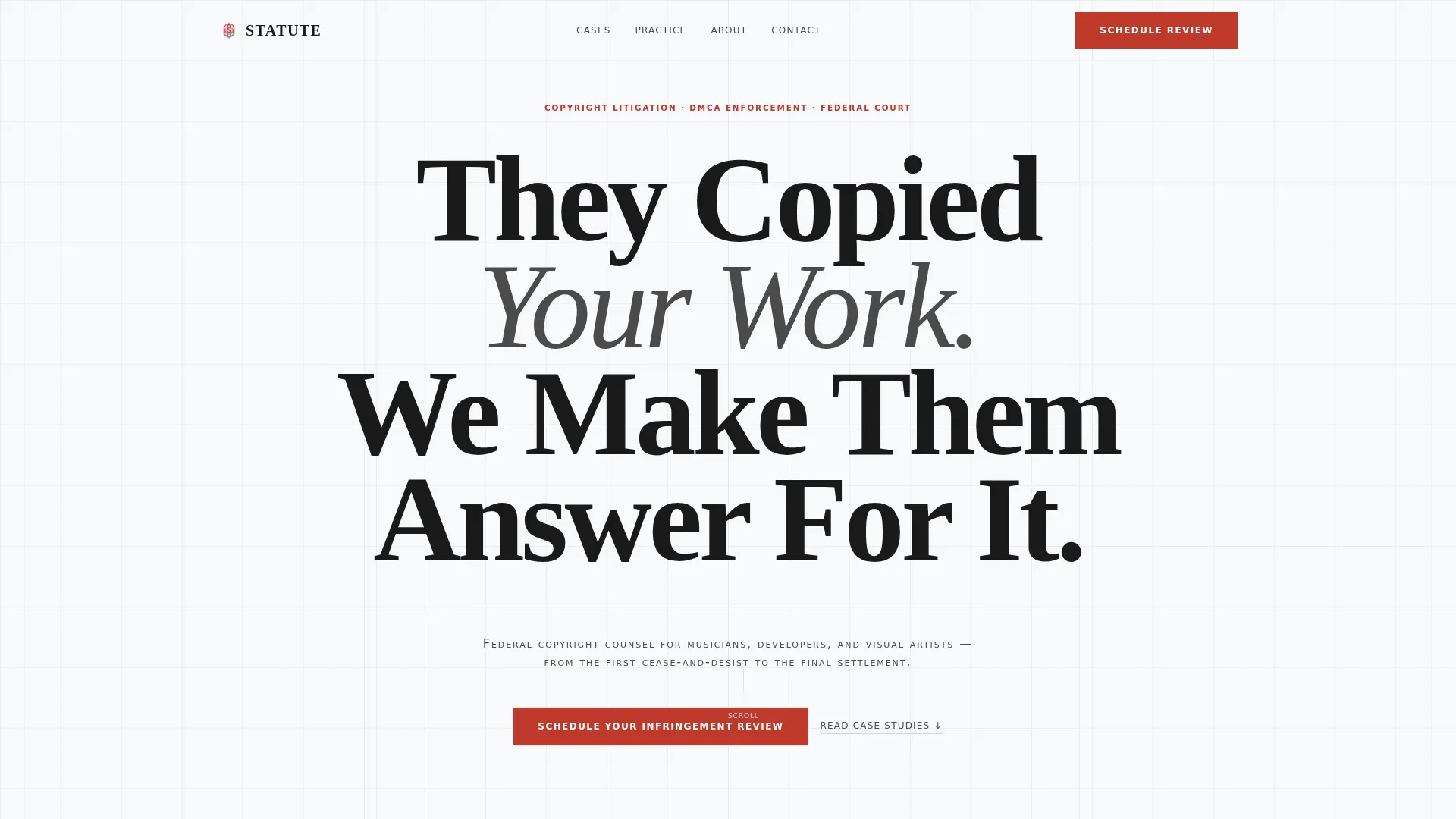
- A giant centered headline hero with massive serif typography, a horizontal rule, and a small-caps subhead, no images required
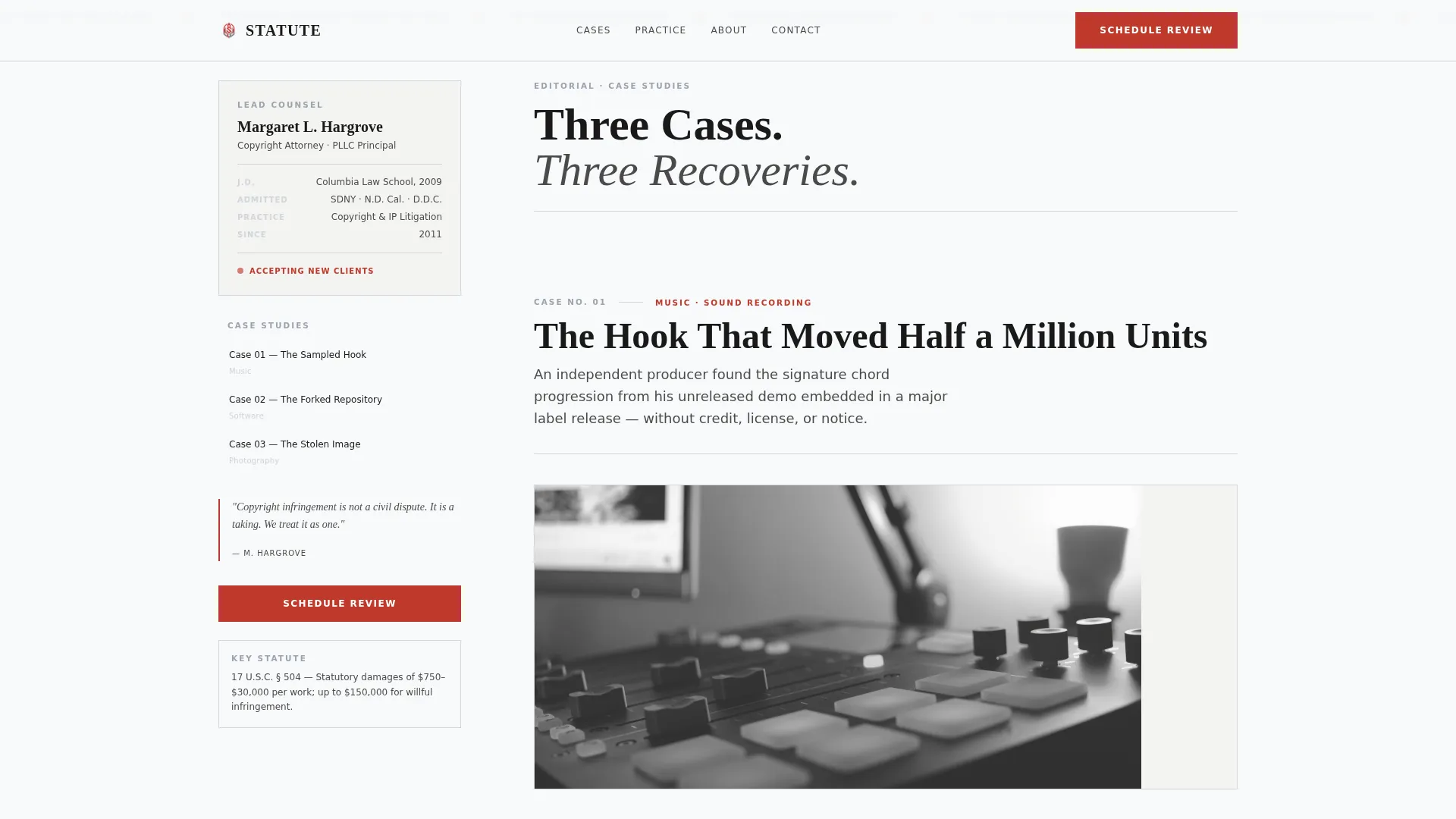
- A sidebar that stays fixed while the main column scrolls, containing a table of contents, attorney credentials, and the "Schedule Your Infringement Review" booking form
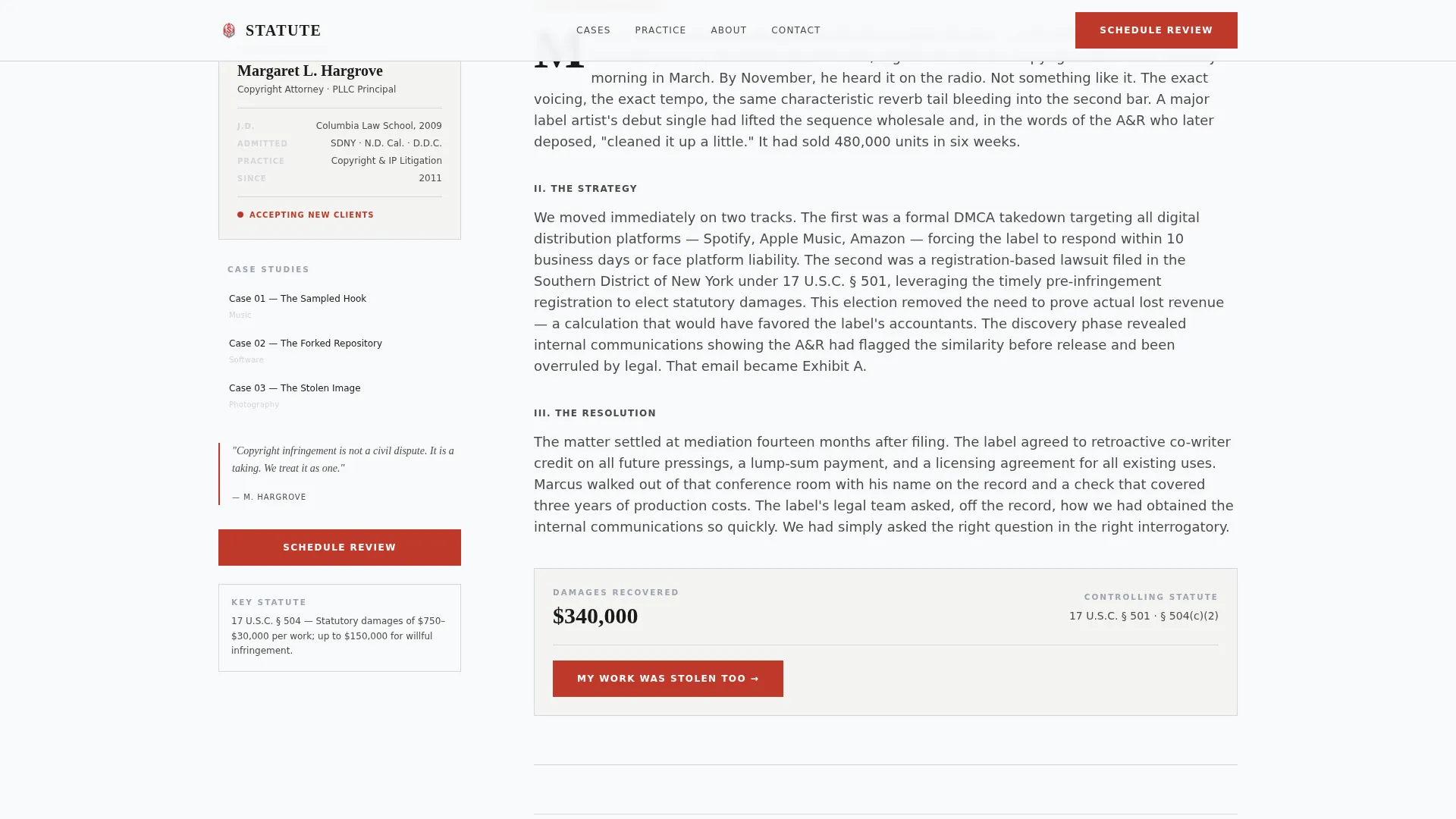
- Three magazine-style case study narratives, each telling the theft, the legal strategy, and the resolution, with pull quotes in prosecutorial red citing specific statutes and settlement figures
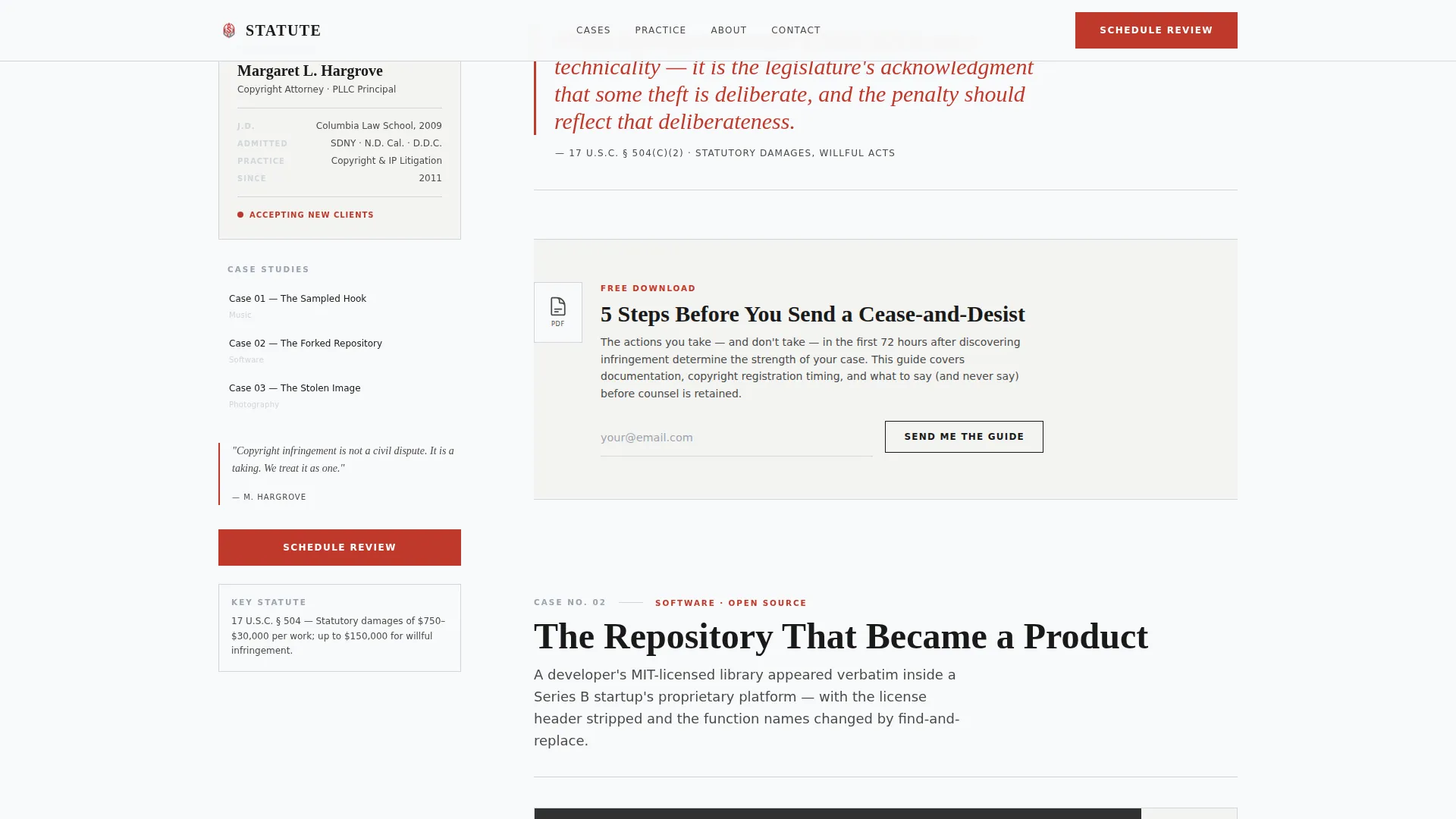
- A secondary lead capture strip offering a free downloadable PDF titled "5 Steps Before You Send a Cease-and-Desist" in exchange for an email address
- A linear single-row footer
Feature list
This template was purpose-built for legal service conversion. Each feature below maps directly to a defined element in the source layout.
Giant Headline Hero Section
The hero opens with a large serif headline at 120-point-plus weight set against pure white. A single thin horizontal rule sits beneath it, followed by a one-line subhead in small caps. There is no image or illustration. The typography itself carries the entire visual weight of the opening impression.
Sticky Sidebar with Table of Contents
The sidebar anchors to the viewport as the visitor scrolls. It displays a persistent table of contents with active section highlighting, attorney credential information, and the primary booking call to action. On mobile, the sidebar collapses into a stacked layout.
Three Editorial Case Study Narratives
The main content column presents three case studies in ascending complexity and stakes. Each is written in a magazine feature format covering the inciting theft, the legal strategy deployed, and the final resolution with damages recovered. Pull quotes in prosecutorial red interrupt the column between cases, citing statutes and figures that reinforce credibility.
Booking Form with Three Focused Fields
The consultation booking form asks for exactly three inputs: the type of work infringed via a dropdown (music, software, visual art, written work, or other), the URL where the infringement was discovered, and the visitor's preferred consultation date and time. The form appears in the sidebar and again after each case study.
Lead Capture PDF Strip
A dedicated section below the case studies offers a free downloadable guide titled "5 Steps Before You Send a Cease-and-Desist." Visitors who are not ready to book provide their email to receive it. This captures high-intent visitors who need one more step before committing.
Scroll-Reveal Animations and Interactive Sidebar
The template includes medium-intensity scroll-reveal animations for body text, character-reveal effects for headings, and staggered entry animations for case study sections. The sidebar table of contents highlights the active section as the visitor scrolls through the page.
Page sections overview
| Section | Purpose |
|---|---|
| Hero Headline | Establishes authority and names the core problem immediately |
| Sticky Sidebar | Anchors navigation, credentials, and primary booking form |
| Case Study One | Introduces the practice through a real-format music infringement narrative |
| Pull Quote One | Reinforces credibility with a statute citation and outcome figure |
| Case Study Two | Escalates stakes with a software developer open-source case narrative |
| Pull Quote Two | Breaks the column with a second editorial callout and settlement reference |
| Case Study Three | Delivers the most complex case, building toward the highest-stakes resolution |
| Booking Call to Action | Repeats the "Schedule Your Infringement Review" prompt after all three cases |
| Lead Capture Strip | Offers the free PDF guide in exchange for an email address |
| Footer | Single-row linear layout with essential links |
Design & branding system
The visual identity follows an Editorial Magazine theme. The palette evokes a freshly printed broadsheet on a marble surface: austere, high-contrast, and impossible to skim carelessly.
- Color system: glacial white (#F8F9FA) as the base, cool reading gray (#4A4A4A) for body text, hairline rule silver (#D1D5DB) for dividers, and prosecutorial red (#C0392B) reserved for pull quotes and the booking button
- Typography: Fraunces serif for all display headings and pull quotes, DM Sans for body copy and user interface elements
- The design avoids decorative imagery entirely, relying on typographic scale, white space, and precise rule lines to communicate authority
Mobile & speed optimization
The template is designed desktop-first to support the sidebar layout. It degrades gracefully to a single-column mobile stack without losing the editorial structure or the conversion flow.
- The sticky sidebar converts to a stacked block on smaller screens, keeping the booking form accessible without overlap
- Scroll-reveal and character-reveal animations are implemented with client-side interaction layers, while static content sections use server components to keep initial load lean
- The three-field booking form and the lead capture strip both remain fully functional in the mobile stacked layout
How this template helps you convert
The entire page is structured around a single outcome: turning an infringement discovery into a booked consultation. Every section is a deliberate step in that sequence.
- The hero headline names the visitor's problem in plain, direct language, creating immediate recognition and establishing that the attorney understands what happened
- The three case studies build trust progressively, each one more complex and higher-stakes than the last, so that by the third case the visitor has internalized both the attorney's range and their track record
- The booking form appears multiple times at logical decision points, in the sidebar and after each case study, so the visitor never has to search for the next step when they feel ready to act
Other information about this template
This template is categorized under Legal and Compliance with a focus on Intellectual Property. It is suited for copyright attorney practices in the United States market, with date and currency formatting set to United States conventions (MM/DD/YYYY and USD).
- The template uses an Arctic White color system, consistent with the editorial law review aesthetic described in the source brief
- The Sidebar Companion template style is a defined layout pattern that pairs a persistent side panel with a scrolling main column, a structure well suited to long-form case study content
- The intersection match for this template aligns Legal and Compliance, Intellectual Property, and Copyright Attorney as its core context, with a Booking and Scheduling call-to-action direction
- The template is localized for United States audiences and does not include multi-language or multi-currency configuration
Theme
Editorial Magazine
Creative direction
Case Study Narrative
Color system
Arctic White
Style
Sidebar Companion
Direction
Booking/Scheduling
Page Sections
Giant Typography Hero Section
Sticky Sidebar with Active Navigation
Three Escalating Case Study Narratives
Three-field Consultation Booking Form
Lead Capture PDF Download Strip
Scroll-reveal and Character-reveal Animations
Related questions
Who is the primary visitor this landing page is designed to serve?
Can the booking form fields be changed to match a different intake process?
Does this landing page require stock photography or custom illustrations?
What does the page offer visitors who are not ready to book a consultation?
Is this template suited for attorneys who handle multiple types of copyright cases?