Parkinson's Disease Care Professional Website Template
Steady is a compassionate Parkinson's caregiver support landing page template built for services that walk beside care partners every step of the way. Its sidebar companion layout pairs a warm Organic Flow visual identity with Stats-First Impact storytelling, downloadable resources, a stage-by-stage symptom guide, and a persistent "You're Not Alone" resource finder, all designed to earn trust before asking for anything in return.
by Rocket studio
Quick summary
Steady is a sidebar companion landing page template for Parkinson's disease caregiver support services. It opens with an oversized caregiver testimonial, builds a data-driven case for the scale of the crisis, then delivers a comprehensive range of downloadable tools and stage-by-stage guidance. Every section gives something useful before asking a single thing in return.
Who this template is for
This template is made for services that support the people doing the hardest, quietest work, caring for a loved one with Parkinson's disease. It speaks directly to the real people behind that role, not just their title.
- Adult children managing a parent's Parkinson's care remotely, tracking medication management windows across time zones
- Retired spouses adapting daily life and daily tasks as their partner's motor symptoms change
- Night-shift healthcare professionals and professional caregivers who return home to a second, unpaid shift they never trained for
What problem this template solves
Parkinson's care can feel overwhelming at 2 a.m. in a hallway you don't know how to navigate. Family members searching for help deserve a page that feels human, not clinical. Most caregiver service pages are cold, cluttered, and slow to get to the point. Steady solves that.
- Care partners arrive exhausted and skeptical; this layout earns trust with one warm voice before asking for an email
- Resource pages often bury practical advice behind long forms; here, the Caregiver Starter Kit is offered before anything is requested
- Visitors lose confidence when disease progression feels too big to name; this template names it, stage by stage, in plain language
What you get with this template
You get a fully structured, single-page layout designed for content and resource delivery in the Parkinson's care space. Every section is built to reduce friction and make the journey easier for exhausted visitors.
- A sidebar companion layout with persistent navigation and a sage-toned "You're Not Alone" resource finder that stays visible as the visitor scrolls
- Animated stats counters, a stage-by-stage symptom guide, community voices testimonials, and a free Caregiver Starter Kit download form requiring only a first name and email
- Clay-toned accent lines, fog white base, and a DM Serif Display and Manrope typographic pairing that makes even dense information feel unhurried and readable
Feature list
This template ships with a tightly considered set of built-in components, every one chosen to make parkinson's care content feel less like a brochure and more like a hand on the shoulder.
Opening Testimonial Card Hero
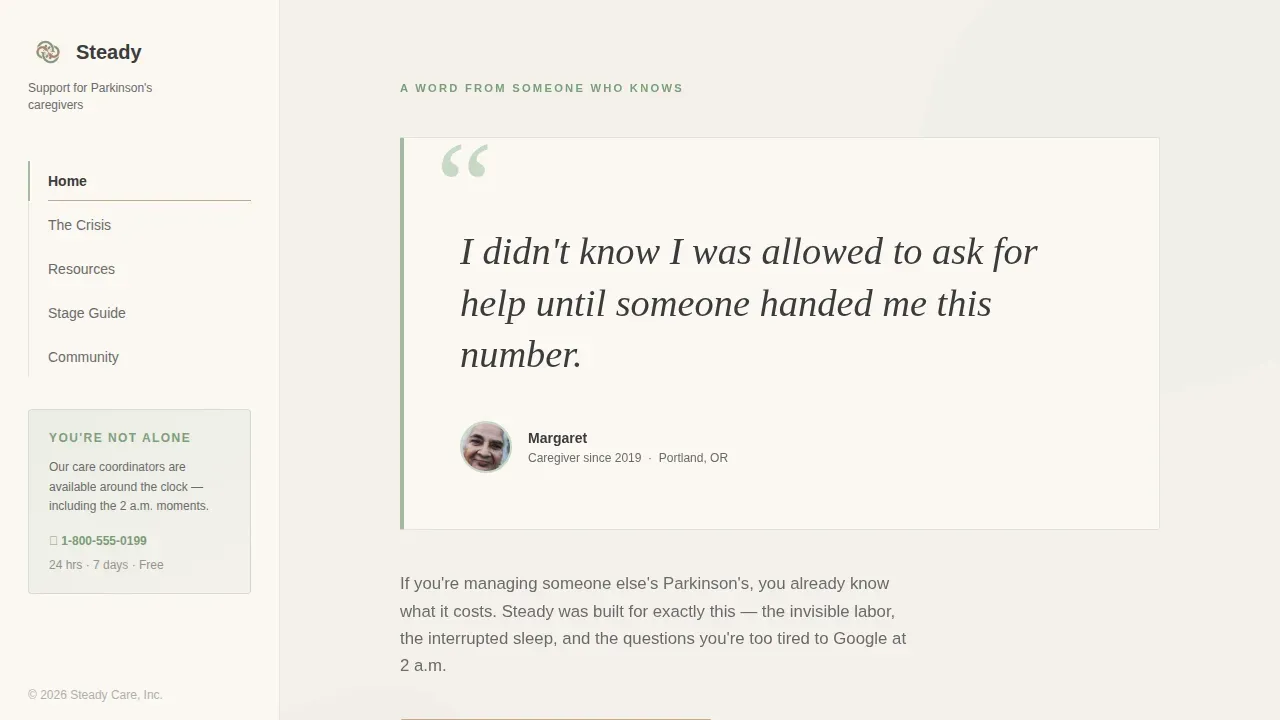
The header holds a single oversized card on warm cream. A handwritten-style caregiver quote fills the viewport, accompanied by a small portrait circle, a first name, and the words "Caregiver since 2019." There is no stock photography, no medical imagery. Just one human voice and the silence around it. This emotional anchor sets the tone for everything that follows.
Stats-First Impact Section
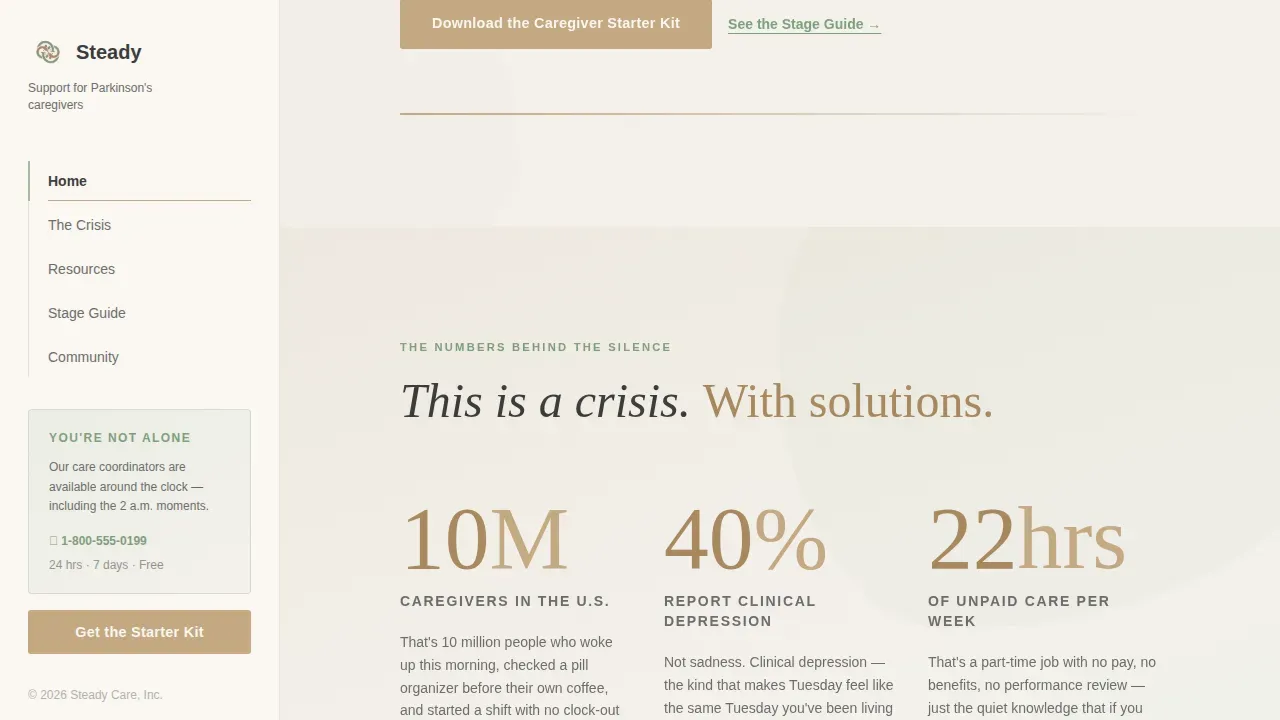
Three large, scroll-linked animated counters present the scale of the Parkinson's caregiver crisis: 10 million caregivers in the United States, 40% reporting clinical depression, and an average of 22 unpaid care hours per week. Each counter lands with weight, then dissolves into a short paragraph translating that number into a single caregiver's Tuesday. Data and breath alternate down the page.
Caregiver Starter Kit Download Form
The primary call to action, "Download the Caregiver Starter Kit", sits both beneath the hero testimonial and pinned gently in the sidebar after the first scroll. The form collects only a first name and email. An optional checkbox reads: "I'd like a care coordinator to call me." No gates, no lengthy intake process.
Stage-by-Stage Symptom Guide
Dedicated guidance cards address each stage of Parkinson's disease, giving care partners practical ways to adapt as Parkinson's progresses. Cards cover motor symptoms, non motor symptoms, cognitive changes, freezing episodes, balance issues, and what to expect in advanced Parkinson's. The guide supports understanding parkinson's disease without requiring a medical background to follow.
Downloadable Resource Suite
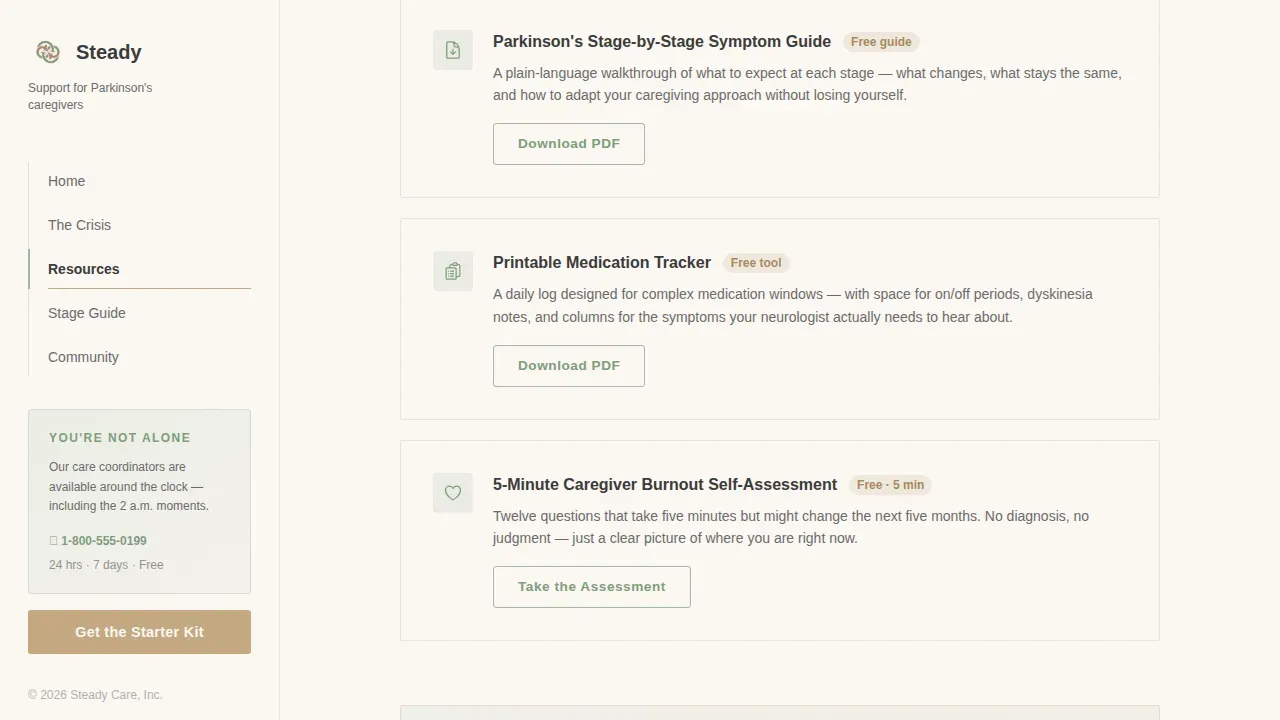
Beyond the Starter Kit, the template includes three secondary resource paths: a printable medication tracker to support medication management, a 5-minute caregiver burnout self-assessment, and the stage-by-stage guide as a standalone download. Each resource is positioned to give first and ask second.
Community Voices Testimonials Block
Three caregiver testimonials with named individuals, specific situations, and care durations anchor the social proof section. Highlighting the voices of other caregivers and care partners builds trust and makes seeking support feel normal, not desperate.
Page sections overview
| Section | Purpose |
|---|---|
| Hero Testimonial Card | Opens with a single caregiver voice to anchor emotional trust |
| Stats Impact Block | Animated counters frame the scale of Parkinson's caregiving |
| Starter Kit call to action | Primary download form with optional coordinator call checkbox |
| Stage Guide Cards | Stage-by-stage symptom and care guidance for care partners |
| Downloadable Resources | Medication tracker, burnout self-assessment, printable guides |
| Community Voices | Three named caregiver testimonials as social proof |
| Sidebar Resource Finder | Persistent "You're Not Alone" navigation and resource links |
| Footer Row | Linear single-row footer pattern |
Design & branding system
The visual identity follows an Organic Flow theme paired with the Cloud Canvas color system. Nothing here feels clinical or sterile. The palette is described in the source brief as linen curtains moving in a slow breeze through a sunlit room, and that warmth is baked into every layout decision.
- Fog white (#F4F1EB) base, washed sage (#A3B8A0) sidebar and accents, warm clay (#C4A882) call-to-action elements and accent lines, and quiet charcoal (#3B3B3B) for body text
- DM Serif Display headings and quotes paired with Manrope body text create an editorial warmth that lets fatigued eyes rest
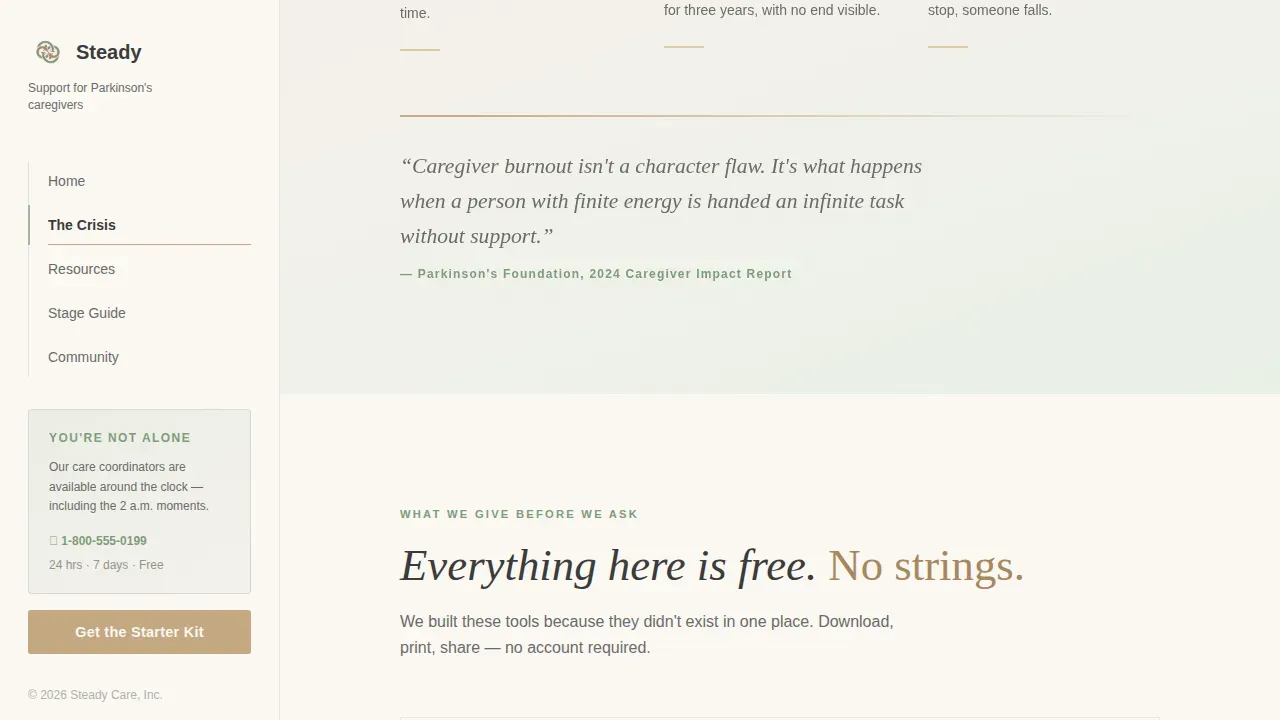
- Generous whitespace in the main column, clay-toned horizontal accent lines between sections, and a sage sidebar border that is barely visible, present but never loud
Mobile & speed optimization
The template is built desktop-first, with the sidebar companion layout designed to collapse gracefully on smaller screens. Care partners often reach for help on a phone, and the layout accounts for that without sacrificing the editorial feel.
- The sidebar collapses into an accessible top-navigation strip on mobile, keeping the resource finder reachable without interrupting the content flow
- Scroll-linked animations use Intersection Observer reveals and staggered fades, built with server components handling static content and client components managing animations and the form
- The single-column mobile view preserves all section content, prioritizing the testimonial card, the stats block, and the download form at the top of the reading order
How this template helps you convert
Every conversion decision in this template is engineered around one principle: give before you ask. The layout earns the click by making the visitor feel seen before it makes any request.
- The hero testimonial card does not lead with a headline or a button, it leads with a voice. By the time a visitor sees the Caregiver Starter Kit call-to-action, they already feel understood, making the form feel like an offer rather than a hurdle.
- The stats section reframes the visitor's exhaustion as a documented crisis with documented solutions. That shift from "am I struggling too much" to "this is real and help exists" removes the hesitation that stops care partners from taking action.
- The sidebar resource finder stays pinned after the first scroll, so the download call-to-action is never more than a glance away, without ever feeling pushy or intrusive.
Other information about this template
The Steady template is designed to serve a Parkinson's caregiver support service in the Health and Medical category, specifically within the Parkinson's Disease Care subcategory. Here is additional context that may be helpful as you evaluate and deploy this template.
- The Parkinson's Foundation provides statistics and resources that align naturally with this template's Stats-First Impact section. The Parkinson's Foundation Helpline is a natural fit for the prominent call-to-action button described in caregiver support best practices, and care partners can reference the Parkinson's Foundation's CareMAP video series for added preparation.
- This template's resource suite supports the kind of practical tips and non medical guidance that professional caregivers and family members need most: daily routines adapted as Parkinson's progresses, proper hydration reminders, fall prevention strategies, and familiar surroundings adjustments.
- Home safety guidance fits naturally within the stage guide cards. Actionable tips include removing throw rugs, installing grab bars, clearing and lighting walkways, using mobility aids such as walkers or bed rails, and maintaining a warm home environment. These changes can prevent falls and make daily tasks safer.
- Parkinson's affects brain cells responsible for producing dopamine, which leads to both motor symptoms such as tremors and involuntary rhythmic movements, and non motor symptoms such as restless legs syndrome, memory issues, and cognitive issues.
- As disease progresses into advanced Parkinson's, palliative care becomes a relevant conversation. The template's stage guide cards create a natural place to introduce palliative care options with calm, supportive language.
- The template supports personalized care plans that adapt as Parkinson's progresses, prioritizing mobility support, routine consistency, and ongoing contact between the care team and healthcare providers.
- Caregiver burnout is a state of physical, emotional, and mental exhaustion. Building a support system of close friends, other caregivers, and organized support groups makes a meaningful difference. Care partners should be encouraged to stay connected with their own health and own well being, not only their loved one's needs.
- The Peterson Foundation for Parkinson's offers Care Partners small group meetings so care partners can build a support system alongside other care partners. It also hosts events like the Navigating the Parkinson's Path Expo, bringing together care partners, healthcare professionals, and advocates. Wellness scholarships for exercise, art, and music therapy are available for individuals and their care partners.
- "Care to Talk" cards are a practical resource for helping care partners plan ahead and start difficult conversations with their loved one, their care team, and healthcare providers.
- This is the steady compassionate parkinson's caregiver support landing page template, built for services that believe supporting a parkinson's caregiver is just as important as supporting the person living with the disease itself.
Theme
Organic Flow
Creative direction
Stats-First Impact
Color system
Cloud Canvas
Style
Sidebar Companion
Direction
Content/Resource
Page Sections
Testimonial Card Hero Header
Animated Stats Impact Block
Starter Kit Download Form
Stage-by-stage Symptom Guide Cards
Persistent Sidebar Resource Finder
Community Voices Testimonials Block
Related questions
Who is this template designed for?
What resources does the template include out of the box?
Can the sidebar layout work on mobile devices?
How does this template handle sensitive caregiver messaging?
Is this template suitable for advanced Parkinson's care services?