PTSD Care Professional Website Template
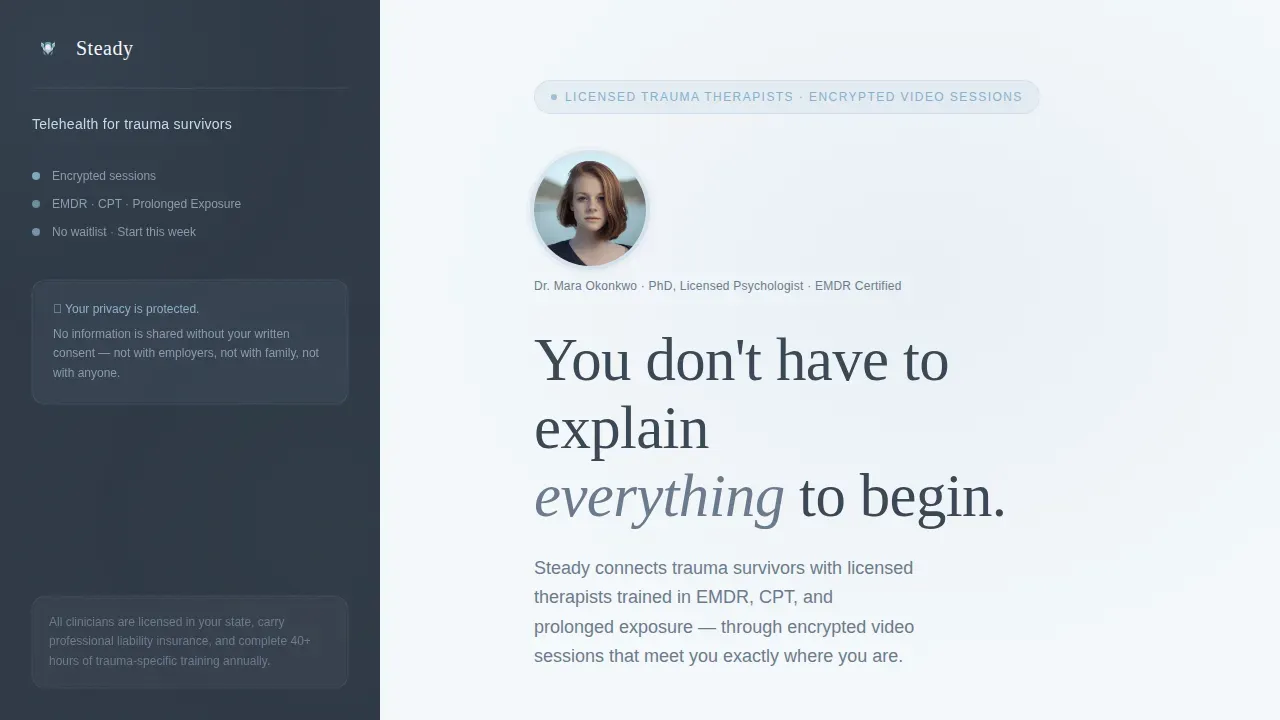
Steady is a sidebar companion landing page template built for trauma-specialized telehealth services. It pairs a portrait-centered hero with a scrolling clinician expert panel, a five-question fit assessment, and a calm Slate and Sky color system. The design helps clients begin their mental health journey without fear or friction, creating a sense of quiet trust from the first scroll.
by Rocket studio
Quick summary
Steady is a single-page sidebar companion template designed for modern PTSD telehealth services. It guides visitors through a portrait-centered hero, a scrolling clinician panel, and a gentle five-question screener. Every design choice aims to calm the user's nervous system and help trauma survivors feel understood before they agree to take any next steps toward care.
Who this template is for
This template is built for licensed trauma therapists and mental health care teams who need a landing page that does more than list credentials. It speaks directly to the people who need it most and makes it easy for them to begin.
- Combat veterans, first responders, and assault survivors who could not sustain in-person therapy
- Mental health practices offering encrypted telehealth sessions with EMDR, Cognitive Processing Therapy (CPT), or prolonged exposure training
- Family members who search for remote care options on behalf of a loved one
What problem this template solves
Many mental health landing pages feel clinical, transactional, or overwhelming. They lead with jargon, rush toward a booking button, and ignore the weight a trauma survivor carries when they first search for help. That approach raises risk of losing the very person who needs care the most.
- Survivors often feel shame or fear when reading pages that read like medical intake forms
- A cold design can signal danger rather than safety, causing visitors to leave before they engage
- Busy, high-friction flows add stress at the exact moment a user needs calm and control
What you get with this template
Steady delivers a complete, ready-to-adapt landing page structure with every essential section pre-built. Clinicians and coaches can read through the layout and understand exactly where their content lives before making a single edit.
- A portrait-centered hero with credential line and anchor statement
- A scrolling sidebar expert panel featuring clinician introductions and short video snippet slots
- A five-question screener embedded in the main content panel, with sidebar reassurance copy alongside it
- A secondary care team path for visitors not ready to self-assess
- A trust and standards section covering encryption, licensing, and clinical credibility
Feature list
A clean description of each built-in feature helps clinicians and coaches evaluate this template before they sign up and begin building.
Portrait-Centered Hero with Credential Display
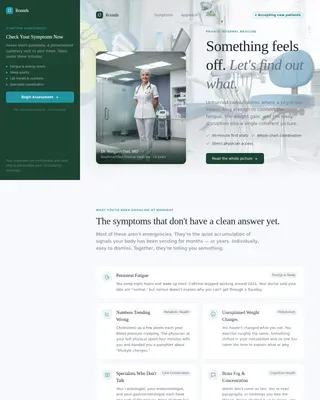
The hero section centers on a single therapist portrait against a soft, desaturated background. A credential line appears beneath in weathered stone type. The anchor statement reads "You don't have to explain everything to begin," setting a calm and unhurried tone before the visitor reads another word.
Scrolling Sidebar Expert Panel
As the user scrolls, the sidebar companion shifts to feature different clinicians. Each clinician has a specialty description, a fifteen-second video snippet slot, and a calm paragraph in the main panel. This model builds trust through accumulated expertise rather than a hard sell, allowing the design to explain trauma responses without escalating intensity.
Five-Question Fit Assessment
The primary call to action, "See If We're the Right Fit," opens a gentle screener embedded in the main content panel. Questions use plain, non-clinical language. Each answer subtly adjusts the sidebar content to reflect the visitor's experience, making the session feel responsive and personal rather than mechanical.
Secondary Care Team Path
A second call-to-action path, "Talk to Our Care Team First," gives visitors who are not ready to self-assess a lower-risk way to begin. No result is pathologizing. Every outcome leads to a recommended next step and a human follow-up within twenty-four hours.
Trust and Standards Section
This section covers encryption details, licensing standards, and clinical credibility indicators. It gives visitors the assurance that their privacy is protected and their care is guided by qualified therapists, which is essential for anyone feeling vulnerable when they first reach out.
Organic Flow Design System
The Slate and Sky color system uses deep therapeutic slate for grounding text and sidebar backgrounds, open-sky blue on interactive elements, and horizon white across content panels. Fraunces serif headings and DM Sans body type work together to hold a calm, readable presence throughout the page.
Page sections overview
| Section | Purpose |
|---|---|
| Hero Portrait Panel | Establish calm trust and anchor the visitor with a direct, human presence |
| Clinician Expert Panel | Build credibility through scrolling clinician intros and short video snippet slots |
| Five-Question Screener | Guide the user toward a low-friction fit assessment in the main content panel |
| Care Team Path | Offer a secondary, low-risk connection point for visitors not yet ready to self-assess |
| Trust and Standards | Communicate encryption, licensing, and clinical safety standards clearly |
| Footer Pattern | Close the page with a clean horizontal flow footer |
Design & branding system
The visual identity follows an Organic Flow theme that feels muted, unhurried, and grounded. The palette shift from deep slate to open horizon white creates the sense of a steady companion walking alongside you rather than pushing from behind.
- Deep therapeutic slate (#3B4856) anchors the sidebar and grounding text; weathered stone (#6B7B8D) handles secondary type and dividers; open-sky blue (#89B0CB) signs interactive elements and progress indicators; horizon white (#F4F7FA) fills content panels
- Fraunces serif headings carry the emotional weight of section titles while DM Sans body text keeps body copy clean, modern, and easy to read
- Low-to-medium animation with scroll-linked sidebar transitions and gentle fade reveals keeps the landing page calm without feeling static
Mobile & speed optimization
Mobile optimization is essential for this template because many users search for mental health support on smartphones. The design is desktop-first with a sidebar layout, and it adapts to a responsive mobile stack so the experience remains clean and readable at every screen level.
- The sidebar companion stacks vertically on smaller screens so no content is hidden or hard to reach
- The five-question screener uses a multi-step format with progress indicators to keep the process manageable and reduce cognitive load on mobile users
- Static content is structured for fast initial load, while client-side components power the interactive quiz logic
How this template helps you convert
A well-designed landing page for a PTSD telehealth service must do more than look calm. It needs to guide a vulnerable person toward care without adding stress. Steady achieves this through a sequence that builds understanding step by step.
- The portrait hero and anchor statement immediately shift the emotional register, helping the user feel seen before they begin reading about services
- The clinician expert panel builds credibility gradually, so by the time the visitor reaches the screener, they trust the therapists and understand the model of care
- The dual call-to-action design, "See If We're the Right Fit" alongside "Talk to Our Care Team First," gives every visitor a clear next step matched to their readiness level, improving the overall effectiveness of the page
Other information about this template
Steady is the steady trusted ptsd telehealth landing page template built specifically for modern mental health practices serving survivors of trauma, violence, or crisis. Telehealth has begun to fundamentally change the conversation around access to mental health care for veterans and first responders. Telehealth reduces stigma by allowing clients to seek care privately from any location. Social support is one of the most protective factors against suicide risk, and telehealth preserves that support even when geography or scheduling creates barriers.
- Crisis moments can be some of the most intense parts of a client's healing journey. The page includes a visible path to emergency resources, including a prompt to display links to the 988 Suicide and Crisis Lifeline, so safety is never a search away
- Insurance and payment transparency sections, medication notes, and consent language can be added to the trust panel to address remaining financial and legal questions clients bring
- No-code tools and modern no-code platforms allow mental health coaches and therapists to adapt this template without programming skills, enabling rapid updates based on real user feedback
- The design is sharing-friendly: clean open-graph metadata and a clear page description make it easy to share the landing page across digital health networks



Theme
Organic Flow
Creative direction
Expert Panel
Color system
Slate & Sky
Direction
Quiz/Assessment
Page Sections
Portrait-centered Hero Section
Scrolling Clinician Expert Panel
Five-question Fit Screener
Dual Call-to-action Path
Trust and Standards Section
Organic Flow Sidebar Layout
Related questions
Does this template include the quiz logic or just the visual layout?
Can therapists and coaches customize the clinician panel with their own video content?
How does this template handle crisis and emergency situations?
Is this template suitable for a solo therapist or only for group practices?
What makes this landing page different from a generic health template?