Land & Environmental Agency Specialist FAQ Website Template
Steward is a modular card-grid landing page built for federal fish and wildlife agencies. It opens with a founding-era manifesto on deep service navy, then routes visitors through expandable FAQ card sections covering permitting, conservation programs, law enforcement, and species data. A regional office finder and Federal Register alert subscription complete the resource hub experience.
by Rocket studio
Quick summary
Steward delivers an authoritative wildlife landing page for federal fish and wildlife agencies. The design feels like a field guide carried in a warden's vest, worn, certain, and immediately useful. Every card is a door to a permit, a refuge, a regulation, or a conservation plan. No locked pages. No wasted scrolling.
Who this template is for
This landing page was built for agencies and professionals who work at the intersection of federal law and wild landscapes. It handles the full range of users who arrive with specific, urgent questions.
- State wildlife officers seeking cooperative agreements and enforcement resources
- Private landowners navigating habitat conservation plans and federal permit requirements
- Graduate researchers pulling endangered species data and Code of Federal Regulations citations
- Hunters and anglers checking federal waterfowl season dates and public lands access
What problem this template solves
Federal wildlife websites often bury critical information behind navigation systems designed for administrators, not field users. A warden in the field or a landowner trying to draft a management plan should not have to hunt for answers. This page solves that by putting every common question one card-click away.
- Visitors arrive with specific questions and leave without finding answers on cluttered agency pages
- Permit applicants, researchers, and officers waste time navigating pages not built around their actual tasks
- Conservation programs, law enforcement resources, and species data live in separate silos instead of one findable hub
What you get with this template
You get a fully structured, modular landing page ready to deploy as a wildlife service resource hub. The layout follows a clear "Learn-Do-Plan" framework so every visitor type finds their next step fast.
- A manifesto hero section with four immediate action cards and a gold-rule divider
- Three FAQ card grid sections covering permitting, conservation programs, and law enforcement plus species data
- A regional office finder with a state dropdown and a Federal Register alert subscription with an email field and topic checklist
- A minimal single-row footer with essential links, copyright, and social icons
Feature list
This page is built around prompt-specified components. Every feature listed below is drawn directly from the project brief.
Quote/Manifesto Hero with Action Cards
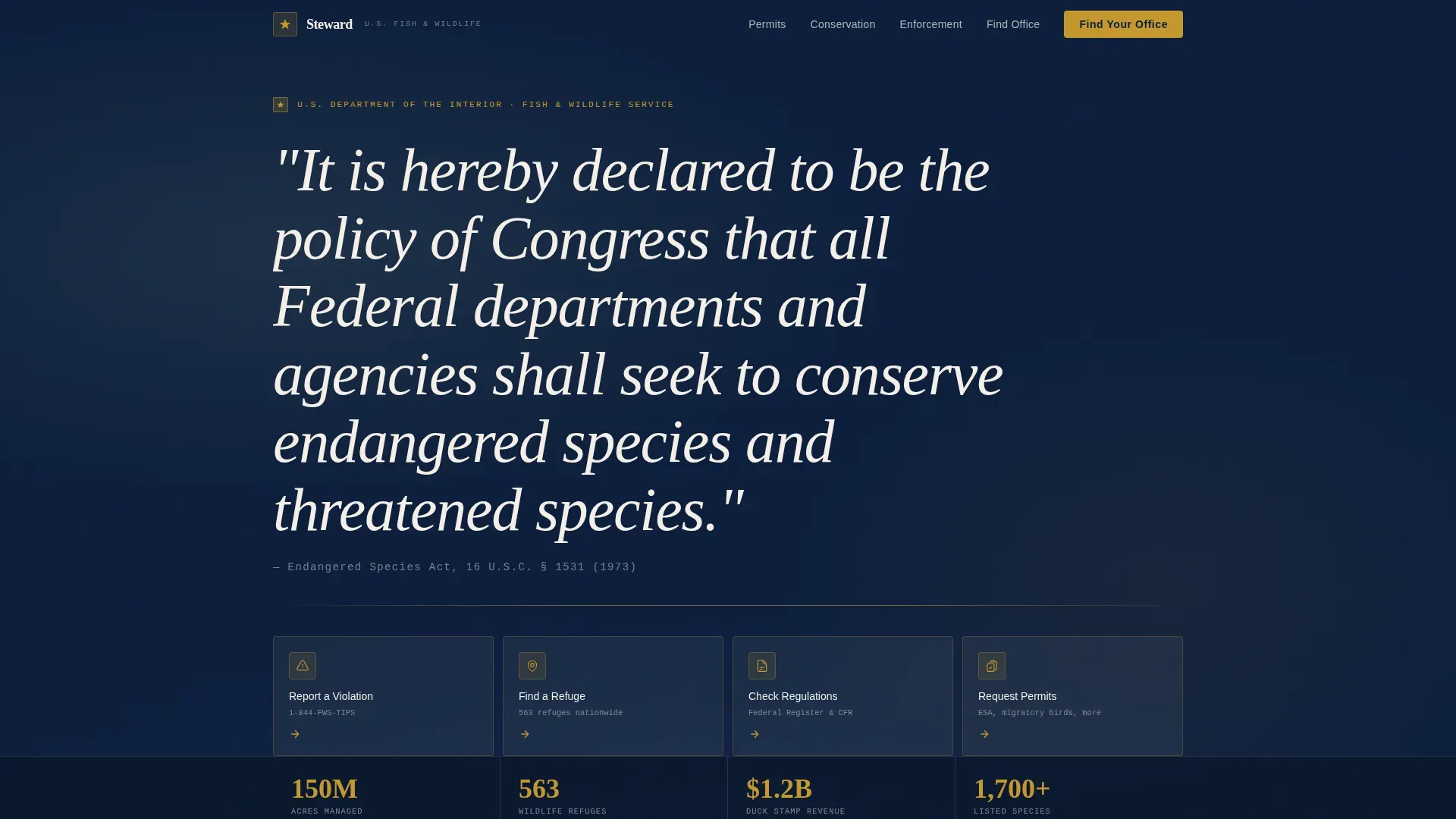
The hero section sets large white text against deep service navy, delivering a founding-era line about the public trust doctrine. A thin wildlife gold rule separates the quote from four action cards: Report a Violation, Find a Refuge, Check Regulations, and Request Permits. Each card carries a simple line icon and a single verb phrase. The manifesto earns trust; the cards earn the click.
Expandable FAQ Card Grid
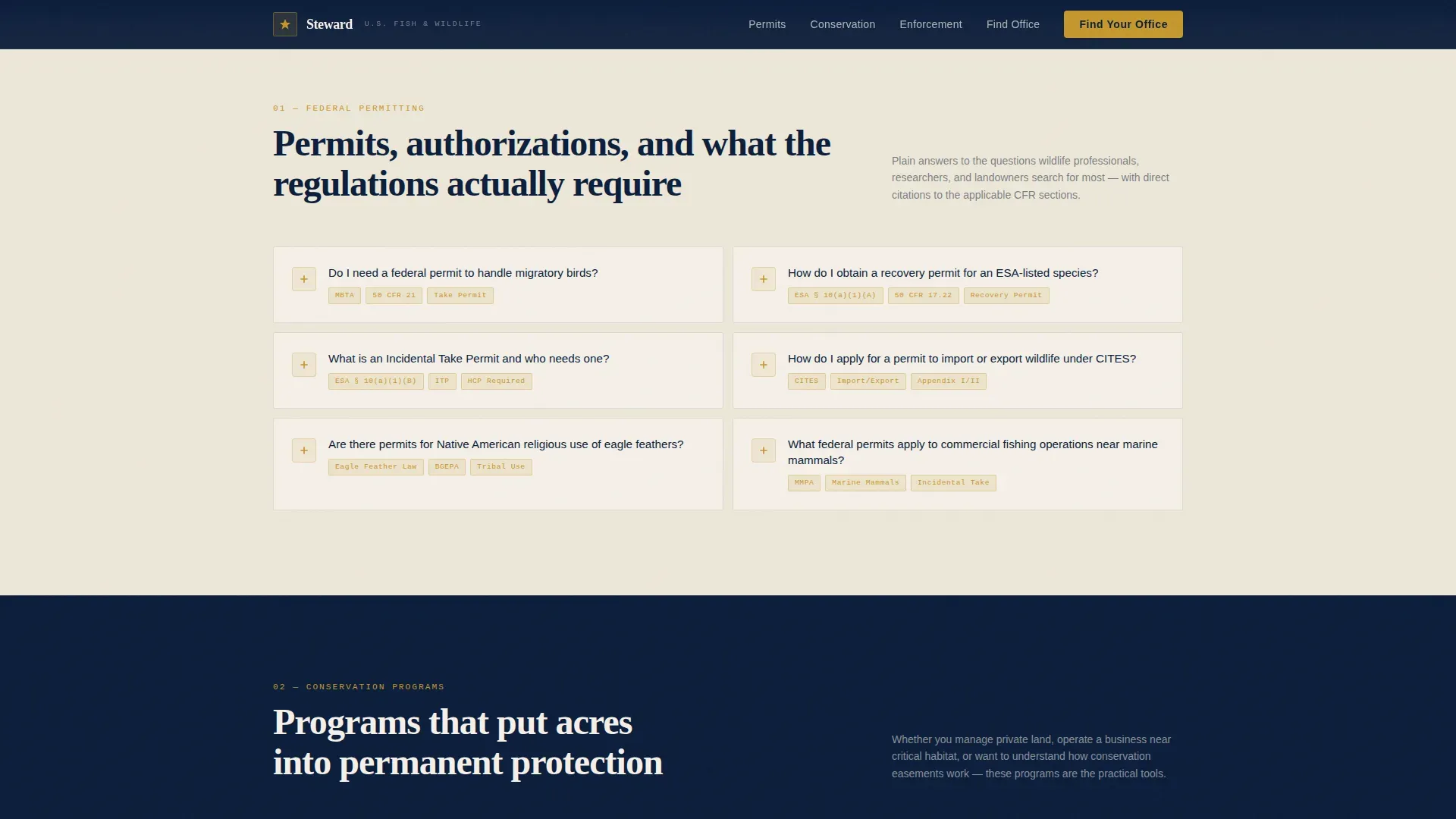
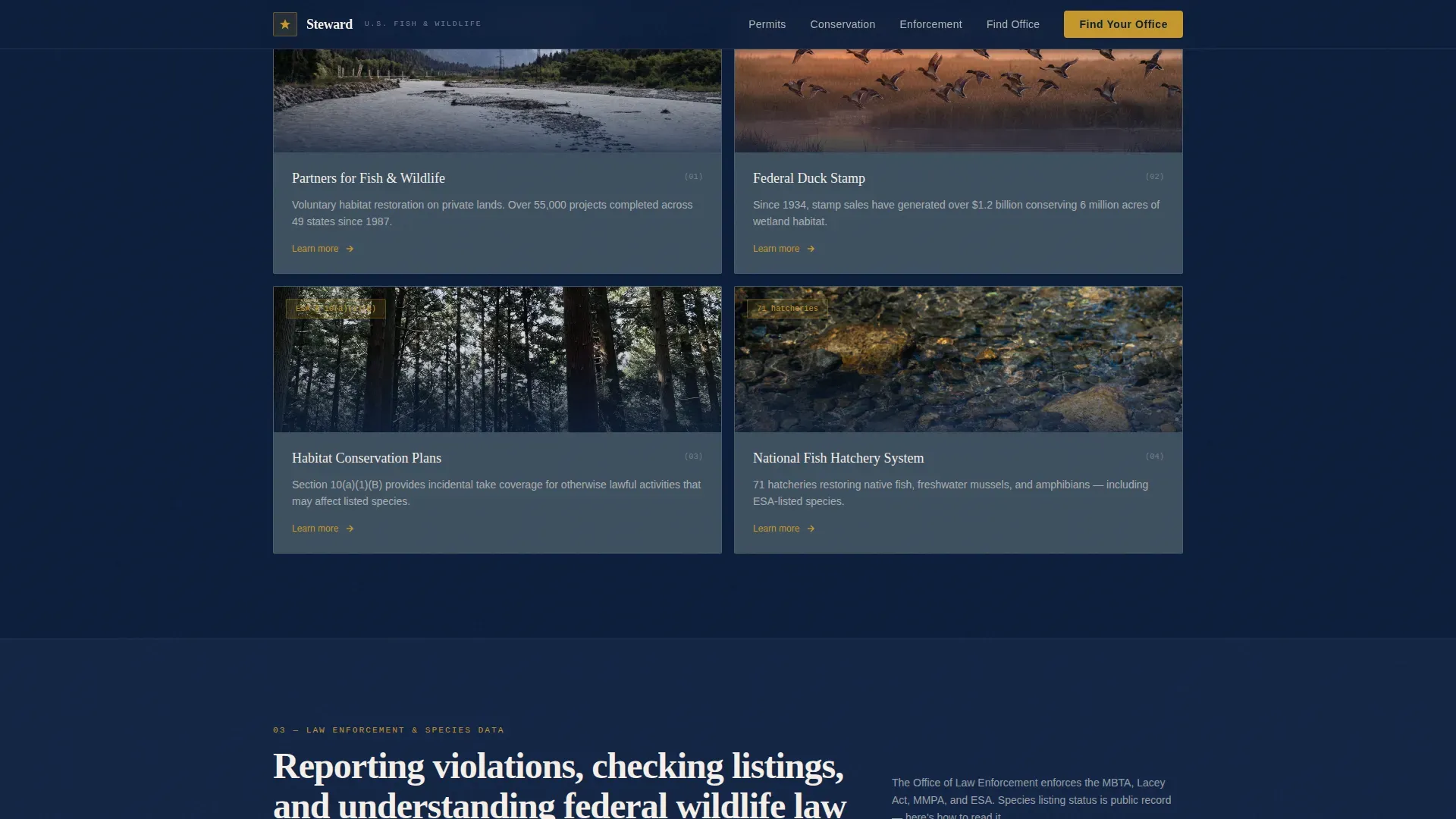
Three modular card grid sections each address a different jurisdiction of concern. Cards expand inline to reveal concise, plainly written answers with embedded links to PDFs, Code of Federal Regulations citations, and regional office contacts. The permitting section answers questions like whether a federal permit is required to handle migratory birds. The conservation section covers programs such as the Duck Stamp and habitat conservation plans. The law enforcement section addresses Lacey Act enforcement and endangered species listings.
Regional Office Finder
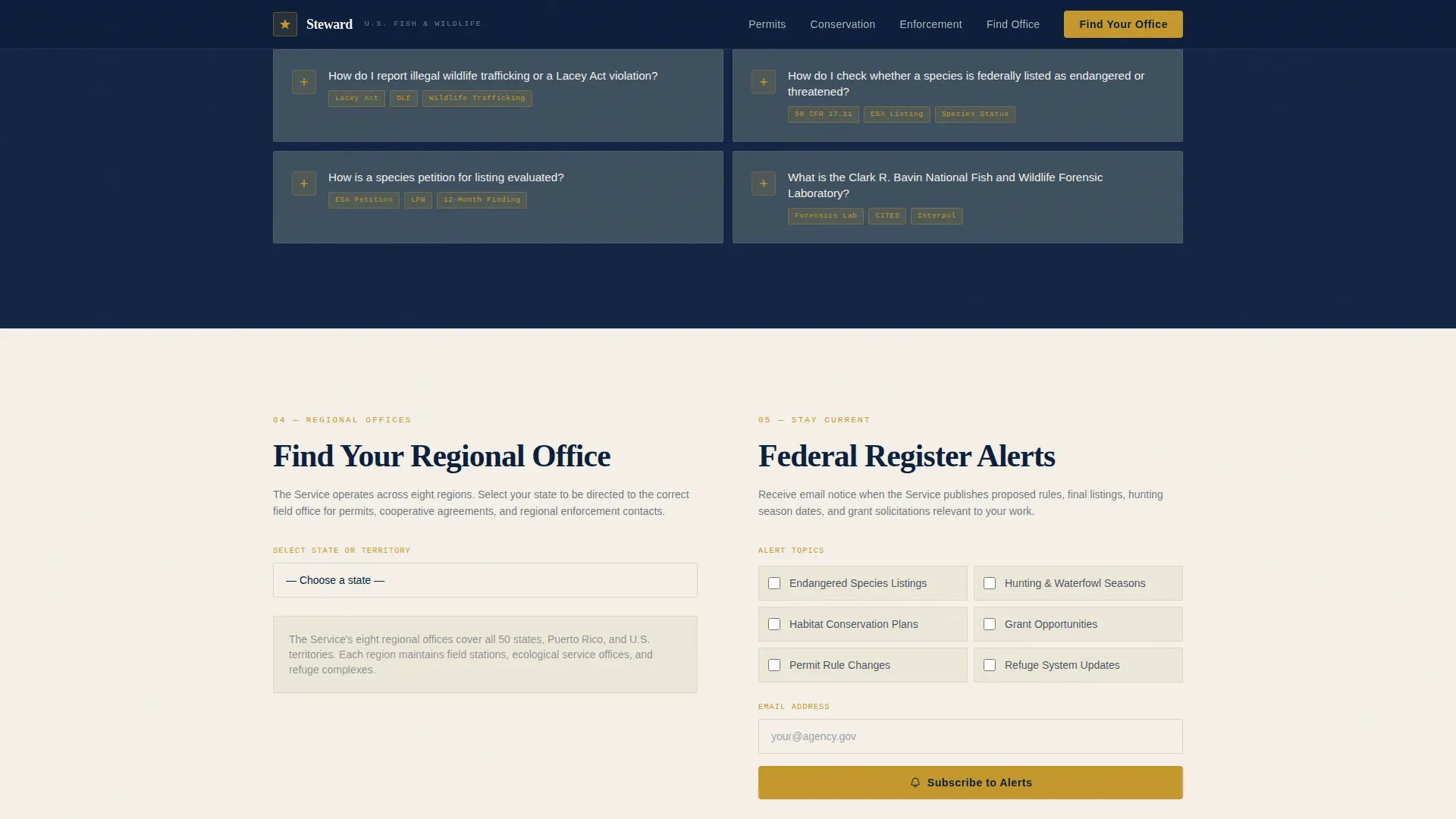
A primary call-to-action section features a state dropdown that routes visitors to the correct field office page. This single interaction replaces a confusing directory and delivers immediate, location-specific wildlife resources. Contact information including physical address details is central to the design, reinforcing the legitimacy of the agency page.
Federal Register Alert Subscription
A secondary conversion path captures an email address alongside a topic checklist. Visitors choose from endangered listings, hunting seasons, habitat plans, and grant opportunities. This section earns ongoing engagement without any persuasion pressure, just easy, useful access to the information people already need.
Institutional Metrics Display
Tangible data validates conservation impact across the page. Figures such as 563 refuges, over 150 million acres managed, and more than 6 million wetland acres conserved give visitors measurable proof of the agency's reach. These numbers appear as trust badges within the layout, functioning as professional accreditation signals.
Page sections overview
| Section | Purpose |
|---|---|
| Manifesto Hero | Founding quote, gold divider, four action cards |
| Permitting FAQ Grid | Expandable cards covering federal permit requirements and CFR citations |
| Conservation Programs Grid | Duck Stamp, habitat conservation plans, Partners for Fish and Wildlife |
| Law Enforcement Grid | Lacey Act resources, forensics lab, endangered species data |
| Regional Office Finder | State dropdown routing to correct field office page |
| Federal Register Alerts | Email subscription with topic checklist for regulatory updates |
| Minimal Footer | Copyright, essential links, and social icons in a single row |
Design & branding system
The visual identity follows an Institutional Authority theme. The palette reads like the brass-and-leather interior of a regional field office, authority without decoration.
- Deep service navy (#0B1D3A) for primary backgrounds, slate uniform gray (#3D4F5F) for card surfaces, parchment white (#F5F0E8) for text fields and open space
- Wildlife gold (#C5972C) reserved exclusively for active states, badges, hover underlines, and critical links, never used decoratively
- Fraunces serif headings for authoritative, slightly worn gravitas; DM Sans body text for legible utility across all card content
Mobile & speed optimization
The page is desktop-first, designed for field office staff and researchers on workstations. Full mobile support ensures wardens and officers can access the page from the field on any device. Responsive design is essential here, a wildlife service page that fails on a smartphone fails the people who need it most.
- Low-to-medium animation profile with card expand and collapse inline, subtle staggered scroll reveals, and gold underline hover states
- Server Components handle static content; minimal JavaScript powers card interactions and the state dropdown router
- Nature-inspired layout stays uncluttered at every screen size so information remains scannable under field conditions
How this template helps you convert
This page earns engagement through immediate usefulness, not persuasion. Every design decision serves the visitor's task first.
- The hero manifesto establishes trust within seconds, and four direct-action cards capture the most common visitor intents before the first scroll
- Expandable FAQ cards answer the exact questions people type into search bars, reducing drop-off and building confidence in the agency's authority
- The regional office finder and Federal Register alert subscription give every visitor a clear next step, whether they need a permit, a plan, or a year of regulatory updates
Other information about this template
This page supports education goals across multiple visitor types. Wilderness education is essential to effective stewardship programs, and this layout can address multiple wildlife management issues across several years of use. An education plan built into the card grid structure means interdisciplinary staff can update individual sections without rebuilding the page.
- Landowners can use this page to explore habitat conservation plan resources and understand what a wildlife habitat management plan requires before contacting a regional office
- Educational content across the card sections can include local species profiles, habitat requirements, and sustainable management practices, keeping the page useful year after year
- Land Management Plans require regular updates, and this page can surface those requirements clearly so landowners and conservation partners stay in compliance
- The Steward authoritative wildlife service landing page template is designed for agencies ready to replace outdated static pages with a living, modular resource hub
Theme
Institutional Authority
Creative direction
FAQ-Driven
Color system
Navy Authority
Style
Card Grid (Modular)
Direction
Content/Resource
Page Sections
Quote/manifesto Hero with Action Cards
Expandable FAQ Card Grid Sections
Regional Office Finder
Federal Register Alert Subscription
Institutional Metrics and Trust Badges
Related questions
Who is this landing page template designed for?
Can landowners use this page to find wildlife habitat management plan resources?
Does the page include a way for visitors to sign up for regulatory updates?
How does the page support the education needs of different visitor types?
What design style does this template use?