Community Hearth Land Management Event Landing Page
The Steward Community Hearth Land Management Event Landing Page Template is built for federal land agencies hosting public meetings. It combines bold serif typography, a warm high-desert color palette, and a focused single-column flow to turn curious visitors into registered attendees. The page guides ranchers, tribal members, conservation groups, and local communities from awareness to action in one clear scroll.
by Rocket studio
Quick summary
This template is a single-column event registration landing page designed for Bureau of Land Management community meetings and similar federal land-use processes. It uses a Community Hearth visual identity to make a consequential public process feel local, accessible, and worth attending. Every section moves visitors from curiosity to registration without confusion or clutter.
Who this template is for
This template was built for government agencies, field offices, and civic organizations that manage public land and need to run organized, inclusive community events. It serves teams who want to protect natural resources and bring diverse voices into the planning process. If you host public meetings where farmers, tribal liaisons, county officials, and first-time attendees all need to feel welcomed, this template was designed with you in mind.
- Land and environmental agency staff organizing federal resource management plan meetings
- Conservation organizations and grassroots groups hosting land stewardship events or public workshops
- Civic professionals who need to develop a clear, trust-building event page quickly
What problem this template solves
Public land meetings often suffer from low attendance because the event page feels bureaucratic, cold, or hard to navigate on a phone in a rural area. Visitors drop off before they find the registration form. The stakes of the meeting are buried in jargon. Communities that should be at the table never show up because the invitation never felt like one.
- Hard-to-read government event pages that bury the date, location, and sign-up form
- No clear sense of why the meeting matters or who belongs in the room
- Registration processes that require too many steps, creating risk of drop-off on mobile devices
What you get with this template
You get a fully structured, single-column landing page that leads visitors through a deliberate Vision and Mission arc. The page begins with WHY the event matters, moves into WHAT will be discussed, explains WHO is invited, and closes with HOW to participate. Each section deepens commitment so that registering feels like the natural next step.
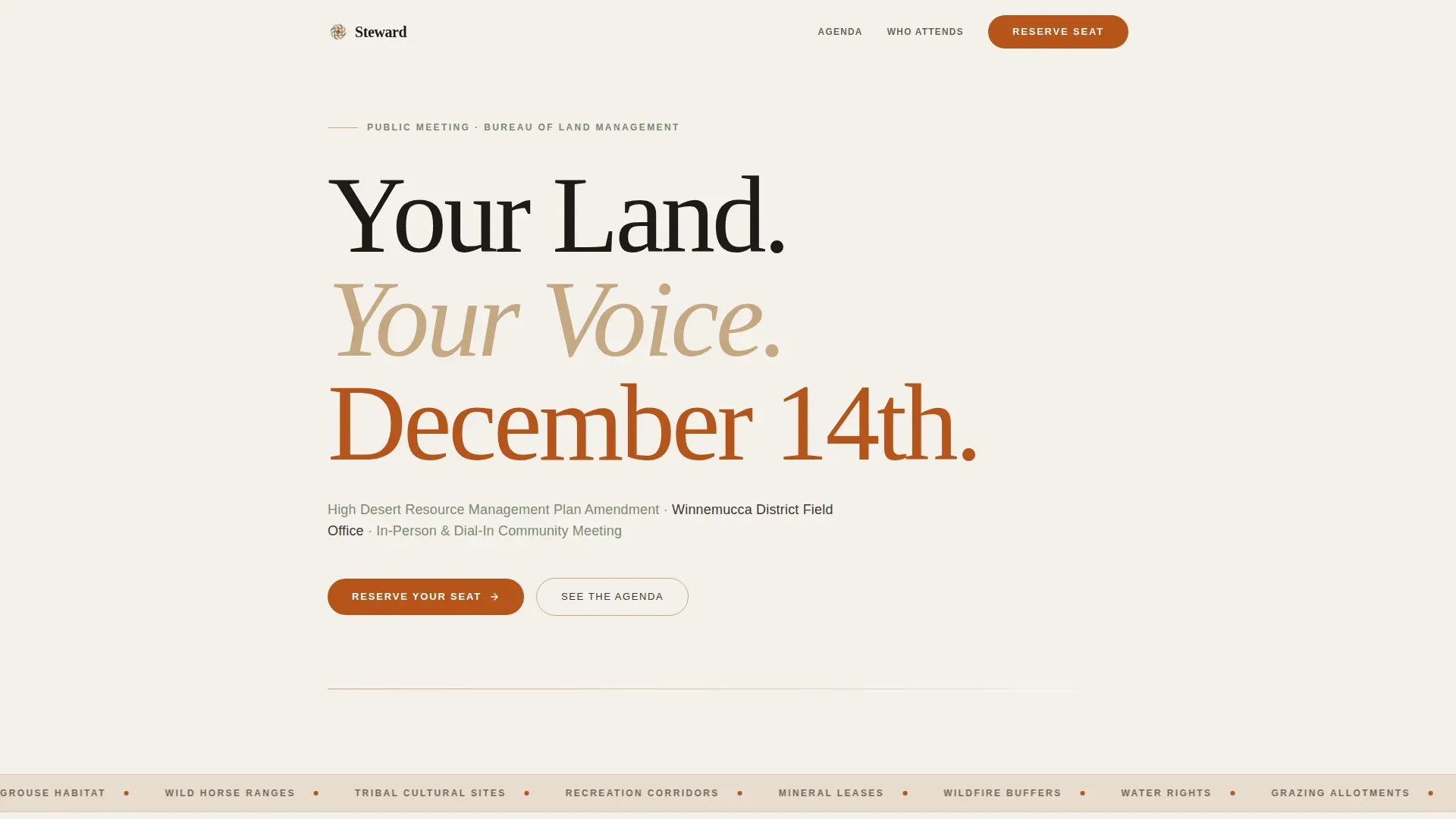
- A hero section with a Giant Headline Left layout using large flush-left serif type, a subtitle line, and no competing imagery
- Four plain-language agenda topic cards, a warm inclusion section, and a dual-path registration block with both a form and a phone dial-in option
- A footer built on a Linear Single-Row pattern keeping the page clean and focused
Feature list
A paragraph of context: every feature below is grounded in the template prompt and reflects what is actually built into this page. These are real, usable components, not speculative additions.
Giant Headline Left Hero
The hero opens with enormous flush-left serif type scaled so large it reads like chiseled sandstone. A single subtitle line in sagebrush gray-green grounds the headline with the specific resource management plan, field office name, and meeting format. No hero image competes with the type. The typography itself becomes the landscape, capturing the importance of the event immediately.
Agenda Topic Cards
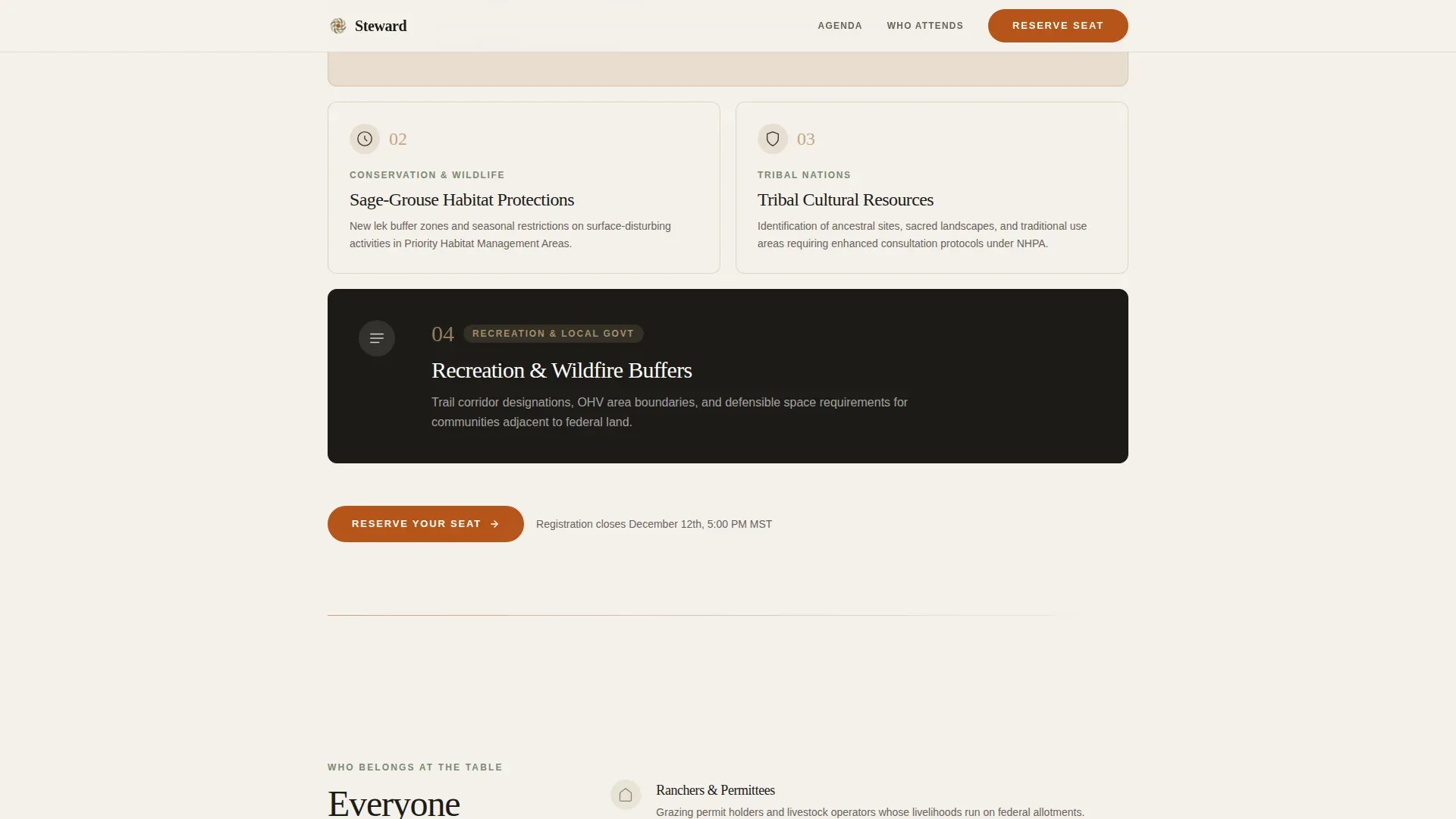
Four plain-language agenda cards present the meeting topics clearly. Each card uses a short label and a supporting icon so visitors can scan the schedule in seconds. This format helps ranchers, conservation professionals, and first-time attendees understand exactly what will be addressed before they decide to register.
Dual-Path Registration Block
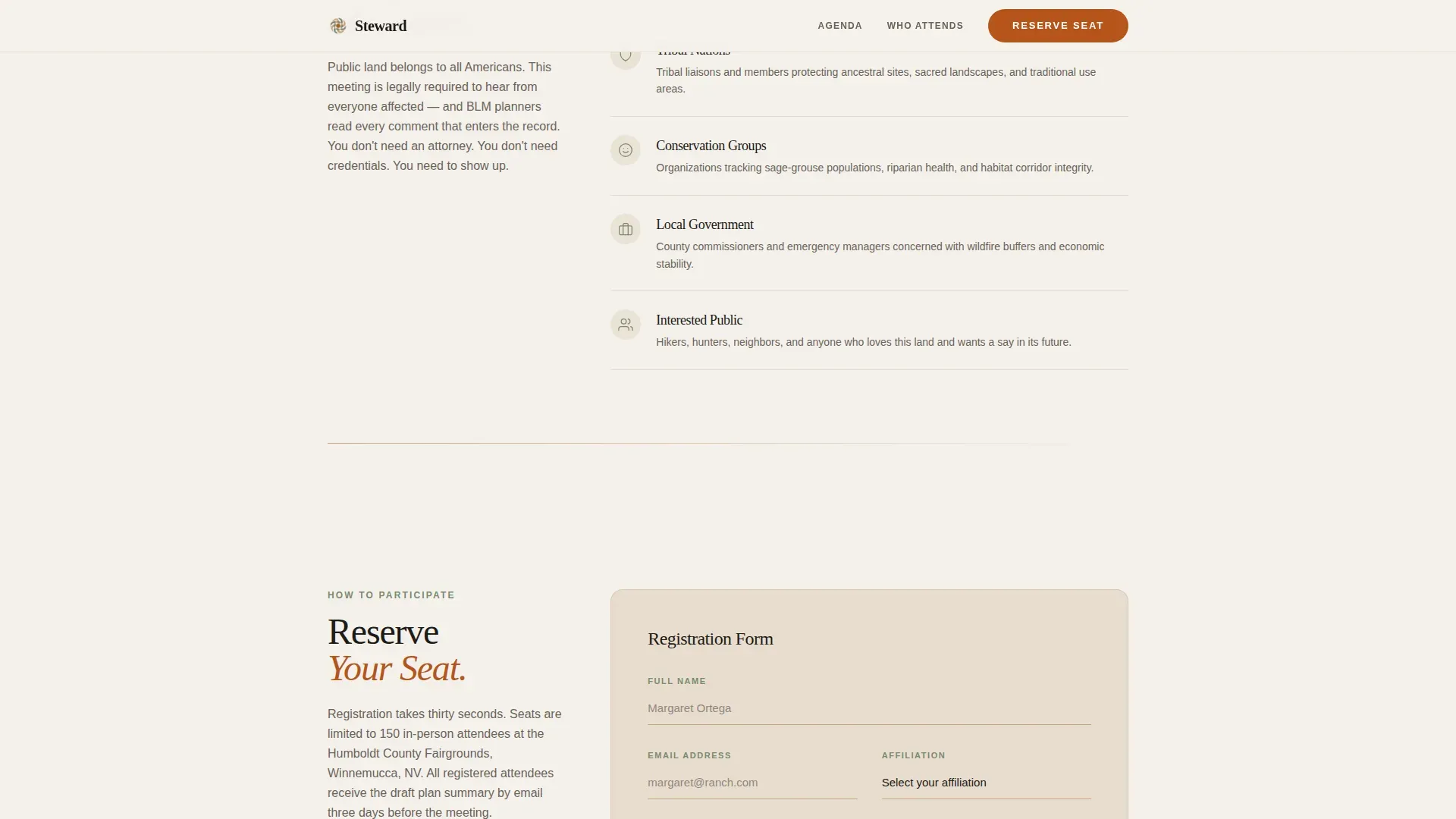
The registration form collects full name, email, affiliation type via a dropdown, and an optional field for a written comment or question submitted in advance. A secondary path displays a dial-in number and access code for rural attendees without broadband. Both paths are visible on the same screen so no visitor feels excluded.
Inclusion Section with Affiliation Icons
A warm paragraph affirms that ranchers, recreationists, tribal members, county commissioners, conservation organizations, and first-time participants all belong at this meeting. Affiliation icons reinforce the message visually. This section directly addresses the risk of low attendance by making every visitor feel personally invited.
Community Hearth Color System
The Cloud Canvas palette uses open sky white for the background, mesa sandstone for section dividers and pull-quotes, sagebrush gray-green for body text and secondary labels, and hearth ember reserved exclusively for call-to-action buttons and urgent callouts. The result is a page that feels warm and unhurried while still directing the eye where action lives.
Repeated Ember call to action Anchors
The primary "Reserve Your Seat" call-to-action button appears in hearth ember after the agenda section and again anchored at the page bottom. Repeating the call-to-action at key scroll moments is a proven method for implementing higher registration rates without overwhelming the page with competing prompts.
Page sections overview
| Section | Purpose |
|---|---|
| Hero Headline Block | Establishes date, event identity, and immediate visual impact |
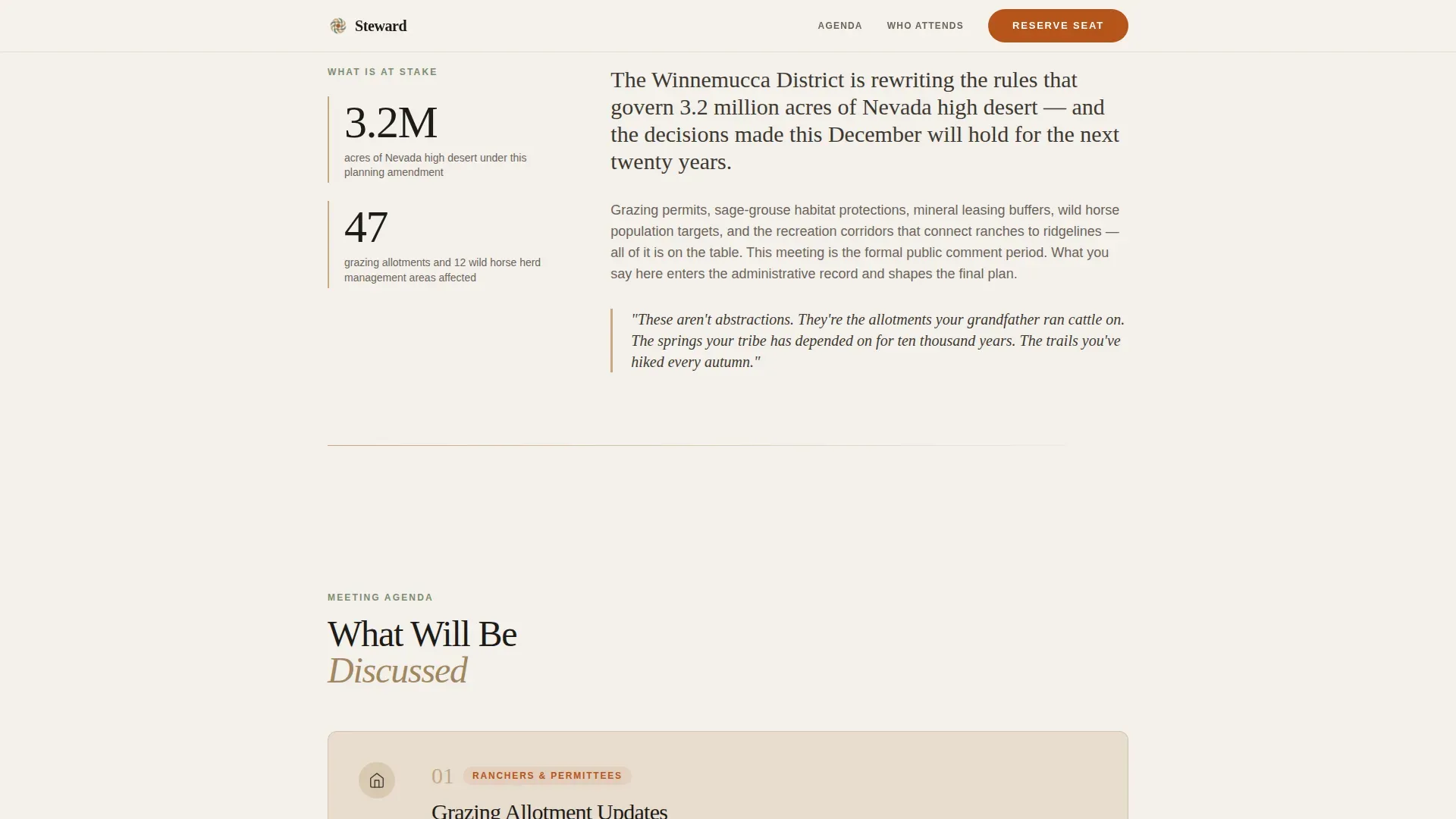
| Stakes Story Block | Explains why this land meeting matters in two sentences |
| Agenda Topic Cards | Presents four discussion topics in plain, scannable language |
| Who Belongs Section | Affirms all affiliation types are welcome at the table |
| Registration Form Block | Collects name, email, affiliation, and optional advance comment |
| Phone Dial-In Path | Provides access for rural attendees without broadband |
| Page Footer | Closes with field office details in a Linear Single-Row pattern |
Design & branding system
The template uses the Community Hearth theme, a typographically led design language built for civic trust and warmth. Fraunces serif handles all headlines, creating a sense of weight and permanence that reflects the gravity of land-use decisions. DM Sans handles body copy, keeping long paragraphs readable and approachable. Together they give the page a voice that feels both official and human.
- Cloud Canvas palette: #F4F1EC background white, #C4A882 sandstone for dividers, #7A8B6F gray-green for body text, #B5541B ember for buttons only
- Sandstone anchors section breaks and pull-quotes; gray-green softens secondary labels; ember draws attention only where action is required
- Animation is set to low-medium intensity with subtle scroll reveals and no distracting motion, keeping focus on content and registration
Mobile & speed optimization
Rural attendees often visit this page on a phone with a variable connection. The template is built desktop-first with a strong mobile fallback so the registration form, phone dial-in path, and agenda cards all reflow cleanly on small screens. Server Components handle static sections, and JavaScript is kept minimal to support fast load times in areas with limited bandwidth.
- Single-column flow naturally collapses to mobile without layout breakage or hidden call-to-action buttons
- The registration form asks only for essential fields, reducing friction and keeping the process fast on touch devices
- The phone dial-in path is always visible alongside the form so rural visitors never have to search for an alternative access option
How this template helps you convert
This page is built around the principle that understanding leads to action. Visitors who grasp what is at stake, who is invited, and what will be decided are far more likely to register than visitors who encounter a generic government notice. Every design and copy decision on this page serves that goal.
- The benefit-driven Giant Headline Left hero captures the "why" immediately, so visitors understand the importance of the event before they read a single body paragraph.
- The four agenda cards reduce uncertainty by showing exactly what will be discussed, making it easier for ranchers, tribal liaisons, and conservation professionals to decide they belong in the room.
- Two visible registration paths, a form and a phone line, mean no attendee is turned away by a technology barrier, which directly increases the number of communities that can participate.
Other information about this template
This template is a strong fit for any agency or organization working within frameworks like the Conservation Stewardship Program (CSP), which helps producers improve grazing conditions and develop wildlife habitat through annual payments for implementing conservation practices on land. The Rural and Family Lands Protection Program (RFLPP) is another example of a program designed to protect important agricultural lands through conservation easements, and meetings organized around such initiatives align naturally with the template's vision and structure.
The page can support events tied to a wide range of land stewardship contexts. For example, initiatives like the Florida Land Steward Program encourage private landowners to manage their land resources for long-term benefits. Similarly, organizations like the Feather River Land Trust protect ecologically and culturally important landscapes while connecting children to nature through place-based education and stewardship experiences. Projects that develop local food systems, organize farmers and farm workers, or create job training for new food workers can all use this template to build trust and drive registration.
The USDA and related agencies, including USDA Natural Resources Conservation Service (NRCS), offer technical assistance at no cost to help producers make informed decisions. The CSP program represents a commitment to conservation with contracts lasting five years, with opportunities for renewal. CSP participants implement practices that protect wildlife habitat, improve soil health, and deliver cleaner water and air across the country. Programs like these generate related news and public interest that make community events like this one consequential and well-attended.
- This template can support events in other states beyond the American West, wherever federal land agencies or conservation organizations hold public meetings
- It works for workshops, training sessions, certification courses, and public comment events tied to land management plans
- Donations, sponsorships, and partner logos from supporting organizations can be added to trust-indicator sections without altering the core layout
- The page structure allows event organizers to explore ideas for future agendas, add data points about planning area acreage, or include related news links in the footer
Theme
Community Hearth
Creative direction
Vision & Mission
Color system
Cloud Canvas
Style
Single Column Flow
Direction
Event Registration
Page Sections
Giant Headline Left Hero Block
Plain-language Agenda Cards
Dual-path Registration Block
Warm Inclusion Section
Community Hearth Color and Type System
Repeated Ember Call to Action Anchors
Related questions
Can I customize the agenda cards and registration form fields?
Does the template support attendees without reliable internet access?
Is this template only for Bureau of Land Management events?
How does the page guide visitors toward registering?
Can this template be adapted for recurring events or a multi-session program?