Federal Public Lands Authority Landing Page Template
The Steward template is a split-screen landing page built for federal public lands agencies. It leads with monumental data, 423 national parks, 85.1 million acres, $14.2 billion in economic impact, and pairs every figure with a land photograph. The page is designed to convert municipal directors, state officers, and tribal land managers into partnership consultation requests.
by Rocket studio
Quick summary
Steward is a stats-first, split-screen landing page template for a federal public lands authority. It establishes institutional trust through data before asking anything of the visitor. Each scroll reveals a new pairing of hard conservation figures and vivid land imagery. The site is built to generate partnership leads from professionals who manage, fund, and steward public lands at every level of government.
Who this template is for
This template serves land management professionals who work across federal, state, and local levels. If you need a site that communicates authority and opens a clear path to formal partnership, Steward was designed for exactly that work.
- Municipal parks directors seeking federal grant alignment and program coordination
- State recreation officers navigating compliance frameworks and co-management terms
- Tribal land managers coordinating co-stewardship agreements with federal agencies
- Nonprofit conservation partners and grant-seeking regional organizations
What problem this template solves
Federal agencies managing public lands carry enormous responsibility. Yet many existing sites bury the data that proves their scope, making it harder for partners and stakeholders to understand what collaboration actually looks like. Steward fixes that.
- Visitors arrive at a site that leads with evidence, not introductions
- The scale of land stewardship efforts is communicated before any form appears
- The partnership process feels logical, not transactional, by the time the call to action arrives
What you get with this template
Steward delivers a fully structured single-page layout with five core content sections, a persistent call-to-action bar, and a dual-path lead generation system. Every section is grounded in the same design discipline: data on the left, land on the right.
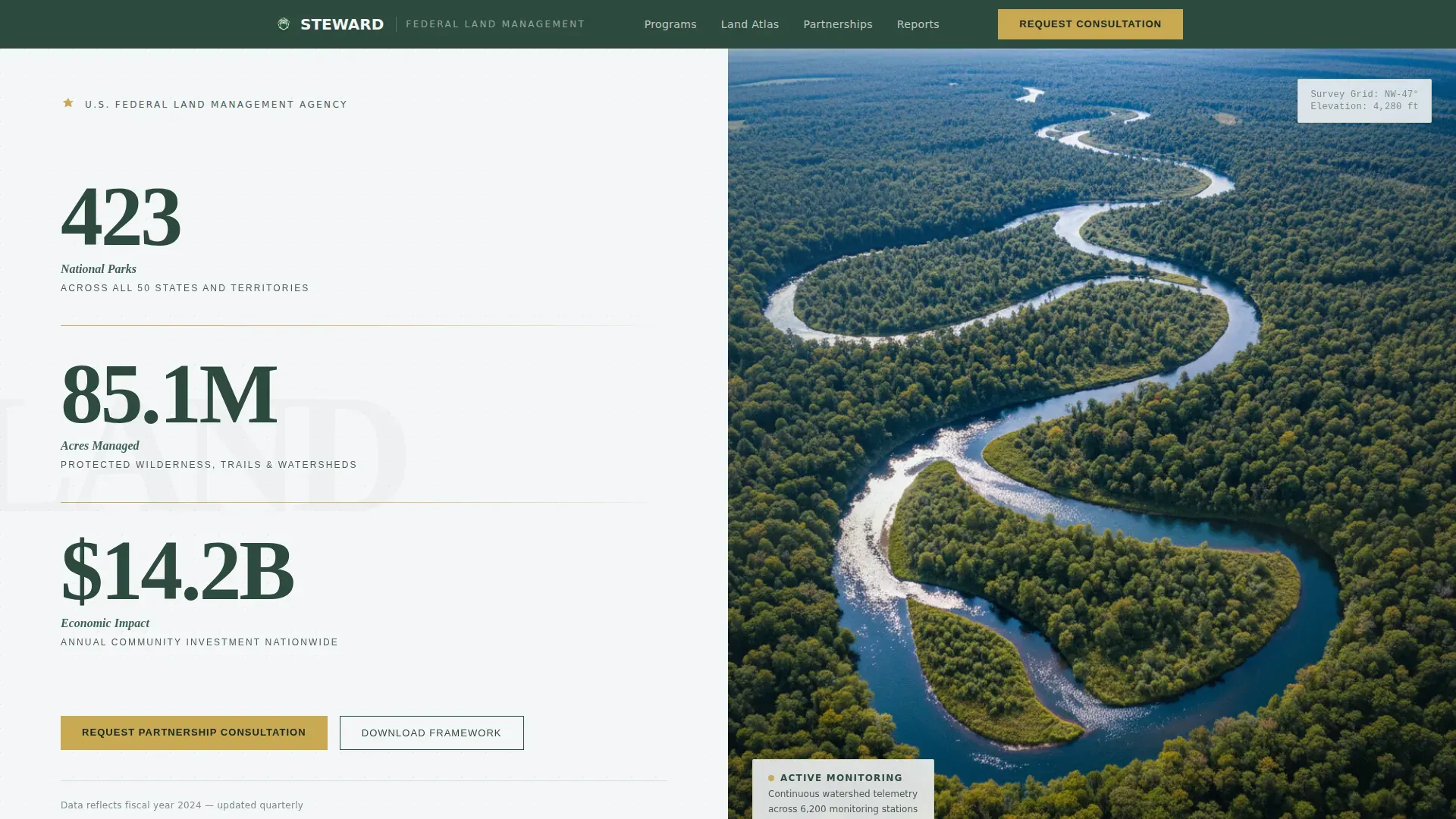
- A stats wall header pairing three monumental figures with an aerial wilderness photograph
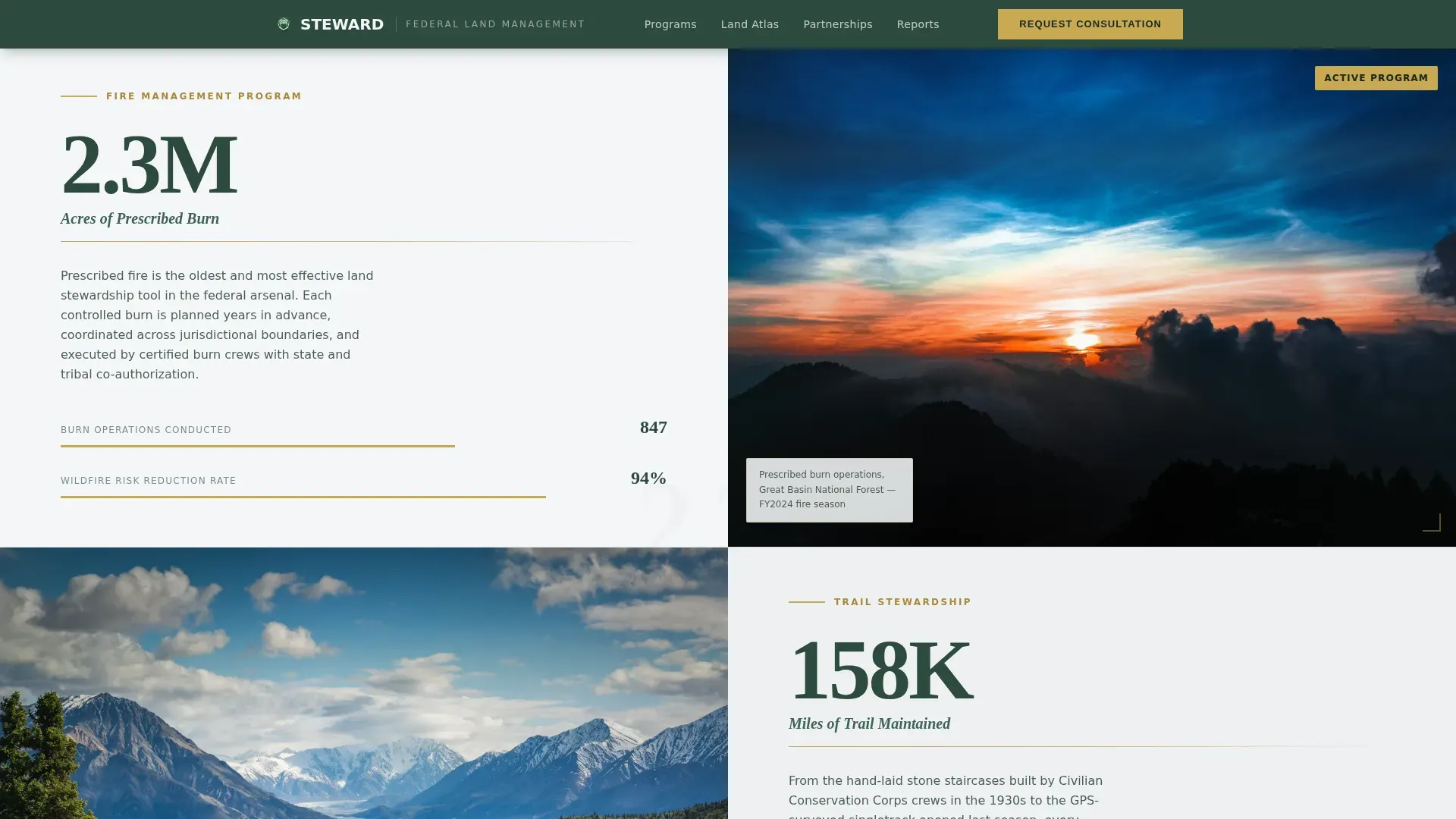
- Scroll-linked section pairs covering prescribed burn acreage, trail miles maintained, and economic impact data
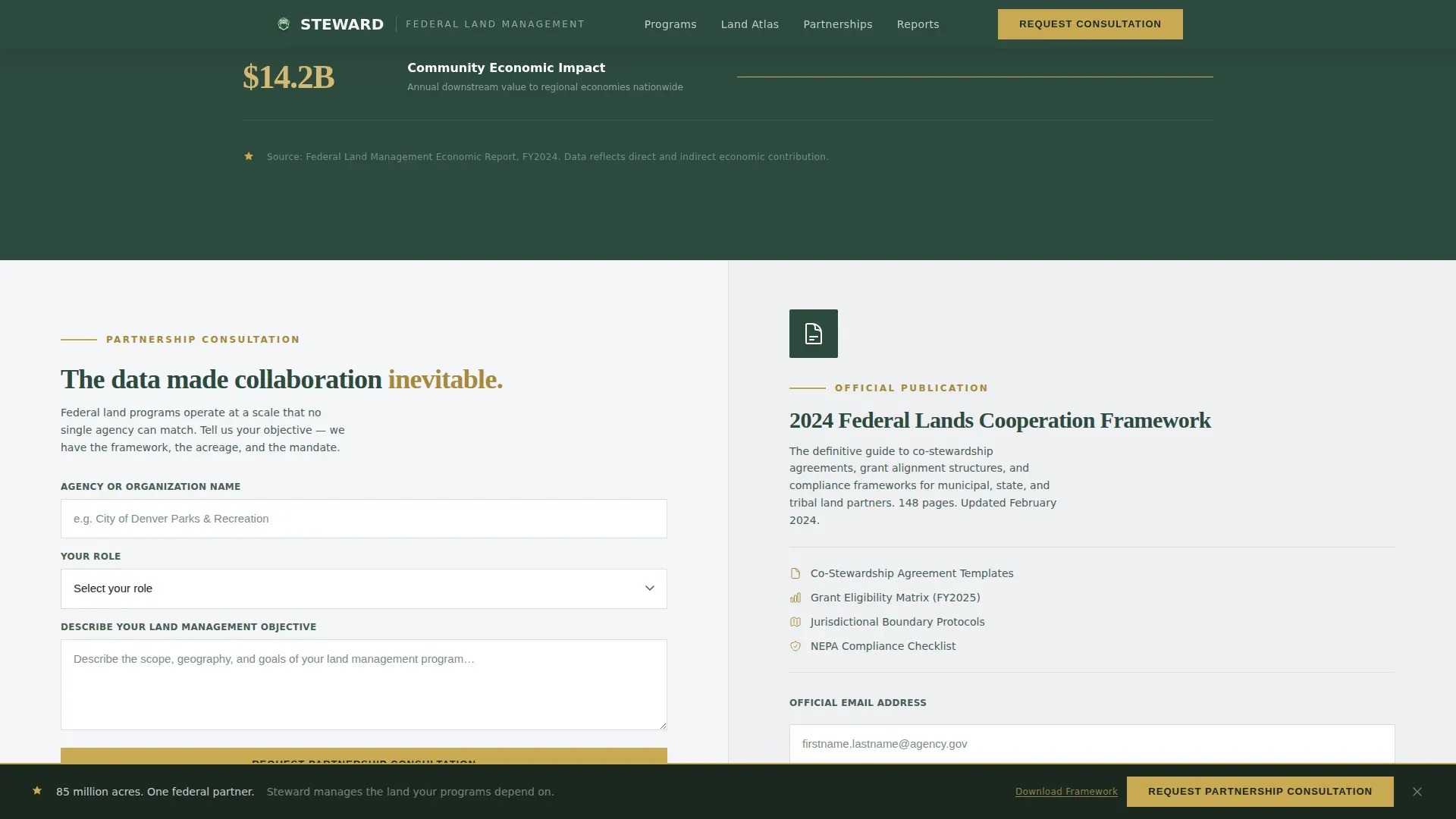
- A partnership consultation form with a role selector and an email-gated framework download
- A persistent bottom bar that appears after the second scroll, anchoring the primary call to action
Feature list
This template is built around a clear set of capabilities drawn directly from the project brief. Each feature supports the site's core goal: providing enough data-backed context that requesting a consultation feels like the natural next step.
Stats-First Split Screen Layout
Every section of this site uses a 50/50 split. Hard conservation data and program figures occupy the left panel. A full-bleed land photograph fills the right. This structure lets visitors absorb information and evidence in parallel, building trust through visual storytelling rather than marketing language.
Monumental Header Data Wall
The opening section presents three oversized figures in serif type: 423 National Parks, 85.1 million acres managed, and $14.2 billion in community economic impact. A thin goldenrod rule separates each figure. No headline competes with the data. The numbers are the authority, and that is exactly how this site earns the visitor's attention from the first moment on the page.
Scroll-Linked Section Reveals
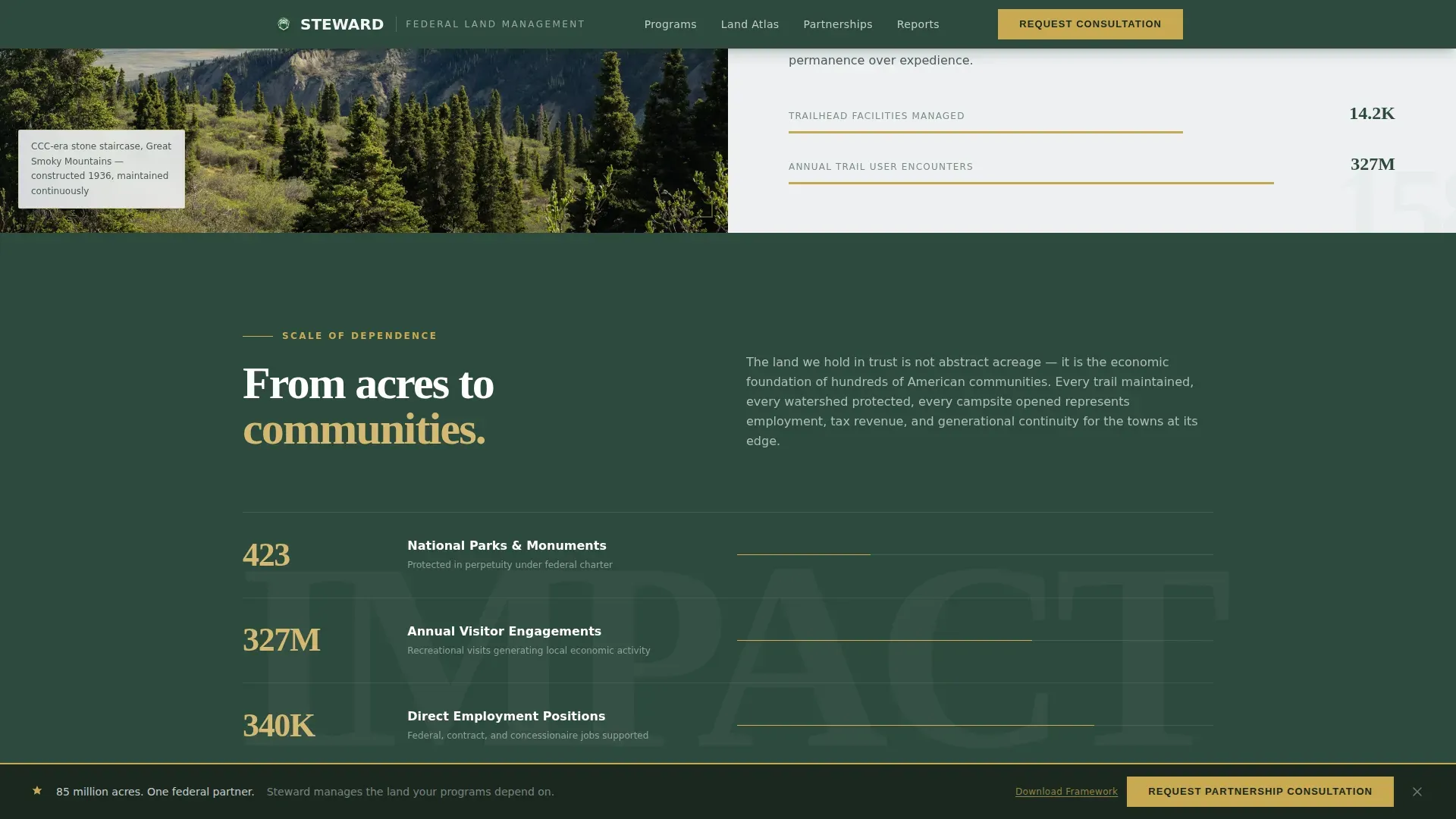
As visitors move through the page, each new data pair animates into place using scroll-linked IntersectionObserver reveals. Staggered stat counters bring figures to life section by section. The sequence is intentional: acres lead to visitors, visitors lead to jobs, jobs lead to communities. By the midpoint, the scope of land stewardship is clear. By the bottom, the case for partnership is made.
Dual-Path Lead Generation System
The page supports two conversion paths without creating friction between them. The primary path collects an organization name, a role selection, and a single open field for the visitor's land management objective. The secondary path offers a downloadable cooperation framework behind a simple email gate. Both paths appear in the same section, giving partners a way to engage at the level they are ready for today.
Persistent Partnership Call-to-Action Bar
A bottom bar reading "Request Partnership Consultation" appears after the second scroll and remains visible as the visitor reads. It is anchored in goldenrod, the only color in the palette reserved for interactive elements. The bar does not interrupt the reading experience. It simply stays available until the visitor is ready to act.
Institutional Authority Design System
The full site runs on the Cloud Canvas color system: cirrus white dominates backgrounds, deep forest green anchors headers and navigation, and muted goldenrod appears only where action is needed. Fraunces serif handles the monumental data figures. DM Sans handles body text and navigation. The result is a site that feels like an official document produced on heavy stock and stamped with an embossed seal.
Page sections overview
| Section | Purpose |
|---|---|
| Stats Wall Header | Opens with three monumental public lands figures paired with aerial wilderness photography |
| Prescribed Burn Section | Pairs prescribed burn acreage data with a controlled fire photograph |
| Trail Stewardship Section | Shows trail miles maintained alongside a historic CCC stonework image |
| Economic Impact Section | Cascades jobs-to-communities data in a full-width visualization |
| Partnership Form Section | Hosts the consultation request form and the email-gated framework download |
| Footer | Single-row linear footer with navigation links and agency information |
Design & branding system
The visual identity follows an Institutional Authority theme. Every design decision reinforces the feeling of a well-resourced federal agency that has been doing this work for years and will continue doing it long after any single administration ends.
- Cloud Canvas palette: cirrus white (#F4F6F8) for backgrounds, overcast gray (#B0BEC5) as a secondary surface, deep forest green (#2E4A3E) for headers and navigation, and goldenrod (#C8A951) reserved strictly for badges, seals, and interactive elements
- Fraunces serif for monumental data figures; DM Sans for body copy and navigation, consistent with federal design conventions
- The u.s flag and official seal aesthetic informed the embossed, document-weight feel of the overall design system
Mobile & speed optimization
The template is built desktop-first, reflecting the reality that municipal directors, state officers, and tribal liaisons typically work from agency workstations. A responsive mobile fallback is included so the site remains usable on smartphones when needed.
- Server Components handle all static sections for faster initial load; Client Components are scoped to the form and animation layers only
- Scroll-linked animations use IntersectionObserver, keeping the interaction layer lightweight and the reading experience smooth
How this template helps you convert
Steward earns every lead before asking for one. The page is structured so that by the time a visitor reaches the partnership form, the data has already made the case. The call to action feels like a logical completion of what the site started, not an interruption.
- The stats wall establishes federal scale immediately, so the visitor understands the level of conservation resources and program reach behind any partnership they are considering
- Each scroll deepens the evidence, connecting land condition data to real community results, which builds the confidence needed to submit a formal consultation request
- The dual-path form lets visitors choose their own level of engagement, reducing hesitation and increasing the chance that every type of partner finds a way to respond today
Other information about this template
This template is a strong match for any team exploring how to position a federal land stewardship program online with clarity and institutional weight. The design and structure align with several well-established standards and real-world conservation contexts worth knowing.
- The Conservation Stewardship Program (CSP), administered with support from the United States Department of Agriculture (USDA), is an example of the type of program this site format can represent. CSP provides financial and technical assistance to landowners to develop conservation plans and is the largest conservation program in the country. Participants can receive annual payments for implementing conservation practices over a typical five-year contract, with opportunities for renewal based on results.
- Community Land Trusts (CLTs) are nonprofits that steward land and property to serve lower-income community members. CLTs retain land ownership and agree to long-term ground leases, using restrictions on resale prices to keep property affordable for years to come. Local governments and CLTs have partnered to produce sustained community benefits, as cases like the St. Joseph Community Land Trust in South Lake Tahoe show.
- Volunteer site steward programs assist in monitoring the condition of archaeological sites, trails, and historic structures. Partnerships that recruit, train, and oversee volunteer site stewards benefit public lands resources. Recognizing volunteer contributions regularly helps make these efforts rewarding and sustainable.
- Public lands in the United States are managed by nearly 15,100 agencies and nongovernmental organizations. The Bureau of Land Management (BLM) reports to the Department of the Interior and partners with a variety of organizations to enhance stewardship. The PAD-US database contains more than three billion public land and marine acres and allows users to explore land boundaries and designations by type.
- The U.S. Fish and Wildlife Service (USFWS) promotes conservation of public lands through various initiatives. Federal sites are expected to follow the U.S. Web Design System (USWDS) for typography and components. A standard USWDS banner should identify the site as an official government entity and link back to the agency homepage. A signed agreement between partner organizations and the federal department can also detail terms of any co-stewardship project at the outset.
- This template is the Steward Federal Public Lands Authority landing page template, purpose-built for the Parks and Recreation Federal Agency niche within the Government and Public category.
Theme
Institutional Authority
Creative direction
Stats-First Impact
Color system
Cloud Canvas
Style
Split Screen (50/50)
Direction
Lead Generation
Page Sections
Stats-first Split Screen Layout
Monumental Header Data Wall
Scroll-linked Section Reveals
Dual-path Lead Generation System
Persistent Partnership Call-to-action Bar
Institutional Authority Design System
Related questions
Who is the primary audience for this template?
What lead generation paths does the template include?
Can this template support a program involving volunteer site stewards?
How does the split-screen layout work across all sections?
Is this template suitable for co-stewardship and tribal partnership contexts?