Public Lands Consultation Landing Page Template
The Watershed Public Lands Consultation Event Registration Landing Page Template is built for federal agencies managing rural and tribal watersheds. It pairs an interactive SVG watershed map with a transparent consultation pipeline, helping county resource managers, tribal environmental directors, and nonprofit land trusts find open sessions, track comment periods, and register before regulatory windows close.
by Rocket studio
Quick summary
This template gives federal land management agencies a map-first, process-transparent landing page for public consultation events. Visitors see exactly which watershed regions have open sessions, walk through each stage of the consultation pipeline, and register in a lightweight form before deadlines pass. The design feels grounded, authoritative, and urgently civic without being bureaucratic.
Who this template is for
Federal agencies and their partners need a reliable, legible way to communicate public process deadlines. This template is built specifically for organizations running consultation events tied to public lands, conservation funding, or regulatory comment windows. It respects the expertise of its visitors while making the process fully readable for anyone arriving from a search or a notice link.
The primary users of this template include:
- County resource managers and tribal environmental directors who file cooperative agreements and need consultation schedules in a timely manner
- Nonprofit land trusts and conservation organizations tracking open comment periods before a regulatory window closes
- Program directors and government officials coordinating multi-agency watershed planning events and funding cycles
What problem this template solves
Public lands consultation is often scattered across Federal Register notices, agency portals, and emailed PDFs. Visitors with legitimate standing, resource managers, tribal directors, local governments, and land trusts, struggle to find the right session, confirm a deadline, and register without confusion. The process feels opaque even when it is legally open.
This template removes that friction directly:
- It replaces scattered notices with a single, map-filtered event list so visitors land on the right watershed session immediately
- It shows every stage of the consultation pipeline before asking for a single form field, building the civic confidence that the process is responsible and the deadline is real
- It reduces the drop-off caused by confusing multi-step government portals by keeping the registration form minimal: name, organization affiliation, watershed region, session date, and email
What you get with this template
The template delivers a fully structured, single-page layout organized around transparent process and filtered event discovery. Every section serves a practical function for the user and moves them toward registration with clear context at each scroll step.
Included layout components and features:
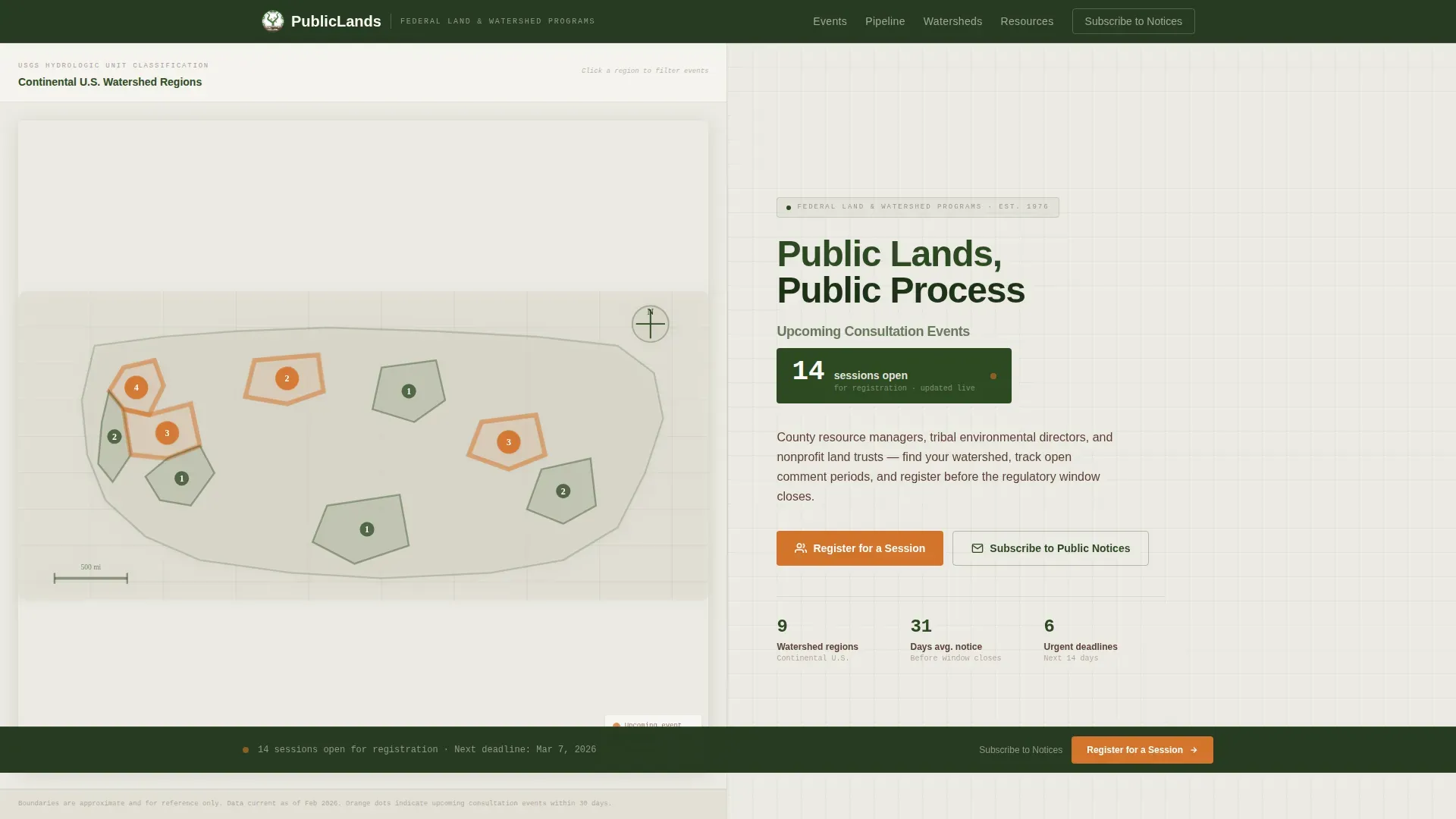
- A split-screen hero (50/50) with an interactive SVG watershed map on the left and a live event count headline on the right
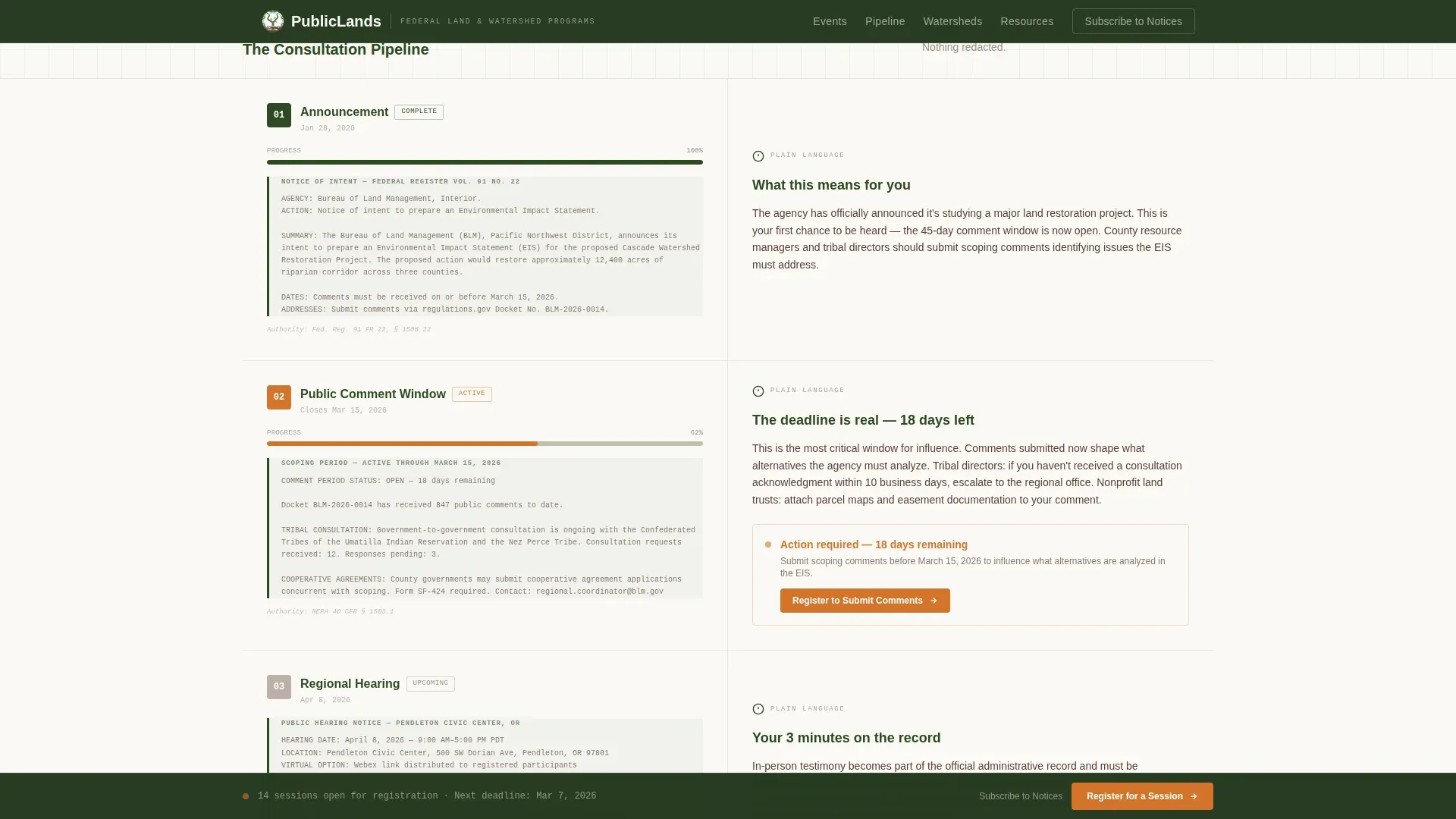
- A scroll-linked consultation pipeline section that pairs documentary evidence on the left with plain-language explanations and progress indicators on the right across five stages
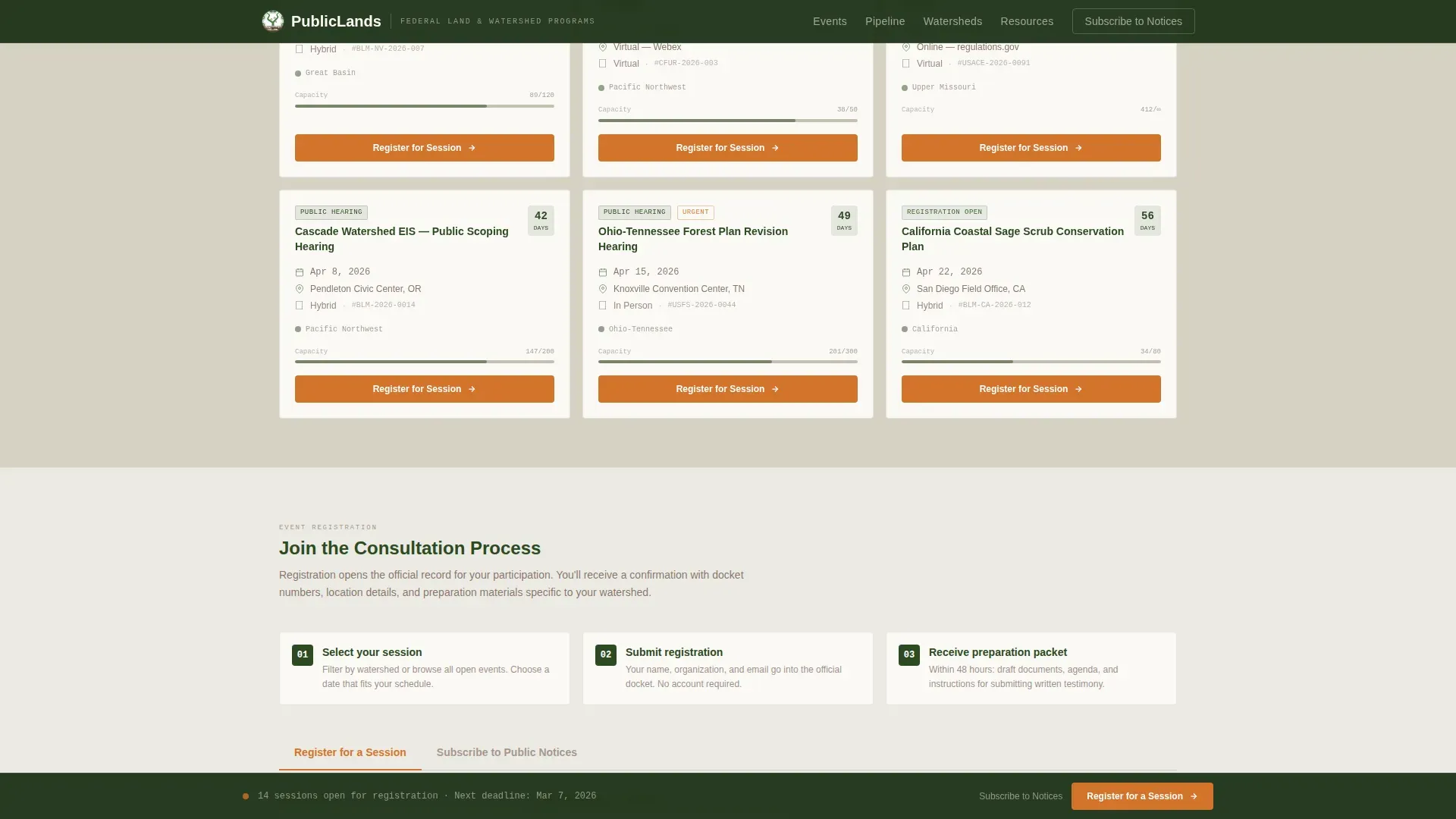
- A filterable upcoming events section showing watershed-badged event cards with deadline urgency indicators, a primary "Register for a Session" call-to-action form, and a secondary "Subscribe to Public Notices" email capture path
- A three-step "How Registration Works" section that explains the process before the form appears
- A footer in Arc Browser Split pattern with logo and tagline on the left and essential navigation links on the right
Feature list
This template contains purpose-built features aligned with how federal watershed consultation events actually work. Each component earns its place by solving a real visitor problem.
Interactive SVG Watershed Map
The left panel of the hero holds a vector map of the continental United States shaded by watershed region. Clicking any boundary filters the event list below to sessions within that region and auto-fills the watershed field in the registration form. Boundaries pulse softly in survey orange when an upcoming event falls within them, so the map communicates urgency at a glance without any additional copy.
Scroll-Linked Consultation Pipeline
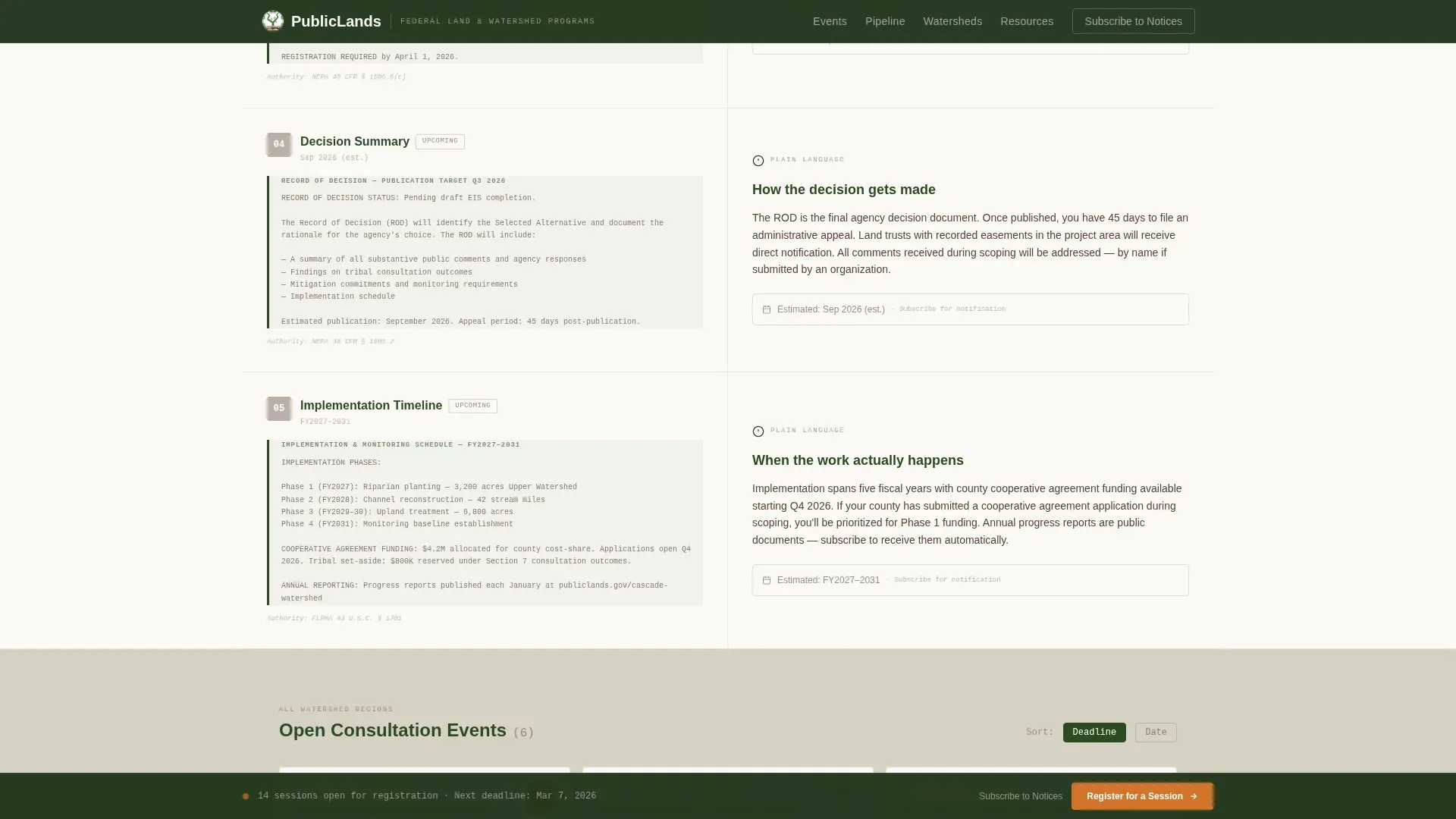
Five scroll sections reveal the agency's consultation process one stage at a time: announcement, public comment window, regional hearing, decision summary, and implementation timeline. The left panel of each stage holds documentary evidence such as Federal Register excerpts, comment-period calendars, and hearing transcripts. The right panel translates each artifact into plain-language explanation with a progress indicator. This architecture makes every management decision traceable and legible before any registration ask appears.
Filterable Event Cards with Deadline Badges
The upcoming events section displays session cards filtered by the map selection. Each card carries a watershed region badge, a session date, capacity indicators, and a deadline urgency signal. Visitors see exactly how many seats remain and how much time is left, which creates honest urgency grounded in real data rather than manufactured pressure.
Lightweight Registration Form with Watershed Auto-Fill
The primary call-to-action form collects only the fields needed: watershed region (auto-filled when the map is clicked), session date chosen from a filtered calendar, name, organization or agency affiliation, and email address. A secondary path captures email-only signups for visitors not yet ready to commit to a session date. Keeping the form minimal reduces abandonment and respects the professional context of the users.
Pinned "Register for a Session" Call-to-Action
After the first scroll, the primary call-to-action button pins to the page in survey orange. It stays visible through the pipeline and events sections so visitors who are ready to act can do so without scrolling back to the top. The pinned button disappears once the registration form comes into view, keeping the interface clean.
Forest Trust Color System and Civic Typography
The visual identity uses old-growth canopy green for headers and footers, morning-fog gray for backgrounds, weathered trail-sign brown for body text, and survey-marker orange reserved exclusively for active buttons and alert badges. Typography pairs Manrope for authoritative sans-serif headings with IBM Plex Mono for data fields, timestamps, and registration confirmations. The palette reads like a national forest boundary sign: honest, field-tested, and immediately trustworthy.
Page sections overview
| Section | Purpose |
|---|---|
| Split-Screen Hero | Map plus live event count headline |
| Consultation Pipeline | Five-stage process reveal |
| Upcoming Event Cards | Filtered sessions with deadlines |
| How Registration Works | Three-step pre-form explanation |
| Register or Subscribe | Primary form and email capture |
| Arc Split Footer | Logo, tagline, and essential links |
Design & branding system
The template follows a Civic Service theme built around the Forest Trust color system. Every color decision carries a functional rationale tied to real civic trust signals. The aesthetic references a USGS quad map and a national forest boundary sign: colors that have earned their authority by standing in the field for decades.
Design choices that carry the civic identity:
- Fog gray (#D6D2C4) dominates backgrounds for calm readability, canopy green (#2D4A22) anchors headers and footers for authoritative structure, and trail-sign brown (#5C4033) carries body text for warmth and legibility
- Survey-marker orange (#D4742C) appears only on active buttons, deadline badges, and pulsing map boundaries, so every orange element signals that action is required right now
- Manrope handles all heading and interface text for clear sans-serif authority, while IBM Plex Mono appears on data-heavy elements like timestamps, Federal Register citation numbers, and capacity counts
Mobile & speed optimization
The template is built desktop-first to match the primary use case: resource managers and program directors working at agency workstations. A mobile fallback ensures the page remains fully functional for visitors arriving via a shared link or a public notice email on a phone.
Optimization details that matter for this audience:
- Static-first architecture means most of the page loads immediately; Client Components are used only for the interactive map and the registration form to keep load time low
- The SVG map collapses to a scrollable region list on smaller screens so mobile visitors can still filter by watershed without a complex touch interaction
- Medium animation intensity uses scroll-linked pipeline reveals and staggered event card entry to maintain visual engagement without degrading performance on lower-bandwidth rural connections
How this template helps you convert
A landing page for a watershed public lands consultation event must build trust, explain the relevance of the watershed, and make the registration process frictionless to encourage community participation. This template earns each registration by showing rather than telling.
Three conversion mechanics work in sequence:
- The interactive watershed map creates an immediate personal connection: visitors click their region, see their upcoming sessions, and understand within seconds that this page is directly relevant to their land and their deadline, making the case for registration before a single word of persuasion copy appears
- The five-stage consultation pipeline reveals the full process in plain language before the form ever appears, so visitors arrive at the registration section already convinced that the process is responsible, transparent, and worth their time
- The pinned orange call-to-action button and the session capacity indicators work together to communicate honest urgency: seats are limited, the comment window is real, and registering now is the responsible choice for anyone with standing in the watershed
Other information about this template
This template is designed to support the specific civic and regulatory context that watershed consultation events operate within. The sections below provide additional background relevant to agencies, program directors, and conservation partners considering this template for their public process work.
- The template structure reflects best management practices for public engagement, placing critical information where eyes naturally scan using an F-Pattern layout and keeping the registration form minimalist to avoid form fatigue
- Watershed Condition Assessments (WCAs) are required to inform conservation actions and promote healthy ecosystems on public lands; the Bureau of Land Management must complete WCAs at least once every 10 years to inform land use planning and restoration planning, and this template is built to support the public-facing consultation step that feeds into those assessments
- The template's consistent approach to process transparency aligns with the National Environmental Policy Act, which requires federal agencies to involve the public in decisions that affect natural resources, water resources, wildlife habitat, and aquatic resources on public lands
- Federal land policy and applicable laws such as the Clean Water Act and the Federal Land Policy and Management Act require responsible, multi-use management decisions; this template helps agencies meet those obligations by making the consultation process legible and accessible to local governments, tribal organizations, and stormwater utilities
- The Delaware Watershed Conservation Fund, administered by the National Fish and Wildlife Foundation (NFWF), awards grants ranging from $75,000 to $1,500,000 in 2026 for projects that conserve, restore, and protect habitats; eligible applicants include non-profit 501(c) organizations, federal agencies, state and local governments, Tribal governments, and educational institutions, and this template can support the community engagement and registration components that NFWF prioritizes in proposals
- The 2026 Core Conference Theme, Building Resilient Watersheds: Advancing Innovation and Partnership in Rapidly Changing Environments, reflects the kind of content this template is structured to present: climate change adaptation strategies, stormwater management innovations, clean water goals, and watershed health monitoring updates that visitors need to understand before they register
- The Fifth Annual Watershed Conference, themed Collaborating For Change and held from November 3 to 5 in a hybrid format, demonstrates that modern watershed consultation events blend in-person and virtual attendance; this template supports that model with session date filtering and an email-only subscribe path for visitors not ready to commit to a specific date
- Nature-based management strategies, including wetland restoration, living shorelines, and rain gardens, are the kinds of project types discussed at consultation events this template is built to support; agencies covering stormwater management, water quality improvement, reduce flooding initiatives, and wildlife habitat conservation will find the pipeline and event card sections structured to communicate those topics clearly
- The Army Corps of Engineers and the Environmental Protection Agency are among the federal agencies whose consultation events fit the scope this template addresses; government officials coordinating with local communities on water quantity, drinking water protection, and aquatic resources restoration will find the layout suited to their audience
- Additional data fields in the registration form, such as agency affiliation and watershed region, help program directors conduct technical review of registrant lists and plan session capacity accordingly
- The template supports multiple grants and federally funded projects by providing a consistent approach to event registration that local requirements and compliance obligations can be clearly communicated within; funding details, session agendas, and downloadable project summaries can be surfaced in the pipeline and event card sections
- Conservation actions, restoration projects, and ongoing efforts to improve water quality across rural and tribal land benefit from higher public participation rates; this template is built specifically to raise those rates by removing every unnecessary barrier between a motivated visitor and a confirmed registration
Theme
Civic Service
Creative direction
Transparent Process
Color system
Forest Trust
Style
Split Screen (50/50)
Direction
Event Registration
Page Sections
Interactive SVG Watershed Map Hero
Scroll-linked Consultation Pipeline
Filterable Event Cards with Deadline Urgency
Dual-path Registration and Subscribe Form
Pinned Survey-orange Call-to-action Button
Civic Cartographic Typography and Color System
Related questions
Who is this template designed for?
What sections are included in the template?
Does the registration form auto-fill based on the map selection?
Can visitors subscribe without registering for a specific session?
What kind of events is this template suited for?