Environmental & Conservation NGO Professional Website Template
Steward is a zigzag landing page template built for forest and land conservation nonprofits. It guides rural landowners, neighborhood associations, and families through an educational story about conservation easements, forest regrowth, and community stewardship. With a Community Mosaic hero, alternating narrative sections, and a focused click-through structure, it earns trust before asking for action.
by Rocket studio
Quick summary
Steward is a single-page conservation template designed to turn curious visitors into committed partners. It uses an alternating section layout to walk landowners, families, and community groups through the full picture of land protection, from threatened parcels to signed easements to thriving canopy. The layout earns every click before it asks for one.
Who this template is for
This template speaks directly to people with a personal stake in the land. It works equally well for a land trust running active easement programs and for grassroots environmental groups just finding their footing.
- Rural landowners (55+) thinking about legacy and what happens to their acreage
- Neighborhood associations pushing back on rezoning proposals in their area
- Young families and weekend volunteers ready to plant, walk, and learn
What problem this template solves
Conservation organizations struggle to explain complex legal and ecological concepts without losing the audience. A single landing page that mixes legal language with stock imagery creates distance, not connection. Steward solves that by making the scroll feel like a guided walk through a field notebook.
- Visitors leave before understanding what a conservation easement actually does for their property
- Organizations fail to capture both landowner leads and volunteer sign-ups in one place
- Generic templates lack the local, place-specific tone that builds genuine trust
What you get with this template
You get a fully structured, story-driven landing page that moves visitors from awareness to action without confusion. Every section has a clear job, and the overall flow creates a sense of quiet responsibility by the time the call to action appears.
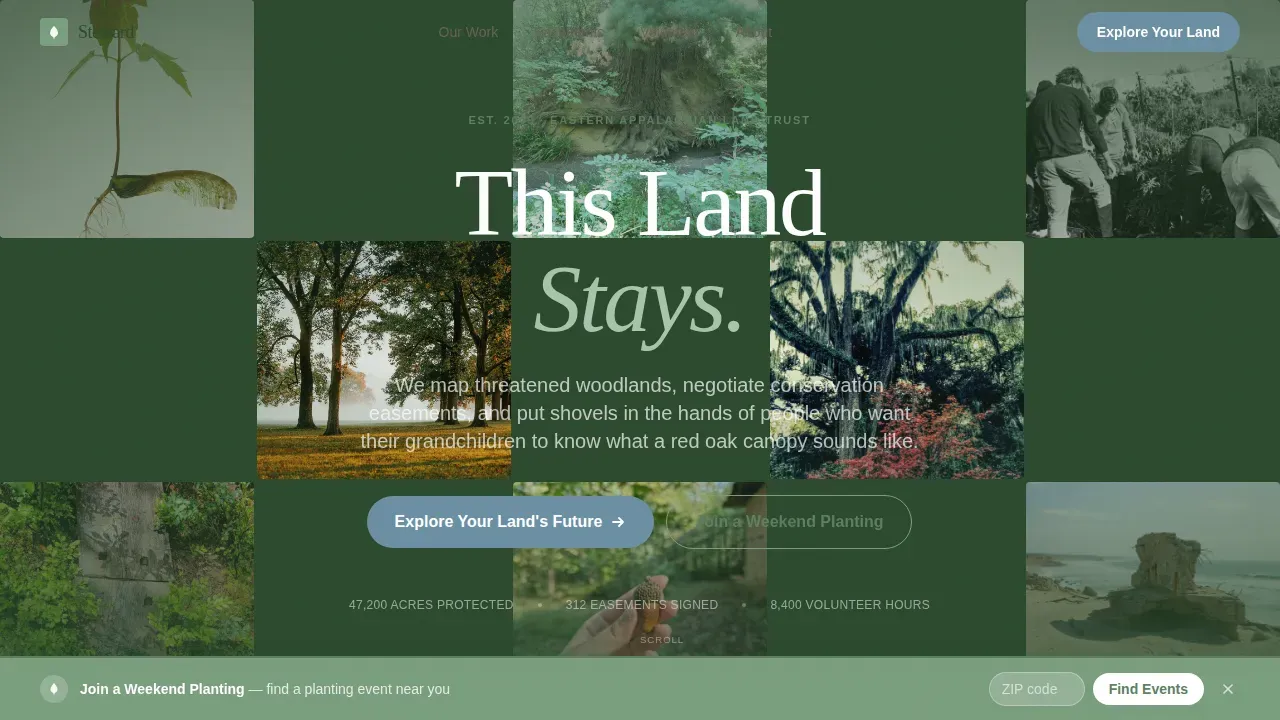
- Community Mosaic hero with a breathing photo grid and animated headline reveal
- Six alternating content sections covering the problem, easements, and forest regrowth
- Two conversion paths: a primary parcel lookup button and a persistent volunteer ribbon
Feature list
This template includes purpose-built components that reflect real conservation communication needs. Each feature supports the educational, trust-first approach the brief calls for.
Community Mosaic Hero Section
A grid of community photographs breathes gently on load, with tiles scaling before the center cluster parts to reveal the headline. Every image is captioned with a name and township, providing visual proof of real stewardship at work.
Zigzag Educational Section Layout
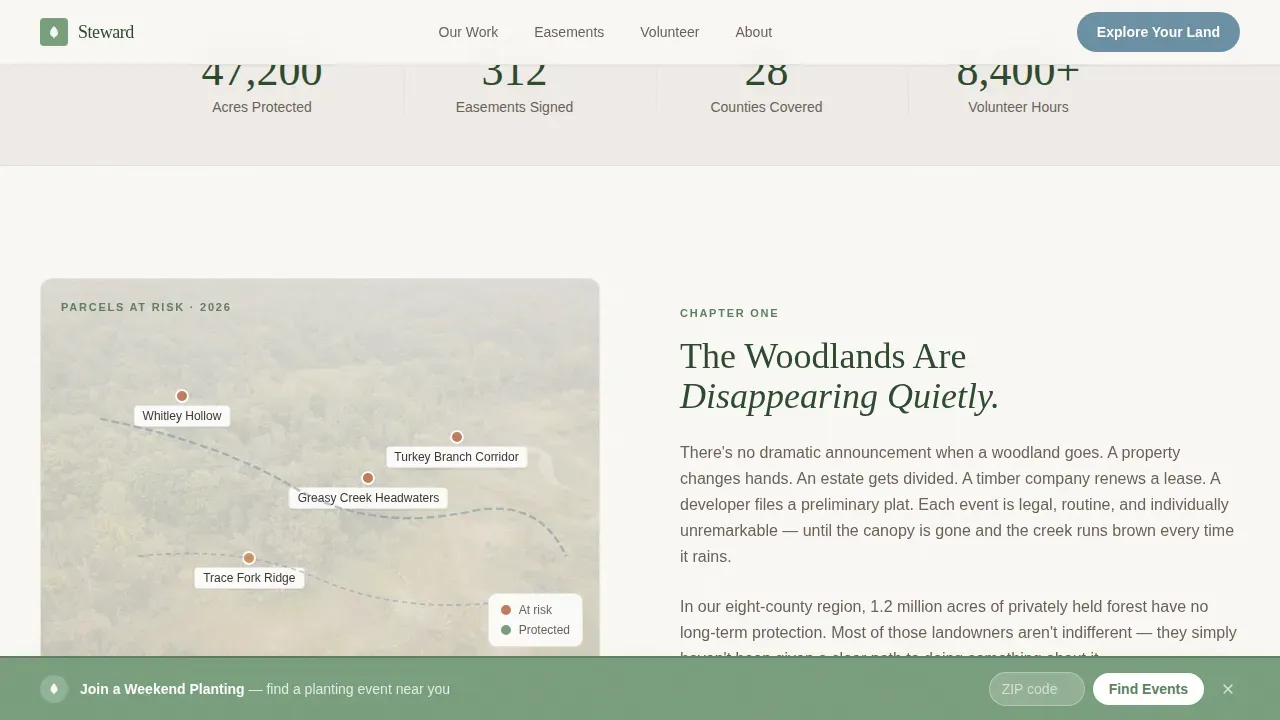
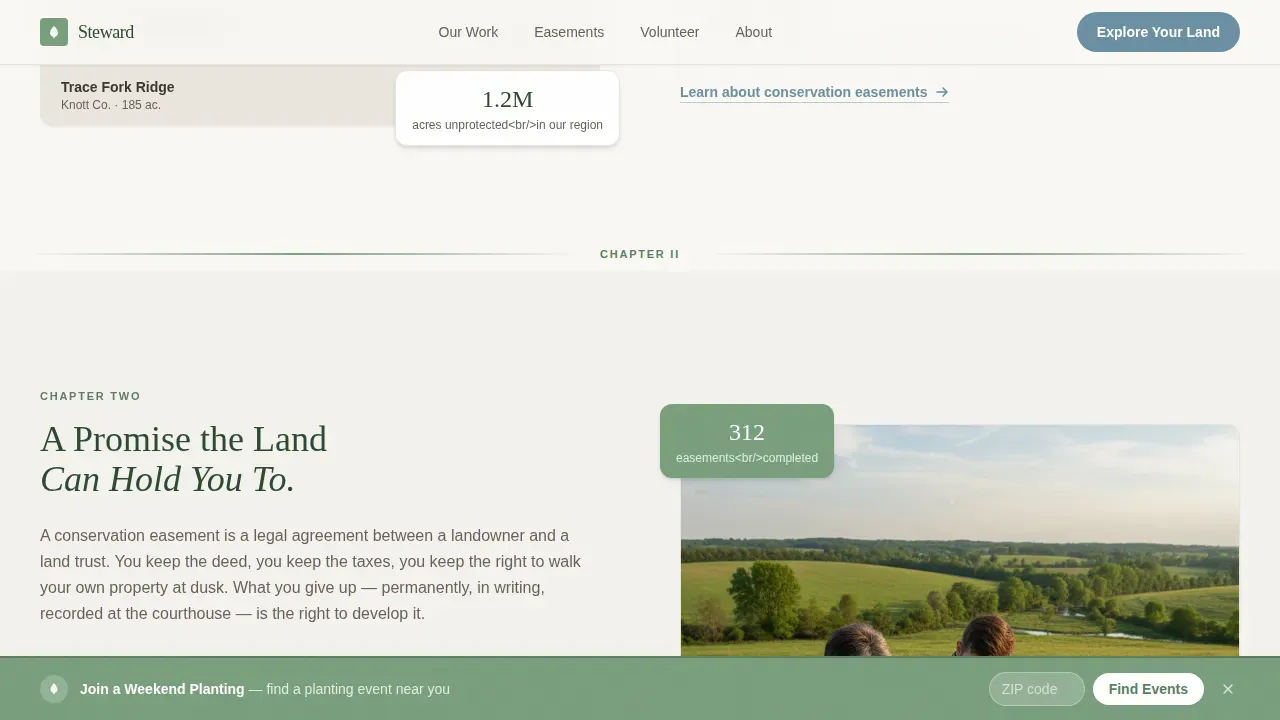
Each alternating row acts as a chapter. Left and right blocks swap between map details showing parcels at risk, narrative text about conservation practices, illustrated timelines of forest regrowth, and species lists. The scroll teaches without lecturing.
Dual Conversion Path Design
The primary call to action, "Explore Your Land's Future," appears first as a ghost button, then solidifies in creek blue at the final panel. A persistent ribbon along the bottom captures volunteer sign-ups by zip code, keeping both audiences engaged.
Social Proof Mosaic Panel
A dedicated section surfaces landowner testimonials alongside volunteer metrics and acres conserved. Tangible impact data, like total land protected and planting events completed, give the organization credibility and help visitors find the confidence to contact the team.
Conservation Easement Narrative Block
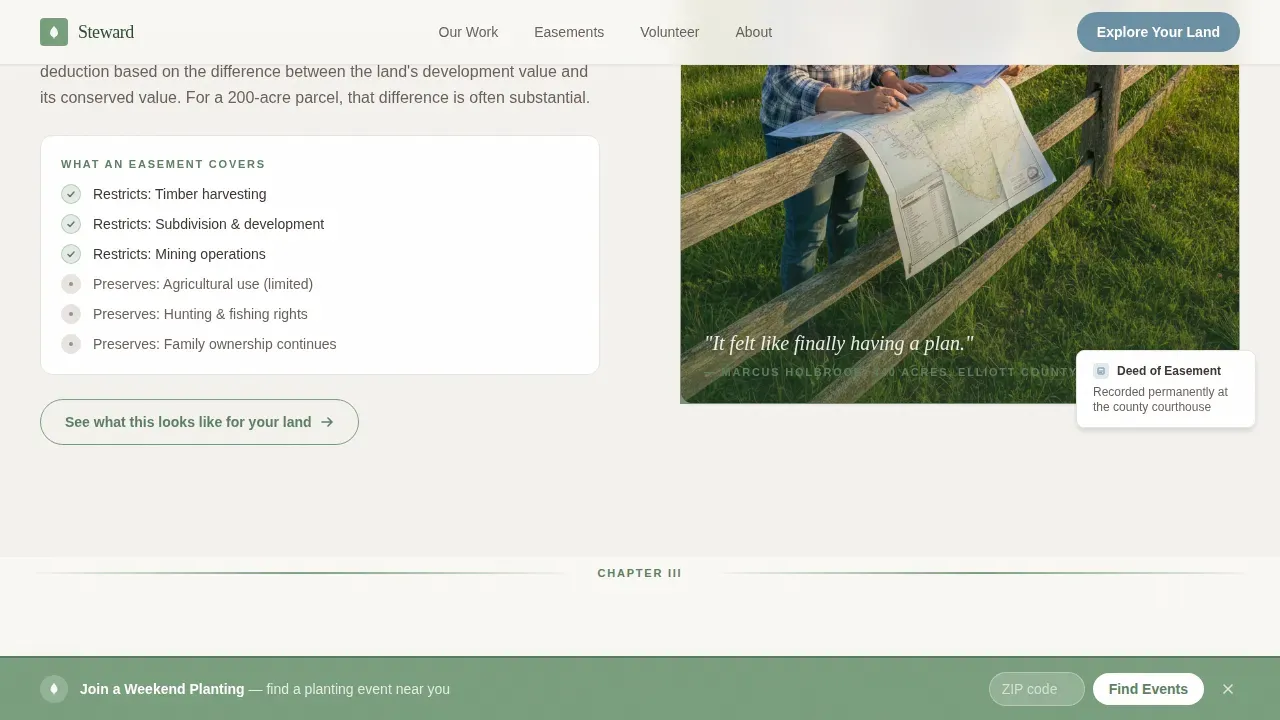
One full zigzag section explains what easements protect, written in plain language, as if a neighbor is explaining it over a fence. It covers property rules, boundaries, and what stays and what changes when a landowner signs an agreement.
Focused Footer with Clear Contact
The footer uses a split layout with logo and tagline on the left and links on the right. Direct contact information is visible and accessible, reassuring visitors that a real, active team is behind the work.
Page sections overview
| Section | Purpose |
|---|---|
| Community Mosaic Hero | Reveal headline through breathing photo grid |
| Parcels at Risk | Show local land loss with map detail |
| Easement Explanation | Plain-language conservation easement narrative |
| Forest Regrowth Timeline | Illustrated 20-year species return sequence |
| Social Proof Mosaic | Landowner quotes and volunteer metrics |
| Final Call to Action | Solidified creek blue button and promise sentence |
| Footer Arc Split | Logo, tagline, links, and contact information |
Design & branding system
The visual identity follows an Educational Guide theme grounded in a Soft Mist color system. The palette feels like a field notebook left open on a mossy stump: muted, layered, and alive at the edges.
- Birch bark white (#FAF8F5) dominates backgrounds; lichen green (#7A9E7E) anchors icons and dividers
- Fog gray (#E8E4DF) softens secondary text; creek blue (#6B8FA3) is reserved for links and calls to action
- Fraunces serif handles display headings; DM Sans handles body text for clean readability
Mobile & speed optimization
The template is built desktop-first with strong mobile support, reflecting how landowners and families each prefer to browse. Scroll reveals use blur, stagger, and parallax depth to improve the reading experience without slowing it down.
- Static sections use server components; animated elements use client components to balance load and motion
- The persistent volunteer ribbon and mosaic hover states work across screen sizes
- Image tiles in the hero grid are optimized so the breathing animation does not block the initial render
How this template helps you convert
Good stewardship of a visitor's attention works the same way as good land stewardship: you build trust before you ask for commitment. This template is designed to do exactly that.
- The educational zigzag layout gives visitors the knowledge they need to feel informed and locally responsible before the primary call to action appears.
- Two distinct conversion paths capture both landowners ready to explore their property's future and volunteers ready to walk out to a creek bank and plant a tree.
Other information about this template
This template is a strong fit for organizations that work alongside federal conservation programs. The United States Department of Agriculture (USDA) Natural Resources Conservation Service (NRCS) runs the Conservation Stewardship Program (CSP), which provides technical and financial assistance to improve land management practices. Eligible producers can receive annual payments for implementing conservation practices, and CSP contracts can be renewed based on performance. Technical Service Providers (TSP) assist producers in planning those practices. The template's contact section and information panels can support outreach to landowners who may be eligible for NRCS programs. Note that Landscape, a connected web and mobile app used by hundreds of conservation organizations, is an example of the kind of data management tool that helps a land trust compile project information, track funds, and maintain consistent monitoring across all protected areas.
- The template board can note that it aligns with Land Trust Alliance accreditation display standards
- Sign-up ribbon and contact form fields follow a streamlined, minimal-field approach
- Producers and landowners can use the parcel lookup path to discuss options and learn next steps
- Visit the volunteer section to find sign-up opportunities and explore ways to improve local conservation areas
Theme
Educational Guide
Creative direction
Local & Neighborhood
Color system
Soft Mist
Style
Zigzag/Alternating
Direction
Click-Through
Page Sections
Community Mosaic Hero with Animation
Zigzag Educational Section Layout
Dual Conversion Path Design
Social Proof and Impact Panel
Conservation Easement Narrative Block
Focused Footer with Contact Details
Related questions
Can I use this template without photography of my own land?
Does this template support two different audience types at once?
How does the conservation easement section help visitors unfamiliar with the concept?
Is this template suitable for a nonprofit that also works with federal land programs?
Can families and children participate in the volunteer activities shown in this template?