Retail Design Portfolio Landing Page Template
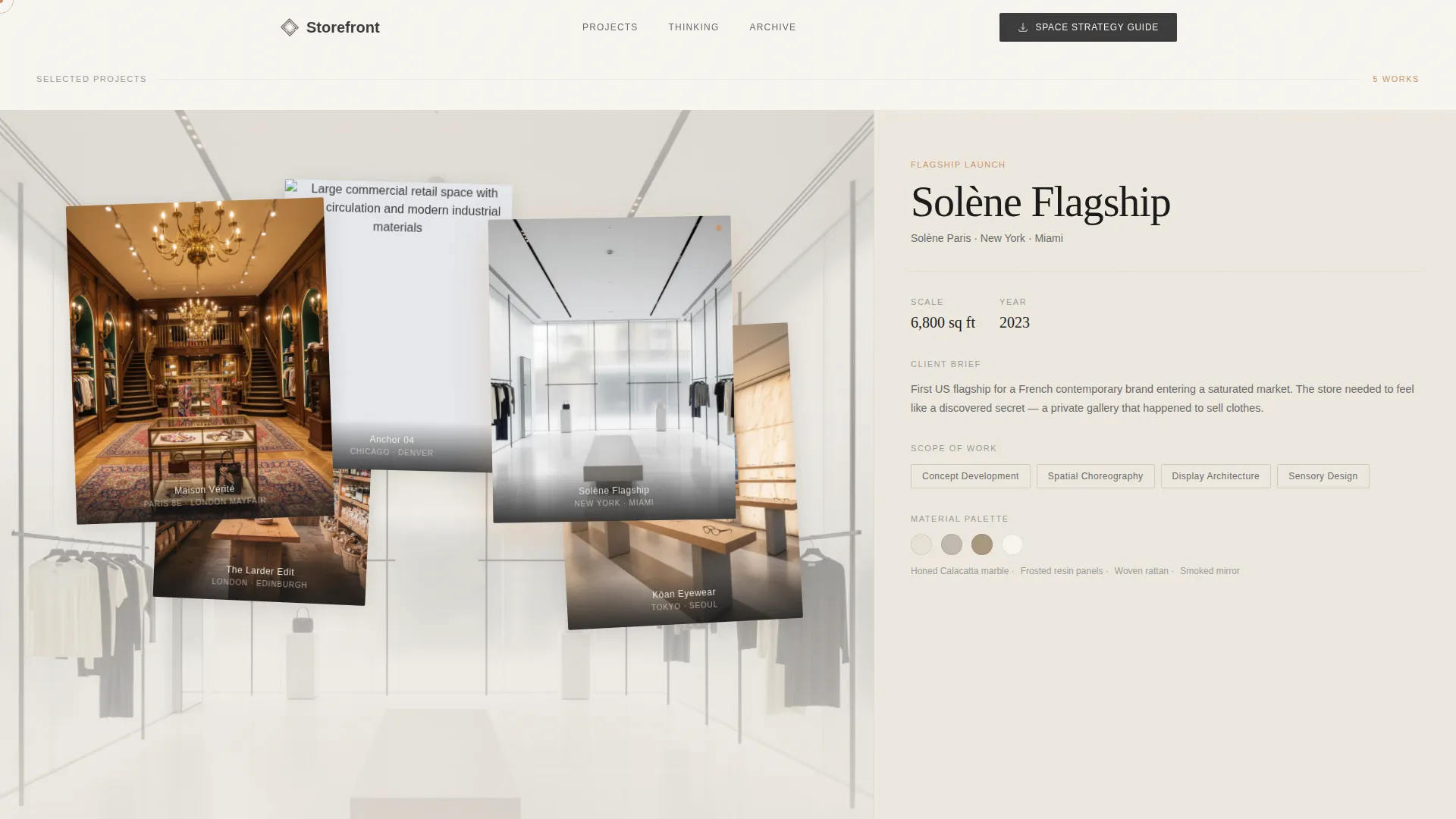
Storefront is an asymmetric 60/40 retail design portfolio landing page built for studios that shape how people experience physical spaces. It pairs a cinematic scroll-jacked header with an interactive project explorer, a gated Space Strategy Guide, and a free case study teardown, giving retail design professionals a destination-grade portfolio presence that earns trust before asking for anything.
by Rocket studio
Quick summary
Storefront is a single-page retail design portfolio template built around spatial storytelling. The layout uses an asymmetric 60/40 grid, a five-beat scroll-jacked opening sequence, and an interactive project explorer. It is designed for studios that work at the intersection of retail architecture, visual merchandising, and experiential interiors.
Who this template is for
This template is built for design professionals who shape physical retail environments and need their portfolio to reflect the quality of their thinking, not just their completed projects.
- Retail brand directors launching flagship store concepts who need to communicate vision to landlords and investors
- Commercial landlords repositioning underperforming anchor spaces who want to attract premium design partners
- Visual merchandising leads at heritage fashion houses presenting spatial strategy to internal stakeholders
What problem this template solves
Most portfolio pages in the retail design space look like project galleries. They list work without revealing the thinking behind it. Prospective clients scroll past images without understanding scope, strategy, or process. That gap costs studios high-value briefs.
- A flat image gallery gives no sense of how a studio approaches spatial choreography or the reasoning behind design decisions
- Generic portfolio layouts fail to communicate the specialised expertise that separates retail environment design from general interior work
- There is no mechanism to qualify visitors by role, capture serious leads, or demonstrate depth before asking for a conversation
What you get with this template
This template gives you a fully structured, visually immersive retail design portfolio landing page. Every component is grounded in the brief, from the opening animation sequence to the lead-capture flow.
- A five-stage scroll-jacked header that assembles a retail environment layer by layer, from architectural wireframe through to warm theatrical lighting
- A 60/40 asymmetric grid workspace where immersive project photography and contextual project metadata respond to visitor interaction
- A dual-conversion flow: a gated Space Strategy Guide PDF paired with a free, ungated case study teardown that demonstrates expertise upfront
Feature list
The template is built around a small set of highly specific, high-impact features grounded directly in the brief.
Five-Beat Scroll-Jacked Header
The viewport locks on entry. As the visitor scrolls, a single retail environment assembles in five distinct stages: architectural wireframe, material wash, product placement, human figures, and finally the warm theatrical glow of opening night. Navigation only appears after the sequence completes, releasing the visitor into the portfolio below.
Interactive 60/40 Project Explorer
The 60-column holds full-bleed project photography with cursor-driven parallax depth. The 40-column carries swappable project metadata, material palettes, and client brief summaries. Projects are not listed in a grid; they are presented as overlapping thumbnail clusters the visitor pulls apart to reveal scope, square footage, and location details.
Gated Space Strategy Guide
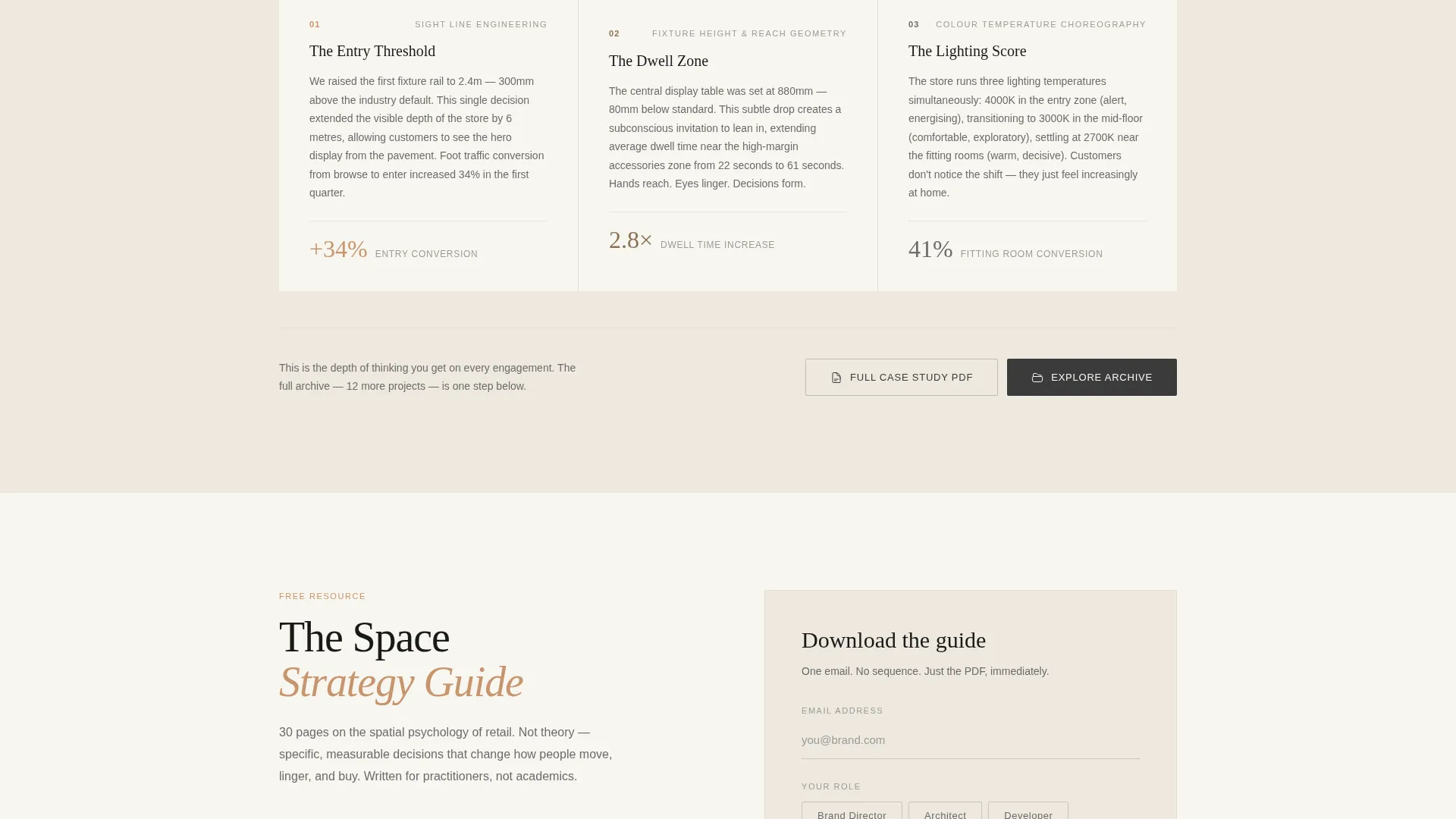
The primary conversion point is a downloadable 30-page PDF on retail spatial psychology. It is gated behind a single email field and a role selector with four options: Brand Director, Architect, Developer, and Visual Merchandising Lead. The role selector allows the studio to qualify leads at the point of capture.
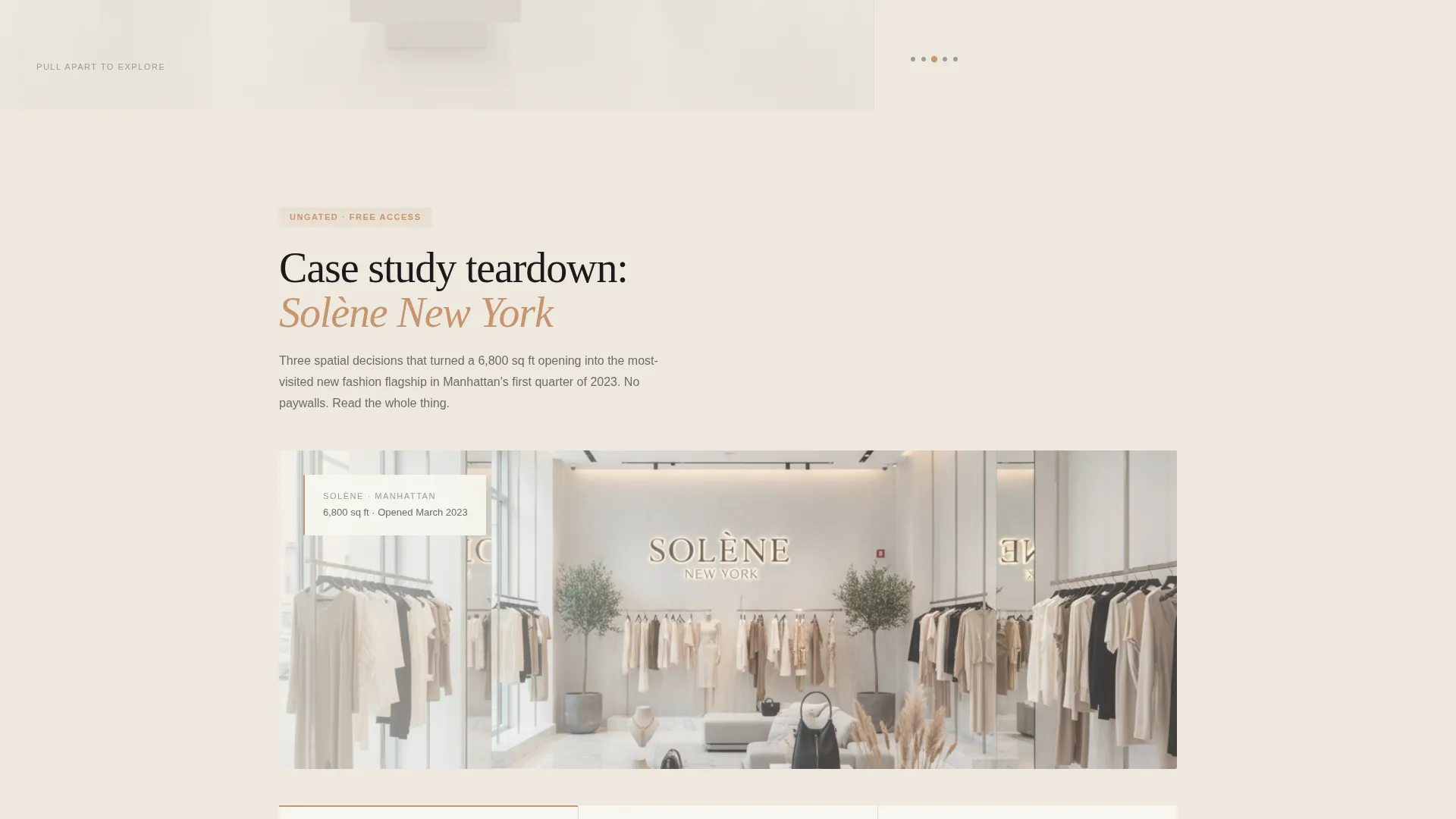
Free Ungated Case Study Teardown
One complete project case study is published without a gate. This gives first-time visitors a genuine sample of the studio's strategic depth before any exchange is requested. It functions as the trust-building mechanism that makes the gated guide feel worth requesting.
Contextual Metadata Columns
As visitors navigate between projects, the 40-column updates contextually with material palettes, project scope notes, and client brief summaries. The experience feels like reviewing a physical project folder rather than clicking between pages.
Progressive Grid Loosening
The deeper a visitor explores, the more the grid layout softens and opens. The layout is designed to reward exploration, creating a sense of personal discovery rather than a fixed presentation sequence.
Page sections overview
| Section | Purpose |
|---|---|
| Scroll-jacked header | Assembles a retail space across five scroll beats before revealing navigation |
| Project cluster explorer | Lets visitors pull apart overlapping thumbnails to discover project details |
| Free case study | Delivers one complete ungated teardown to establish strategic credibility |
| Space Strategy Guide gate | Captures email and role via a gated 30-page PDF on spatial psychology |
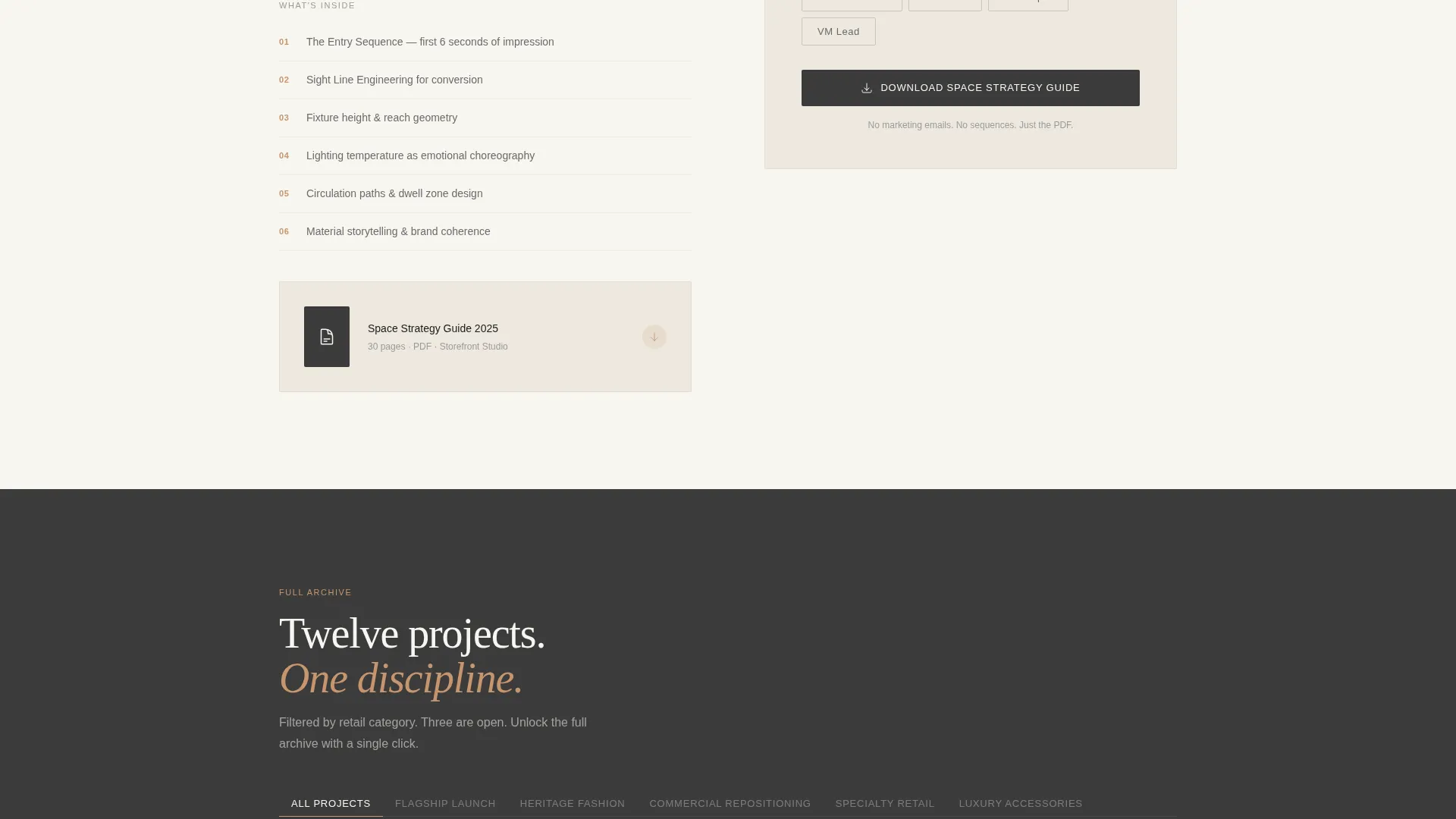
| Full archive unlock | Secondary conversion that filters case studies by retail category |
Design & branding system
The visual identity uses an Atelier Studio theme built on the Cloud Canvas color system. The palette is drawn from materials found on a designer's drafting table: soft, matte, and deliberately unhurried.
- Core tones are stretched-linen white (#F7F5F0), pencil-sketch graphite (#3B3B3B), and tracing-paper cream (#EDE8DF), giving the layout a soft, sketchbook quality where negative space carries as much weight as any element
- A single accent color, pinning-needle rose gold (#C7956D), is reserved exclusively for hover states, active links, and interactive affordances, keeping the palette disciplined and the accent meaningful
- Typography and surface treatments stay matte and restrained throughout, so the photography and spatial content remain the dominant visual force on the page
Mobile & speed optimization
The template is structured to translate its immersive desktop experience to smaller viewports without losing the sense of atmosphere or narrative.
- The scroll-jacked header sequence and parallax behaviors are designed to adapt gracefully to touch-based navigation on mobile devices
- The asymmetric 60/40 grid reflows for narrower screens so project photography and metadata columns remain readable without horizontal scrolling
- The role-selector lead form and gated PDF flow are structured to function cleanly on mobile without requiring additional configuration
How this template helps you convert
The conversion architecture in this template is deliberate. It earns attention before requesting anything, and it qualifies leads at the moment of exchange.
- The free ungated case study teardown is positioned early in the page flow, giving visitors a genuine proof of strategic thinking. This removes hesitation before the gated guide is introduced.
- The gated Space Strategy Guide uses a role selector alongside the email field. This means every lead captured is immediately segmented by professional role, making follow-up more targeted from the first contact.
Other information about this template
This template is well suited to studios operating in experiential retail design, architectural spatial strategy, and high-end commercial interior consultancy. It is structured as a single landing page, so all content and conversion flows exist within one cohesive scroll experience.
- The template is part of the Atelier Studio theme family and uses the Cloud Canvas color system, making it consistent with other studio-grade portfolio templates in the same visual language
- The "Explore the Full Archive" secondary call to action unlocks filtered case studies by retail category, giving return visitors a reason to go deeper without requiring a second page load
- The asymmetric grid format and interactive explorer behavior are designed to feel like a curated workspace rather than a standard portfolio scroll, which suits studios whose value proposition is spatial thinking and curatorial precision
- This template is a strong fit for pitch preparation contexts, where a retail design studio needs to send a portfolio link that functions as a self-guided credentials presentation for a prospective client
Theme
Atelier Studio
Creative direction
Interactive Explorer
Color system
Cloud Canvas
Style
Asymmetric Grid (60/40)
Direction
Content/Resource
Page Sections
Five-beat Scroll-jacked Header
Interactive 60/40 Project Explorer
Gated Space Strategy Guide
Free Ungated Case Study Teardown
Progressive Grid Loosening
Related questions
Who is the primary audience for this template?
What is the Space Strategy Guide and how does the gate work?
Can I use this template if I do not have many completed projects yet?
Is this a single page or a multi-page template?