Rehabilitation & Therapy Professional Website Template
Stride is a single-column landing page template built for amputee rehabilitation clinics. It guides visitors from the fear and disorientation of early limb loss toward a confident first step. The design uses a warm Soft Mist palette, a portrait-centered hero, and a problem-to-solution scroll arc that earns trust before asking for anything.
by Rocket studio
Quick summary
Stride is a content-led landing page template for amputee rehabilitation clinics. It opens with a portrait-centered hero and a headline that speaks directly to the patient's experience. The scroll arc moves from fear validation to clinical confidence, ending with a free guide download and a secondary video call to action. Every section earns the next.
Who this template is for
This template is designed for rehabilitation clinics that work with amputees at the earliest, most vulnerable stage of recovery. It speaks plainly to patients and their families, not to medical administrators or insurance teams.
- Clinics serving recent above-knee, below-knee, or upper limb amputees
- Practices supporting veterans navigating post-military limb loss
- Rehabilitation providers whose patients include aging adults facing vascular amputation
What problem this template solves
Most rehabilitation landing pages feel institutional. They list credentials and certifications but never acknowledge the patient's actual fear. Stride solves the trust gap that exists between a scared new patient and a clinic they have never visited.
- Patients searching from hospital rooms need warmth and clarity, not medical jargon
- Family caregivers researching options need specific timelines and real outcomes, not vague promises
- Clinics struggle to convert page visits into first appointments without a strong content-first approach
What you get with this template
Stride is a fully structured single-column landing page with five distinct section groups and a clear conversion architecture. Every component is mapped to a specific moment in the patient's emotional and clinical journey.
- A portrait-centered hero with a deep navy headline and a scroll-blur lavender-to-white background
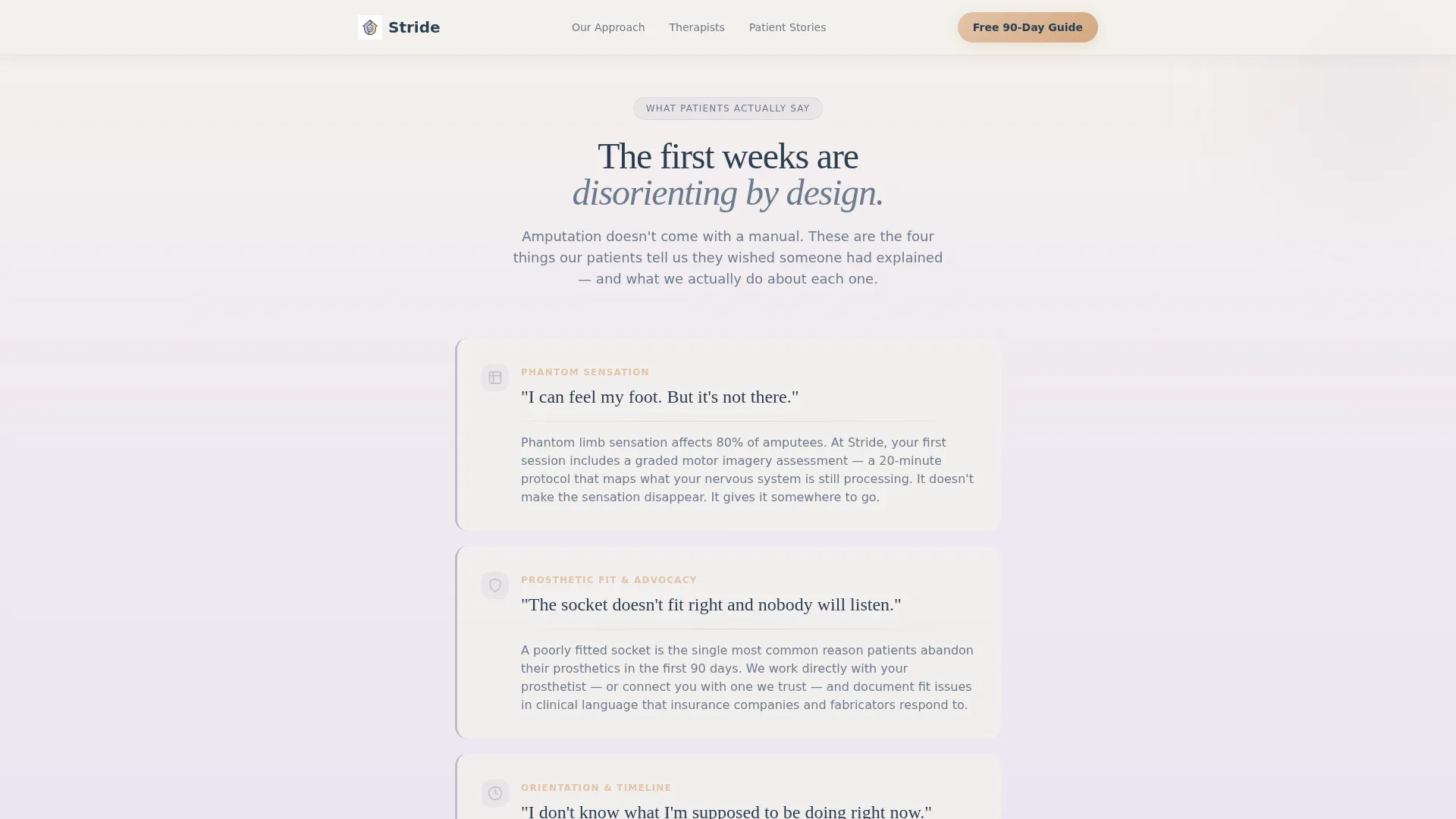
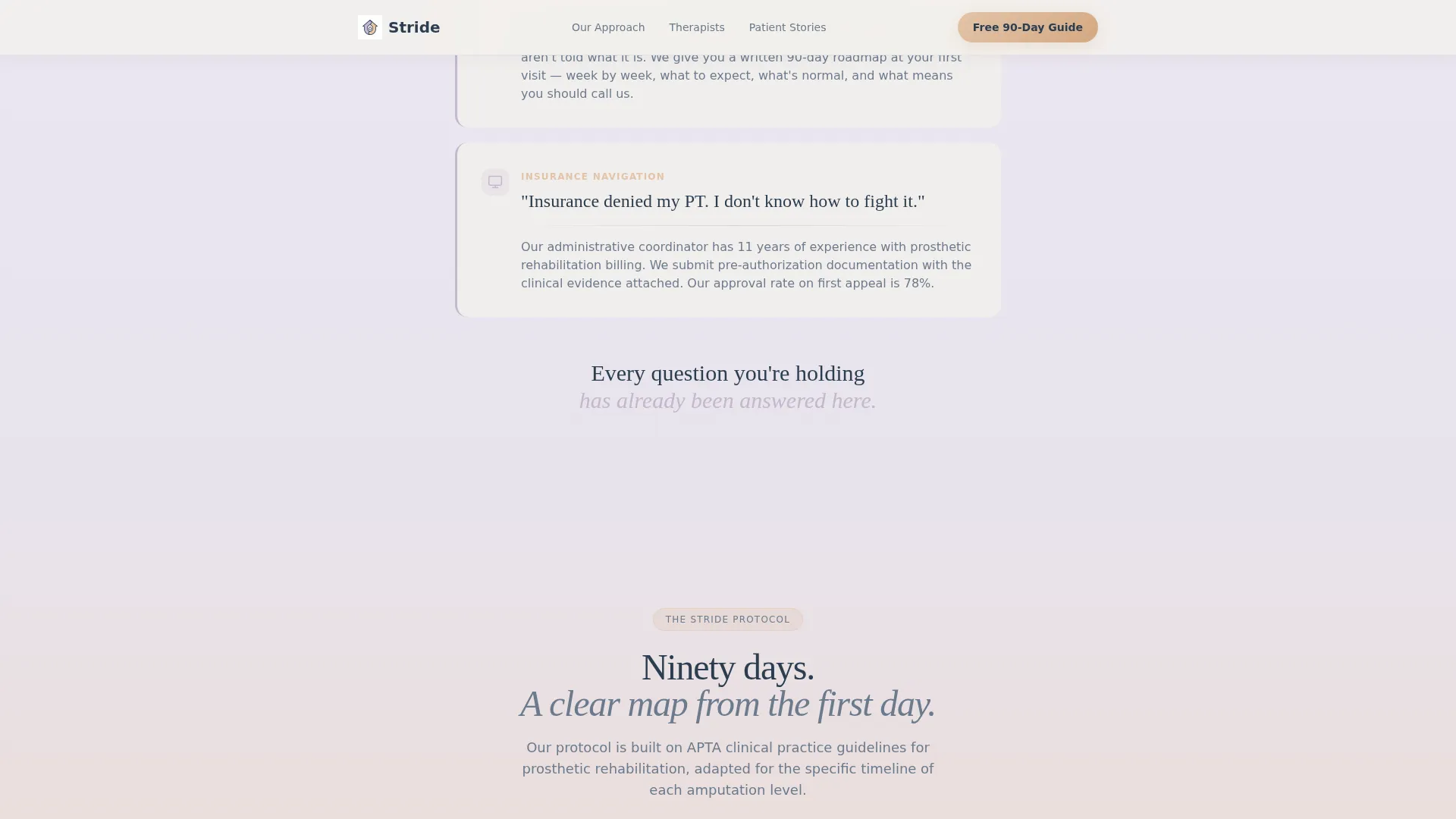
- A problem arc section that validates fear using patient language, then answers each fear with a named clinical response
- A protocol and timeline section, a patient outcomes section, a downloadable guide form, and a footer
Feature list
This template ships with a focused set of components, each built around the realities of patient acquisition for rehabilitation clinics.
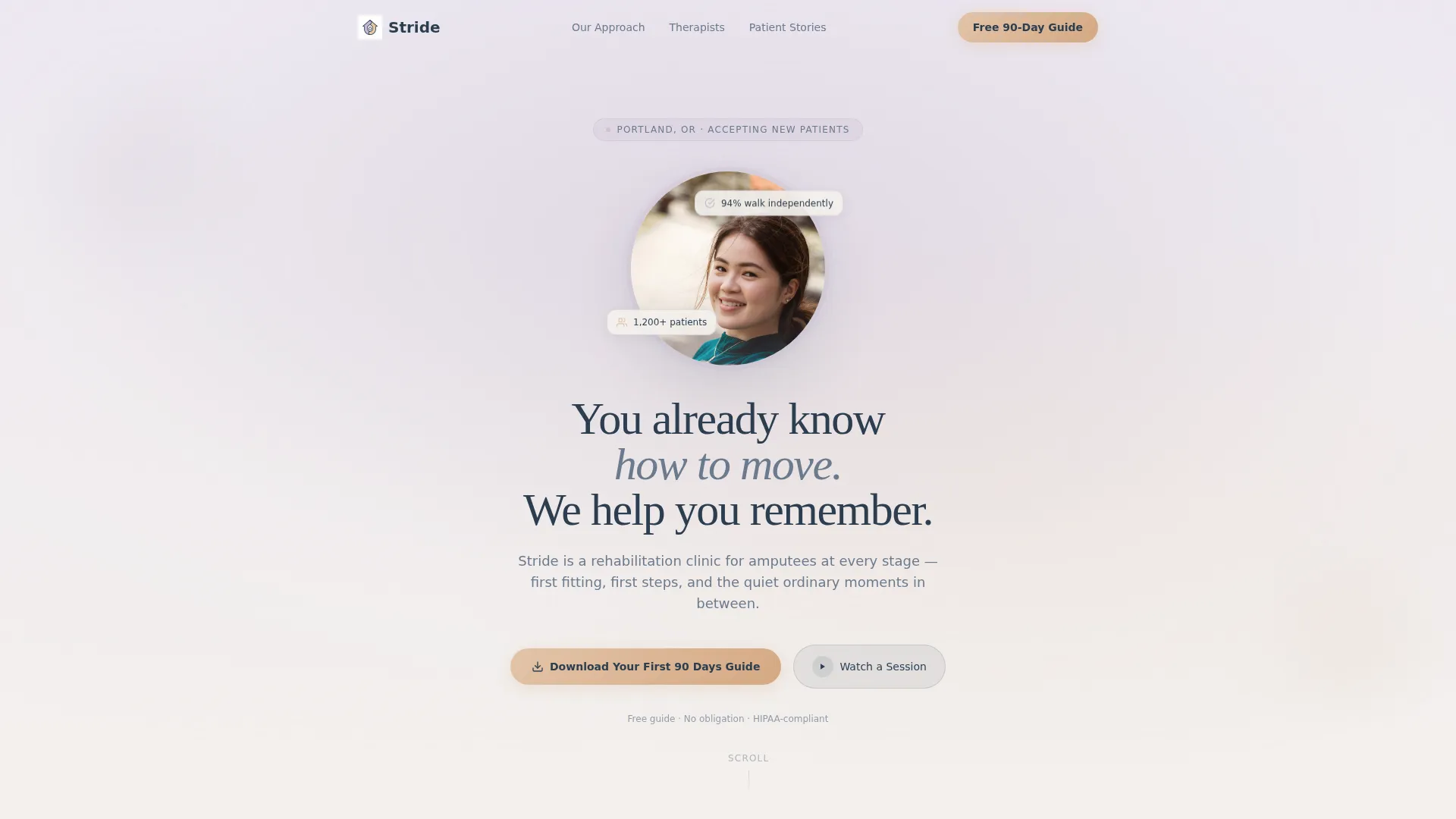
Portrait-Centered Hero Section
The hero places a single patient portrait front and center, with soft directional light and a lavender-to-white dissolved background. The headline sits below the portrait in deep reassurance navy, written to feel unhurried and human. A parallel bar appears at the frame edge, grounding the image without leading with the prosthetic.
Problem-to-Solution Scroll Arc
Each scroll section opens by naming a specific patient fear, then dissolves it into a concrete clinical answer. The language is drawn from patient experience, not medical textbooks. The gradient background warms subtly as the visitor scrolls, shifting the page from cool lavender mist toward the skin-tone register.
Protocol and 90-Day Timeline Layout
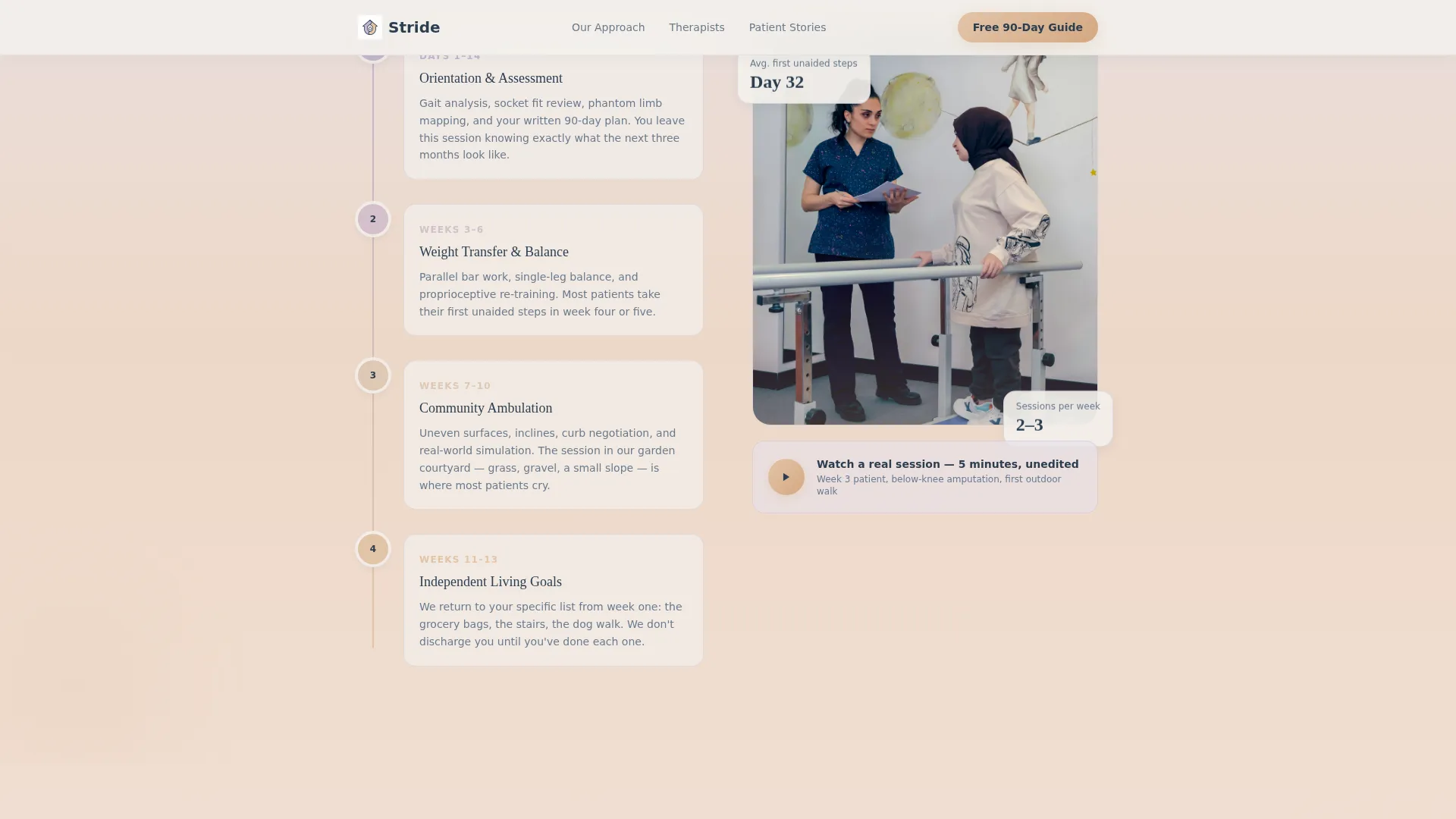
A split-layout section presents a named therapy protocol alongside a real 90-day breakdown of what to expect, from initial fitting through independent ambulation. This section gives patients the specific timeline information that turns curiosity into commitment.
Patient Outcomes and Therapist Profiles
Ordinary-life photography shows patients carrying grocery bags, kneeling in a garden, and walking a dog. Therapist profile cards include credentials and a human-scale description. Patient quotes cite specific outcomes, not general satisfaction.
Multi-Step Download Guide Form
The primary call to action is a free illustrated PDF guide covering the first 90 days of recovery. The form collects first name, then amputation level, then email address in that order. This sequence builds personal connection before asking for contact details.
Secondary Video Call to Action
A clearly marked secondary path invites visitors to watch a five-minute unedited therapy session. This gives hesitant visitors a low-commitment way to experience the clinic before filling out any form.
Page sections overview
| Section | Purpose |
|---|---|
| Hero portrait area | Establish human connection and headline trust |
| Problem arc section | Validate fear, answer with clinical clarity |
| Protocol and timeline | Show named approach and 90-day roadmap |
| Outcomes and profiles | Demonstrate real results and therapist credibility |
| Download guide form | Capture leads with a free 90-day PDF offer |
| Watch a session | Provide low-commitment video path for hesitant visitors |
| Page footer | Close with horizontal navigation and contact anchors |
Design & branding system
The Soft Mist color system is the emotional foundation of Stride. Every color choice was made to feel clinical enough to trust and human enough to exhale into. The palette avoids sharp contrasts and cold whites throughout.
- Morning fog white (#F4F1ED) and healing lavender (#C4B7CB) form the background gradient that drifts and warms as the visitor scrolls
- Deep reassurance navy (#2C3E50) anchors all headlines and body text, providing stability without coldness
- Warm skin tone (#E2C4A8) appears exclusively on buttons and interactive moments, reinforcing that this page is about bodies and recovery
Mobile & speed optimization
Stride is built mobile-first because a significant portion of its target audience searches from phones in hospital settings. The layout is a single-column flow that reads naturally at any screen width without requiring layout changes.
- Staggered fade-ins and scroll-linked blur animations are handled through IntersectionObserver for smooth rendering on mobile devices
- Server Components handle static content delivery while Client Components manage the form interactions and animation states
- The multi-step form feel is designed to reduce friction on smaller screens, where long forms typically cause drop-off
How this template helps you convert
Stride does not ask for anything until it has given something of real value. The conversion architecture follows the emotional arc of the page, so the call to action feels like a natural next step rather than an interruption.
- The problem arc section builds trust by speaking the patient's language before presenting any offer, so visitors feel seen and understood before the form appears
- The free 90-day guide positions the clinic as a genuine resource, and the form sequence (name first, amputation level second, email third) reduces friction and builds personal rapport before collecting contact details
Other information about this template
Stride is a strong fit for clinics that want a content-first patient acquisition page rather than a traditional appointment-booking form. The template is designed to prove clinical expertise through detail, earning the download rather than demanding it.
- Typography uses DM Sans for body and interface text alongside Fraunces for headlines, combining warm serif authority with clean readability
- Animation intensity is set to medium, using scroll-linked blur, staggered fade-ins, and hover states that feel intentional without being distracting
- The footer uses a horizontal flow pattern that keeps navigation visible without pulling attention away from the primary conversion path
- This template is well suited for use with platforms like Webflow, Framer, or similar visual development tools that support component-level animation and form handling
Theme
Soft Gradient
Creative direction
Problem→Solution Arc
Color system
Soft Mist
Style
Single Column Flow
Direction
Content/Resource
Page Sections
Portrait-centered Hero with Scroll Blur
Problem-to-solution Scroll Arc
Protocol and 90-day Timeline Layout
Patient Outcomes and Therapist Profiles
Multi-step Download Guide Form
Secondary Video Call to Action
Related questions
Who is the Stride template designed for?
What is the primary call to action on this landing page?
Does the template include the therapy video or the PDF guide content?
Can I customize the colors and fonts?
Is this template suitable for mobile users?