Veteran & Military Support Blog Website Template
Garrison is an editorial-style military family support landing page template built to connect active duty spouses, Gold Star families, reservists, and PCS-weary parents with emergency childcare, peer counseling, and youth mentorship programs. Warm typography, documentary photography, and a clear chapter-finder call to action make this page feel like a trusted resource, not a brochure.
by Rocket studio
Quick summary
The Garrison template is a cause-driven, editorial landing page designed for military family support networks. It uses a long-form magazine format to tell real stories, present stark program statistics, and guide every visitor toward a chapter-finder tool. The page blends emotional warmth with practical clarity, serving families whether they arrive at midnight or midday.
Who this template is for
This template is built for nonprofit organizations, garrison community groups, and family readiness networks that serve the military community. It speaks directly to the people who need support and to those who want to give it.
- Military spouses, Gold Star families, and parents navigating a Permanent Change of Station (PCS) move who need immediate access to childcare, counseling, or mentorship resources.
- Civilian volunteers and community partners who want to coordinate meaningful service beyond care packages.
- Retiring soldiers, retirees, and transitioning service members whose families are building roots after years of relocation.
What problem this template solves
Military families often carry their hardest moments in silence. Finding the right program, the right contact, or the right post resource at 0300 should not require a dozen browser tabs. This template solves that by presenting a clear, trustworthy, and emotionally resonant entry point that earns confidence before asking for a click.
- Families assigned to a new installation cannot always locate local support quickly. This page acts as a reliable, no-wrong-door source of direction.
- Active duty spouses managing dependent care alone during deployment need to see that help is real, nearby, and ready to respond.
- Civilian visitors need a clear secondary path that does not compete with the primary message but still lets them sign up to serve.
What you get with this template
This page is a complete, single-page editorial experience. Every section is built to move the visitor through an emotional and informational journey that ends with a confident click. You receive a fully structured layout with distinct content zones and a clear visual rhythm.
- A half-page hero section with a serif headline, editorial photograph placement, and a primary ember-red call-to-action button linking to a chapter-finder tool.
- A "By the Numbers" typographic spread, staggered first-person testimonial cards, and a three-column program breakdown covering Emergency Support, Peer Connection, and Youth Mentorship.
- A full-width closing call-to-action block, a secondary "Volunteer With Us" text link path, and a minimal horizontal footer.
Feature list
Each built-in feature serves a specific communication goal. Nothing here is decorative filler. Every element is designed to build trust, provide clarity, and help families take the next step.
Editorial Half-Page Hero
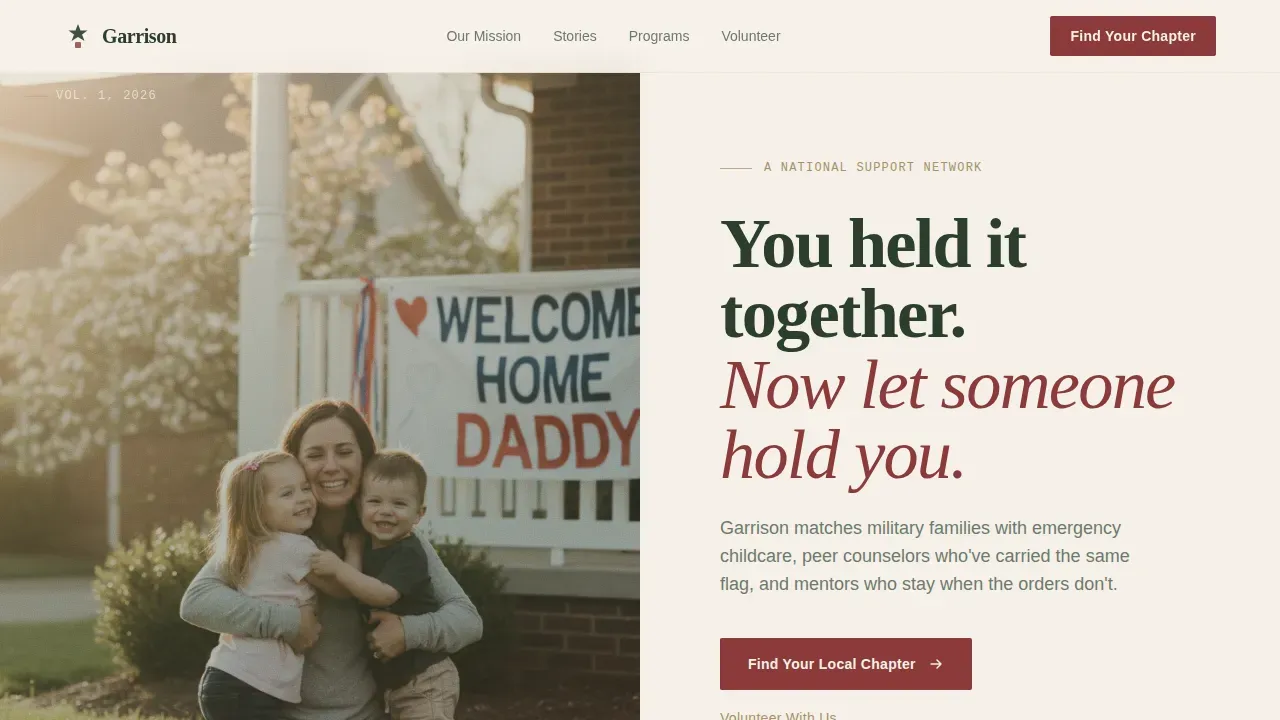
The header splits into two zones. The left side holds a candid, grain-touched golden-hour photograph of a military spouse with children. The right side carries a large, quiet serif headline and a single ember-red call-to-action button. This format immediately sets a tone of warmth and credibility.
Typographic Statistics Spread
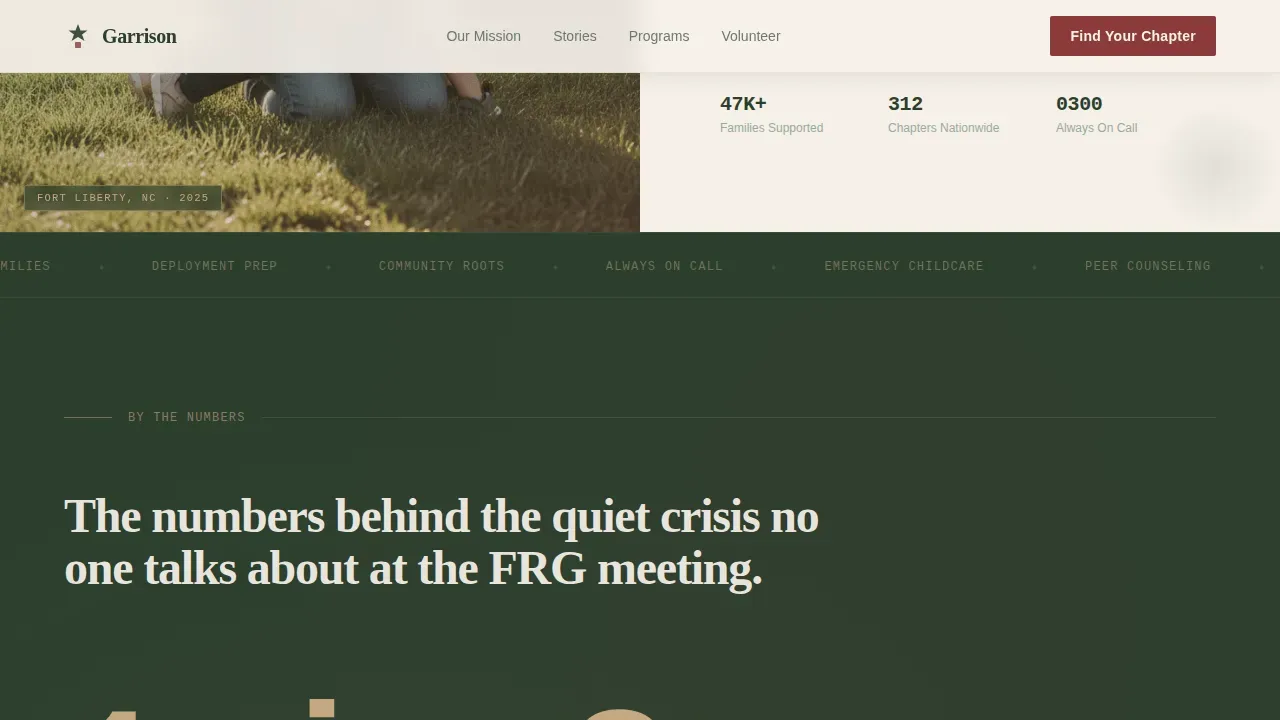
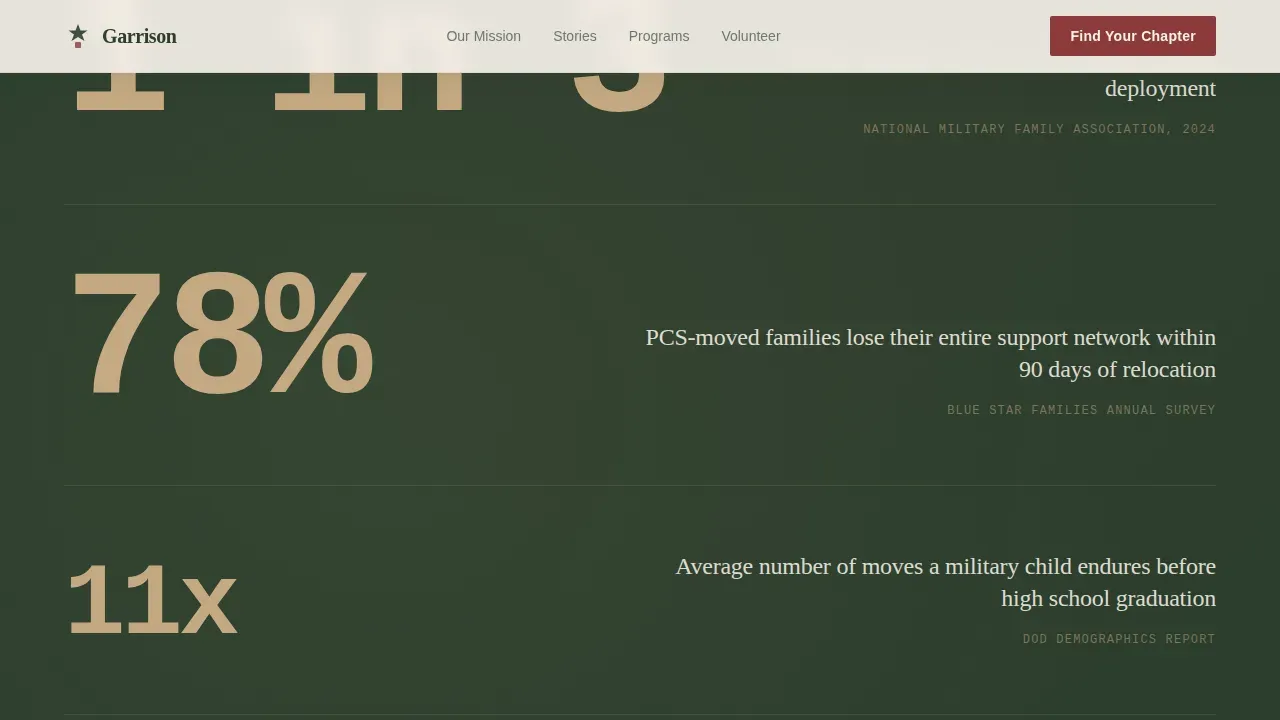
A "By the Numbers" section presents stark isolation statistics in oversized serif type set against deep woodland green. Numbers are formatted in JetBrains Mono for visual contrast. Scroll-triggered counter animations bring the data to life without diminishing its weight.
Staggered Testimonial Cards
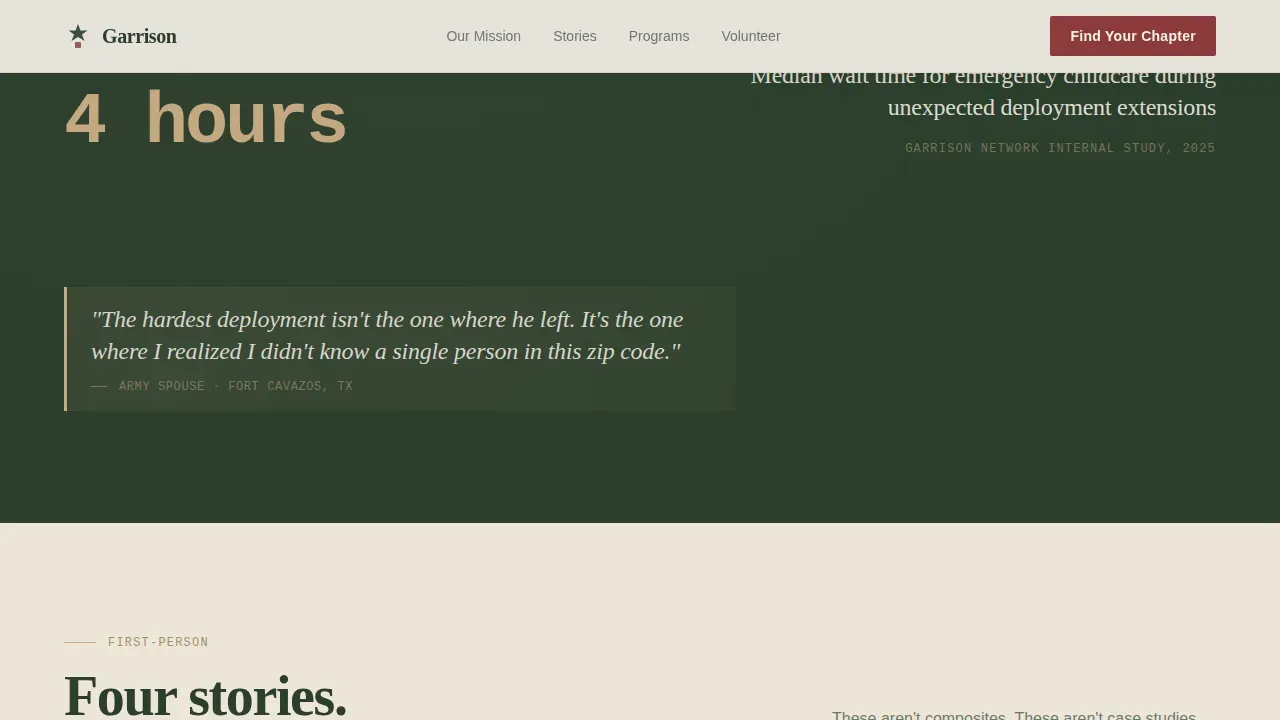
First-person testimonial cards are laid out in a staggered photo-essay format. Each card presents a real story in three sentences. Hover states and scroll-linked reveal animations ensure the section feels dynamic and human, not static.
Three-Column Program Breakdown
Emergency Support, Peer Connection, and Youth Mentorship each receive a dedicated editorial column. Each column uses documentary-style photography and concise program descriptions. This section alternates emotional weight with practical detail, ensuring families understand exactly what service is available.
Repeated Call-to-Action Architecture
The primary "Find Your Local Chapter" button appears three times: in the hero, after testimonials, and at the page close. Each placement uses ember red against garrison cream. A secondary "Volunteer With Us" text link in hearthstone sits beneath each primary button for the civilian visitor.
Scroll-Triggered Animation System
Medium-weight animations activate on scroll throughout the page. Testimonial cards stagger in, statistics count upward, and section transitions feel like turning the pages of a long-form feature article. The rhythm is unhurried and intentional.
Page sections overview
| Section | Purpose |
|---|---|
| Hero Split | Introduce the mission with editorial photo, headline, and primary call to action |
| By the Numbers | Present military family isolation statistics in bold typographic format |
| Testimonial Cards | Share first-person stories in staggered, photo-essay layout |
| Program Columns | Break down Emergency Support, Peer Connection, and Youth Mentorship offerings |
| Closing Call to Action | Drive final chapter-finder click with full-width ember-red block |
| Minimal Footer | Provide basic navigation and secondary volunteer path |
Design & branding system
The visual identity follows a Community Hearth theme. Every color and type choice is rooted in the feeling of a warm, sheltered space that has weathered many seasons. The palette and typography work together to feel editorial without feeling cold.
- Colors: Deep woodland green (#2C3E2D) anchors headers and section backgrounds; warm hearthstone (#C4A882) highlights pull quotes; soft garrison cream (#F5F0E8) fills body backgrounds; ember red (#8B3A3A) marks every call-to-action element.
- Typography: Fraunces serif for headlines and feature text; DM Sans for body copy; JetBrains Mono for statistics and numbers.
Mobile & speed optimization
The template is built mobile-first. Families searching for post support at midnight on a phone at Fort Liberty are the primary audience. Every layout decision reflects that priority.
- Section stacking, button sizing, and image placement are optimized for single-column mobile display without sacrificing editorial impact.
- Server Components handle static content zones to reduce rendering load, and images are optimized to keep the page responsive on slower connections at any hour of the week.
How this template helps you convert
This page earns the click before it asks for one. Visitors move through a carefully sequenced journey that builds legitimacy, emotional trust, and practical clarity at every scroll step.
- The hero photograph and headline create immediate recognition. Families feel seen before they read a single line of program detail, which lowers resistance and increases the likelihood they will continue scrolling.
- Statistics and testimonials complete the trust-building phase. By the time a visitor reaches the second or third call-to-action placement, they have already received enough evidence to feel confident clicking "Find Your Local Chapter" or choosing to sign up as a volunteer.
Other information about this template
The Garrison template is built around the same principles that guide effective military family support infrastructure. A central, accessible directory approach ensures families can find help immediately, reflecting a "no wrong door" policy across every program area. The design acknowledges that the army community includes active duty soldiers assigned to active duty units, their dependents, reservists, retirees, and Department of Defense (DoD) civilians, each with different requirements and transition timelines.
The template structure can support program descriptions aligned with recognized service models. These include mobilization and deployment support for Reserve and National Guard soldiers and their family members, relocation readiness guidance for PCS processing, emergency financial assistance details for eligible recipients, and education and training resources that promote life skills and resilience during both war and peacetime operations.
Reach is built into the layout. The page is designed to coordinate civilian volunteers and community partners through a clear secondary path, so every person who visits can find a role. The schedule of calls to action ensures no visitor leaves without a next step. Families assigned to installations located across multiple states can use the chapter-finder tool to reach their nearest local post chapter.
- The garrison template functions as a reliable source of direction, not just information, letting families focus on daily life rather than searching for help.
- The page is designed to enhance communication and resource sharing, drawing on editorial layout principles that improve clarity and build trust with every scroll.
- The template is built without forms on the landing page itself; visitors sign up or contact chapters through the chapter-finder tool after clicking through.
- Contractors, sponsors, and community partnership organizations can be featured through the volunteer and partner sections without disrupting the primary family-focused message.
- The Army Emergency Relief program model and Army Family Action Plan principles reflect the type of program administration logic this template is built to present and explain clearly.
- Hope For The Warriors, a national nonprofit that has served over 40,000 individuals and families since 2006, represents the kind of established, high-trust organization this template is purpose-built to serve.
Theme
Community Hearth
Creative direction
Movement & Cause
Color system
Forest Trust
Style
Editorial/Magazine
Direction
Click-Through
Page Sections
Editorial Half-page Hero Section
Bold Statistics Typography Spread
Staggered Testimonial Card Layout
Three-column Program Breakdown
Repeating Call-to-action Architecture
Scroll-triggered Animation System
Related questions
Does this template include a contact form or sign-up form?
Who manages the chapter-finder tool this page links to?
Can this template be adapted for reservists and National Guard families?
Is this template suitable for a transitioning service member audience?
How does the secondary volunteer path work?