Research Center Landing Page Template
A sidebar companion landing page built for a geriatrics research center. It combines a portrait-centered hero, a three-voice testimonial mosaic, and a scroll-tracking sidebar that surfaces contextual downloads as visitors read. The primary goal is driving downloads of the 2024 Aging Research Compendium, with secondary paths for trial eligibility screening and collaboration proposals.
by Rocket studio
Quick summary
This template is a desktop-first sidebar companion landing page for a longevity and geriatrics research center. It weaves scholarly credibility with human warmth, leading visitors from a cinematic portrait hero through biomarker research, multi-voice testimonials, and faculty profiles. Every scroll step unlocks a contextual sidebar offer, earning trust before asking for an email.
Who this template is for
This template is built for research institutions, academic medical centers, and geriatrics programs that need to communicate rigorous science to multiple audiences at once. It handles the hybrid challenge of speaking to specialists and non-specialists on the same page without losing either.
- Academic collaborators and principal investigators exploring joint grant opportunities
- Geriatricians and clinical trial coordinators referring patients or seeking institutional partners
- Adult children and caregivers researching aging interventions for a family member
What problem this template solves
Research centers often publish strong science but present it in ways that feel either too technical for caregivers or too thin for program officers. This template closes that gap with layered storytelling and role-aware content pathways.
- Visitors leave before they reach the download because the page gives them nothing to trust first
- A single static call to action ignores the very different needs of a geriatrician versus a caregiver
- Institutional credibility gets buried in dense text instead of being shown through people and proof
What you get with this template
You get a fully structured, content-ready landing page organized around six purposeful sections, a persistent contextual sidebar, and three distinct conversion paths. The design system is pre-built and consistent from header to footer.
- A hero section with a portrait-centered layout, participant name-and-age caption, and sidebar scaffold
- A testimonial mosaic that rotates between researcher pull quotes, participant audio waveform tiles, and physician handwritten note scans
- A download call-to-action section with an email capture form, role selector, and a five-question trial eligibility screener
Feature list
This template ships with a set of purposefully designed components grounded in the brief.
Scroll-Linked Sidebar Tracker
The persistent sidebar watches where visitors are on the page. It surfaces a relevant download at each section: a white paper near the biomarker research area, a trial eligibility checklist in the participant section, and a collaboration prospectus near faculty profiles. The sidebar uses amber only for interactive states, teaching the eye to trust clickable elements.
Three-Voice Testimonial Mosaic
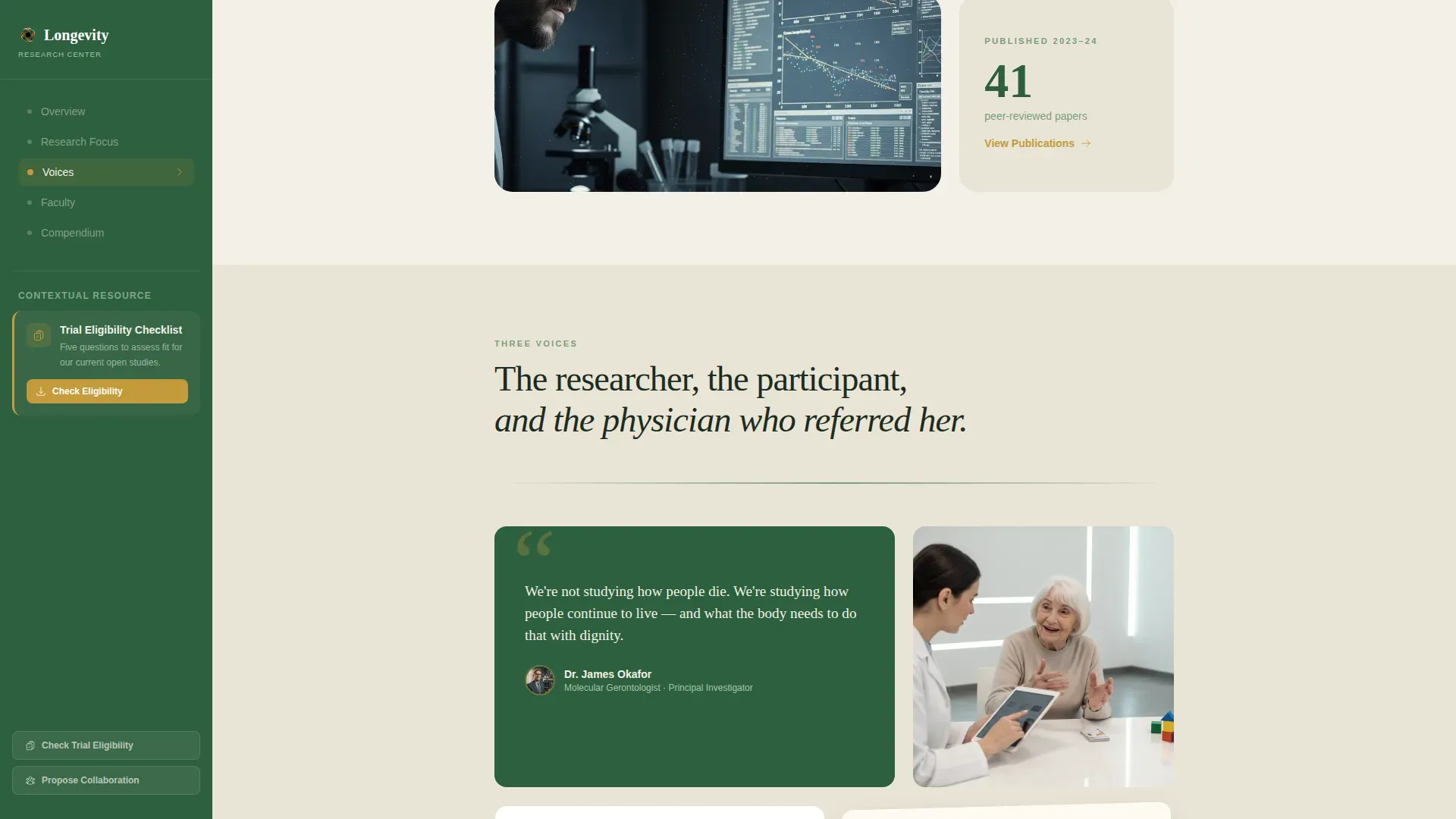
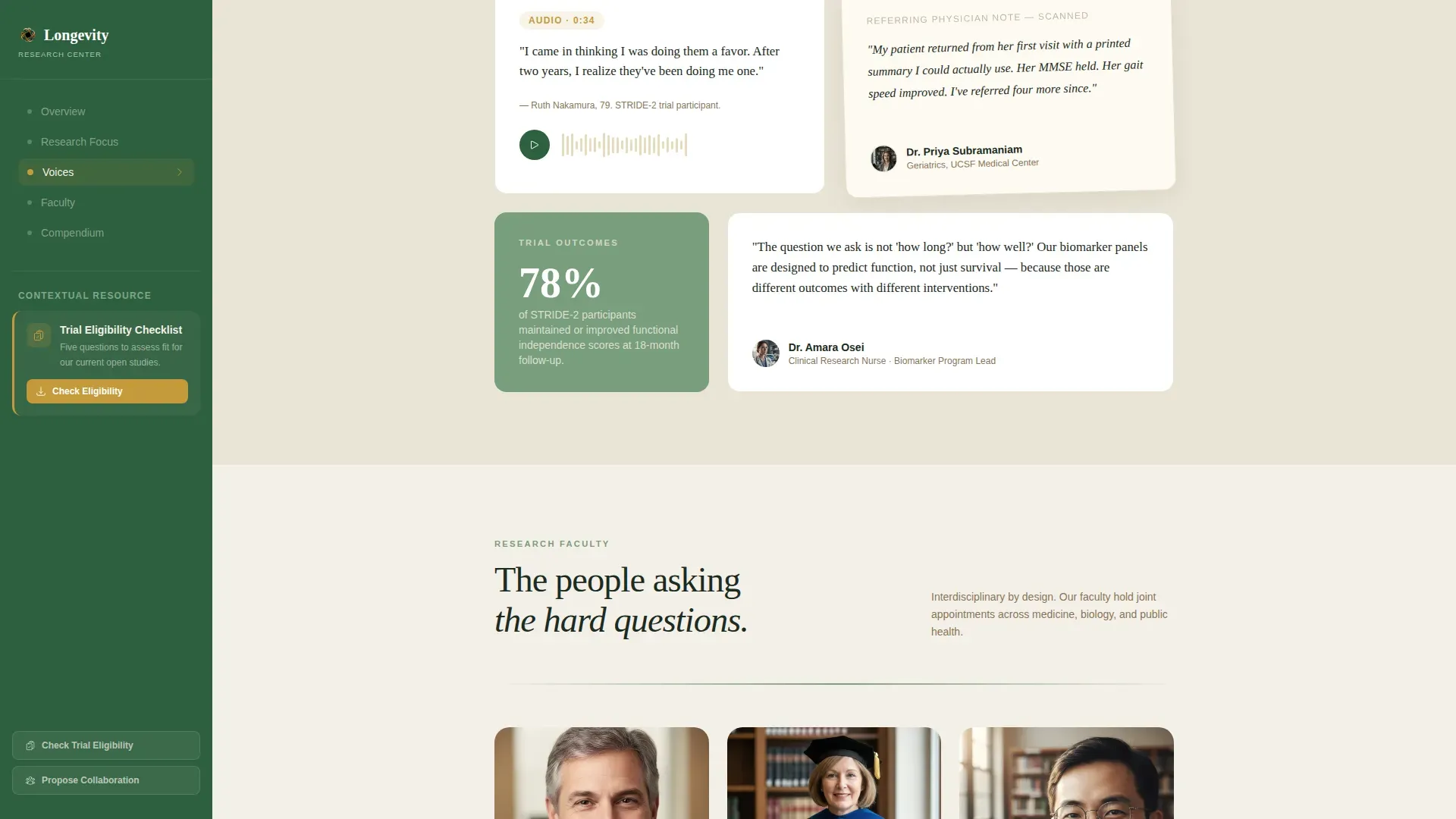
Social proof is delivered in three rotating formats. Researcher tiles carry methodology pull quotes over muted photography. Participant tiles embed thirty-second audio clips with waveform visualizations. Physician tiles display scanned handwritten notes. The format shifts with each tile so the mosaic never feels repetitive, even as the message accumulates.
Portrait-Centered Hero Section
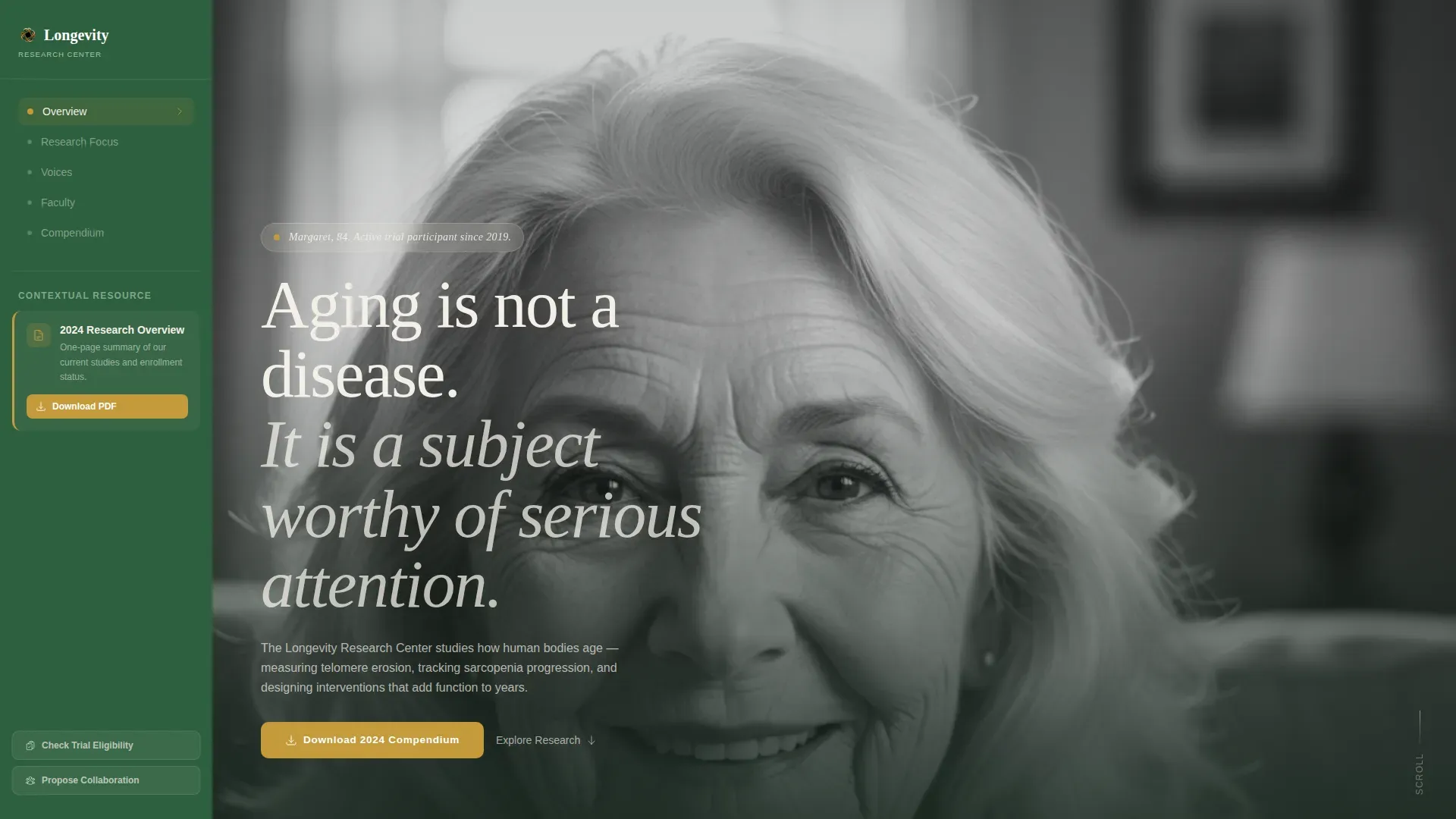
The hero leads with a large-format black-and-white photograph of an elder research participant. The image is lit with soft window light to emphasize human texture rather than clinical setting. A serif caption below reads the participant's first name and age, grounding the page's argument before any research language appears.
Role-Aware Download Form
The primary call to action collects only an email address and a role selection from five options: clinician, researcher, caregiver, journalist, or other. The form is framed as access to the 2024 Aging Research Compendium, positioning the download as a continuation of the reading experience rather than a transaction.
Biomarker Research Bento Layout
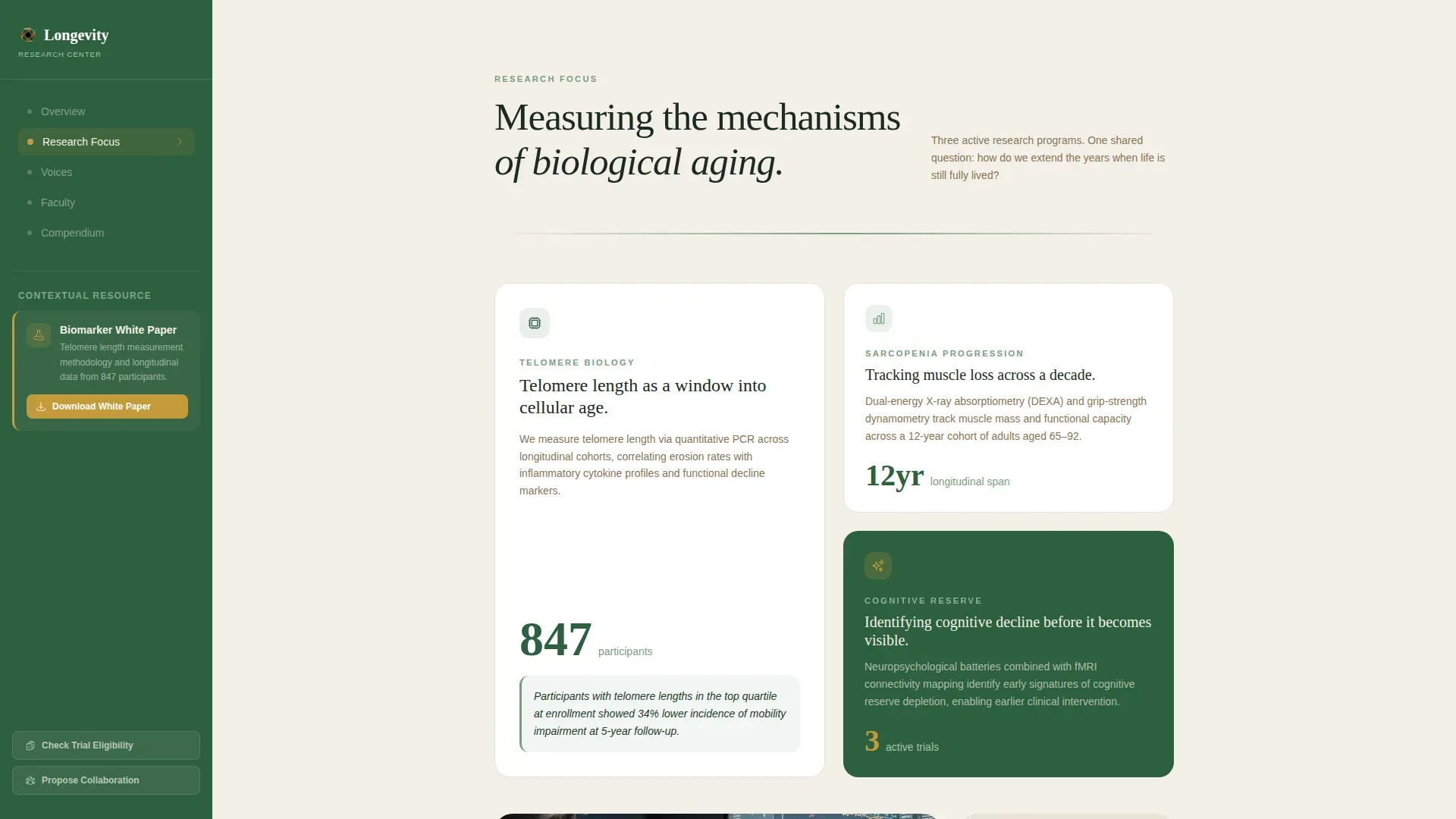
The research focus section presents three study areas in a bento-style grid: telomere erosion measurement, sarcopenia progression tracking, and cognitive intervention design. Each cell provides a readable insight or a quotable statistic to reward scrolling before asking for any action.
Collaboration and Trial Eligibility Paths
Two secondary conversion paths live in the sidebar throughout the scroll. "Check Trial Eligibility" opens a five-question modal screener. "Propose a Collaboration" links to a brief intent form collecting institutional affiliation, research focus, and preferred contact method.
Page sections overview
| Section | Purpose |
|---|---|
| Hero Portrait | Establish human credibility with elder participant portrait and sidebar scaffold |
| Research Focus Bento | Present telomere, sarcopenia, and cognitive biomarker methodology |
| Testimonial Mosaic | Build trust through researcher, participant, and physician voices |
| Faculty Profiles | Showcase team expertise with asymmetric cards and collaboration call to action |
| Download Call to Action | Capture email via Compendium form with role selector and trial screener |
| Minimal Footer | Close with clean horizontal footer pattern |
Design & branding system
The visual identity follows an Organic Flow theme rooted in a Forest Trust color palette. The overall aesthetic evokes pressed botanical specimens under glass: scholarly, living, and patient. Fraunces serif handles all headings; DM Sans handles body copy.
- Old-growth canopy green (#2D5F3E) anchors the persistent sidebar; birch bark cream (#F4F0E8) dominates the reading column
- Understory moss (#7A9E7E) softens section dividers; quiet amber (#C49A3C) appears exclusively on links, download buttons, and active sidebar states
- Scroll-triggered fade reveals and medium animation intensity keep the experience calm without feeling static
Mobile & speed optimization
Although the template is desktop-first to serve its academic audience, it is built to stack cleanly on smaller screens. The sidebar collapses into inline contextual prompts on mobile, preserving the conversion logic without the fixed-column layout.
- Sidebar companion converts to inline contextual download prompts on mobile
- Static sections use server-rendered components; interactive elements such as the sidebar tracker, modal screener, and role selector form are handled client-side
- Waveform SVG animations and tab switchers are scoped to client components to keep initial load lean
How this template helps you convert
This template is designed around a give-first philosophy. Every section delivers something of value before presenting an ask, so the final download feels earned rather than extracted.
- The hero portrait and participant caption create immediate emotional credibility, lowering the skepticism that greets institutional pages before a single word of science is read.
- The scroll-aware sidebar offers the right resource at the right moment, reducing friction for users who know what they need but might not scroll all the way to the form.
- The role selector on the download form lets visitors self-identify, making the Compendium feel personally relevant and increasing the perceived value of submitting an email.
Other information about this template
This template is suited to any academic medical institution building a content-led research presence for a geriatrics or longevity-focused program. It is equally useful for centers preparing grant submissions who need a credible web presence to share with program officers.
- The template style is Sidebar Companion, built for long-form content that benefits from persistent contextual navigation
- The header concept is Portrait-Centered, a deliberate choice to lead with human subjects rather than laboratory imagery
- Creative direction follows a Testimonial Mosaic approach, cycling through three distinct voice-and-format combinations to sustain engagement across a long scroll
- The landing page direction is Content and Resource, meaning the primary measure of success is a qualified download rather than a direct service inquiry
- Footer uses a minimal horizontal pattern consistent with academic institutional design standards
- The template supports a desktop-first layout with a responsive mobile stack, appropriate for an audience that predominantly accesses research content on larger screens
Theme
Organic Flow
Creative direction
Testimonial Mosaic
Color system
Forest Trust
Style
Sidebar Companion
Direction
Content/Resource
Page Sections
Scroll-linked Sidebar Tracker
Three-voice Testimonial Mosaic
Portrait-centered Hero
Role-aware Download Form
Biomarker Research Bento Grid
Trial Eligibility and Collaboration Paths
Related questions
Who is this landing page template designed for?
Can I adapt the testimonial mosaic for my own content?
What does the scroll-tracking sidebar do?
How does the download form work?
Is the trial eligibility screener included in the template?