Surface — Expert Asphalt Contractor Landing Page Template
Tarmac is a single-column editorial landing page built for Nairobi asphalt paving contractors targeting property managers, county procurement officers, and logistics firms. It uses a bold frequently asked question-driven layout, flush-left serif headlines, an Ink and Paper color palette, and a site survey form to convert serious B2B visitors into qualified leads efficiently.
by Rocket studio
Quick summary
Tarmac is an editorial landing page template designed specifically for asphalt paving contractors operating in Nairobi's commercial and institutional markets. The page flows as a single vertical column, leading visitors through bold frequently asked question blocks that answer the exact questions property managers and procurement officers ask before committing to a paving project. Every design choice reinforces authority, clarity, and trust.
Who this template is for
This template is built for paving contractors who work at a commercial or institutional scale. It suits operators who need their landing page to do the heavy qualification work before a sales call happens.
- Asphalt paving contractor teams serving commercial estates, mall parking decks, and market access roads across Nairobi sub-counties
- Paving contractors who handle county or government procurement inquiries and need a page that reads as a credible industry document
- Logistics and construction firms looking to communicate hot-mix overlay, cabro interlocking, drainage grading, and line marking expertise to developers and property managers
What problem this template solves
Over 85% of people use the internet to find local paving contractors, and 76% of customers research online before contacting a business. Despite that, most asphalt paving contractor websites fail to answer the specific technical and logistical questions that B2B buyers need resolved before they will commit to a site survey request. The result is lost leads and wasted traffic.
This template solves that problem directly:
- Unanswered buyer doubts around lot size minimums, rain-season paving capability, county permit paperwork, project timelines, and material quality are addressed inline, before a visitor has a chance to leave
- Weak trust signals are replaced by editorial project captions that name tonnage, square meterage, and completion days, giving procurement officers the factual specificity they expect
- Scattered conversion paths are replaced by a repeating "Request a Site Survey" call to action placed after every third frequently asked question block, supported by a secondary PDF spec sheet download gated behind a business email field
What you get with this template
The template delivers a complete, publication-quality landing page that paving contractors can deploy to convert serious B2B visitors into site survey requests. Every section is structured to educate, qualify, and convert without wasting a reader's time.
- A single-column flow layout running from a giant flush-left serif hero headline through sequenced frequently asked question blocks, an inline site survey form, and a horizontal footer pattern
- An accordion-style frequently asked question system with scroll-reveal animations and an amber rule draw effect that keeps information organized while preventing visitors from being overwhelmed by text
- Two conversion paths built into the page: the primary "Request a Site Survey" form collecting company name, project location by Nairobi sub-county dropdown, estimated area in square metres, and preferred contact method toggle; and a secondary PDF spec sheet download gated behind a business email field
Feature list
This section covers the core built-in capabilities that make the Tarmac landing page work for asphalt paving contractors in a competitive local market.
Giant Flush-Left Editorial Hero
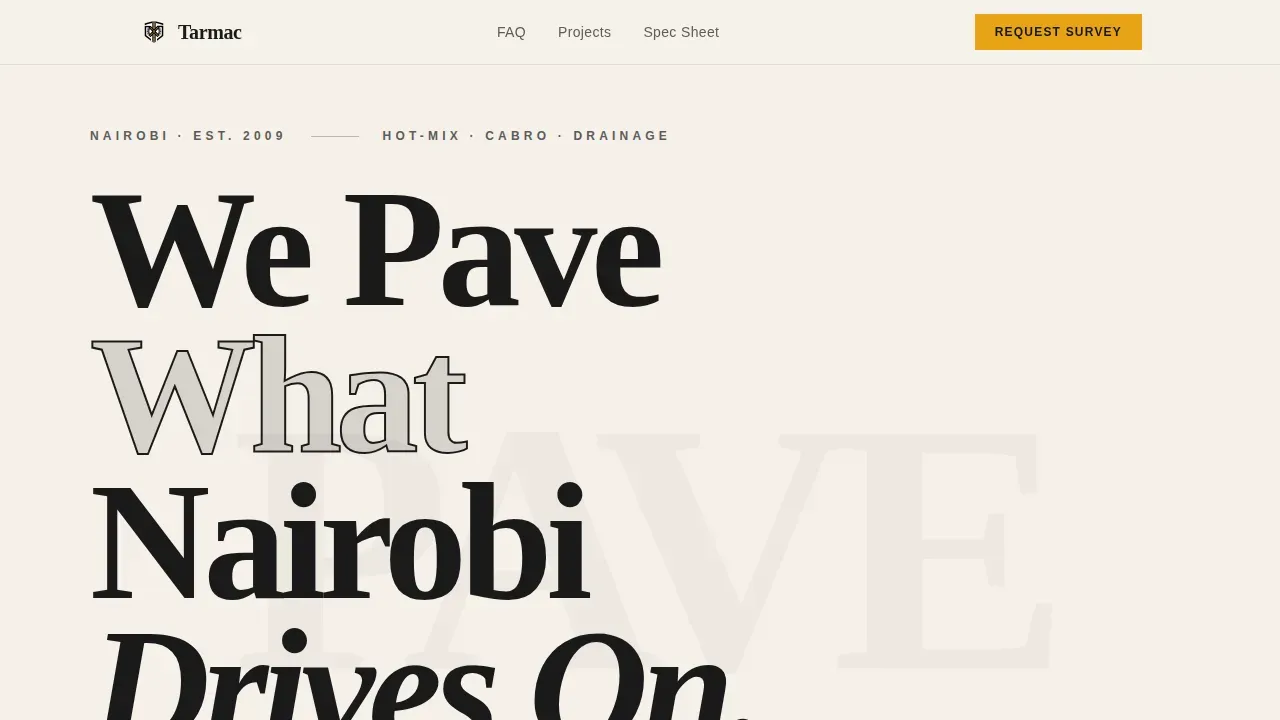
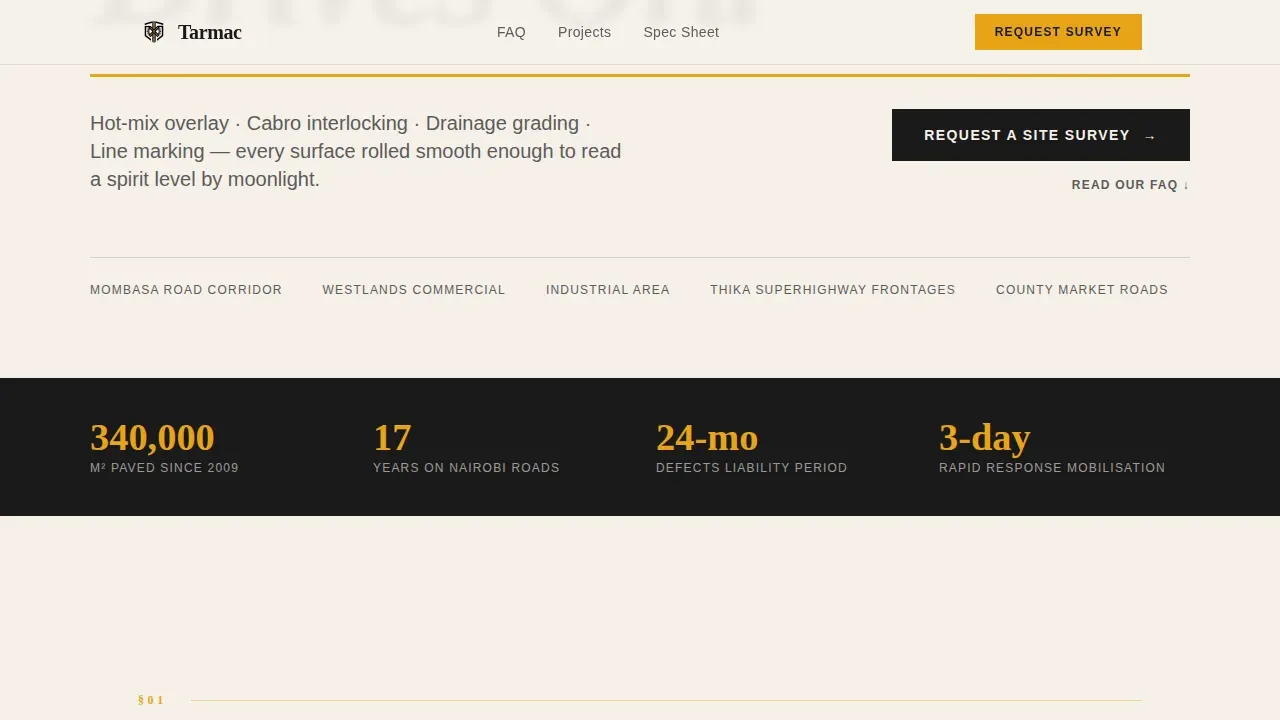
The hero section opens with an enormous Fraunces serif headline set flush-left in publication black against broadsheet cream. The word "Pave" is sized to fill roughly half the viewport width, making an immediate authority statement without relying on photography. A thin amber rule runs beneath the headline, and a restrained Manrope sans-serif deck line names the core paving services: hot-mix overlay, cabro interlocking, drainage grading, and line marking. White space does the selling, keeping the page feeling dense and certain rather than cluttered.
frequently asked question-Driven Vertical Content Architecture
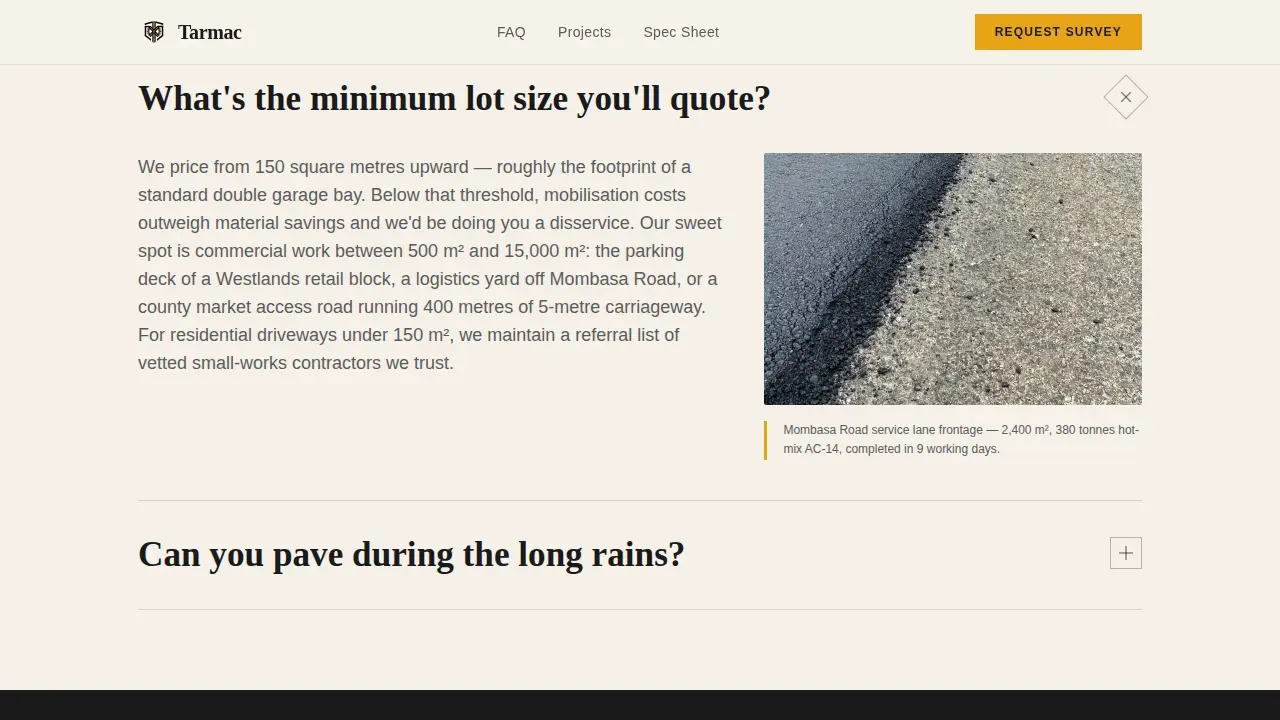
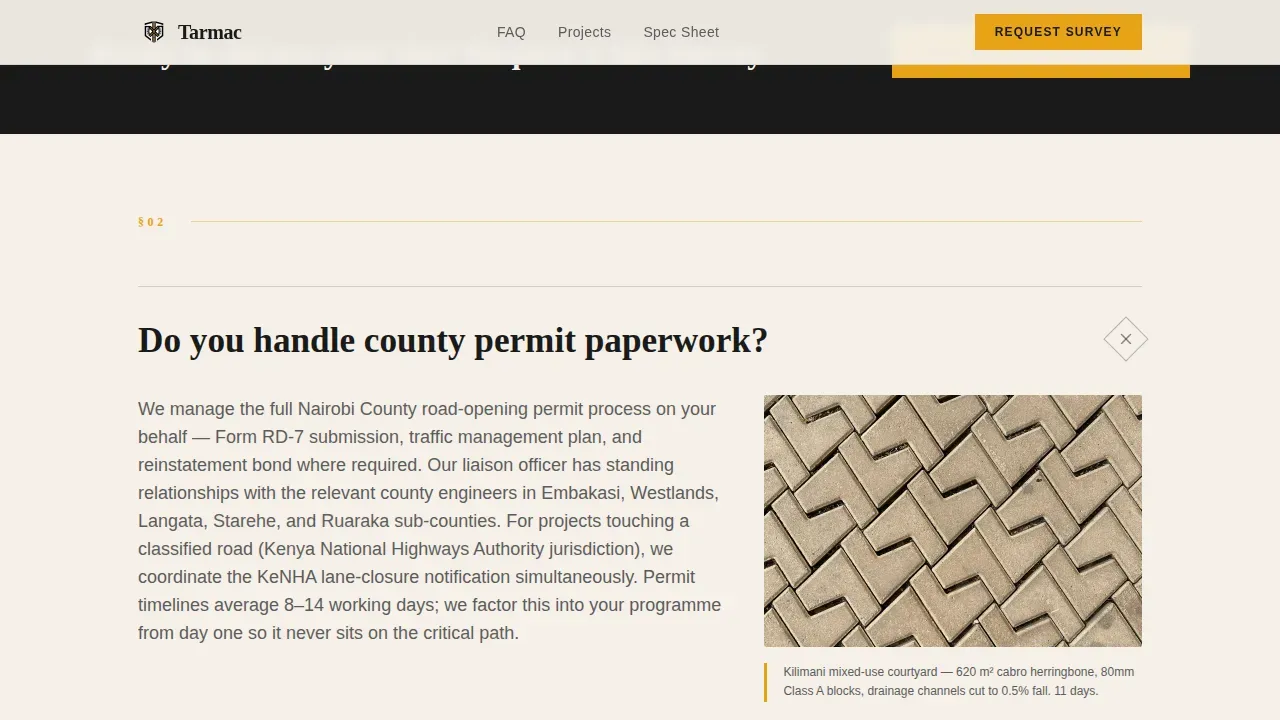
The page's content strategy is built around a vertical stack of bold question-and-answer blocks. Each question is typeset at heading scale, mimicking a magazine section header. Answers unfold as measured editorial paragraphs with space for inline project photos captioned with real project data including tonnage, square meterage, and completion days. Using collapsible accordion-style reveals, visitors can scan questions and expand only the answers relevant to their project, which keeps the page scannability high and prevents cognitive overload.
Repeating Site Survey Call to Action
A "Request a Site Survey" call-to-action block in road-marking amber on publication black repeats after every third frequently asked question section. This placement strategy captures leads at multiple moments of peak interest as a visitor reads through the page. The form collects only the essential fields needed to qualify a lead: company name, project location as a Nairobi sub-county dropdown, estimated area in square metres, and a preferred contact method toggle between phone and email. Strategic form placement at multiple points in the page is a proven method for converting visitors who are ready to act.
Gated PDF Spec Sheet Download
Below the frequently asked question blocks, a secondary conversion path offers a downloadable paving standards PDF. Visitors must provide a business email address to access it. This gate filters out casual browsers and qualifies serious paving contractors, developers, and procurement officers who are actively preparing a project brief. It gives the asphalt paving contractor a second lead-capture mechanism that does not compete with the primary site survey form.
Ink and Paper Editorial Design System
The entire page uses a four-color Ink and Paper palette: publication black at #1A1A1A, broadsheet cream at #F5F0E8, asphalt mid-gray at #5C5C5C, and road-marking amber at #E8A317. Amber is used exclusively for links, dividers, call-to-action elements, and the animated rule beneath the headline. Fraunces handles all serif display headings. Manrope handles all body text, captions, and deck lines. The result is a page that reads like an infrastructure journal, which is exactly the authority signal that county procurement officers and property managers respond to.
Scroll-Reveal Animation and Interaction Layer
The template includes low-to-medium animation implemented through scroll reveals, an animated amber rule draw on page load, and subtle hover states on frequently asked question blocks and call-to-action buttons. The accordion-style frequently asked question interaction is powered by minimal JavaScript, keeping the page lean. Server components handle all static sections. The overall interaction layer reinforces the editorial reading experience without distracting from the core content.
Page sections overview
| Section | Purpose |
|---|---|
| Hero Headline Block | Flush-left serif headline, amber rule, and services deck line establish authority immediately |
| frequently asked question Block One | Addresses lot size minimums and rain-season paving capability with editorial answers |
| Site Survey call to action One | First amber-on-black call-to-action prompt after initial frequently asked question block |
| frequently asked question Block Two | Covers county permit paperwork, materials quality, and inline project photo illustrations |
| Site Survey call to action Two | Second repeating call-to-action placement at mid-page peak interest moment |
| frequently asked question Block Three | Handles project timeline, pricing transparency, and spec sheet download offer |
| Site Survey call to action Three | Third call-to-action placement closing the frequently asked question content sequence |
| Full Form Section | Complete site survey form with sub-county dropdown and contact toggle |
| Footer Pattern | Horizontal footer pattern with brand and navigation closure |
Design & branding system
The Tarmac template uses an Ink and Paper color system that evokes an infrastructure journal left on a site engineer's desk. The visual language is authoritative and restrained, making it immediately credible to commercial and institutional buyers who encounter many generic contractor websites.
- Typography pairing: Fraunces serif at display sizes for all headlines and question blocks; Manrope sans-serif for body copy, caption text, and the services deck line under the hero, creating a clear editorial hierarchy
- Color roles: Publication black (#1A1A1A) and broadsheet cream (#F5F0E8) carry all structural weight; asphalt mid-gray (#5C5C5C) handles supporting text; road-marking amber (#E8A317) is used exclusively for links, horizontal dividers, call-to-action buttons, and the animated amber rule beneath the hero headline
Mobile & speed optimization
The template is designed desktop-first to match the primary audience of procurement officers and property managers who typically review contractor materials on desktop. Responsive design is implemented so the layout adapts cleanly to mobile devices, since over half of all web traffic now comes from mobile. Research shows that 40% of visitors will abandon a website that takes more than 3 seconds to load, so the template uses server components for all static sections and minimal JavaScript for interactive elements.
- Responsive design ensures the single-column flow reads correctly across desktop, tablet, and mobile screen sizes without breaking the editorial layout
- Minimal JavaScript powers only the accordion frequently asked question reveals and form toggle interaction, keeping the page lean and reducing load time risk for mobile visitors on variable Kenyan network connections
How this template helps you convert
The average website engagement window is just 54 seconds. This template is structured so that every second of that window moves a visitor toward taking action. The frequently asked question-driven layout means visitors are answered before their doubts form, and the repeating call-to-action blocks mean there is always a clear next step visible.
- frequently asked question content reduces hesitation: Each question block addresses a real objection that property managers, procurement officers, or logistics firm representatives have before they will request a site survey. Answering doubts around costs, rain-season capability, permit guidance, and project timelines inline means fewer visitors leave to search for answers elsewhere.
- Dual conversion paths qualify leads by intent: The primary site survey form captures visitors ready to start a project now. The gated PDF spec sheet captures visitors who are still in a research and preparing phase. Both paths generate usable leads without competing with each other, helping the asphalt paving contractor develop a stronger pipeline from a single landing page.
Other information about this template
This template is designed to serve as the foundation of an online marketing strategy for asphalt paving contractors competing in Nairobi's local market. It fits naturally into a broader set of strategies that paving contractors can develop to win more leads and grow their business.
- Local search presence: A well-built landing page supports local search visibility. Paving contractors who also maintain an active Google Business Profile and run Google Ads campaigns will find this page functions as a high-quality destination for paid and organic traffic. Google Analytics can then provide a comprehensive view of how visitors interact with the page, letting the team measure success and refine their approach over time.
- Content marketing alignment: The frequently asked question-driven editorial format acts as a comprehensive guide to the paving contractor's services, methods, and project standards. Content marketing of this type generally costs significantly less than traditional advertising while generating more leads. The page's editorial articles-style frequently asked question content can also educate visitors who arrive with research intent, converting them into qualified leads before they sign with a competitor.
- Trust signal integration: The template supports inline project photo illustrations with captions, space for client testimonials, and a downloadable paving standards PDF. Brief testimonials and logos of trusted partners can serve as social proof alongside the editorial content. Businesses with photos receive 42% more requests for directions and 35% more clicks to their websites compared to those without images, which makes the project photo caption system a direct influence on lead generation outcomes.
- Marketing measurement guidance: Return on Ad Spend, or ROAS, calculates the revenue generated from each advertising dollar spent on Google Ads or other paid channels. Lead quality, which measures what percentage of leads turn into estimates and paying jobs, is the other key metric for paving contractors to track. The most important metric is ultimately return on investment, and this template is structured to protect and improve that number by qualifying visitors before they reach the form.
- Paving resources context: Professionals seeking guidance on paving types, installation techniques, drainage specifications, and materials standards will find that the editorial frequently asked question format of this template mirrors the kind of authoritative resources that experienced paving specialists rely on. The template's toolbox-style frequently asked question structure assists both the contractor and their clients in understanding project scope and expectations clearly before work begins.
- Template title reference: This is the Tarmac editorial frequently asked question driven paving contractor landing page template, designed for Nairobi-based asphalt paving contractor businesses operating at commercial and institutional scale.
Theme
Editorial Magazine
Creative direction
FAQ-Driven
Color system
Ink & Paper
Style
Single Column Flow
Direction
Partnership/B2B
Page Sections
Giant Flush-left Editorial Hero Section
Accordion Frequently Asked Question Content System
Repeating Site Survey Call-to-action
Gated PDF Spec Sheet Download
Ink and Paper Editorial Design System
Scroll-reveal and Minimal Animation Layer
Related questions
Can I customize the frequently asked question questions and answers for my specific paving services?
Does the site survey form support different Nairobi project locations?
Is this landing page layout suitable for both desktop and mobile visitors?
Can I add real project photos and caption data to the frequently asked question sections?
Does the template include the gated PDF spec sheet download component?