Neurology Medicine Booking Website Template
Synapse is a single-column flow landing page built for private neurology practices. It walks prospective patients through every step of the care process before asking them to book. The design uses a Portrait-Centered hero, a transparent five-step patient journey timeline, and a dual-path conversion section with a consultation form and a downloadable PDF lead magnet.
by Rocket studio
Quick summary
Synapse is a lead generation landing page designed for a private neurology practice. It leads with a portrait of the treating neurologist, names conditions in plain language, and walks visitors through the full patient journey before presenting a consultation request form. The page earns trust by showing exactly what happens at every step, before asking for anything.
Who this template is for
This template is built for private neurology practices that want to convert anxious, research-driven patients into booked consultations. It works especially well when the practice offers longer, more thorough appointments than a typical GP referral.
- Neurologists running an independent private practice who need a professional web presence that reflects clinical authority
- Practices serving patients with unresolved symptoms, such as tremors, memory lapses, migraines, or seizures, who need reassurance before they commit to calling
- Clinics that want to capture two types of leads: ready-to-book patients and earlier-stage visitors who want more information first
What problem this template solves
Many patients with neurological symptoms have already cycled through multiple referrals. They arrive at a specialist's page carrying doubt, anxiety, and unanswered questions. A generic medical website with a phone number and a stock photo of a hospital corridor does not address any of that.
- Patients need to see what actually happens before, during, and after their first appointment, not just a list of conditions treated
- Practices lose potential bookings when the process feels opaque or clinical in the cold, impersonal sense
- Two types of potential patients visit the same page: those ready to call today and those who are still researching, and one call-to-action path cannot serve both
What you get with this template
The template delivers a complete, scroll-guided landing page experience. Every section is sequenced to reduce patient anxiety and build confidence in the practice before the conversion moment arrives.
- A seven-section single-column layout: hero, conditions treated, patient journey timeline, diagnostic tools, testimonials, dual call-to-action section, and a linear single-row footer
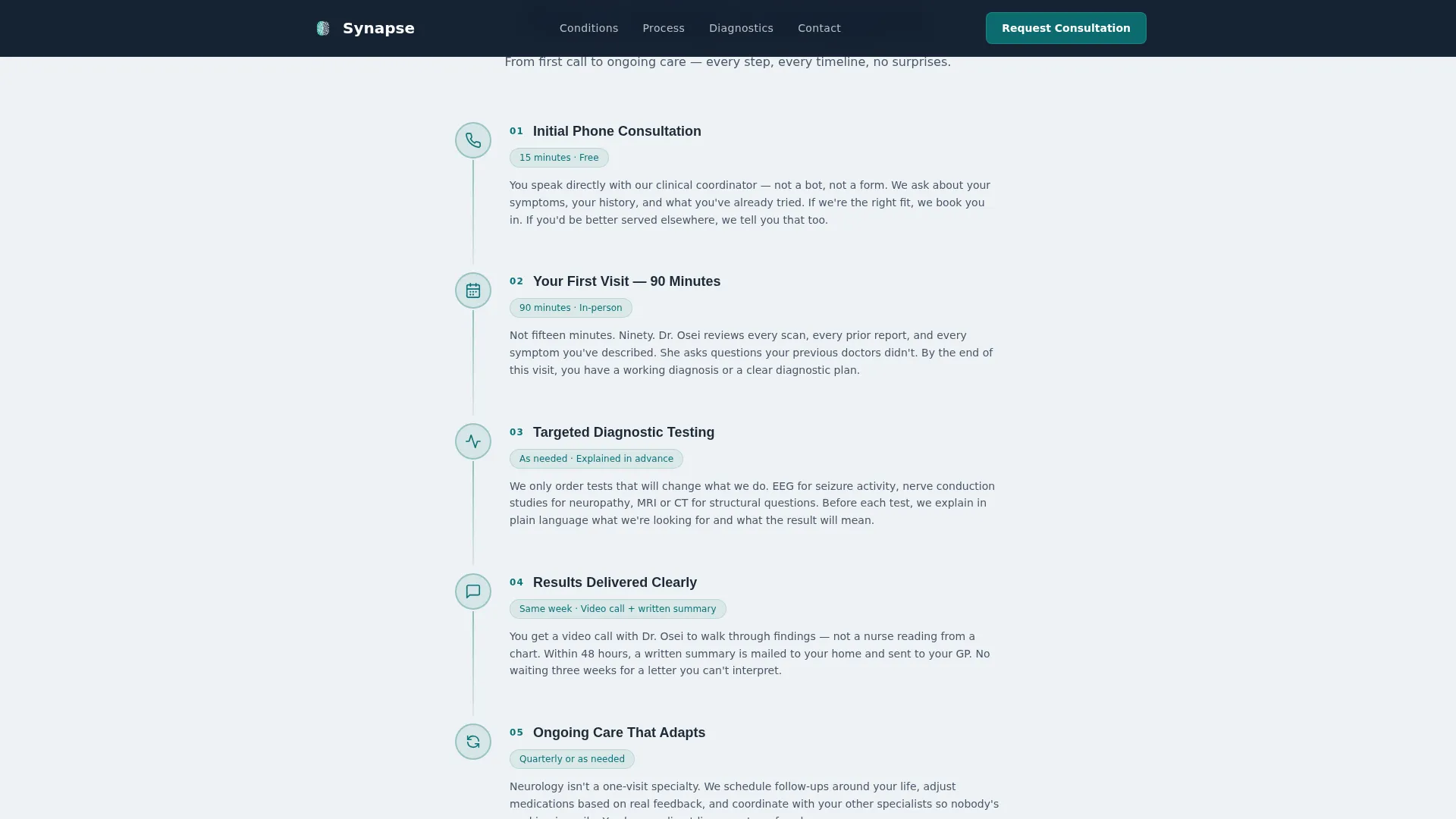
- A five-step transparent process timeline with teal icons, showing the patient journey from the initial phone consultation through to ongoing care
- A dual-path conversion section combining a consultation request form with a gated PDF download, capturing both ready-to-book and still-researching visitors
Feature list
This section covers the core built-in components and design capabilities included in the Synapse template.
Portrait-Centered Hero Section
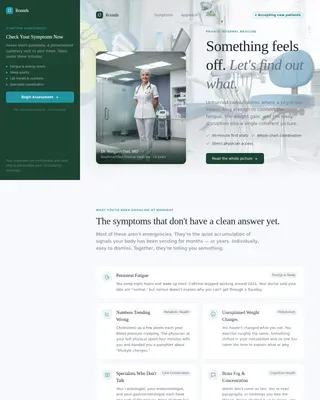
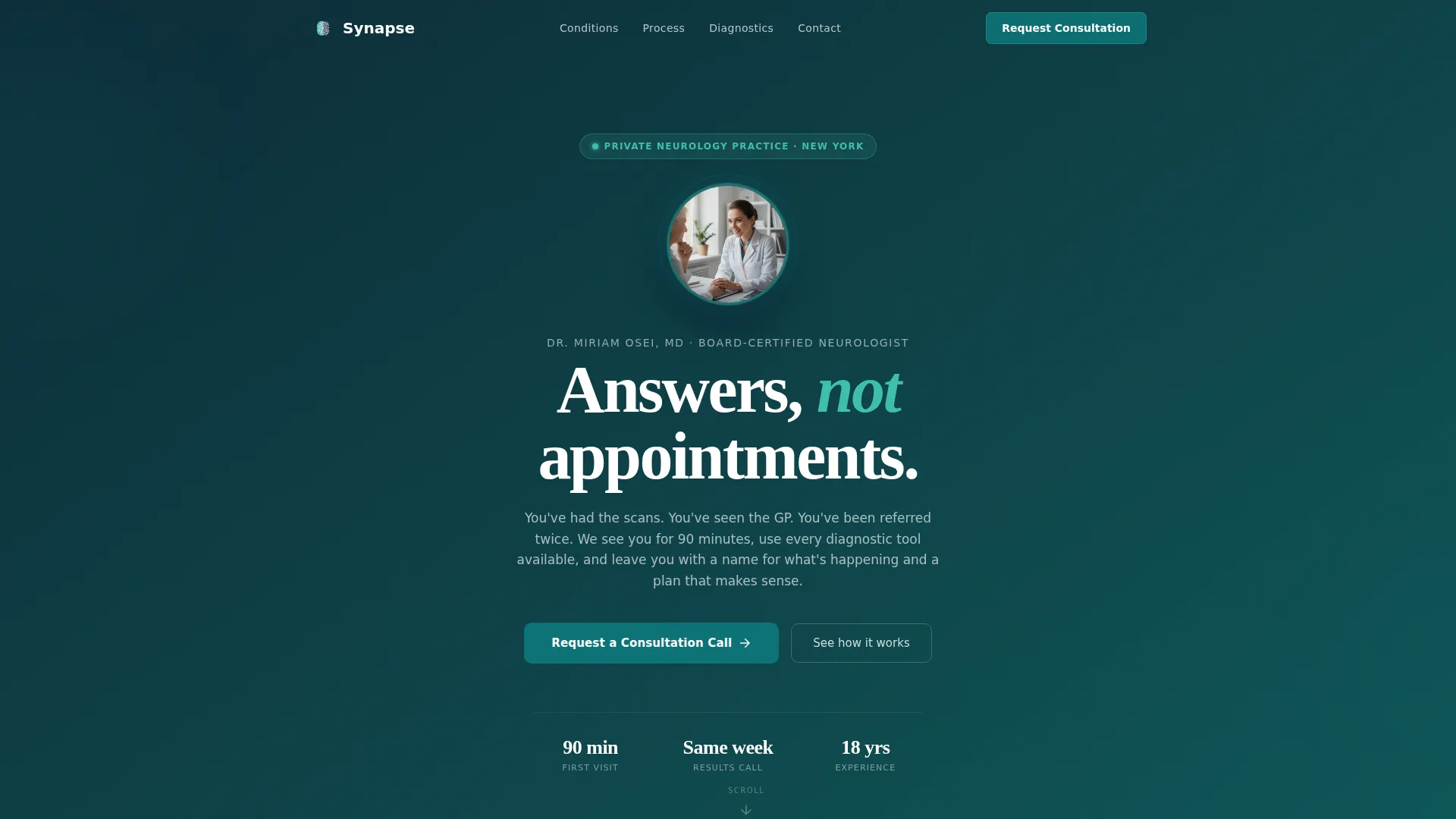
The hero features a tightly composed, shoulders-up portrait of the lead neurologist against a muted teal-gray gradient. The headline reads "Answers, not appointments." A primary call-to-action button sits directly below, prompting visitors to request a consultation call. The layout is designed to feel personal and direct, not institutional.
Five-Step Patient Journey Timeline
A numbered vertical timeline walks visitors through every stage of care. Steps cover the initial phone consultation, the first 90-minute visit, the diagnostic tools used (electroencephalogram, nerve conduction studies, and neuroimaging), how results are communicated via same-week video call and written summary, and what ongoing care involves. Each step displays a single teal icon and two concise sentences.
Plain-Language Conditions Grid
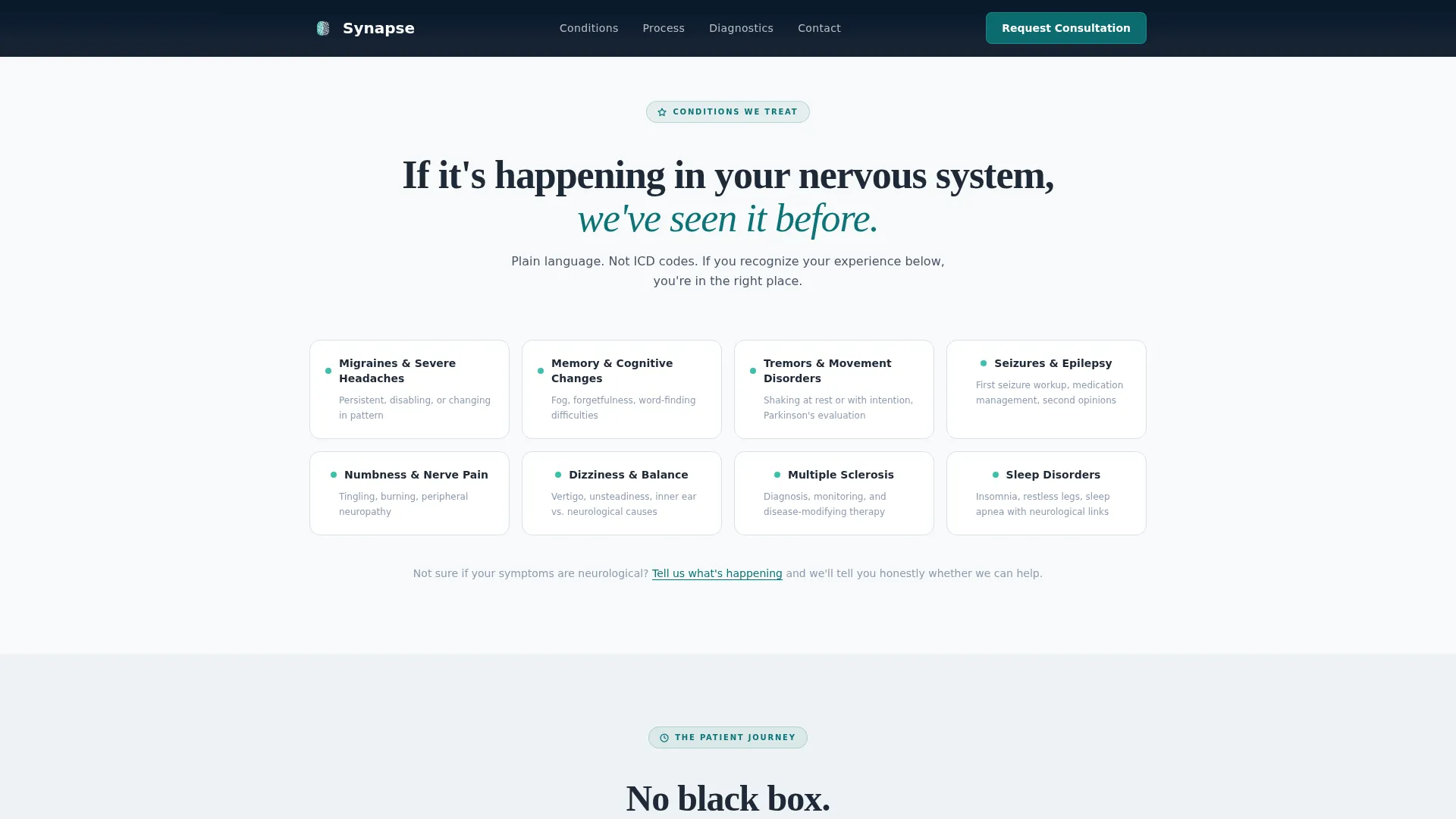
Conditions treated are listed using everyday language, not clinical codes. The grid covers headaches and migraines, memory and cognition concerns, movement disorders, seizures, and numbness or nerve pain. This approach makes the page immediately legible to patients who do not have a medical background.
Dual-Path Conversion Section
The conversion section offers two distinct paths in a single area. The primary path is a consultation request form asking for first name, phone number, a concern dropdown, and an optional free-text field. The secondary path gates a downloadable PDF guide behind an email address only, capturing visitors who are not yet ready to call.
Scroll-Reveal Animation System
Sections animate into view on scroll using a blur and vertical translate entrance effect. Staggered timing ensures that each content block appears in sequence, guiding the reader's eye down the page without distraction. The animation intensity is set to a medium level so it feels purposeful rather than decorative.
Fixed Mobile Call-to-Action Bar
On mobile devices, a fixed bar at the bottom of the screen keeps the primary "Request a Consultation Call" action accessible at all times. This is designed for patients who are researching on a phone during a high-anxiety moment and may be ready to act at any point during the scroll.
Page sections overview
| Section | Purpose |
|---|---|
| Hero portrait area | Establish trust with a direct, personal neurologist portrait and primary headline |
| Conditions treated grid | List neurological conditions in plain, patient-friendly language |
| Patient journey timeline | Show the full five-step care process with teal icons and concise descriptions |
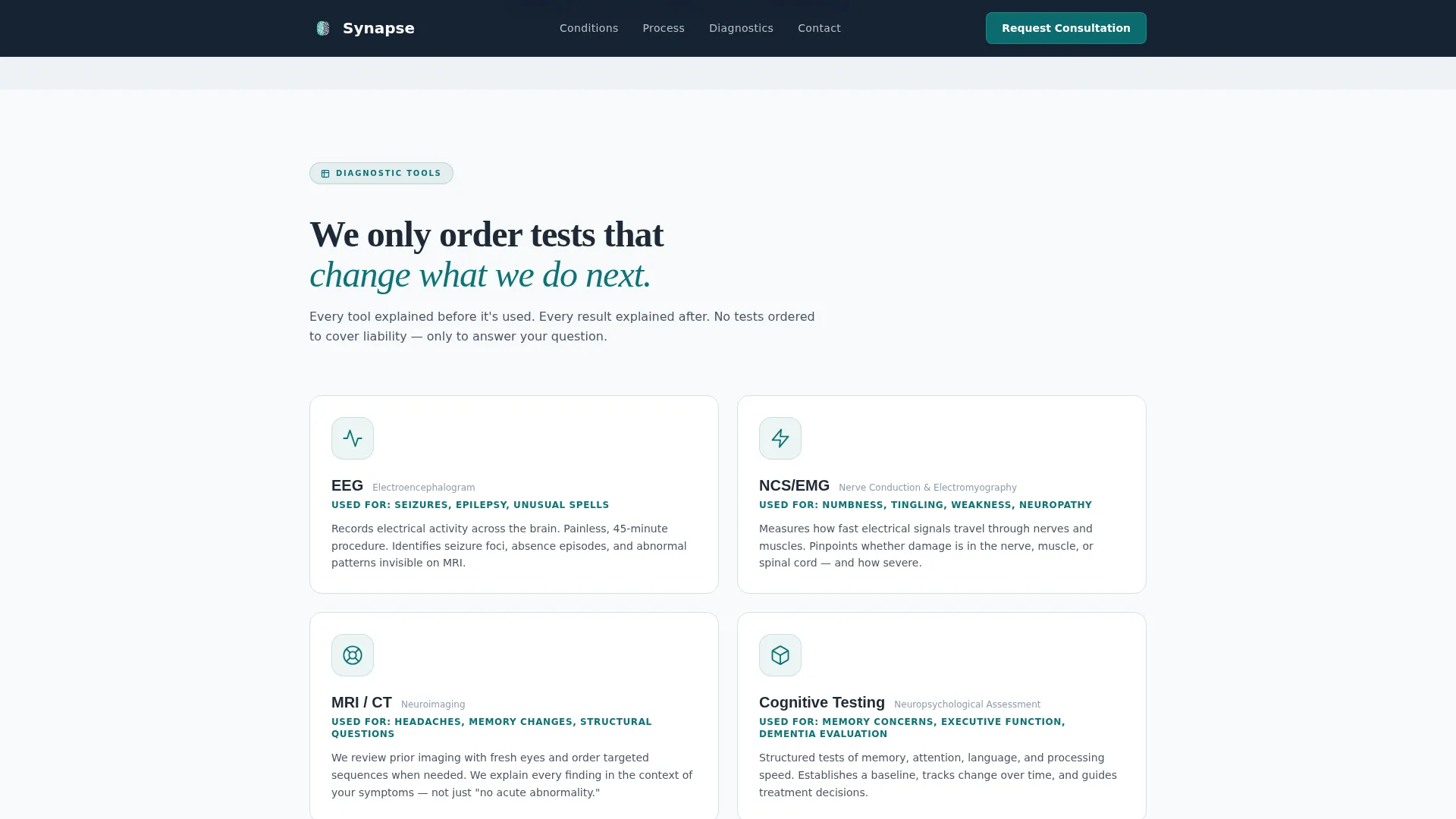
| Diagnostic tools explained | Describe the tools used (electroencephalogram, nerve conduction, neuroimaging) and why |
| Patient testimonials | Provide social proof through stacked cards showing specific patient outcomes |
| Consultation form section | Capture ready-to-book leads via a short, focused request form |
| PDF lead magnet | Capture earlier-stage leads with a gated downloadable guide, email only |
| Footer row | Deliver essential practice links and contact details in a clean single-row layout |
Design & branding system
The visual identity follows a Corporate Precision theme. The palette is called Teal Catalyst, and every color choice is deliberate: authority without coldness, calm without emptiness.
- Primary colors: clinical deep teal (#0D7377) for accents, charcoal slate (#1E2A38) for headlines and anchoring text, sterile warm white (#F7F9FA) for section backgrounds, and soft catalyst green (#3FBFAD) for hover states and progress indicators
- Typography pairing: Fraunces serif for headlines to carry authority, and DM Sans for body text to keep reading comfortable and clear
- Interaction details: hover states shift to the catalyst green, scroll-reveal animations use blur combined with a vertical translate, and the FAQ section uses an accordion component for tidy information layering
Mobile & speed optimization
The template is built with a mobile-first priority. Patients researching neurological symptoms often do so on a phone, frequently in a moment of anxiety, and the layout accounts for this directly.
- The fixed bottom call-to-action bar on mobile keeps the consultation request button visible throughout the entire scroll without interrupting the reading experience
- Static sections use server-side rendering while interactive elements such as the consultation form, PDF modal gate, and FAQ accordion are handled as client-side components, keeping the initial page load light
How this template helps you convert
The page is structured so that every section reduces a specific barrier to booking before any call-to-action appears. Transparency is the core persuasion mechanism.
- The patient journey timeline and diagnostic tools section answer the most common patient fear, which is not knowing what will actually happen, before the form is ever shown
- The dual-path conversion section ensures that visitors who are not ready to call still leave something behind, an email address in exchange for the PDF guide, keeping them within reach for follow-up
Other information about this template
The Synapse template is a focused, single-use landing page purpose-built for the neurology private practice niche. A few additional details are worth noting for anyone evaluating it.
- The consultation form includes a free-text field labeled "Anything you'd like us to know before we call," which lowers the perceived barrier to submitting by giving patients a sense of control over the conversation
- The PDF lead magnet is titled "What to Expect at Your First Neurology Visit" and is gated by email address only, intentionally keeping the ask small for visitors still in the research phase
- The footer follows a Pattern 1 Linear Single-Row layout, keeping the bottom of the page clean and uncluttered so the conversion section above it remains the visual priority
- Form fields include first name, phone number, and a dropdown for primary concern covering headaches and migraines, memory and cognition, movement disorders, seizures, numbness and nerve pain, and a general other category
Theme
Corporate Precision
Creative direction
Transparent Process
Color system
Teal Catalyst
Style
Single Column Flow
Direction
Lead Generation
Page Sections
Portrait-centered Hero with Headline
Five-step Transparent Timeline
Plain-language Conditions Grid
Dual-path Conversion Section
Fixed Mobile Call-to-action Bar
Scroll-reveal Animation System
Related questions
Can I use this template for a multi-doctor neurology practice?
Does the consultation form connect to any external booking system?
How does the PDF lead magnet section work?
Is this template suitable for patients searching about a specific neurological condition?
Can the colors and fonts be changed to match an existing practice brand?