Tariff Customs Compliance Guide Landing Page Template
The Tariff Legal Shield Customs Compliance Comparison Table landing page template is built for trade compliance consultancies that prove their value with hard numbers. It leads with a live metrics wall, escalating case study narratives, and an interactive industry comparison table. The result is a high-authority, click-through landing page that moves qualified prospects directly toward a consultation booking.
by Rocket studio
Quick summary
This template gives a customs and trade compliance firm a single-page presence that feels like walking into a federal briefing room. Three animated performance counters open the page. Escalating before-and-after case studies follow. An interactive comparison table lets visitors toggle across industries and watch tariff rates shift in real time. Every scroll reveals another proof point, and every call to action routes to a consultation booking flow.
Who this template is for
This template is built for B2B professional services firms operating in the customs and trade compliance space. The target client base includes logistics directors, compliance officers, and freight forwarders who are already under pressure, not just browsing.
- Logistics directors at mid-market manufacturers who have received a CF-28 Request for Information from U.S. Customs and Border Protection (CBP)
- Compliance officers at e-commerce companies scaling into cross-border fulfillment and facing new tariff exposure
- Freight forwarders whose clients are subject to misclassification risk, pending penalty notices, or active CBP inquiries
What problem this template solves
A trade compliance firm cannot afford a generic professional services page. The clients arriving at this page are already in a crisis. They need to see evidence, not language about expertise. Most template options in this market category offer no mechanism for displaying case-level proof, no structured way to compare tariff rate outcomes by industry, and no visual urgency that matches what a logistics director feels when holding a Form 29 Notice of Action.
- Firms lose qualified leads because their page cannot display the scale of outcomes they have actually achieved
- Visitors searching for help with tariffs, HTS classifications, or penalty defense cannot quickly determine whether the firm handles their specific industry or exposure type
- Without a structured comparison table, it is impossible to compare before-and-after duty rates across sectors like electronics, textiles, automotive parts, or agricultural goods
What you get with this template
This template delivers a fully structured, single-page click-through layout designed specifically for a customs compliance consultancy. Every section is production-ready and maps directly to the buyer journey from crisis awareness to consultation booking.
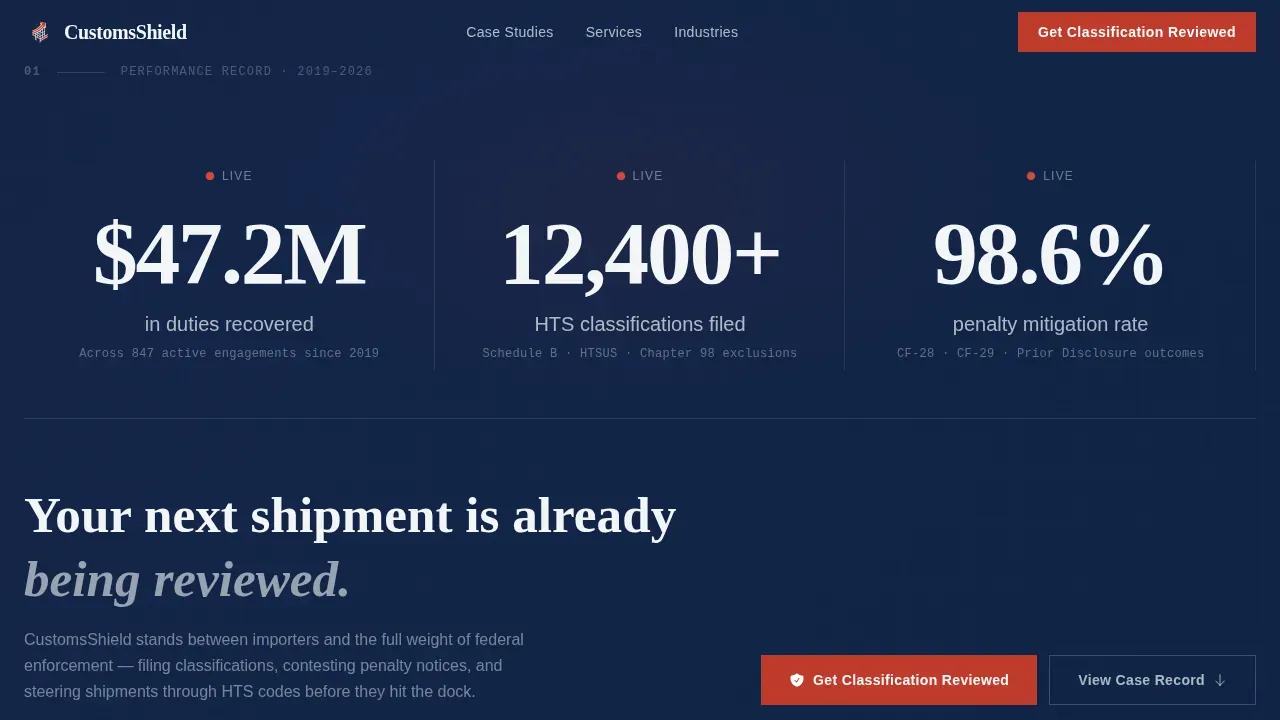
- A hero section with three animated counter displays showing recovered duties, total HTS classifications filed, and penalty mitigation rates, followed by a fade-in headline
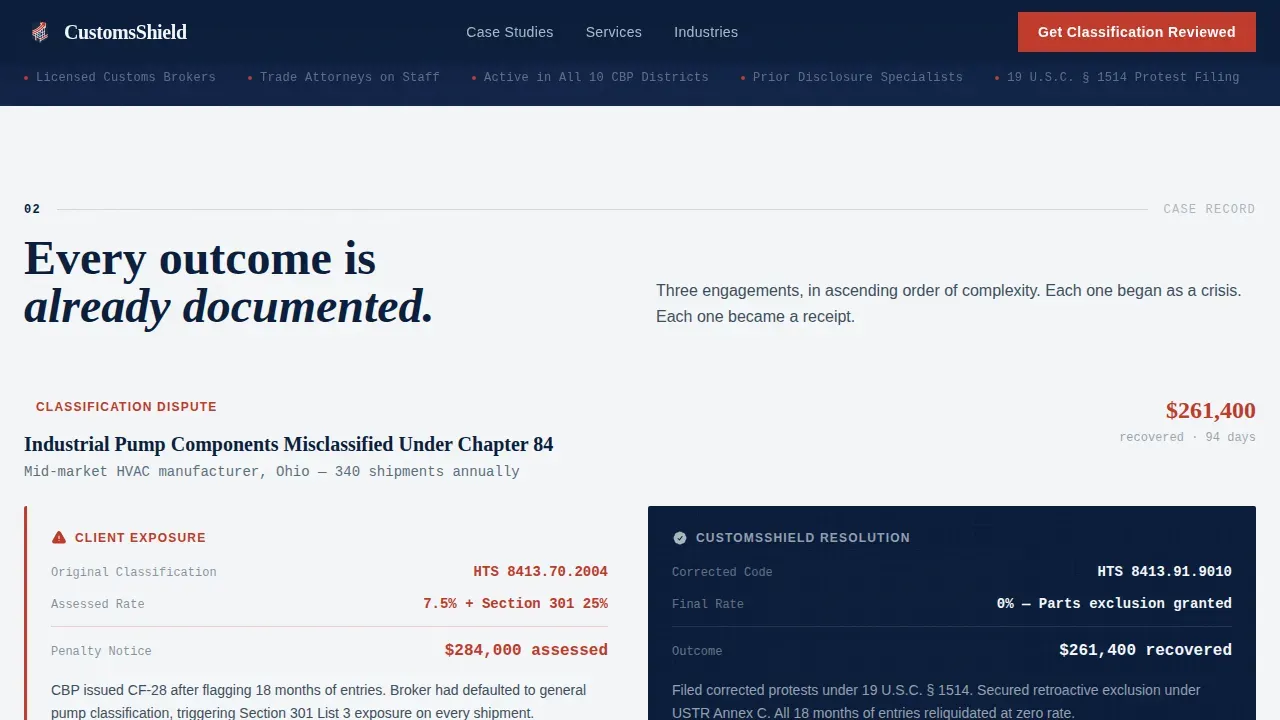
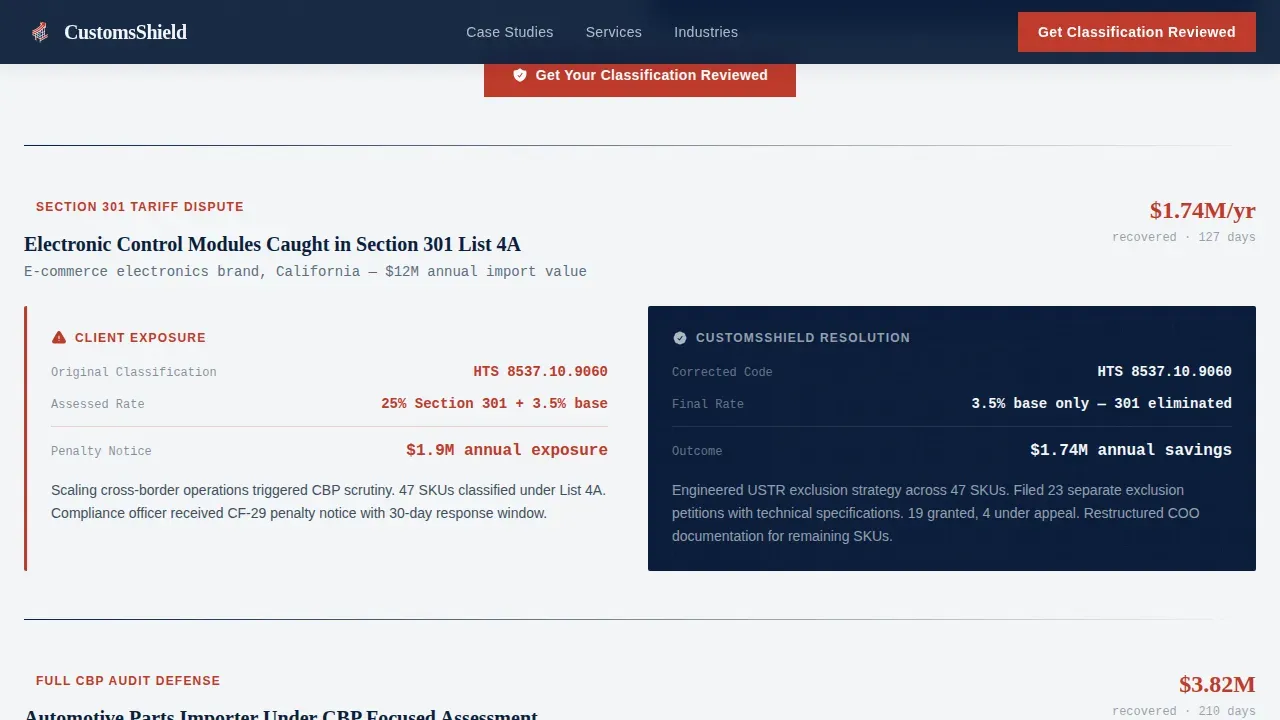
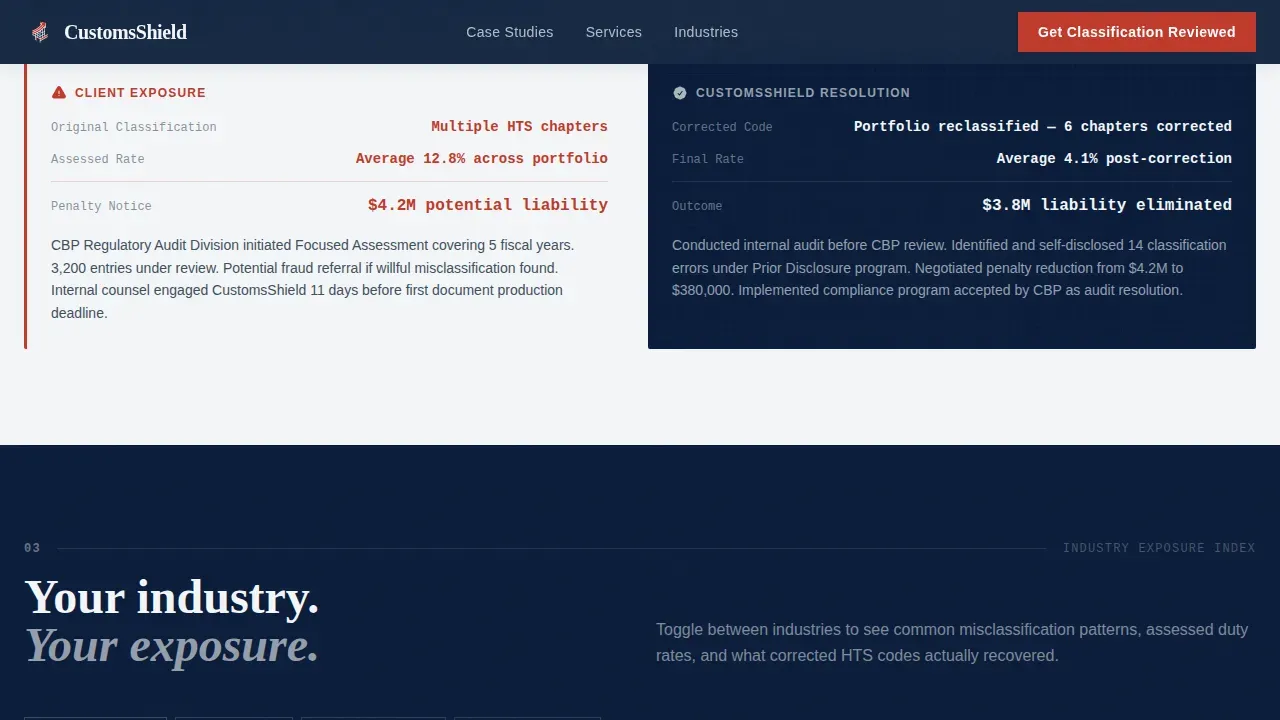
- Three escalating case study blocks with before-and-after column layouts showing original classifications, assessed duty rates, and final resolved outcomes, with risk figures rendered in penalty red
- An interactive industry comparison table with tab switching across electronics, textiles, automotive parts, and agricultural goods, plus two primary call-to-action placements and a Tariff Risk Report lead capture section
Feature list
This template is built around a specific set of features derived directly from the design brief. Each one serves the core purpose of converting a high-intent visitor into a booked consultation.
Animated Metrics Wall Hero
The header displays three massive performance counters rendered in classified-white against admiralty navy. Figures include recovered duty totals, HTS classification volume, and a penalty mitigation rate. Each counter animates on load with staggered reveals. A single headline fades in below the figures. This section establishes immediate credibility through arithmetic rather than claims, giving the visitor a clear point of reference before they read a single word of body copy.
Escalating Case Study Narrative
Three case study blocks are structured as two-column before-and-after layouts. The left column displays the client's original exposure: the incorrect HTS code, the assessed tariff rate, and the penalty notice amount rendered in penalty red to signal financial risk. The right column displays the firm's resolution: the corrected classification, the reduced rate, and the final outcome in white on navy. Cases escalate in complexity, moving from a routine HTS classification dispute through a Section 301 tariff challenge and into a full CBP audit defense.
Interactive Industry Comparison Table
The comparison table is the centerpiece of the page. Visitors can toggle between industry tabs, including electronics, textiles, automotive parts, and agricultural goods, and the table updates to display the relevant tariff rate data for each sector. This gives logistics directors and compliance officers an immediate way to determine how the firm's results apply to their specific trade category. The table also displays a primary call to action inside the table view, ensuring the path to consultation is always visible.
Service Tier Overview
Three service tiers are presented in a structured layout: Classification Review, Penalty Defense, and Audit Representation. Each tier is scoped clearly so visitors understand which engagement level matches their current situation. A company facing its first CF-28 notice can identify the right entry point. A manufacturer already subject to a formal CBP audit can find their tier immediately. This means less friction between discovery and contact.
Tariff Risk Report Lead Capture
A secondary conversion path captures earlier-stage visitors who are not yet in an active crisis but know one is likely. The section displays a prompt to download the 2024 Tariff Risk Report behind an email gate. This allows the firm to warm leads who are still in the search phase, discussing risk internally, and not yet ready to book a consultation. It extends the page's commercial reach beyond immediate crisis clients.
Fixed Mobile Call-to-Action Bar
On mobile screens, a persistent bottom bar keeps the primary call to action in view at all times. The bar reads "Get Your Classification Reviewed" and remains fixed during scroll. This means a compliance officer reviewing the page from a phone during a shipment delay can act instantly without having to search for a contact point.
Page sections overview
| Section | Purpose |
|---|---|
| Hero Metrics Wall | Displays animated performance counters and fade-in headline |
| Case Study One | Routine HTS classification before-and-after |
| Case Study Two | Section 301 tariff dispute resolution |
| Case Study Three | Full CBP audit defense outcome |
| Industry Comparison Table | Interactive toggle across trade sectors with call to action |
| Service Tiers | Scoped classification, defense, and audit services |
| Risk Report Capture | Email-gated lead capture for earlier-stage visitors |
| Footer | Linear single-row pattern with legal links |
Design & branding system
The visual identity follows a Legal Shield theme built on a Navy Authority color system. The palette is intentionally institutional, recalling the interior of a federal courtroom rather than a startup landing page. It signals that the firm operates in a world where the wrong tariff rate carries real financial consequences.
- Admiralty navy (#0B1D3A) dominates headers and section backgrounds; classified-white (#F4F6F8) opens breathing room in body sections; gunmetal briefing gray (#3D4F5F) carries body text; penalty red (#C0392B) appears only on risk indicators and duty amounts to draw the eye to financial stakes
- Typography pairs Fraunces, a serif with quiet institutional authority, for headlines and section titles, with DM Sans for precise, readable body text
- Animation is set to high across the template: counter animations fire on load, case study blocks use staggered scroll reveals, and the comparison table responds to tab switching with live data updates
Mobile & speed optimization
The template is built desktop-first, reflecting the reality that logistics directors typically work at workstations when responding to CBP inquiries. Desktop layout receives full visual priority. Mobile is handled through a targeted optimization: the fixed bottom call-to-action bar.
- The fixed bottom bar keeps "Get Your Classification Reviewed" visible throughout the entire mobile scroll, so a freight forwarder reviewing the page on a phone can act without hunting for a contact point
- Server Components handle all static sections of the page, while Client Components are reserved for interactive elements such as the animated counters and the industry comparison table, keeping the split clean
How this template helps you convert
This template is designed as a click-through landing page with one primary outcome: routing a qualified prospect to a consultation booking page. The conversion architecture is deliberate and layered.
- The hero metrics wall establishes authority in the first viewport, giving visitors a reason to scroll before they read a word of body copy; the fade-in headline then frames urgency, and the first call to action appears immediately after the opening case study
- The interactive comparison table places a second call to action inside the most engagement-intensive section of the page, reaching visitors who needed to see industry-specific tariff rate evidence before they were ready to act
- The Tariff Risk Report email gate captures leads who are not yet in crisis, allowing the firm to receive contact details from earlier-stage visitors and warm them toward a future consultation
Other information about this template
The tariff legal shield customs compliance comparison table landing page template was designed against a backdrop of significant regulatory change. Understanding that context helps firms use the template's case study and table sections to maximum effect.
- Tariff classifications are determined based on the Harmonized Tariff Schedule (HTS), which categorizes all products for international trade; to locate a code, you can use the Harmonized System (HS) code for your product, and the United States Census Bureau Foreign Trade Data offers a Schedule B Search Engine to find a 10-digit Schedule B number
- The Customs Info Database provides up-to-date applied and preferential rates and HS codes, and it includes corresponding local taxes to help estimate landed costs; the FTA Tariff Tool incorporates all products classified within all chapters of the Harmonized System and includes information on product-specific rules of origin
- You may also work with your broker or freight forwarder to help identify your product HS code before engaging a compliance firm
- On February 20, 2026, President Trump released an Executive Order terminating all International Emergency Economic Powers Act (IEEPA) tariff actions following the Supreme Court's decision; the Supreme Court held that the president does not have the authority to impose tariffs under IEEPA
- On February 6, President Trump signed an Executive Order ending the additional 25% IEEPA tariff on goods of Indian origin; separately, the United States and India issued an Interim Agreement under which IEEPA reciprocal tariffs on certain Indian goods would be reduced to 18%
- On February 9, the United States and Bangladesh concluded an Agreement on Reciprocal Trade that lowers the reciprocal tariff rate from 20% to 19%; on February 12, a new Agreement on Reciprocal Trade with Taiwan was announced, which will adjust tariffs on Taiwanese goods; additionally, the United States Trade Representative signed an Agreement on Reciprocal Trade with El Salvador establishing a base reciprocal rate of 10%
- On January 5, 2026, a rollback of tariffs on furniture, kitchen cabinets, and vanities was announced, delaying higher tariff rates for another year; the United States has also extended tariff exemptions for nearly 200 categories of Chinese products, allowing them to avoid tariffs of between 7.5 and 25 percent
- The U.S. Court of Appeals for the Federal Circuit upheld the Office of the U.S. Trade Representative's imposition of Section 301 China tariffs on products covered by Lists 3 and 4A; separately, the majority of Trump-era tariffs were ruled not legal by a federal appeals court, stating that the president overstepped his authority by using IEEPA to impose tariffs
- The United States and China have extended their tariff truce for another 90 days, pushing off questions about the future of trade with China; on August 21, 2025, the United States and European Union announced a Framework on an Agreement on Reciprocal, Fair, and Balanced Trade
- On August 1, 2025, Executive Orders increased reciprocal tariff rates for multiple countries; on July 30, President Trump signed an Executive Order suspending the de minimis exemption, applying tariffs to low-value imports from all trading partners
- On June 16, President Trump and British Prime Minister Keir Starmer signed a trade deal that will slash tariffs on United Kingdom auto and aerospace industry imports; on April 2, 2025, reciprocal tariffs on foreign products were announced based on the combined rate of tariffs and non-monetary barriers
- Lauan plywood is subject to a 15% tariff under Section 122 as it is not listed in the annexes; the United States and Indonesia concluded an Agreement on Reciprocal Trade that affects tariff rates on lauan plywood; tariff classifications can significantly affect the cost of importation for goods such as lauan plywood into the United States
- The U.S. imposes tariffs on various products, including textiles and apparel, which may be subject to reciprocal tariff adjustments depending on the origin of goods and applicable trade agreements; the U.S. Trade Representative has signed agreements that adjust tariff rates for products from Taiwan, Bangladesh, and other trading partners
- Misclassifying goods or misidentifying the country of origin can result in significant penalties, especially regarding Section 301 and Section 232 duties; the Department of Justice has identified tariff underpayment as a top enforcement priority
- Valuation defense includes legal support for complex valuation methodologies to avoid duty underpayment claims; binding rulings are written, legally binding classification decisions submitted to CBP to secure duty rates in advance
- Effective customs compliance services encompass reviewing HTS classifications and valuations, identifying duty mitigation opportunities, and providing proactive legal advice; proactive compliance audits can identify weaknesses in classification, valuation, and country of origin in import operations
- U.S. Customs and Border Protection is employing advanced analytics and artificial intelligence to detect infractions in import data for 2025 and 2026, increasing the importance of internal auditing for any company engaged in cross-border commerce
- Duty Drawback allows the refunding of duties on exported goods, while Foreign Trade Zones enable avoidance of duties during storage or processing; companies meeting the qualifying criteria can hold goods in a Foreign Trade Zone before paying applicable tariff rates
- Creating Customs Compliance Manuals or Standard Operating Procedures is a vital corrective action plan for compliance; customs compliance has evolved into a critical board-level strategic risk due to trade volatility and changes in legal frameworks
- As of February 6, 2026, U.S. Customs and Border Protection has shifted to all-electronic refunds via the Automated Clearing House; effective February 24, 2026, a new temporary import surcharge of 10% under Section 122 was implemented
- Mandatory links for legal services must include a Privacy Policy, Terms and Conditions, and a Disclaimer; privacy assurance is essential for compliance services to ensure client information is secure and confidential
- Tariff legal shield options for customs compliance utilize specialized international trade law firms, compliance software, and risk management strategies; legal shield services include proactive audits and defenses against CBP enforcement actions
- The template's footer follows a linear single-row pattern and provides link placement for Privacy Policy, Terms and Conditions, and Disclaimer pages; the office contact details and department routing information can be posted in the footer row
- Free trade agreements and trade agreements in general play a major role in determining which goods qualify for preferential treatment or duty free rates; products from Mexico, for example, may qualify under applicable free trade agreements depending on rules of origin compliance
- The FTA Tariff Tool is helpful for searching product-specific rules of origin across all chapters of the Harmonized System; firms discussing tariff rate reductions with clients will find it a useful resource for determining which articles qualify for reduced rates under specific trade agreements
- The schedule of applicable tariff rates, exclusions, and provisions changes frequently; firms should note every pending executive action and legislative development as part of ongoing trade compliance monitoring
- The scope of excluded articles, accessories, and vehicle parts such as a chassis can vary depending on the specific tariff schedule provision in effect on a given date; the language of each executive order or bilateral agreement will determine the effect on classified goods
Theme
Legal Shield
Creative direction
Case Study Narrative
Color system
Navy Authority
Style
Comparison Table
Direction
Click-Through
Page Sections
Animated Metrics Wall Hero
Escalating Case Study Blocks
Interactive Industry Comparison Table
Service Tier Layout
Tariff Risk Report Lead Capture
Fixed Mobile Call-to-action Bar
Related questions
What industries does the comparison table cover?
How does the page route visitors to a consultation?
What is the secondary conversion path on this page?
Can I customize the case study figures and industry tabs?
What compliance information should the footer include?