Memory Care Donation Landing Page Template
Tend is a single-column memory care landing page built for residential facilities that support people living with Alzheimer's and dementia. It leads with emotional honesty, walks families through exactly where their money goes, and earns trust before making any ask. The primary call to action is donation-focused, with a giving selector that ties each gift amount to a real, tangible outcome.
by Rocket studio
Quick summary
Tend is a warm, single-column landing page for a residential memory care home. It speaks directly to exhausted families facing one of the hardest decisions of their lives. The page builds trust through radical transparency, then invites visitors to fund a day of care with a giving selector that makes every dollar feel purposeful and real.
Who this template is for
This template is built for memory care facilities and dementia care homes that want to connect with families, not just inform them. It suits operators who are willing to be fully open about their costs, their staffing, and their daily routines.
- Memory care facility directors and residential home operators
- Nonprofit and mission-driven dementia care organizations
- Fundraising coordinators seeking donation-focused page layouts
What problem this template solves
Families searching for memory care are often overwhelmed, sleep-deprived, and carrying deep guilt. Most facility pages greet them with stock photography and vague reassurances. This template does the opposite.
- It answers the hard questions families are too tired to ask, including costs, staffing ratios, and daily schedules
- It replaces manufactured warmth with documented evidence, such as inspection results and satisfaction surveys
- It builds the emotional and informational case for giving before presenting any donation form
What you get with this template
You get a fully structured, single-column landing page designed around the donor and family journey from first scroll to gift submission. Every section earns the next one.
- A giant centered headline section, a transparent cost breakdown, a resident day-in-the-life journal entry, staff credentials and retention data, and a donation form with a tangible giving selector
- A Cloud Canvas color system with soft, handcrafted tones that feel calm rather than clinical
- A Civic Service visual theme with terracotta call-to-action buttons, linen and overcast white alternating section backgrounds, and deep graphite body text
Feature list
A brief overview of what makes this template work as a fundraising and trust-building tool for memory care.
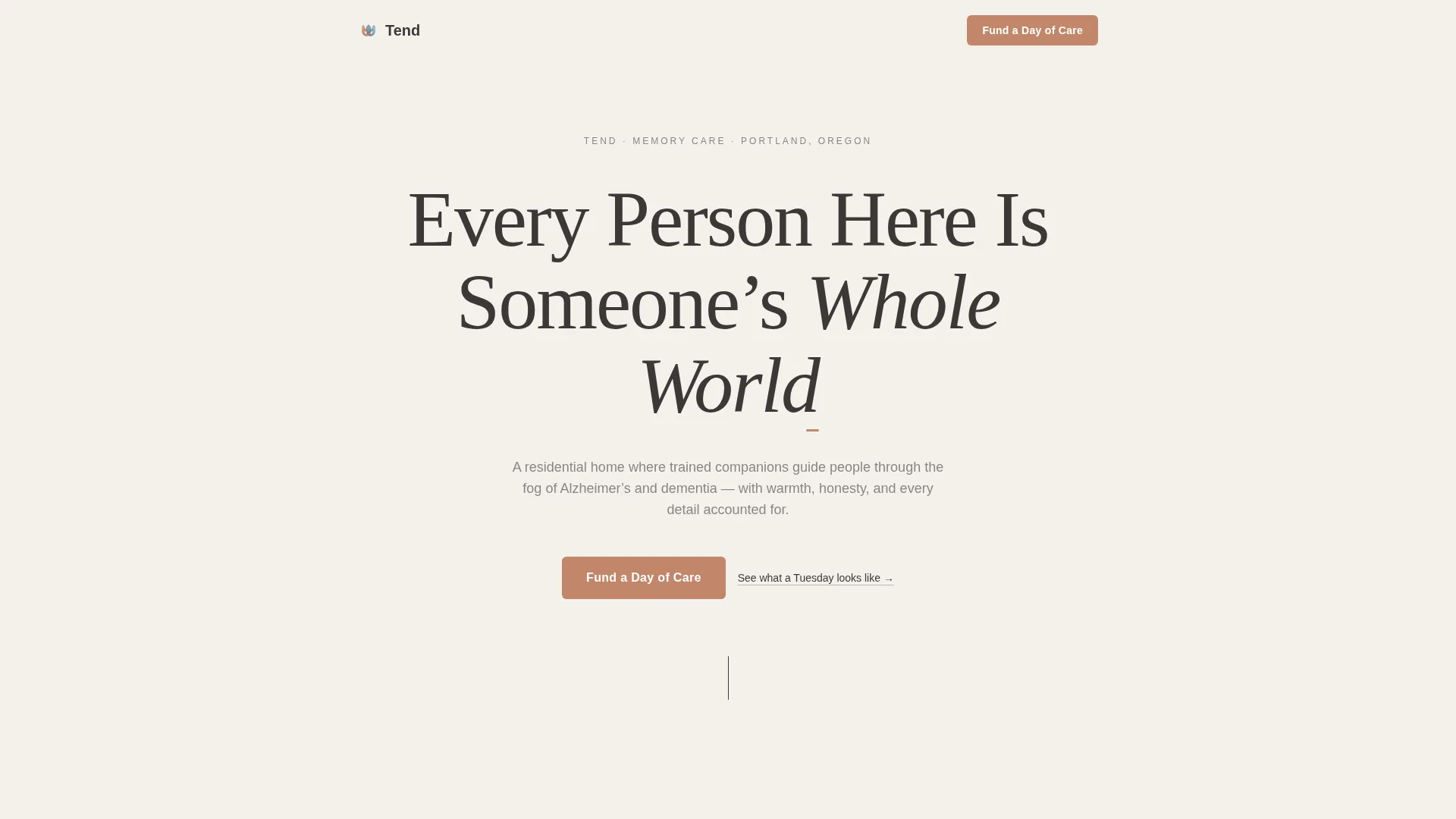
Giant Centered Headline Section
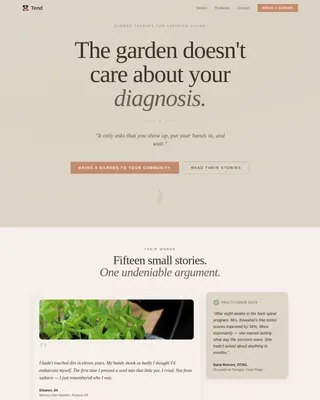
The page opens with one enormous serif headline: "Every Person Here Is Someone's Whole World." It fills seventy percent of the viewport, fades in slowly, and uses a terracotta underline accent under "Whole World." There is no image, no video, and no competing element. The headline earns space before the visitor scrolls.
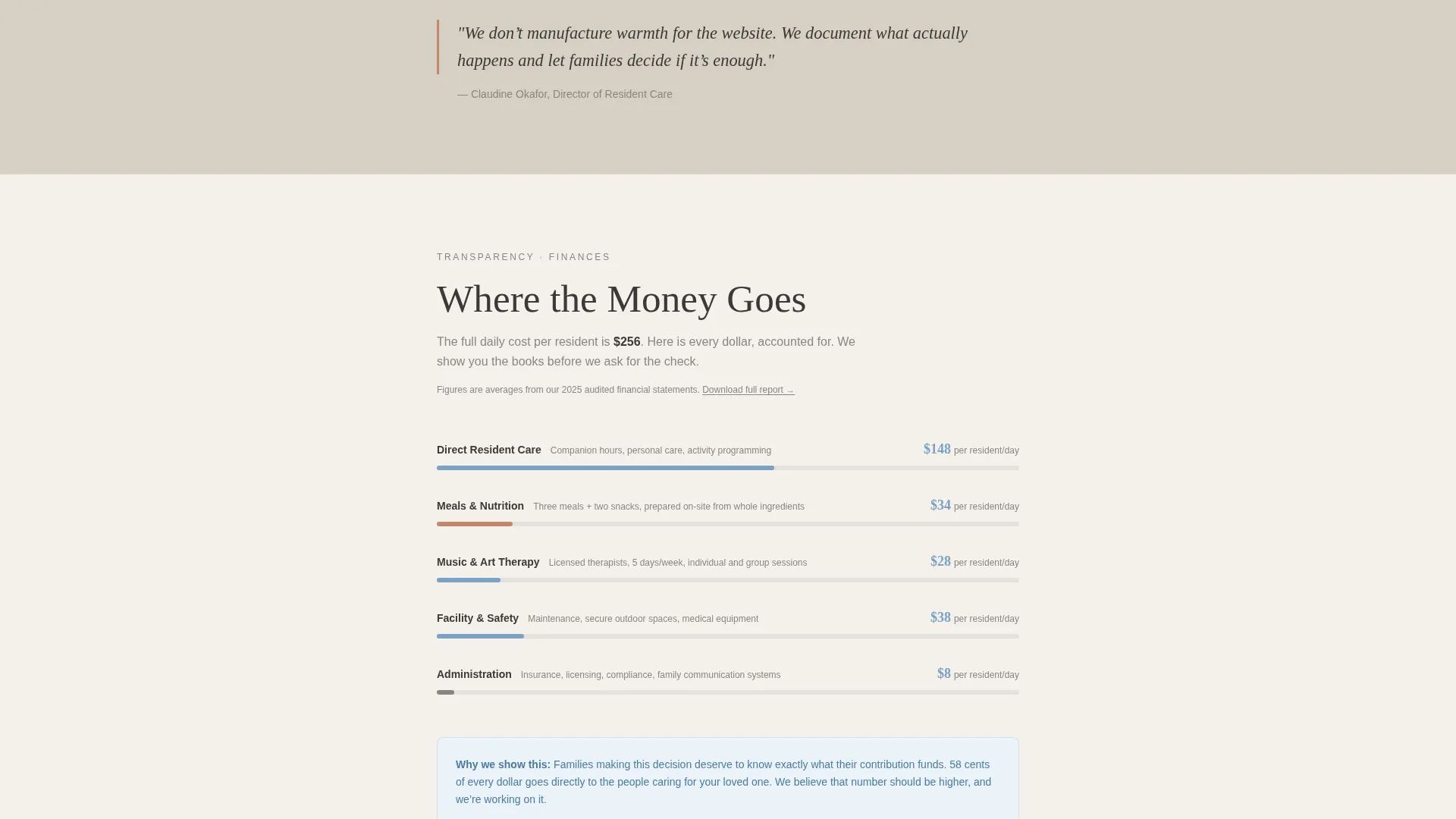
Illustrated Dollar Breakdown
A visual cost breakdown shows families exactly where every dollar goes. Real numbers cover staffing ratios, meal programs, music therapy hours, and facility maintenance. This section uses the muted forget-me-not blue to signal trust and replaces vague percentages with specific, readable figures.
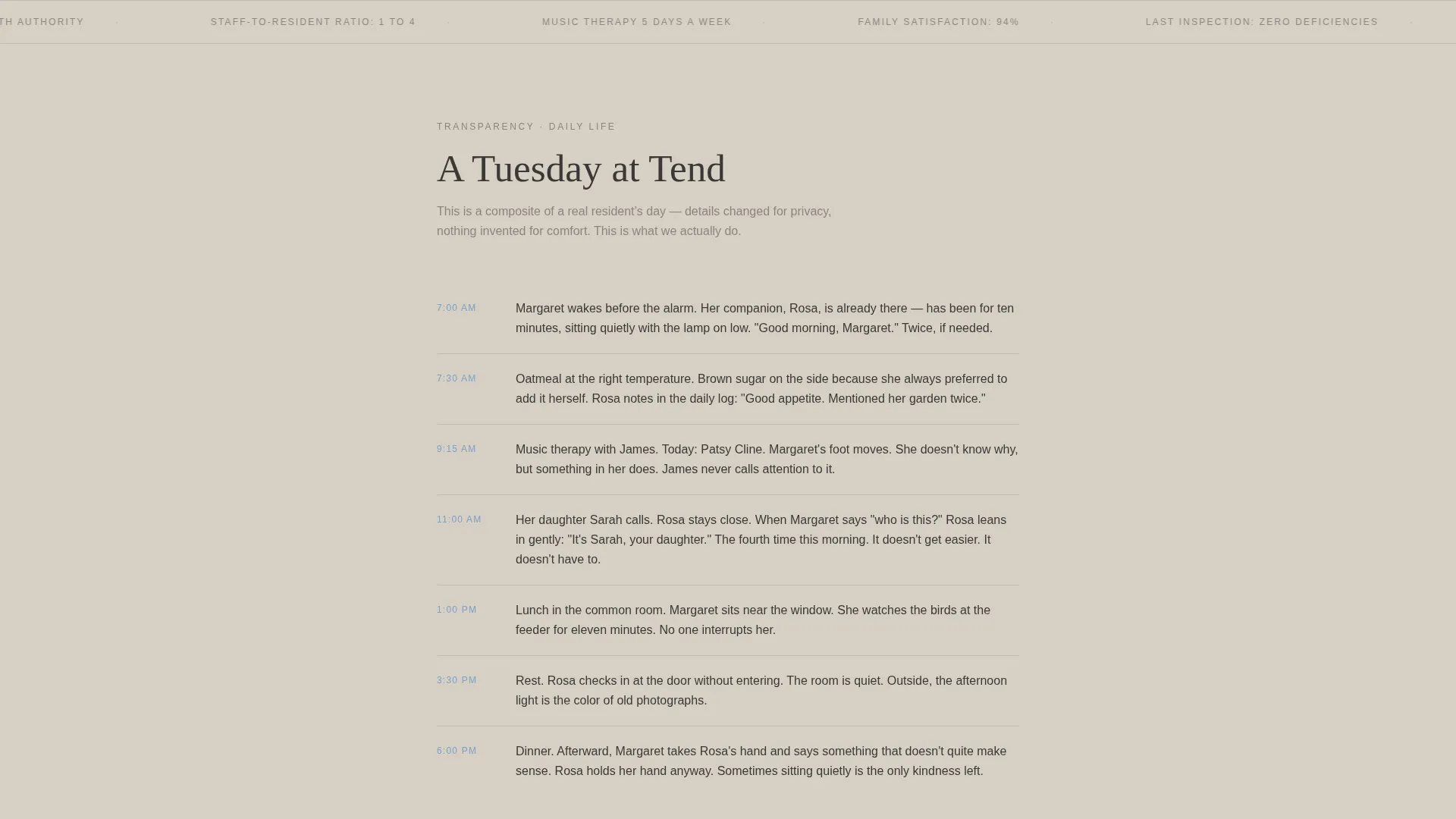
Resident Day-in-the-Life Journal
A detailed, hour-by-hour account of what a resident's Tuesday actually looks like. Written in journal-entry style, it makes the daily rhythm of care feel human and specific rather than clinical and generic.
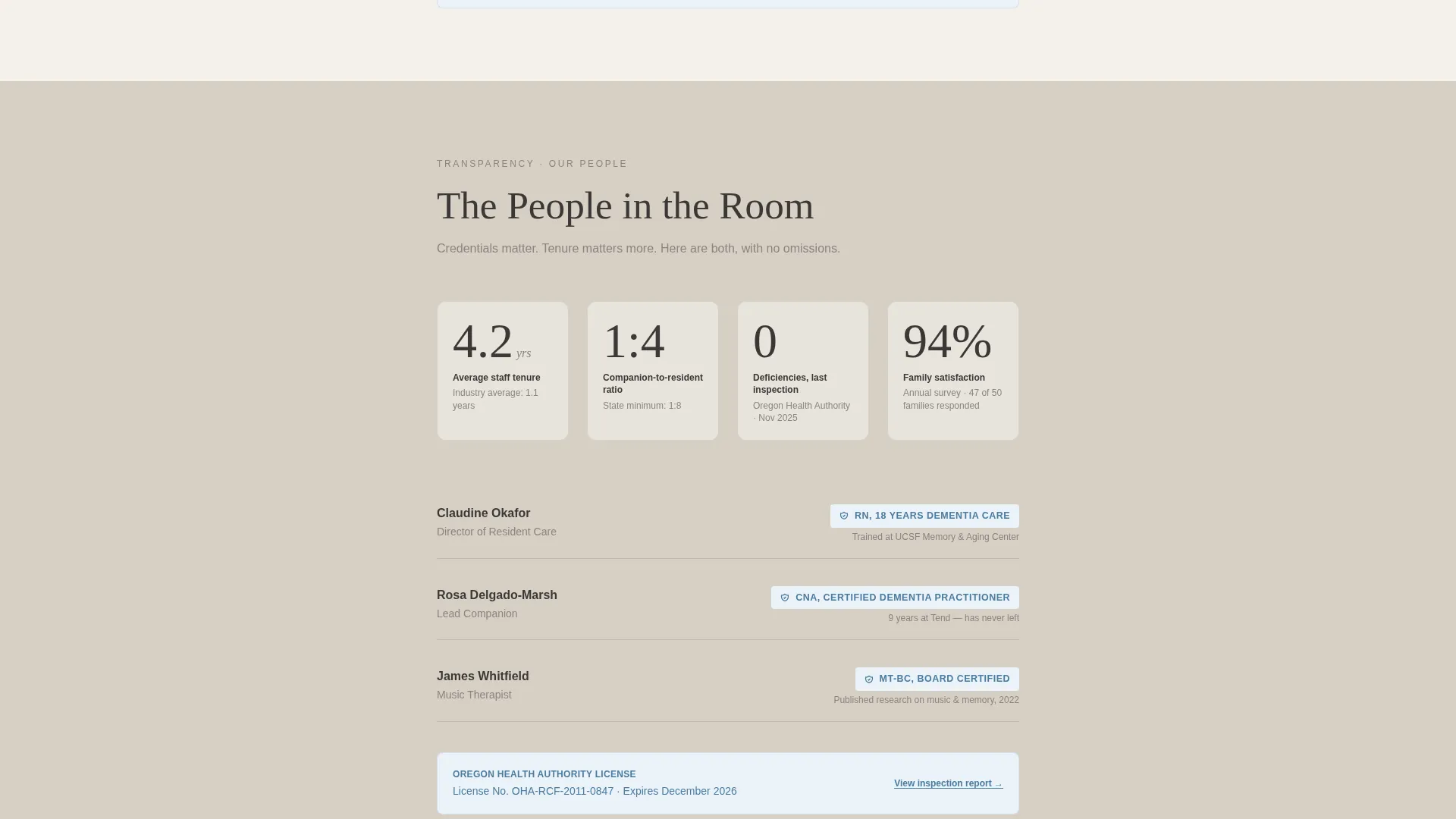
Staff and Facility Transparency Panel
This section surfaces staff retention rates, licensing inspection results, and family satisfaction survey data with methodology disclosed. The forget-me-not blue appears here again, reinforcing credibility at the exact moment families need it most.
Tangible Giving Selector
The primary call to action reads "Fund a Day of Care." A giving selector shows three tiers with real-world equivalents: thirty-five dollars covers a music therapy session, eighty dollars covers a full day of meals, and two hundred fifty dollars sponsors a family respite weekend. A secondary invite, "Stay in This With Us," encourages monthly sustaining gifts.
Minimal Donation Form
The form captures only three fields before moving to card details: amount, name, and email. It removes friction at the moment of commitment and keeps the experience calm and uncluttered.
Page sections overview
| Section | Purpose |
|---|---|
| Giant headline hero | Opens with emotional weight and no distractions |
| Cost breakdown panel | Shows exactly where money goes with real figures |
| Day-in-the-life journal | Makes daily care feel specific and human |
| Staff credentials panel | Builds trust with retention data and inspection results |
| Family satisfaction data | Shows survey results with disclosed methodology |
| Primary donation form | Presents giving tiers tied to tangible care outcomes |
| Monthly giving invite | Encourages recurring support with a warm secondary ask |
Design & branding system
The Cloud Canvas color system keeps every visual choice quiet and purposeful. Nothing shouts; everything breathes. The palette evokes an old photograph left on a sunlit windowsill.
- Colors: soft overcast white (#F4F1EC) and faded linen (#D6CFC4) alternate as section backgrounds; muted forget-me-not blue (#7BA0C4) appears at trust-critical moments; quiet terracotta (#C2866A) is reserved for buttons and pull-quotes
- Typography: deep graphite (#3B3836) body text in a warm serif that feels handwritten even when it is not; generous letter-spacing in the headline
- Civic Service theme: structured, honest, and community-minded in its visual language, with no stock photography and no decorative noise
Mobile & speed optimization
The single-column layout adapts naturally to smaller screens. The emotional hierarchy of the page stays intact whether a visitor is on a laptop at a kitchen table or a phone in a hospital waiting room.
- Single-column flow means no grid reflow or layout breakage on mobile devices
- Minimal imagery and no video keep the page light and quick to render
- The short donation form reduces friction for mobile users completing a gift on a small screen
How this template helps you convert
This template converts by earning trust first and making the ask second. Every section lowers a barrier before the donation form appears.
- The transparent cost and care sections answer the questions families carry silently, which removes the hesitation that stops most visitors from giving
- The tangible giving selector turns an abstract donation into a specific act of care, making it far easier for a visitor to choose an amount and commit
Other information about this template
This template is well suited to organizations that operate as nonprofits or that rely on community fundraising to supplement residential care fees. It works equally well for facilities in a launch phase that need to establish credibility with a new audience.
- The Civic Service theme and Transparent Process creative direction make this layout a strong fit for grant-seeking organizations that need to demonstrate accountability to donors
- The "Stay in This With Us" secondary call to action supports recurring giving programs and monthly sustainer campaigns
- The template is built on a single-column flow structure, so customization requires only straightforward content swaps rather than complex layout adjustments
- Dementia care homes, Alzheimer's care residences, and elder care fundraising pages will find the layout and tone a natural fit for their audience
Theme
Civic Service
Creative direction
Transparent Process
Color system
Cloud Canvas
Style
Single Column Flow
Direction
Donation/Fundraising
Page Sections
Giant Centered Headline Hero
Illustrated Cost Breakdown
Day-in-the-life Journal Entry
Transparency and Credentials Panel
Tangible Giving Selector
Minimal Three-field Donation Form
Related questions
Is this template designed specifically for fundraising?
Can I adapt this template for a facility that charges residential fees instead of relying on donations?
What information does the donation form collect?
Do I need to provide my own data for the cost breakdown and staff panels?
Who is the primary visitor this landing page is written for?