Templates
Elderly Care & Senior Living
Senior Support Services
Tend - Healing Garden Therapy Senior Living Landing Page Template
Tend - Healing Garden Therapy Senior Living Landing Page Template
Tend is a modular card grid landing page built for senior garden therapy programs. It pairs a serif manifesto header with an asymmetric testimonial mosaic, clinical evidence bars, and a warm lead generation form. The Soft Mist color palette and unhurried editorial layout help activity directors, families, and occupational therapists feel the program's value before they ever fill out a field.
by Rocket studio
Quick summary
Tend is a single-page lead generation template designed for healing garden therapy programs in assisted living communities. It opens with a manifesto-style hero, moves through a layered testimonial mosaic, and closes with a gentle conversation form. The layout is editorial, the colors are quiet, and every section is built to earn trust before it asks for anything.
Who this template is for
This template speaks to the people who stand between a resident and a better day. It is built for professionals and family members who care deeply about quality of life in long term care settings and who need a page that reflects that seriousness.
- Activity directors at assisted living communities who want programming that goes beyond scheduled activities and brings residents back to life
- Adult children searching for something meaningful for their parents, something that gives a sense of purpose and a reason to get up in the morning
- Occupational therapists and physical therapists looking to prescribe purposeful movement wrapped in the smell of rosemary and warm soil
What problem this template solves
Most program pages for senior care look like brochures. They list amenities, use stock photography, and ask visitors to call a number. That approach does not work when your audience is a grieving daughter, a stretched activity director, or a therapist trying to justify a new program to a board. Tend solves this by leading with emotion first and evidence second.
- Facilities promoting garden therapy have no ready-made page that balances storytelling with clinical proof in a way that feels earned
- Families and staff visit a program page looking for reassurance, not a sales pitch, and most templates give them the opposite
- The absence of social proof and accessible design leaves patients, nurses, and families with unanswered questions that kill conversions
What you get with this template
You get a fully structured landing page with five distinct sections, each with a clear role. The layout is modular, so content can be swapped without breaking the design. Every element serves the single goal of opening a conversation with the right person.
- A manifesto hero, an asymmetric testimonial mosaic grid, a clinical evidence bar, a lead generation form, and a gated PDF download section, all arranged for a smooth scroll experience
- Fraunces serif headings and DM Sans body text set in a Soft Mist palette of fog white, warm linen, weathered sage, and quiet terracotta
- Scroll-reveal animations with staggered card entries, parallax on the hero sprig illustration, mosaic hover states, a form with a role dropdown, and a gated PDF modal
Feature list
This template ships with a focused set of components. Each one is designed to serve a specific purpose in the healing garden conversation.
Manifesto Hero with Hand-Drawn Sprig
The hero section carries large, unhurried serif type against a warm linen background. A hand-drawn sprig illustration sits below the two-line manifesto like a pressed flower. No image competes with the words. The stillness is intentional and the effect is immediate.
Asymmetric Testimonial Mosaic Grid
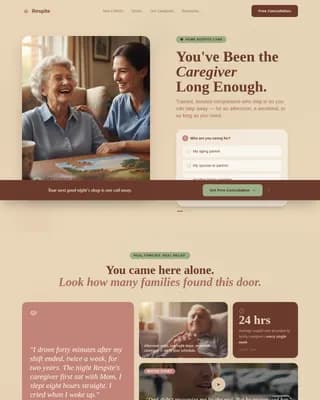
The mosaic is the heart of the page. Cards vary in size, some tall and some wide, so the grid feels gathered rather than manufactured. Each card can hold a resident quote over a soft photo, a short video thumbnail, or a caregiver note in italics. As visitors scroll, the cumulative weight of multiple stories becomes one undeniable argument for the program.
Clinical Evidence Bar
Between mosaic clusters, single-line statistics appear in sage green text. These evidence bars ground the emotional storytelling in clinical data. They give activity directors, nurses, and therapists the numbers they need to bring a proposal to a committee without breaking the page's calm surface.
Lead Generation Conversation Form
The primary call to action reads "Bring a Garden to Your Community." The terracotta button appears first after the third row of cards and again at the bottom of the page. The form collects facility name, requester role via dropdown, number of residents, and a free-text field labeled "Tell us about your people." There is no pricing. The form opens a conversation, not a transaction.
Gated PDF Download Path
A secondary conversion path offers "The First Season: A Guide to Starting Garden Therapy." This download is gated behind a first name and email field only. It captures visitors who are not yet ready to commit but are clearly leaning toward the idea, keeping them in the conversation for the future.
Soft Mist Color and Typography System
The entire design runs on a five-value palette: fog white, warm linen, weathered sage, quiet terracotta, and deep loam brown. Sage borders the cards like garden edging. Terracotta is reserved for buttons and gentle callouts. Fraunces handles headings with warmth, and DM Sans keeps body text clean and readable at every size.
Page sections overview
| Section | Purpose |
|---|---|
| Hero Manifesto | Opens with large serif text and a hand-drawn sprig to create an immediate emotional stop |
| Testimonial Mosaic Grid | Asymmetric bento card layout showcasing resident quotes, caregiver notes, and video thumbnails |
| Clinical Evidence Bar | Single-line sage statistics placed between mosaic clusters to ground emotion in data |
| Lead Generation Form | Terracotta call to action and conversation form collecting facility details and a free-text story field |
| Gated PDF Download | Secondary opt-in path for the First Season guide, requiring only a name and email |
| Footer | Linear single-row footer completing the page |
Design & branding system
The Soft Mist palette was chosen because nothing in a healing garden shouts. Every color decision was made to feel like a watercolor left to dry on a windowsill. The result is a page that breathes rather than sells.
- Colors: fog white (#F5F0EB) and warm linen (#DDD5C7) alternate as section backgrounds; weathered sage (#A3B18A) borders cards and displays statistics; quiet terracotta (#C48B6E) appears on buttons and callouts; deep loam brown (#3D3229) carries all body text
- Typography: Fraunces serif for headings, creating warmth and weight without heaviness; DM Sans for body copy, keeping paragraphs clear and readable at all screen sizes
- Visual style: soft editorial and watercolor-adjacent, with scroll-reveal animations, staggered card entries, and a parallax effect on the hero sprig illustration
Mobile & speed optimization
This template is built desktop-first because activity directors typically visit during working hours at a desk. Full mobile support is included so that families and adult children can access the page from a phone while sitting in a waiting room or visiting a parent after hours.
- Static sections use server-rendered components to keep initial load fast; the form and PDF modal use client-side rendering for interactivity without slowing the rest of the page
- The mosaic grid reflows gracefully on smaller screens so resident stories remain readable and emotionally effective on mobile
- Large, clear Fraunces headings and high-contrast loam-on-linen text keep the page readable for older visitors and anyone reviewing it on a bright or small display
How this template helps you convert
The page is built around a single primary call to action to minimize visual friction. Every design and copy decision leads toward one outcome: a facility director, family member, or therapist submitting the form and starting a real conversation.
- The manifesto hero creates an immediate emotional connection. Visitors feel seen before they read a single feature description. That trust carries them through the mosaic and toward the form naturally.
- The testimonial mosaic uses real resident stories, caregiver voices, and clinical statistics together. This combination addresses both the emotional and rational objections that activity directors and families bring when they visit the page.
- Two conversion paths, the primary form and the gated PDF, ensure that visitors at different stages of readiness both have a clear next step. No one leaves without an easy, low-pressure way to stay involved with the program.
Other information about this template
The Tend healing garden therapy senior living landing page template is a wonderful idea for any facility that wants to communicate the depth of its programming without resorting to corporate language. It is built for programs rooted in horticultural therapy principles, where therapeutic gardens are not decoration but active tools for recovery, healing, and daily life.
- The template is suitable for assisted living communities, long term care centers, memory care wings, and hospital rehabilitation programs where patients benefit from access to nature during recovery from illness or surgery
- Therapeutic gardens referenced in the layout can include raised cedar beds, sensory garden herb spirals, shaded patio seating with benches and chairs, green walkways wide enough for wheelchairs, and water features such as a small fountain that provides calming sound
- The design supports programs where a landscape architect and a horticultural therapist collaborate to create a low maintenance but deeply purposeful outdoor space surrounded by flowers, trees, and greenery
- Perennial plants reduce annual replacement costs, and facilities can close gardens during winter months to reduce the need to maintain them year-round
- The mosaic section can surface stories from diverse groups: residents who regained the ability to walk short distances, patients recovering from injuries, and children of residents who visit more often because the garden gives them something to share
- A healing garden can serve as a refuge from the anxiety of institutional life, offering a green space where nurses, families, and residents can sit together, rest, and feel the peace that only a garden can provide
- The parking lot and surrounding city location of a facility should not limit program ambition; existing empty spaces, rooftop areas, or courtyard locations can be converted into fully functioning therapeutic gardens with careful planning
- The template encourages conversations about accessibility, safety features that prevent wandering, and the importance of budgeting for ongoing garden maintenance from the start of a healing garden project
- University research supports the evidence that access to green spaces and nature reduces stress, lowers blood pressure, and improves cognitive function in elderly patients, making the clinical evidence bar a credible and important template element


Theme
Healing Space
Creative direction
Testimonial Mosaic
Color system
Soft Mist
Style
Card Grid (Modular)
Direction
Lead Generation
Page Sections
Manifesto Hero with Hand-drawn Sprig
Asymmetric Testimonial Mosaic Grid
Clinical Evidence Statistics Bar
Lead Generation Conversation Form
Gated PDF Secondary Conversion Path
Soft Mist Color and Type System
Related questions
Who is this landing page template designed for?
Can I adapt the testimonial mosaic cards with my own content?
Does this template include more than one call to action?
Is the form customizable for different facility types?
How does the design handle readability for older users?