Bauhaus Architecture Pricing Website Template
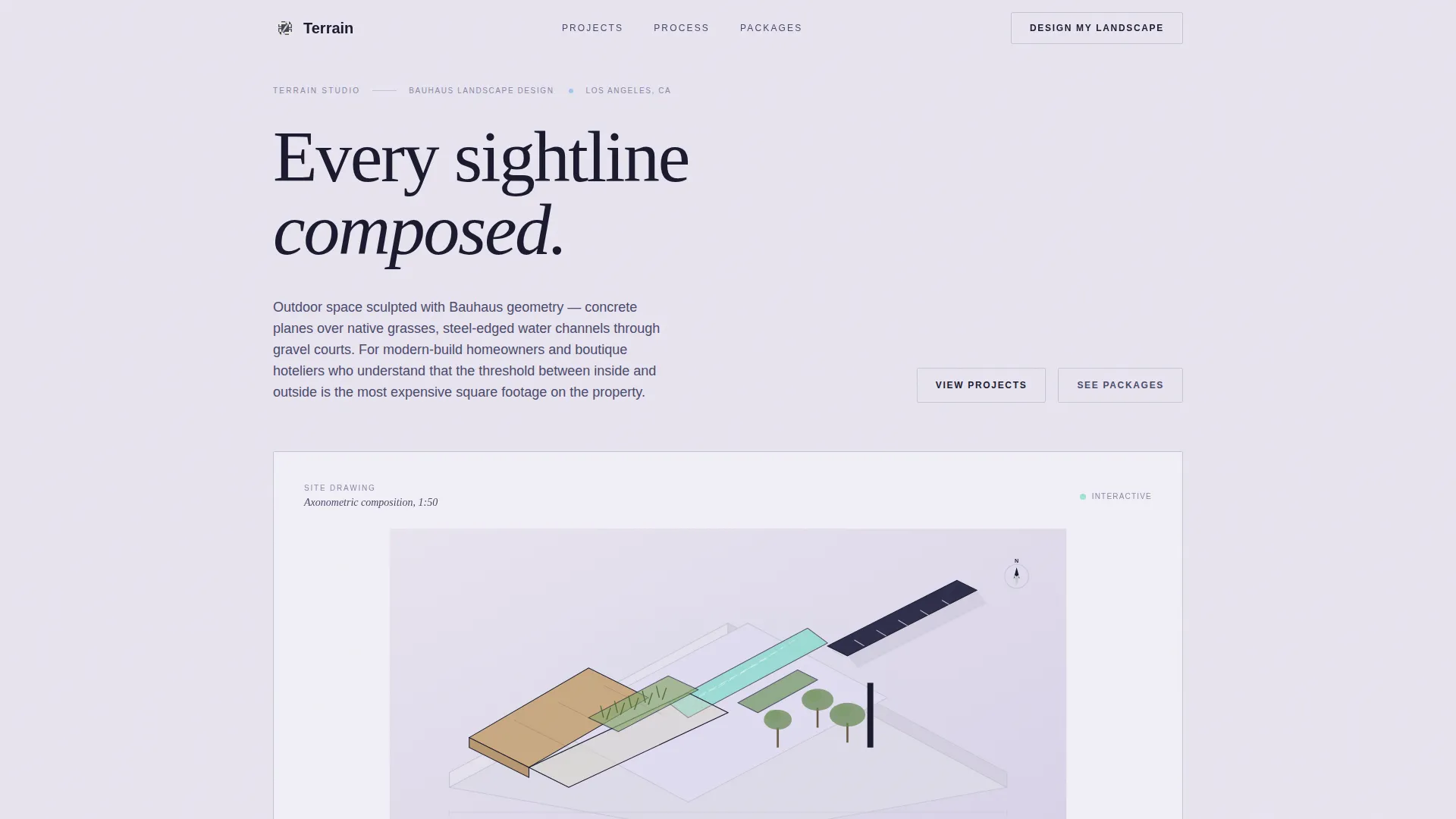
Terrain is a masonry-style landing page template for a Bauhaus landscape design studio. It pairs a cursor-reactive axonometric illustration header with expand-in-place project cards, a scrolling materials marquee, and three tiered design packages sold directly from the page. The result is a landing page that earns trust through visual depth and closes sales through structured simplicity.
by Rocket studio
Quick summary
Terrain is a single-page template built for a Bauhaus landscape design studio. It opens with a fine-line axonometric illustration that reacts to cursor movement, then flows through a masonry project gallery, a materials marquee, and a direct-sales package section. Every layout decision reflects the studio's core idea: outdoor space composed with the precision of a typeset paragraph.
Who this template is for
This template is built for design-forward practices that sell landscape architecture services directly to clients. It suits studios with a strong visual body of work and a clear service offering.
- Bauhaus-influenced landscape designers targeting modern-build homeowners
- Boutique hoteliers and gallery directors who treat outdoor thresholds as premium space
- Independent architecture studios ready to sell tiered design packages online
What problem this template solves
Most portfolio pages show work without selling it. Terrain solves the gap between inspiration and purchase by guiding visitors from project exploration to package checkout without a single page reload.
- Visitors explore real project detail before seeing any pricing, so trust is built before the ask
- The tiered package section replaces vague "contact us" calls to action with specific scope, deliverables, and price
- A secondary booking path captures visitors who want a consultation before committing to a package
What you get with this template
You get a fully structured single-page layout with five distinct sections, all styled to the Luxe Minimal theme. Interactions are high throughout, from hover illumination on the hero illustration to expand-in-place project cards and a before-and-after slider.
- Hero section with a cursor-reactive Bauhaus axonometric SVG illustration
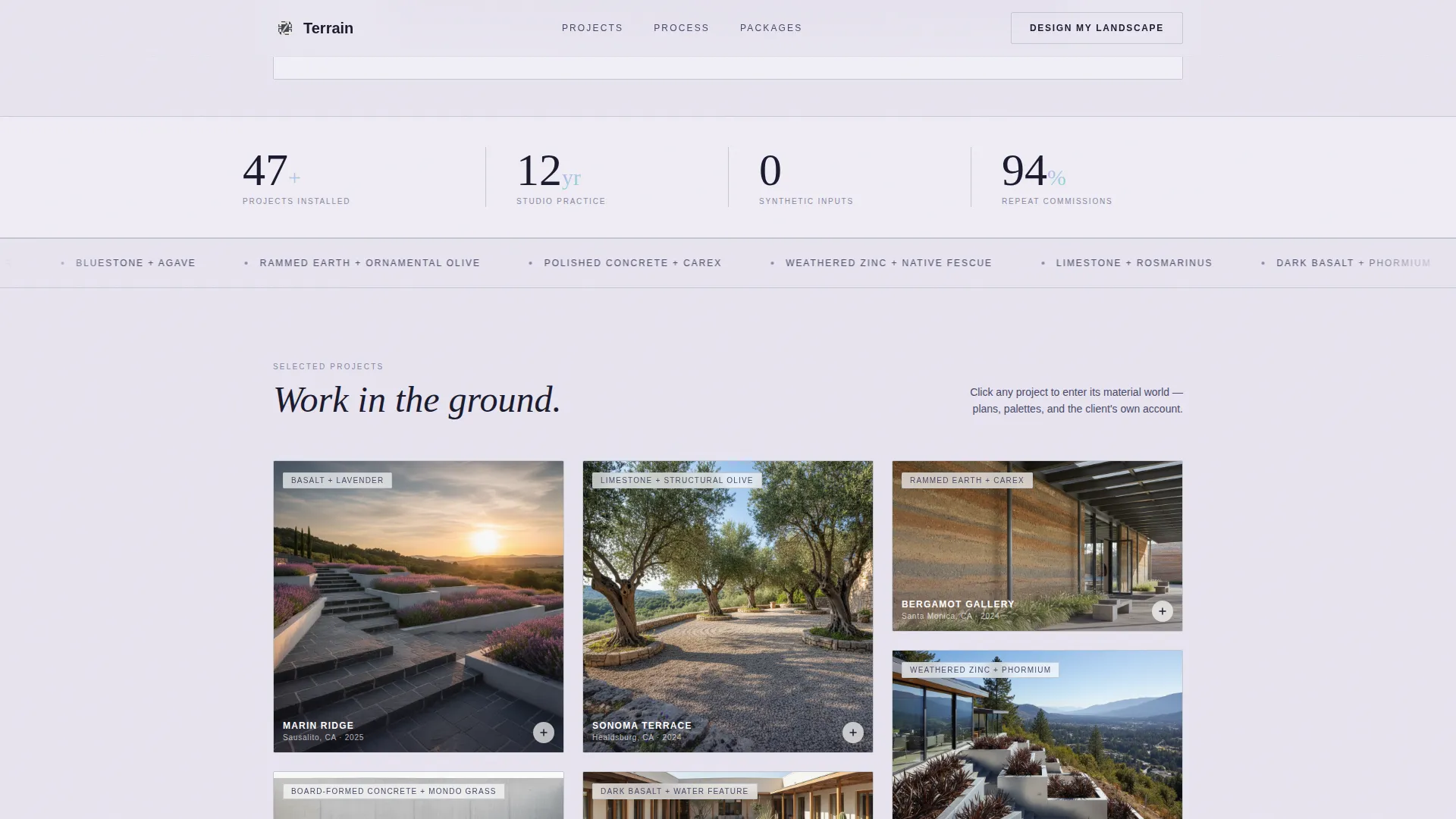
- Masonry project gallery with in-place card expansion showing plans, material palettes, a before-and-after slider, and a client quote
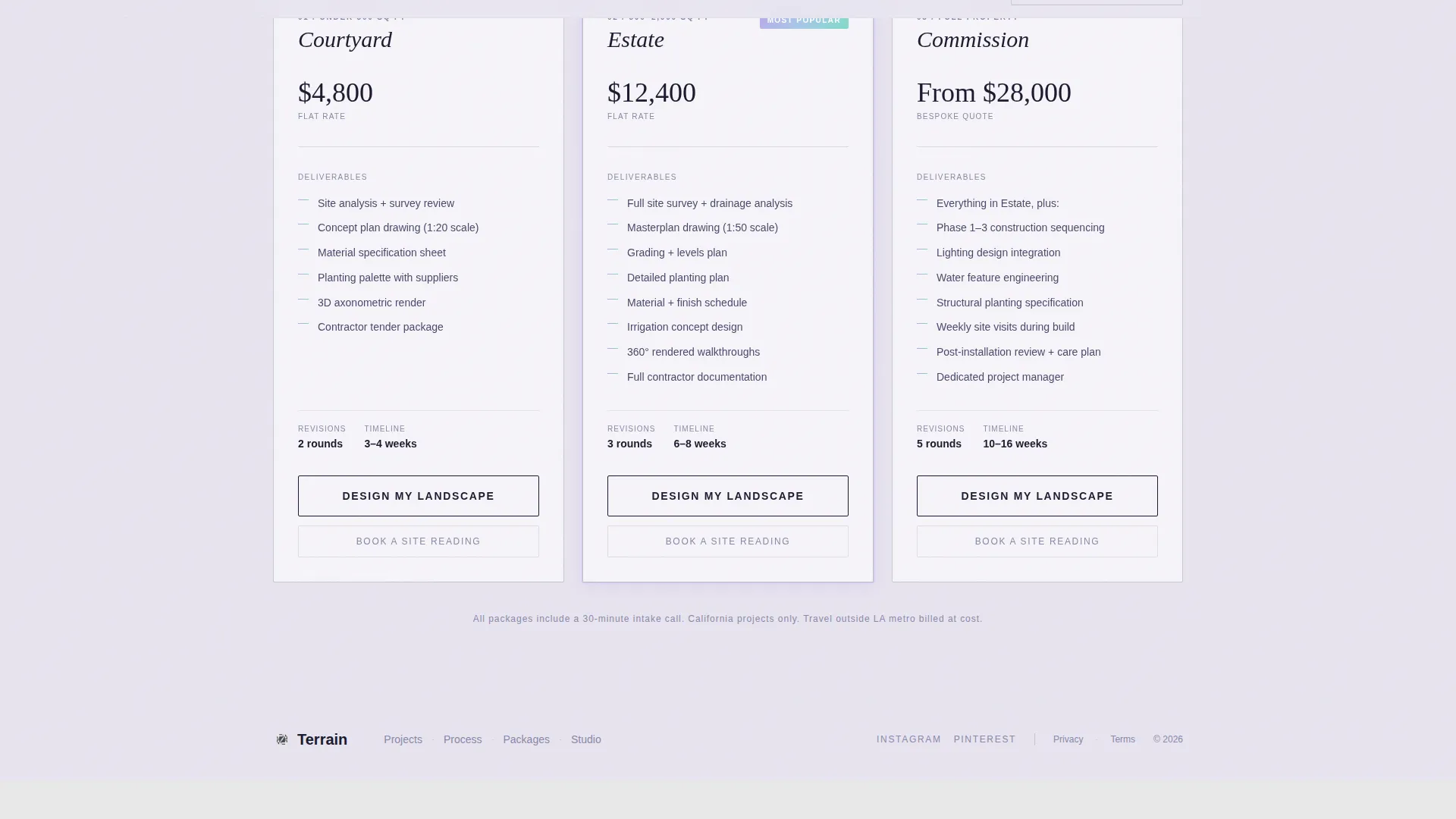
- Three tiered sales cards (Courtyard, Estate, Commission) with checkout flow and a secondary booking modal
Feature list
This template ships with a focused set of interactive and structural features, each grounded in the studio's design-first approach to landscape architecture.
Cursor-Reactive Axonometric Header
The hero is a vector line illustration rendered in isometric perspective on a pearl ground. As the visitor's cursor moves across it, zones illuminate with an iridescent gradient and label each element, such as "Corten Retaining Wall" or "Decomposed Granite Courtyard." No photograph competes; the drawing declares the studio's process.
Expand-in-Place Masonry Cards
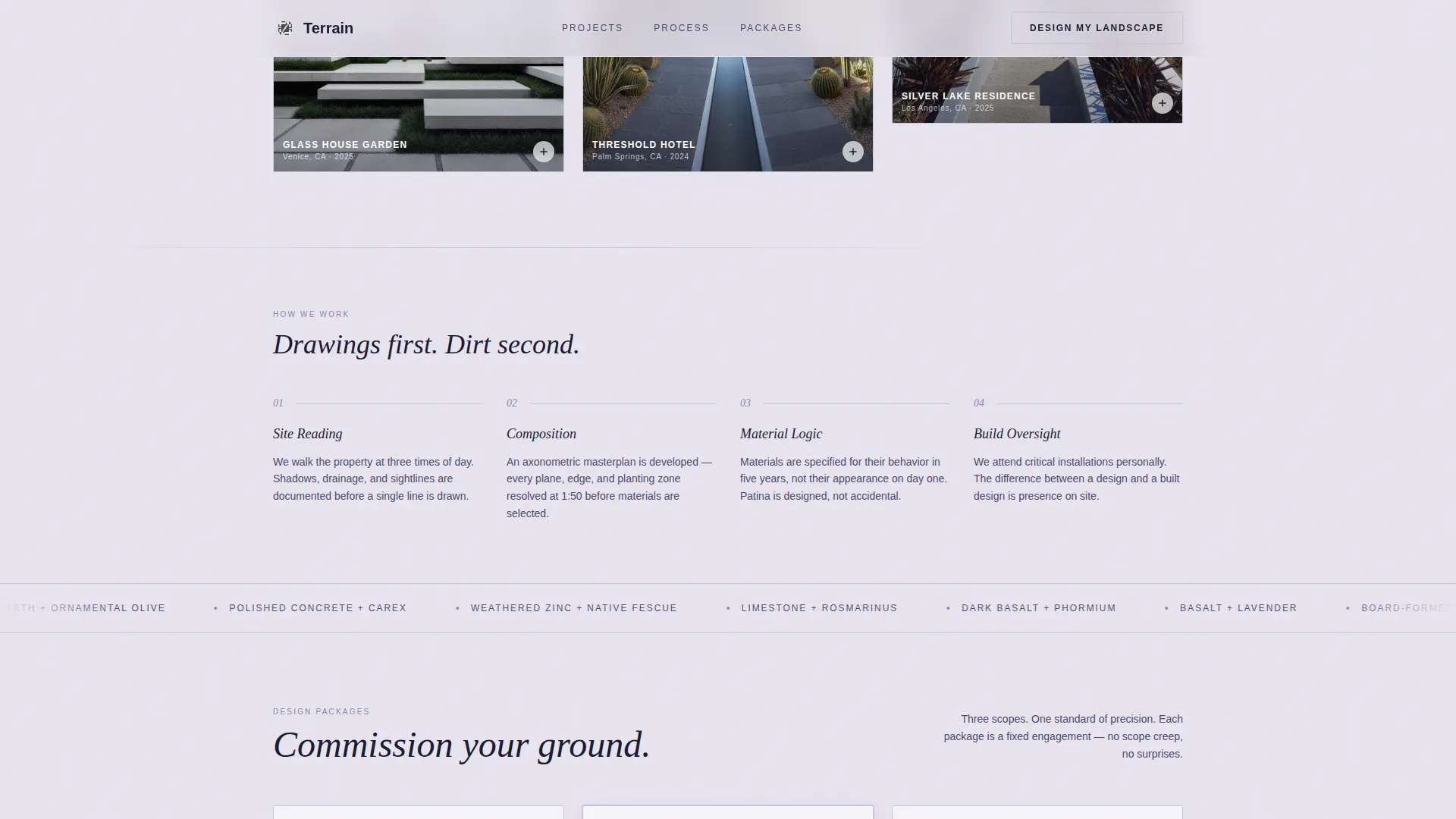
Each project card in the masonry grid opens in place when clicked or tapped. The expanded state reveals a plan drawing, a material palette swatch strip, a before-and-after image slider, and a single client quote. Visitors explore project depth without leaving the page.
Scrolling Materials Marquee
A continuous ticker strip runs between the project gallery and the sales section. It surfaces the studio's material vocabulary, reinforcing credibility through specificity before the visitor reaches the pricing cards.
Tiered Direct-Sales Package Cards
The final masonry row presents three landscape design packages with scope, deliverables, revision count, and price displayed in clean graphite type. The primary call to action opens a streamlined checkout flow covering property address, square footage, site photo upload, and payment.
Secondary Consultation Booking Modal
Beneath each package card, a "Book a Site Reading" link opens a lightweight modal. It collects only name, address, and preferred date, giving hesitant visitors a lower-commitment path to engagement.
Progressive Visual Urgency Layout
The masonry grid is structured so whitespace tightens as the visitor scrolls deeper. The progression moves from aspiration through proof to product, with each row pulling the visitor closer to a purchase decision.
Page sections overview
| Section | Purpose |
|---|---|
| Hero Illustration | Cursor-reactive axonometric SVG, sets studio identity |
| Projects Masonry Grid | Variable-height project cards, expand in place |
| Materials Marquee | Scrolling material ticker, builds credibility |
| Design Package Cards | Three tiered offers with direct checkout |
| Minimal Footer | Vercel horizontal flow pattern, clean close |
Design & branding system
The visual identity uses the AI Iridescent color system on a Luxe Minimal foundation. Iridescent accents appear only on interaction, keeping the resting state calm and architectural.
- Pearl white (#E8E4F0) as the primary ground, deep graphite (#1A1A2E) for all typography, and liquid chrome (#C4C8D0) on card borders and divider lines
- Iridescent accent gradients shift between holographic lilac (#B8A9E8) and spectral aqua (#7FDBCA) on hover states and interactive elements
- Typography uses DM Sans for body text and Fraunces as the serif display face, pairing clinical precision with editorial warmth
Mobile & speed optimization
The template is built desktop-first, reflecting the target audience's habit of reviewing landscape proposals on large screens during architectural planning sessions. Touch interactions are still fully considered.
- Card expansion and before-and-after slider are tap-friendly on mobile viewports
- Server components handle the static shell while client components isolate interactive behavior, keeping initial load lean
- High-animation layers including spotlight cursor effects, SVG zone illumination, and scroll scrub are scoped to client components to avoid blocking the static render
How this template helps you convert
The page is structured as a deliberate narrative funnel. Each section earns the next rather than demanding it.
- The interactive hero establishes the studio's design intelligence before the visitor sees a single project, setting a high-trust baseline from the first scroll.
- The expand-in-place project cards let visitors go deep on real work, so by the time they reach the package section they already understand the studio's eye and process.
- The tiered package cards present scope, deliverables, and price with enough specificity that the call to action feels like a logical next step rather than a sales push.
Other information about this template
This template is part of the Terrain series, sitting at the intersection of Bauhaus architecture principles and luxury landscape design practice. It is localized for English-language, United States-based studios pricing in United States Dollars.
- The template style is Masonry or Pinterest layout, making it well-suited to practices with a varied portfolio of project scales and material palettes
- The creative direction is Interactive Explorer, meaning the visitor's engagement with the page is the primary storytelling mechanism
- The header concept is a Custom Illustration rather than photography, a deliberate choice that signals process-first thinking to design-literate clients
- The landing-page direction is Direct Sales, meaning the page is built to close transactions, not simply to generate leads
Theme
Luxe Minimal
Creative direction
Interactive Explorer
Color system
AI Iridescent
Style
Masonry/Pinterest
Direction
Direct Sales
Page Sections
Cursor-reactive Axonometric Hero Illustration
Expand-in-place Masonry Project Cards
Three Tiered Direct-sales Package Cards
Scrolling Materials Marquee
Secondary Consultation Booking Modal
Progressive Whitespace Compression
Related questions
Who is the Terrain template designed for?
Can visitors purchase a design package directly from the page?
What happens when a visitor clicks a project card?
What is the 'Book a Site Reading' option?
Is this template suitable for commercial landscape clients as well as homeowners?