Terrazzo Worker Portfolio Website Template
Terrazzo is a sidebar companion landing page template built for expert terrazzo craftspeople. It uses an educational, data-driven layout to turn interior designers, architects, and flooring contractors into pre-qualified consultation leads. The design combines deep navy authority, brass accents, and polished stone gray to showcase terrazzo floors, aggregates, and process expertise with the weight of a master's reference library.
by Rocket studio
Quick Summary
This is a premium sidebar companion landing page template designed for a specialist terrazzo craftsperson. It teaches visitors the full story of terrazzo floors, from raw aggregates through seven grinding passes to a 3000-grit polished surface, and converts that education into pre-qualified consultation requests. The layout is desktop-first, authoritative, and built to make every section earn the click.
Who This Template Is For
This template is the ideal choice for terrazzo professionals who work on high-specification commercial and institutional projects. It speaks directly to clients who already understand that quality flooring is an investment, and it helps the craftsperson prove they command every step of the process.
- Interior designers sourcing statement terrazzo floors for boutique hotels and high-end residential projects
- Architects specifying custom aggregates for museum lobbies, hallways, and monumental building spaces
- Experienced flooring contractors and installers who need a portfolio that separates their craft from commodity epoxy terrazzo work
What Problem This Template Solves
Most terrazzo portfolio pages look like tile showroom catalogues. They display photography but do not explain the labor, the materials science, or the grinding sequences that justify a premium price per square foot. Visitors leave without understanding what they are buying, and the craftsperson spends consultation hours re-educating clients from the beginning.
- Designers and architects arrive at consultations asking about price rather than aggregate blends, divider strip profiles, or polishing sequences
- Generic flooring website templates fail to communicate the depth of knowledge that separates a master terrazzo craftsperson from general installers
- No clear education-to-conversion path means research-phase visitors leave without taking action
What You Get With This Template
You get a complete, section-led landing page that doubles as a technical reference and portfolio showcase. Every section of the layout is designed to build knowledge and trust simultaneously, so that visitors who reach the call to action already understand the craft.
- A persistent sidebar table of contents with five labeled sections: Materials Science, Process, Aggregate Library, Case Studies, and Specifications
- An animated hero infographic showing an exploded cross-section of a terrazzo floor, with counter animations for key metrics like pounds of marble per 100 square foot and grinding passes completed
- Two conversion points: a primary "Explore Project Specifications" call to action and a secondary "Download the Aggregate Selection Guide" email capture for designers still in the research phase
Feature List
This template ships with a carefully constructed set of features derived from the brief. Each one serves the core goal: turning a portfolio visit into a pre-qualified project consultation.
Animated Cross-Section Hero Infographic
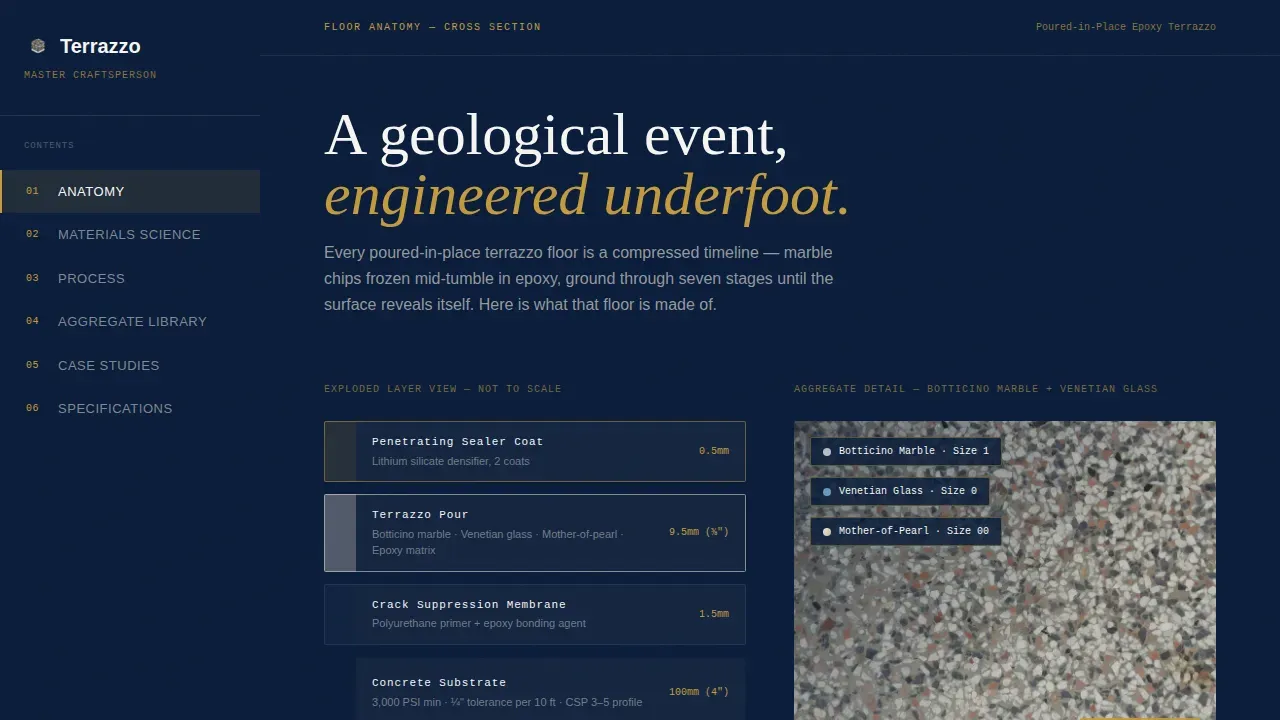
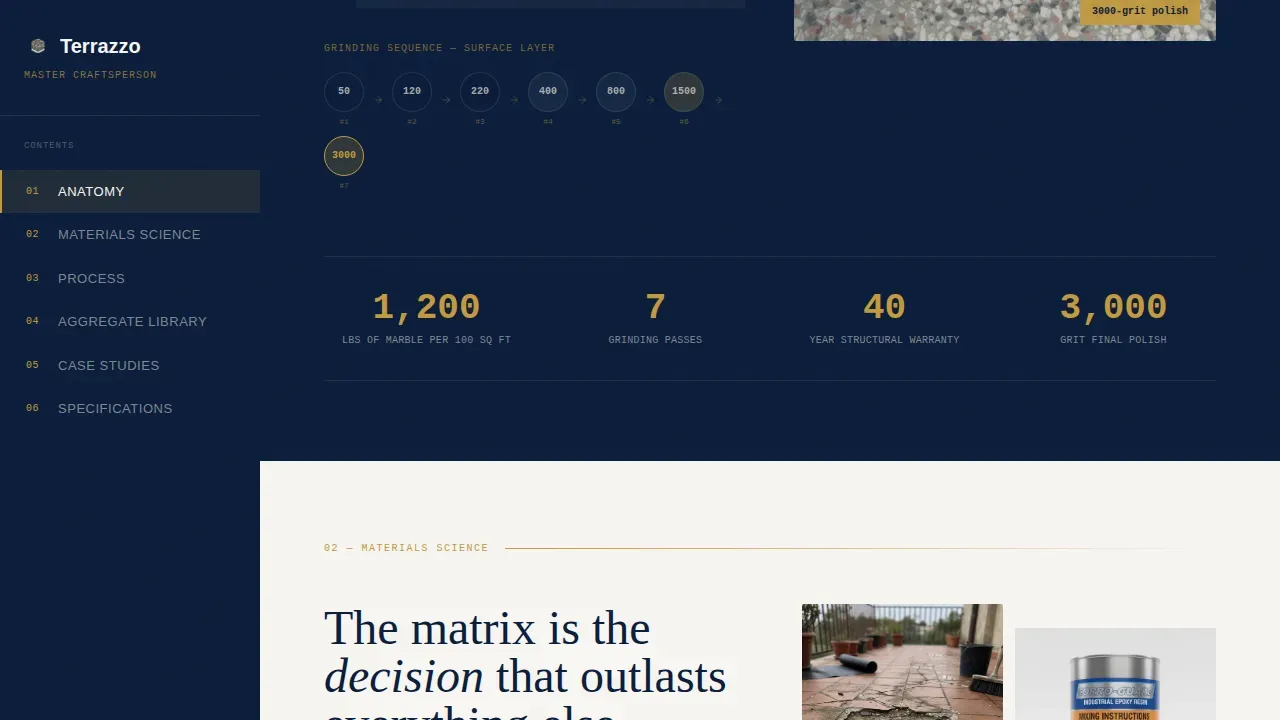
The header opens as a living data visualization rather than a static hero image. An exploded diagram of a terrazzo floor reveals each layer in sequence: the concrete substrate, bonding agent, terrazzo pour with labeled aggregates including Botticino marble, Venetian glass, and mother-of-pearl. Counters animate on page load displaying figures such as "1,200 lbs of marble per 100 sq ft," "7 grinding passes," and "40-year warranty," turning the craft into quantifiable authority before the visitor sees a single project photo.
Persistent Sidebar Table of Contents
The sidebar stays fixed as the visitor scrolls. It tracks five sections: Materials Science, Process, Aggregate Library, Case Studies, and Specifications. Active section highlighting updates in real time using scroll-intersection logic so visitors always know where they are in the content. After the visitor passes the Aggregate Library section, a fixed "Explore Project Specifications" call to action button appears in the sidebar, keeping the conversion action always visible without interrupting reading flow.
Deep-Dive Educational Sections
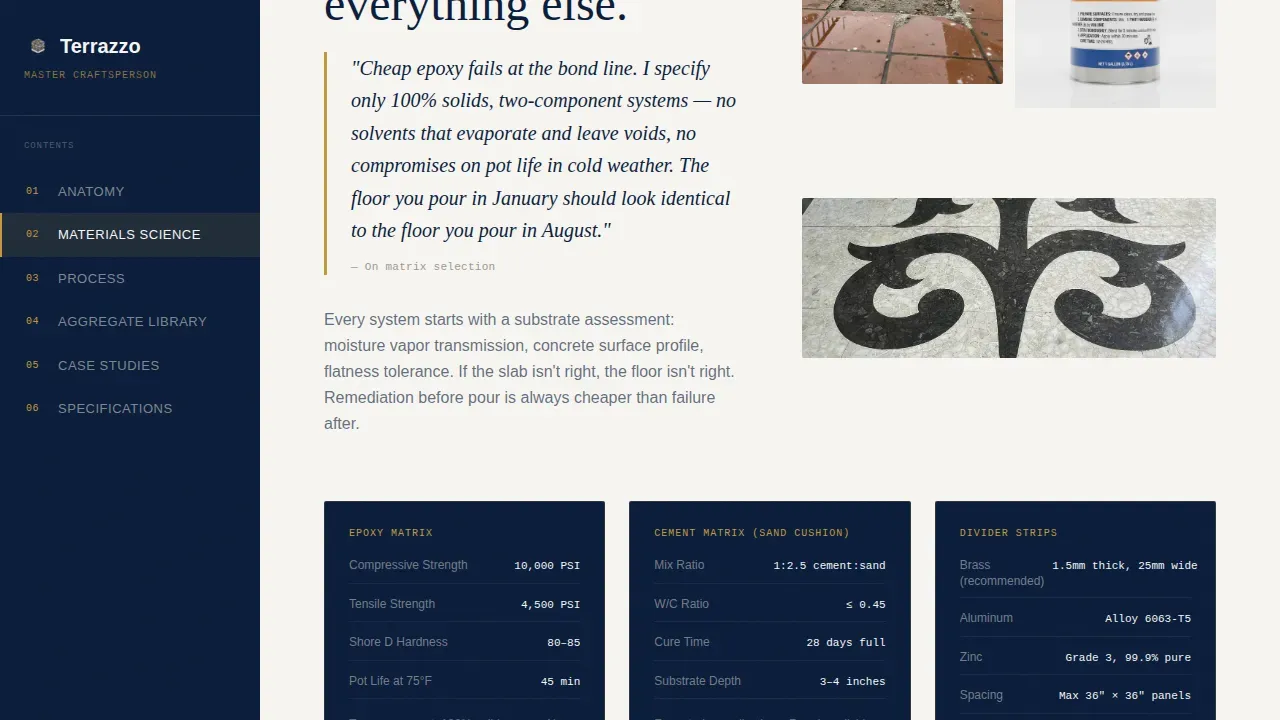
Each content section opens with a pull-quote in the craftsperson's voice, then unfolds into annotated project photography, macro shots of aggregate blends, and specification callouts written in technical literature style. The scroll experience is designed to transform a passive browser into someone who understands cement-to-aggregate ratios, divider strip placement, and the difference between 50-grit and 3000-grit polishing stages. This design structure means visitors arrive at the consultation page already fluent in the craft.
Aggregate Library with Hover States
The Aggregate Library section presents the craftsperson's available materials as a visual reference grid. Each entry includes a macro photography tile showing the individual stone, glass, or recycled aggregate at close range, with specification callouts that display on hover. Designers can browse the library like a physical sample cabinet, building familiarity with the palette before a project brief is written. This section reinforces the idea that every terrazzo floor design is a bespoke composition, not a catalogue selection.
Dual Call-to-Action Conversion Structure
The template places conversion actions at two distinct points in the visitor journey. The primary call to action, "Explore Project Specifications," first appears at the end of the Process section and is repeated as a fixed sidebar element after the scroll threshold. The secondary call to action, "Download the Aggregate Selection Guide," captures email addresses from designers and architects who are still in the research phase and not yet ready to book. This two-track approach serves both ready buyers and future pipeline leads.
Technical Specification Display
The Specifications section uses a technical literature aesthetic to present project data, material tolerances, and service scope. Callout blocks display figures and material names in a monospaced typeface, reinforcing the craftsperson's precision and authority. This section acts as a pre-consultation document, giving designers and architects the information they need to write a brief before they even make contact.
Page Sections Overview
| Section | Purpose |
|---|---|
| Hero Infographic | Establish authority with animated cross-section data and metric counters |
| Materials Science | Educate visitors on aggregate types, matrix chemistry, and material properties |
| Aggregate Library | Display browsable macro photography of available stone, glass, and recycled materials |
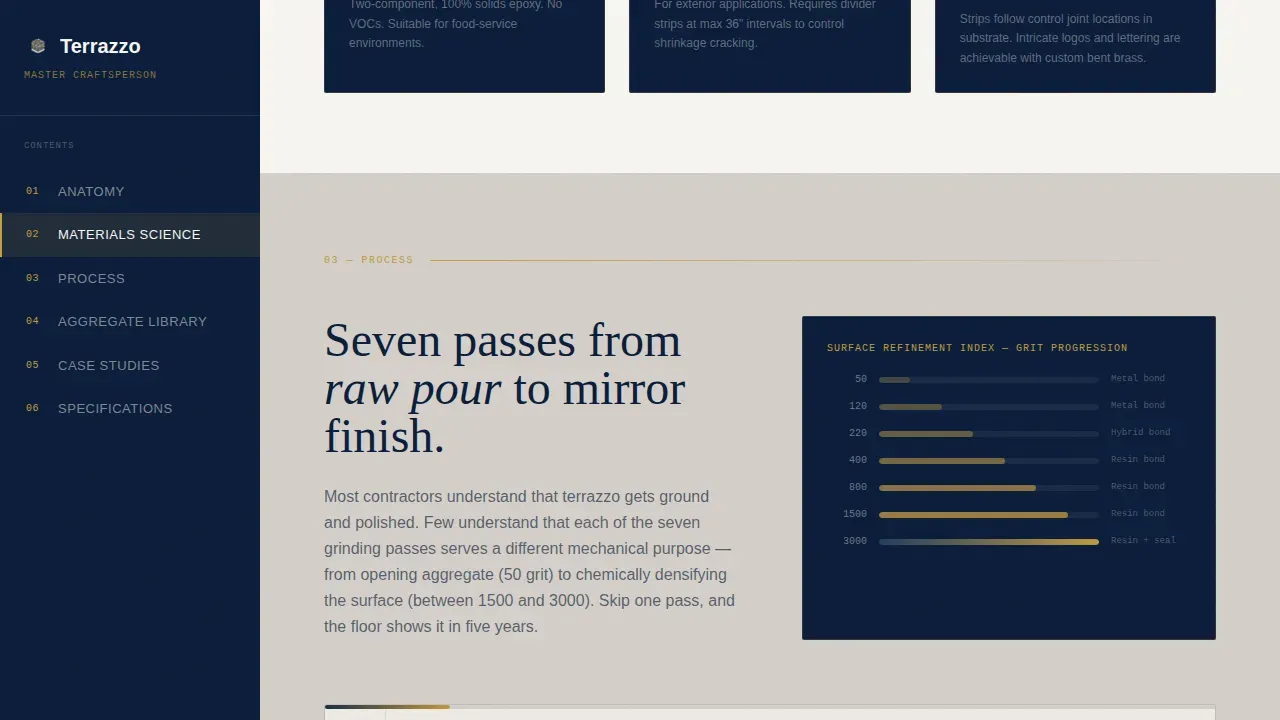
| Process Walkthrough | Show the seven-stage grinding sequence with annotated technical detail |
| Case Studies | Present annotated project photography with specification overlays |
| Specifications Panel | Deliver technical literature-style callouts and trigger the primary call to action |
| Footer Row | Provide contact links and supporting information in a linear single-row layout |
Design & Branding System
The visual identity follows an Educational Guide theme anchored in a Navy Authority color system. The palette feels like a master craftsperson's reference library: leather-bound specification manuals shelved beside actual aggregate samples in glass jars, authoritative but tactile.
- Deep maritime navy (#0B1D3A) anchors the sidebar and all section headers, giving the layout a composed, institutional weight that suits architects and designers working on formal building projects
- Polished stone gray (#D4CFC9) covers the content backgrounds like a cured slab, keeping the layout neutral so terrazzo photography and aggregate colors read true without competing with the interface
- Chalk white (#F7F5F2) is used for body text fields, maintaining legibility against both the navy and stone gray surfaces, while brass (#C49A3C) activates on hover states, active sidebar links, and call-to-action borders to deliver a precise, material accent that echoes the divider strips used in the floor itself
Mobile & Speed Optimization
The template is built desktop-first because interior designers and architects primarily work on large screens, and the sidebar companion layout requires a wide viewport to function as intended. At the same time, the template is structured to remain usable and visually appealing on smaller screens.
- The sidebar collapses gracefully on narrower viewports, keeping the core content sections accessible without losing the navigation structure
- Server Components handle all static content sections to keep initial load lean, while Client Components manage scroll-intersection logic, counter animations, and sidebar active-state tracking independently
How This Template Helps You Convert
This template is engineered as a click-through experience. The destination is a detailed project consultation page, and every section of the layout moves the visitor closer to that click with genuine understanding rather than pressure.
- Education replaces persuasion: each section teaches the visitor something specific about terrazzo floors, aggregates, or the grinding process, so by the time they reach the call to action they are already thinking in the craftsperson's language and asking about aggregate blends rather than price per square foot
- Dual conversion tracks capture both ready buyers and research-phase visitors: the primary "Explore Project Specifications" button targets clients ready to discuss a project, while the secondary "Download the Aggregate Selection Guide" email capture retains designers and architects who need more time before committing
- The fixed sidebar call to action ensures the conversion point is always visible after the visitor passes the Aggregate Library scroll threshold, removing friction at the moment of highest engagement
Other Information About This Template
This template sits at the intersection of portfolio craftsmanship and technical education. The following notes cover additional context that is relevant for terrazzo professionals, flooring contractors, and the designers who work with them.
- The word terrazzo is of Venetian origin and refers to flooring made from bits of marble or stone. The craft traces its roots to the Alpine foothill region of Friuli in northeastern Italy, with the first Venetian terrazzo floors dating to the sixteenth century. Friulian craftsmen later migrated to the United States, Canada, and Australia, with the first Italian mosaic workers arriving in the United States in the 1870s. The National Terrazzo and Mosaic Contractors Association was established in 1924 to support the growing network of terrazzo installers, and the introduction of the electric grinding and polishing machine in the early 1910s significantly improved efficiency for installers across the trade.
- Terrazzo floors are an ideal choice for high traffic areas including hallways, stairs, museum lobbies, and commercial buildings where durability and ease of maintenance matter. The seamless surface resists stain penetration and can be reground and repolished through renovation cycles, extending its life well beyond most competing flooring systems. Epoxy terrazzo systems eliminate the need for divider strips in some applications and can be formulated with zero VOCs (volatile organic compounds) to meet indoor air quality requirements.
- Terrazzo is highly versatile. It can be installed as poured-in-place flooring, precast tile panels, countertops, stairs, and wall panels. Selecting the right terrazzo tile or precast element involves considering size, shape, color, and the specific aggregates and matrix type to be used. The type of aggregate and matrix used in terrazzo tile directly impacts overall appearance and durability. Terrazzo tiles are well-suited to modern styles featuring clean lines and geometric patterns, and they offer a wide range of color options for minimalist design schemes and more expressive artwork-inspired compositions.
- A terrazzo portfolio landing page must balance visually appealing presentation with technical credibility. High-resolution photography is essential for showcasing the quality of aggregate and polish. Including annotated case studies with detailed descriptions of each project, the challenge addressed, and the specific solution applied gives designers and architects the context they need to evaluate the craftsperson's capabilities. Testimonials and social proof from architects and designers further build trust.
- Platforms like WordPress offer maximum flexibility for creating customized portfolio layouts for terrazzo craftsmanship. Squarespace is excellent for image-heavy portfolios with clean, modern templates suited to high-end design crafters. Wix offers a curated collection of portfolio website templates that can be customized to fit individual styles and goals. Wix portfolio templates include designated space for image galleries and visual projects, and they are fully customizable and mobile-ready. Wix allows users to customize templates in the Wix Editor by swapping images, updating text, and fine-tuning colors and typography. Wix also provides built-in SEO settings to help portfolio websites rank for relevant searches, and it enables users to track website performance with analytics to refine content and improve opportunities over time. Wix portfolio templates are designed with a flexible foundation that is easy to update as a body of work grows, and they allow users to add case studies, client quotes, and frequently asked questions to build trust with potential clients.
- Terrazzo flooring is a cost-effective long-term investment. Its durability means lower life-cycle costs compared to standard tile or epoxy alternatives. Using recycled aggregates in the mix can help commercial buildings meet sustainability goals and qualify for LEED credits for recycled content. The seamless surface is easy to clean and maintain, providing clear advantages in high-traffic commercial spaces. Terrazzo can increase the value of a commercial space by creating a strong first impression, whether installed in a hotel lobby, a museum entrance, or a renovated building corridor.
Theme
Educational Guide
Creative direction
Expert Panel
Color system
Navy Authority
Direction
Click-Through
Page Sections
Animated Cross-section Hero Infographic
Persistent Sidebar Table of Contents
Deep-dive Educational Content Sections
Aggregate Library with Hover States
Dual Call-to-action Conversion Structure
Technical Specification Display
Related questions
What types of clients is this template designed for?
Can I customize the aggregate library and project photography?
How does the persistent sidebar navigation work?
Does this template work on mobile devices?
What makes this different from a standard flooring portfolio template?