Agrarian Wine Education Landing Page Template
Terroir is a masonry-style landing page template for wine education schools and WSET preparation programs. It blends a scrapbook-collage header, an unevenly sized card grid, and a friction-reducing quiz flow into one browsable, tactile page. The Agrarian Root theme with a Citrus Burst palette makes it feel warm, credible, and unmistakably rooted in real wine culture.
by Rocket studio
Quick summary
Terroir is a single-page, masonry-layout landing page built for wine education schools and WSET preparation programs. The design borrows from scrapbook culture: overlapping Polaroids, hand-drawn maps, and rotated cards that reward grazing rather than linear reading. A sticky "Find Your Level" call to action and a three-question quiz replace traditional sign-up forms, routing prospective students directly to the right program level.
Who this template is for
This template speaks directly to educators and operators in the wine and food learning space. It was shaped around the specific motivations of adult learners who want formal credentials, not just casual enthusiasm.
- Wine education schools offering structured WSET Level 1, 2, 3, or Diploma programs to career-changers, restaurant professionals, and dedicated home enthusiasts
- Independent sommeliers or small teaching studios that need a credible, tactile web presence without the cost of a fully custom build
- Continuing education programs in the food and beverage sector that want a browsable, neighborhood-feel page rather than a corporate enrollment portal
What problem this template solves
Most wine school pages feel like university registration portals. They front-load dense text, ask for personal data before building any trust, and give prospective students no clear sense of where they belong in the program ladder. The result is obvious: visitors leave before they commit.
- Removes sign-up friction by replacing a traditional form with a three-question quiz that routes visitors to the right WSET level, reducing the decision cost upfront
- Replaces flat grid layouts with an unevenly sized masonry card system that mimics the browsable, accumulative rhythm of a neighborhood corkboard
- Builds credibility through a dedicated band for program stats and a testimonial grid that shows real before-and-after student journeys, giving evidence before asking for anything
What you get with this template
You get a complete, section-led landing page built around the full student conversion journey, from first impression through quiz-driven enrollment. Every section is purposeful and grounded in the brief.
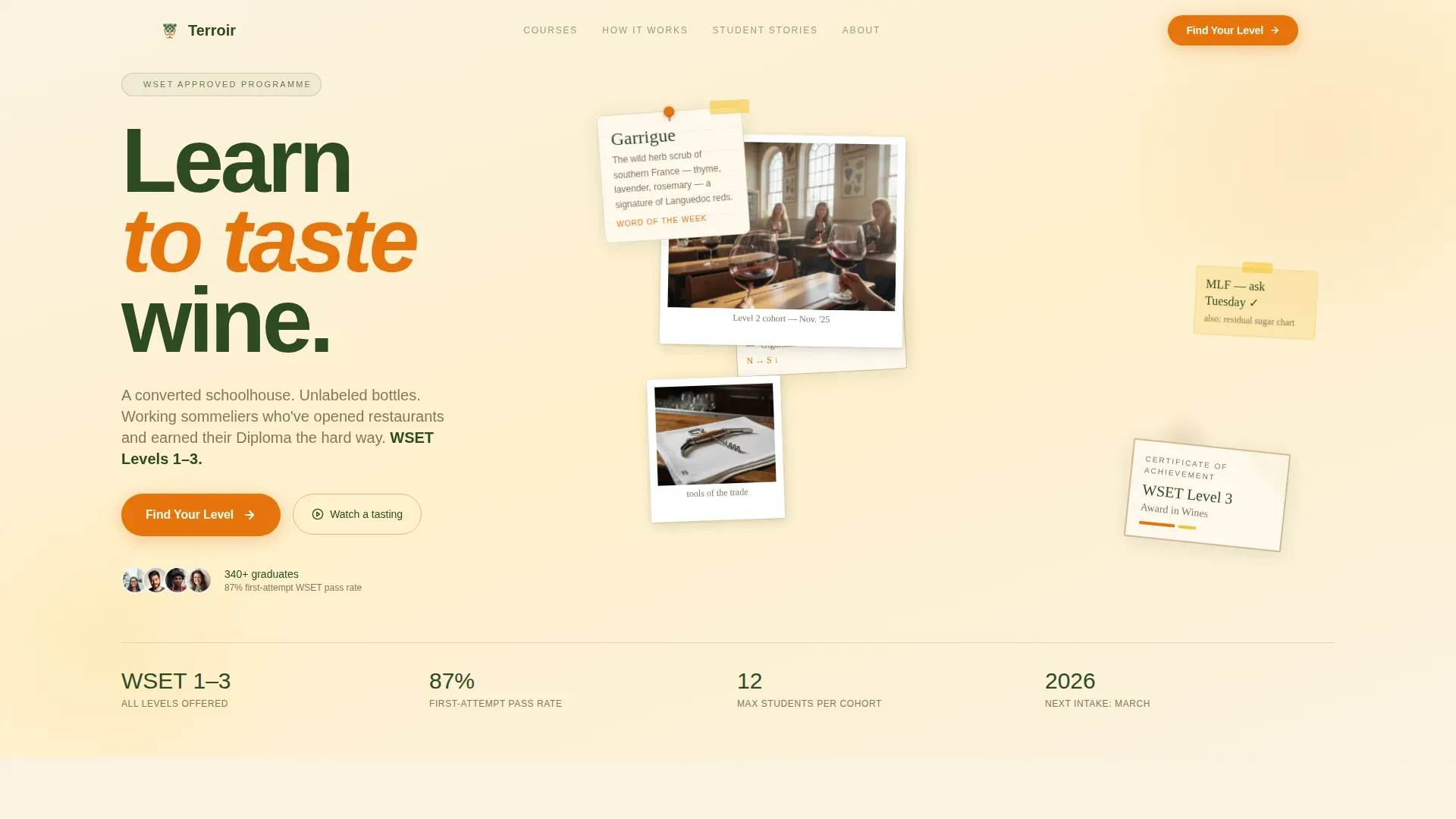
- A scrapbook collage hero with rotated Polaroid artifacts, a hand-drawn appellation map, a wine key on a folded apron, and a sticky "Find Your Level" call to action button
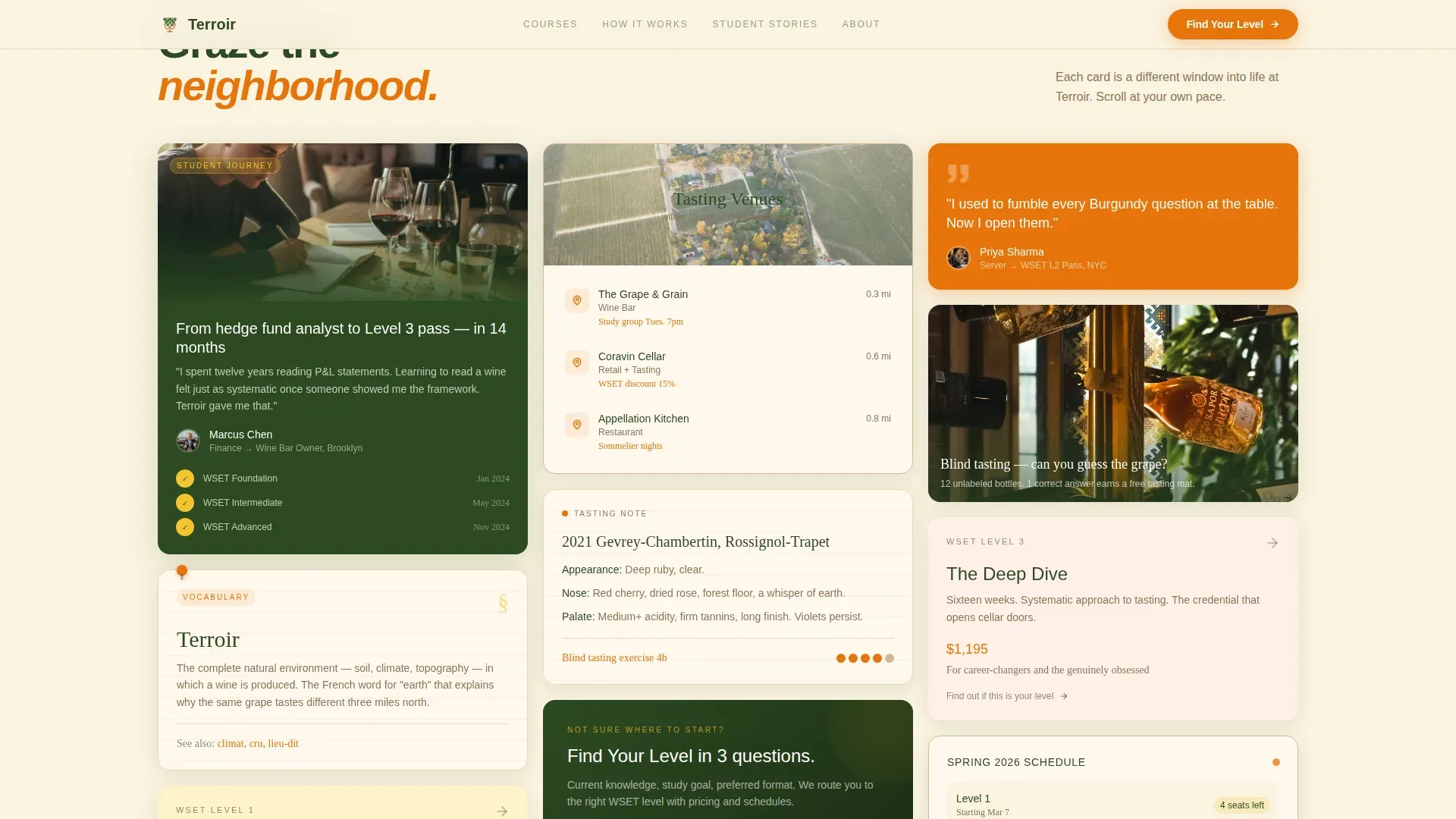
- A masonry card grid with unevenly sized cards: tall journey cards, wide venue maps, small vocabulary squares, and study group Polaroids that each feel posted by a different neighbor
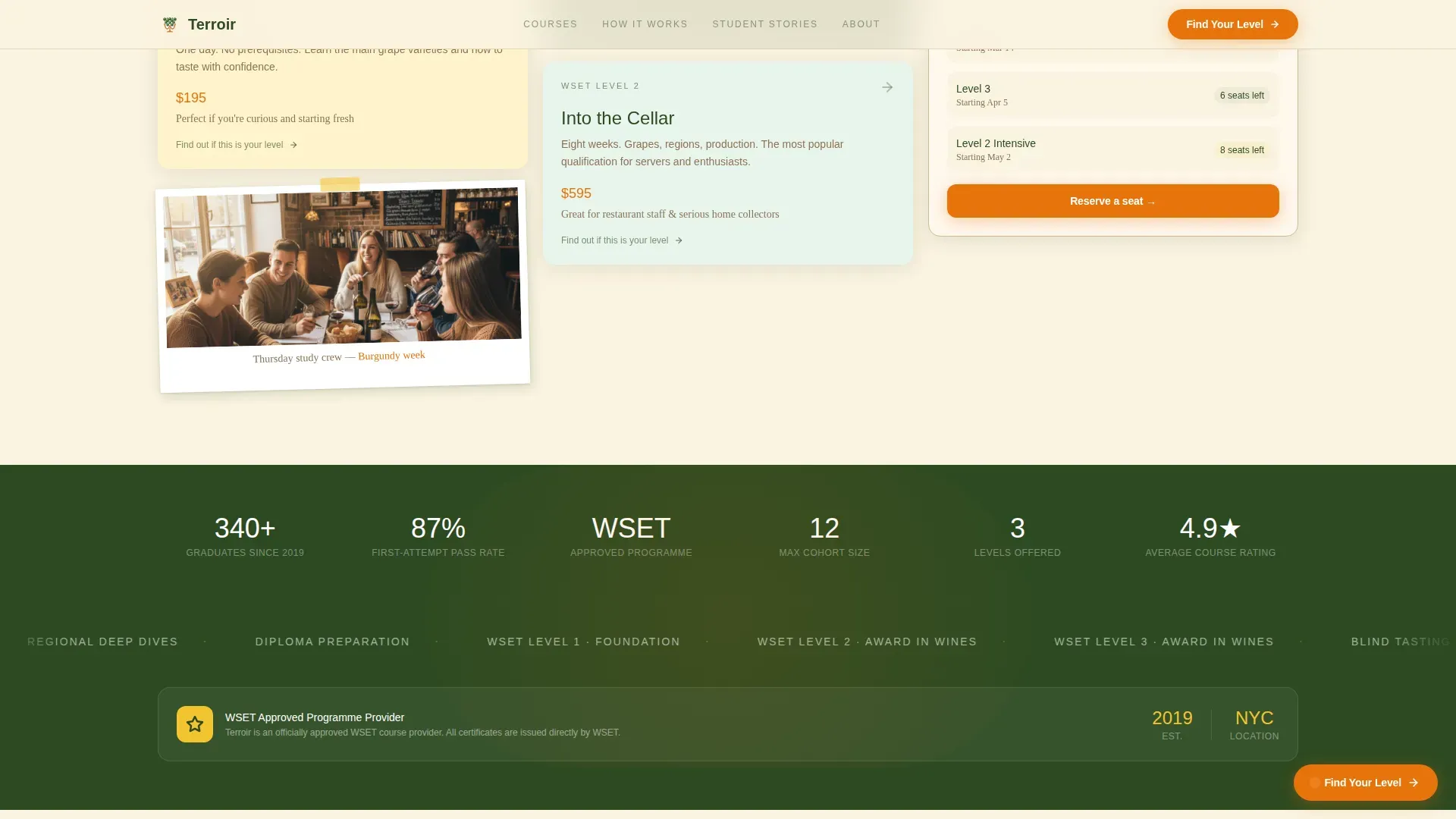
- A credibility band, a "How It Works" sticky carousel timeline, a four-card testimonial grid, a full-width quiz call-to-action band, and a linear single-row footer
Feature list
This section describes the functional and design capabilities built into the Terroir template as stated in the brief.
Scrapbook Collage Hero
The header is built as a collage composition with overlapping, slightly rotated Polaroid-style artifacts. Items include a stained tasting mat, a hand-drawn map of Rhône appellations, a torn certificate corner, and a wine key resting on a folded apron. Nothing appears studio-polished; every element looks touched and lived-in, producing a strong first impression that communicates culture and craft before a word is read.
Masonry Card Grid with Varied Sizing
The pain and proof section uses a Pinterest-style masonry grid where cards are deliberately sized unevenly. A tall card traces a student journey from Level 1 to Diploma. A wide card maps nearby tasting venues. A small square holds a single vocabulary word, for example "Garrigue, the wild herb scrub of southern France." A Polaroid card shows a study group at a corner café. The uneven rhythm encourages visitors to graze and collect impressions rather than skim and leave.
Quiz-Driven Conversion Flow
The primary call to action, "Find Your Level," appears as a sticky button immediately after the hero and repeats as a full-width warm orange band after every sixth masonry card. Clicking opens a short modal quiz with three questions: current wine knowledge, study goal, and preferred format. The quiz routes the visitor to the correct WSET level page where pricing, schedules, and a seat-reservation button are waiting. No form lives on the landing page itself.
Credibility Band with Stats and Marquee
A dedicated credibility section displays WSET official program stats and scrolls a logo marquee across the surface. This section gives prospective students concrete, collected data points before they reach the quiz, building the sense of trust that leads to a click rather than a back-button press.
Sticky Carousel and Timeline Section
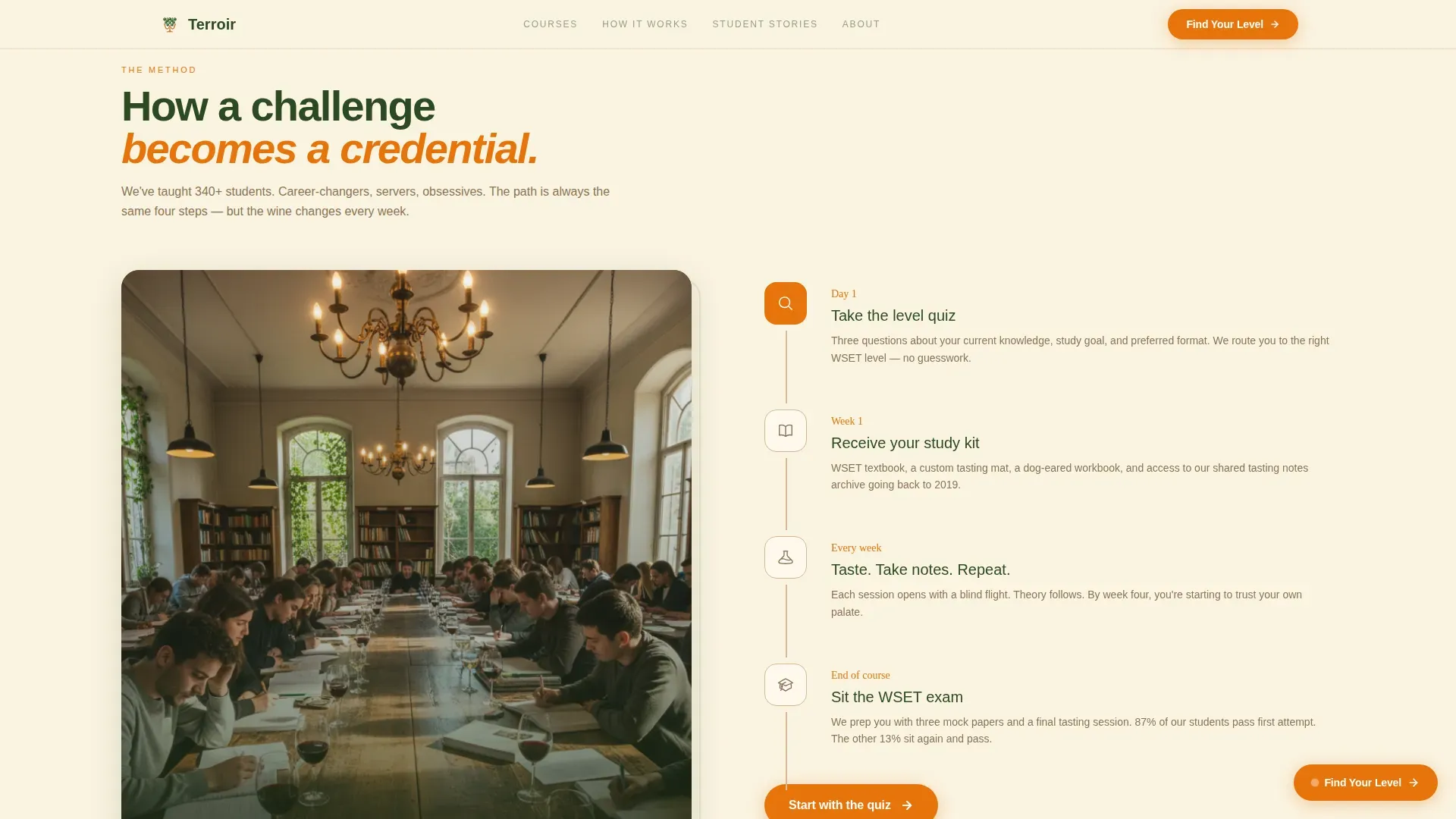
The "How It Works" section pairs a sticky left image carousel with a right-side timeline. As visitors scroll, the left image stays fixed while the timeline steps appear in sequence. This layout makes the enrollment journey feel manageable and clear, reducing uncertainty about what happens after the quiz.
Four-Card Testimonial Grid
The testimonials section presents four cards, each showing a specific student journey with before-and-after roles and measurable outcomes. Specific journeys and metrics make the social proof feel real rather than generic, which is essential for adult learners making a meaningful career or lifestyle decision.
Page sections overview
| Section | Purpose |
|---|---|
| Scrapbook collage hero | Opens with rotated Polaroid artifacts and a sticky "Find Your Level" call to action |
| Masonry proof cards | Displays varied-size cards with student journeys, vocab squares, venue map, and study group shots |
| Credibility stats band | Shows WSET program stats and a scrolling logo marquee to build institutional trust |
| How It Works timeline | Pairs sticky left carousel with a right-side scroll timeline explaining the enrollment path |
| Testimonials grid | Four student journey cards with specific before-and-after roles and outcome metrics |
| Quiz call-to-action band | Full-width warm orange band repeating the "Find Your Level" quiz trigger |
| Linear footer | Single-row footer with essential navigation and contact links |
Design & branding system
The Agrarian Root theme drives every visual decision. The Citrus Burst color palette feels like a wooden crate of citrus split open at a Mediterranean farmers' market: warm, acid-bright, and slightly imperfect. Linen white keeps backgrounds calm, while orange and lemon punctuate interactive elements so the warmth never drifts into sweetness.
- Colors: linen white (#FAF3E0) dominates backgrounds; Seville orange (#E8740C) drives primary actions and hover states; Meyer lemon zest (#F4C430) accents cards; deep vine-leaf green (#2D4A22) grounds headlines and section dividers
- Typography: Plus Jakarta Sans for headings provides editorial weight; DM Sans for body copy keeps reading comfortable and approachable at paragraph depth
- Texture and motion: rotated card hover lifts, Ken Burns carousel animation, scroll-reveal stagger on masonry cards, and a marquee scroll on the credibility band produce a high-animation, high-interactivity feel without losing the handmade, agrarian surface quality
Mobile & speed optimization
The template is built desktop-first to support the grazing, browsable behavior the masonry grid encourages. The brief calls for responsive mobile layout so the page remains functional and navigable on smaller screens.
- Server Components handle static sections such as the credibility band, footer, and testimonial grid; Client Components manage animation-heavy areas like the quiz modal, carousel, and scroll-reveal card stagger
- The masonry grid and collage hero reflow for mobile viewports, preserving the card variety and Polaroid aesthetic at smaller surface sizes
- The sticky "Find Your Level" button and the full-width quiz call-to-action band remain prominent and tappable at all screen widths, keeping the primary conversion path clear on every device
How this template helps you convert
The Terroir template is built around one core insight: curiosity converts better than commitment. Every layout decision funnels visitors toward a low-stakes first action rather than an immediate sign-up.
- The quiz mechanic replaces the traditional enrollment form. Visitors answer three questions about their wine knowledge, study goal, and preferred format. The quiz then routes them to a level-specific page with pricing and a seat-reservation button, so the conversion happens after trust is built, not before.
- The masonry card grid accumulates evidence gradually. Each card adds a layer of proof: a student's journey, a vocabulary moment, a neighborhood venue, a study group snapshot. By the time a visitor reaches the first quiz call-to-action band, they have already collected enough context to feel confident clicking.
- The full-width orange band repeats after every sixth card. The repetition is unhurried and contextual, appearing at natural pause points in the browsing rhythm rather than interrupting it. This distribution of the call to action across the page means visitors encounter it when they are most curious, not just at the top.
Other information about this template
The Terroir template draws on a body of wine education thinking that makes the subject matter feel substantial, not decorative. The facts woven into the card content and vocabulary squares reflect real terroir science and agricultural knowledge that resonates with serious learners.
- Terroir is a concept that embodies the collective knowledge of the interactions between the physical and biological environment, viticultural practices, and cultural dimensions that influence wine production. Education emphasizes regional origins, as seen in appellation systems across France and beyond.
- Soil impacts water retention, drainage, and nutrients, all of which influence wine production. Limestone-rich soils often produce mineral-driven white wines, while gravel soils in Bordeaux help ripen red grapes. Understanding how soil type and irrigation practices shape vine development and grape composition is central to serious wine study.
- Cool climates produce lighter, high-acid wines, while warm climates yield full-bodied, fruit-forward wines. Cool climate wines, such as those from Germany, are characterized by high acidity. Steeper slopes provide better drainage, and high-altitude vineyards offer cooler nights that help maintain acidity and aromatic compounds in grapes.
- Microbial communities on grape surfaces are influenced by vineyard environmental conditions and contribute to a wine's distinctive terroir. The structure of these communities varies widely across different grape growing regions, affecting wine quality. Biodiversity and local microorganisms contribute to a vineyard's unique ecological fingerprint, and understanding microbial terroir helps growers manage vineyards for optimal quality.
- Viticulture zoning techniques are crucial for mapping and studying terroirs. The identification and mapping of agricultural sites with similar physical characteristics is a key component of terroir studies. Precision viticulture methods, combined with remote sensing and machine learning analysis, allow for site-specific management to improve production efficiency across diverse vineyard sites.
- Climate change impacts the resilience of terroir by altering the environmental conditions that define it. Understanding the interaction between climate, soil, and grapevine physiology is essential for managing vineyards under changing conditions. The identification of new suitable land for viticulture appears increasingly important as producers and growers adapt their agricultural systems to shifting growing zones.
- The concept of terroir encourages a deeper connection between consumers and the wines they choose, fostering appreciation for the origin and craftsmanship behind each bottle. The cultural significance of terroir is rooted in its ability to convey a sense of place, history, and identity in winemaking. The pursuit of terroir is seen as a way to achieve greater complexity and depth in wines, moving beyond mere technical perfection.
- The expression of terroir can only be correctly described at the Soil-Plant-Atmosphere scale. A vin de terroir is one that reflects the unique characteristics of a site, with the winemaker's contribution being discreet and not overpowering. This idea is not necessarily obvious from a label alone but is revealed through study, tasting practice, and the kind of guided examination this template is built to support.
- Publication contexts such as Wine Spectator regularly examine how terroir shapes regional identity and wine quality. References to Wine Spectator and its coverage of wineries, producers, and the phenomenon of place-driven flavor help ground the educational content in a credible, recognizable conversation about what makes one wine different from another. These references appear naturally in the vocabulary cards and credibility content the template is designed to surface.
- The template is built for the Food and Beverage category, specifically the Winery and Wine subcategory, under the Wine Education and WSET niche. It is a single-page landing page, not a multi-page website. The terroir agrarian wine education landing page template is designed for operators who want a credible, tactile, high-animation build without commissioning a fully custom project from the ground up.
Theme
Agrarian Root
Creative direction
Local & Neighborhood
Color system
Citrus Burst
Style
Masonry/Pinterest
Direction
Click-Through
Page Sections
Scrapbook Collage Hero Section
Masonry Pinterest Card Grid
Quiz-driven Enrollment Flow
Credibility Band with Marquee
Sticky Carousel and Timeline
Four-card Testimonial Grid
Related questions
Does this template include the quiz functionality built in?
Can I use this template for a single instructor or small studio, not just a large school?
What WSET levels does the template content assume?
Is the masonry grid layout fixed or can cards be rearranged?
How does the page handle visitors who already know their WSET level?