Specialty Construction Appointment Booking Website Template
The Bore landing page template is built for geothermal heating installers who want to turn high propane and oil bills into booked site surveys. It pairs a map-based hero with address input, three escalating case study sections in a zigzag layout, and a five-step guided property assessment. The result is a confident, data-driven page that earns trust and drives action.
by Rocket studio
Quick summary
Bore is a single-page template designed for geothermal heating installation companies. It opens with a satellite map hero and an address input field, then walks visitors through three real-world installation case studies before landing them in a five-step property assessment quiz. Every section reinforces one idea: the earth beneath your home is already producing heat, and the right equipment can put it to work.
Who this template is for
This template serves businesses that drill boreholes, install ground loops, and commission geothermal heat pumps for residential and commercial clients. It is built for companies that need to explain a technical service clearly, justify a premium investment, and convert cautious visitors into booked appointments.
- Geothermal drilling contractors targeting rural homeowners on propane or oil heat
- Specialty construction firms and clean-energy installers pitching to architects and developers
- Any geothermal business that wants to replace a generic contact form with a guided, data-led conversion flow
What problem this template solves
Geothermal heating is a high-trust, high-investment decision. Most visitors arrive skeptical about cost and complexity. A standard service page cannot carry that argument. This template solves the credibility gap by leading with verifiable case study narratives and rewarding curiosity with personalized savings data before asking for anything.
- Homeowners do not understand how geothermal systems work or why drilling deeper provides more consistent heat than shallow loops
- Architects and developers need proof of structural competence and real project outcomes before specifying a driller
- Generic contact forms lose high-intent visitors who want data, not a sales call
What you get with this template
You get a fully structured, single-page layout with every section pre-built and ready to customize. The page is designed around a clear narrative arc that moves from curiosity to conviction. Visual storytelling, interactive assessment logic, and a calendar booking embed are all part of the included structure.
- A map-based hero section with address input, heat-gradient animation, and a fade-in headline reveal
- Three zigzag case study sections with alternating photo and text layout, each featuring a specific annual savings figure
- A five-step guided assessment quiz with micro-insights per step, a personalized savings estimate screen, and a calendar embed for booking
Feature list
This section describes the key functional and visual components included in the Bore template.
Map-Based Hero with Address Input
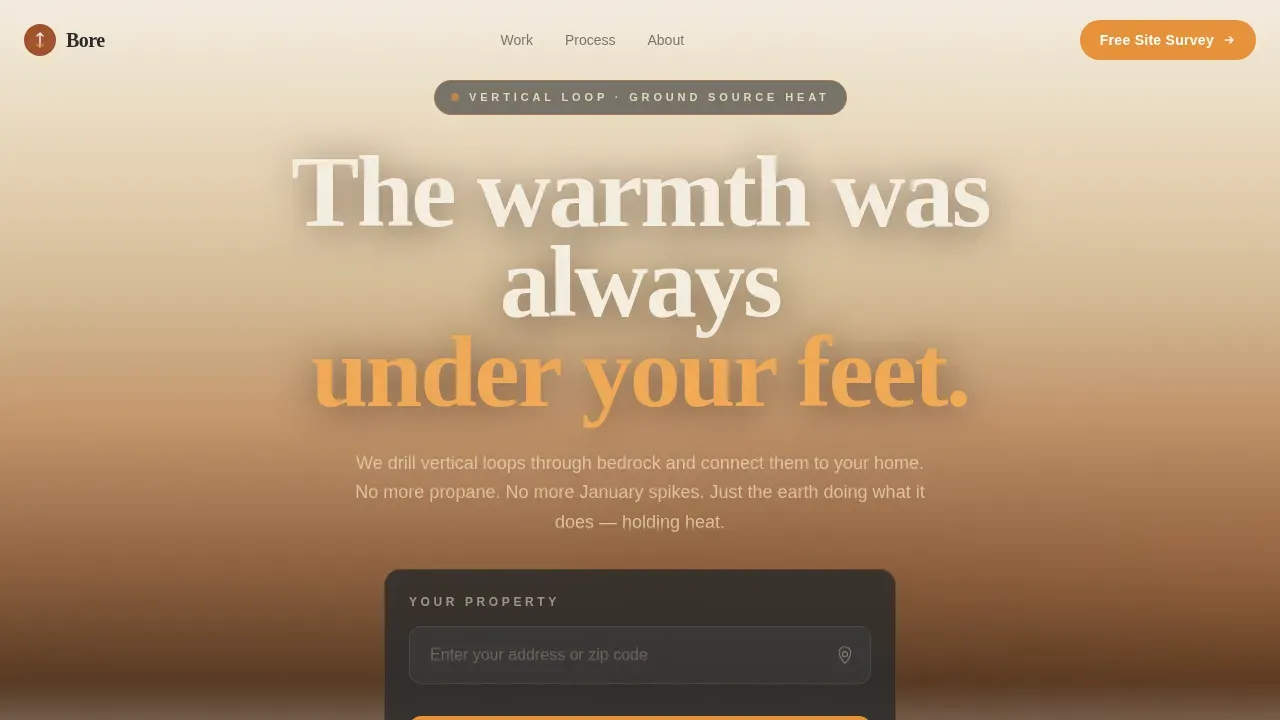
The hero section uses an aerial satellite view overlaid with animated heat-gradient pulses that bleed upward through illustrated geological layers. A single input field sits over the map. When a visitor types an address, a pin drops and the ground beneath it glows warm. A headline fades in reading "Your home is sitting on its own furnace." This opening communicates the core value of geothermal heat in seconds, using visual metaphor rather than a wall of text.
Zigzag Case Study Sections
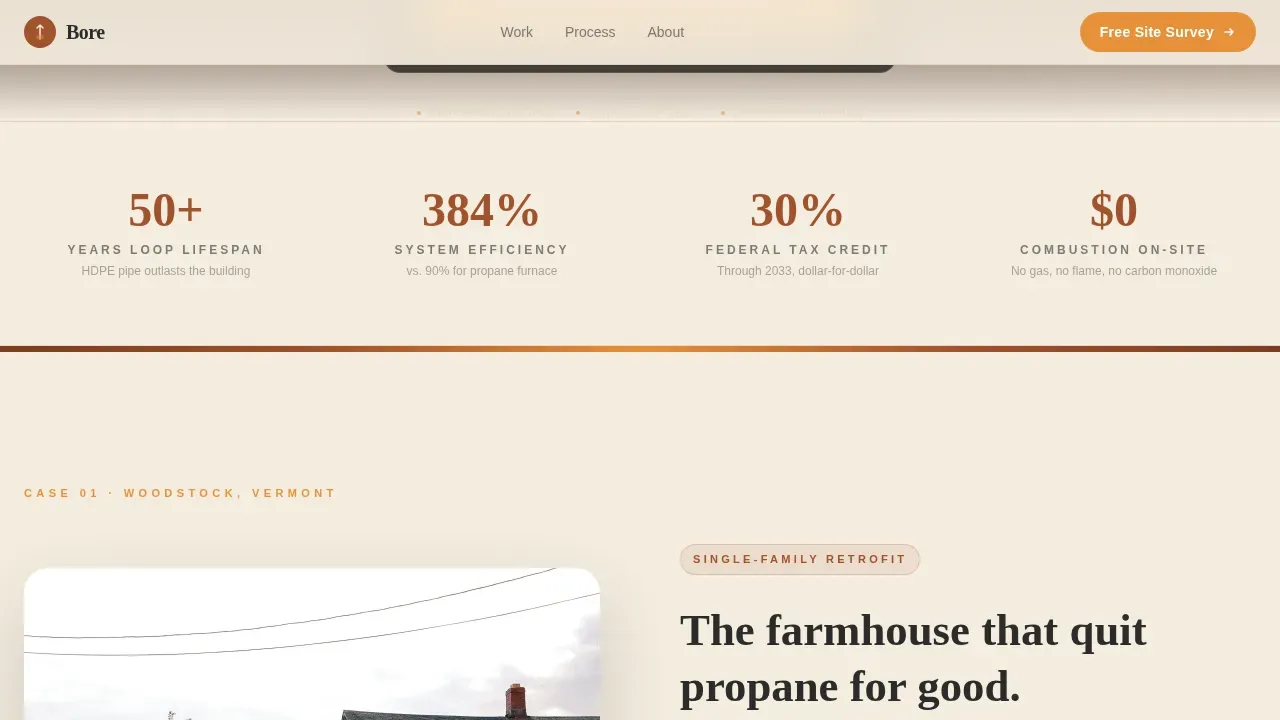
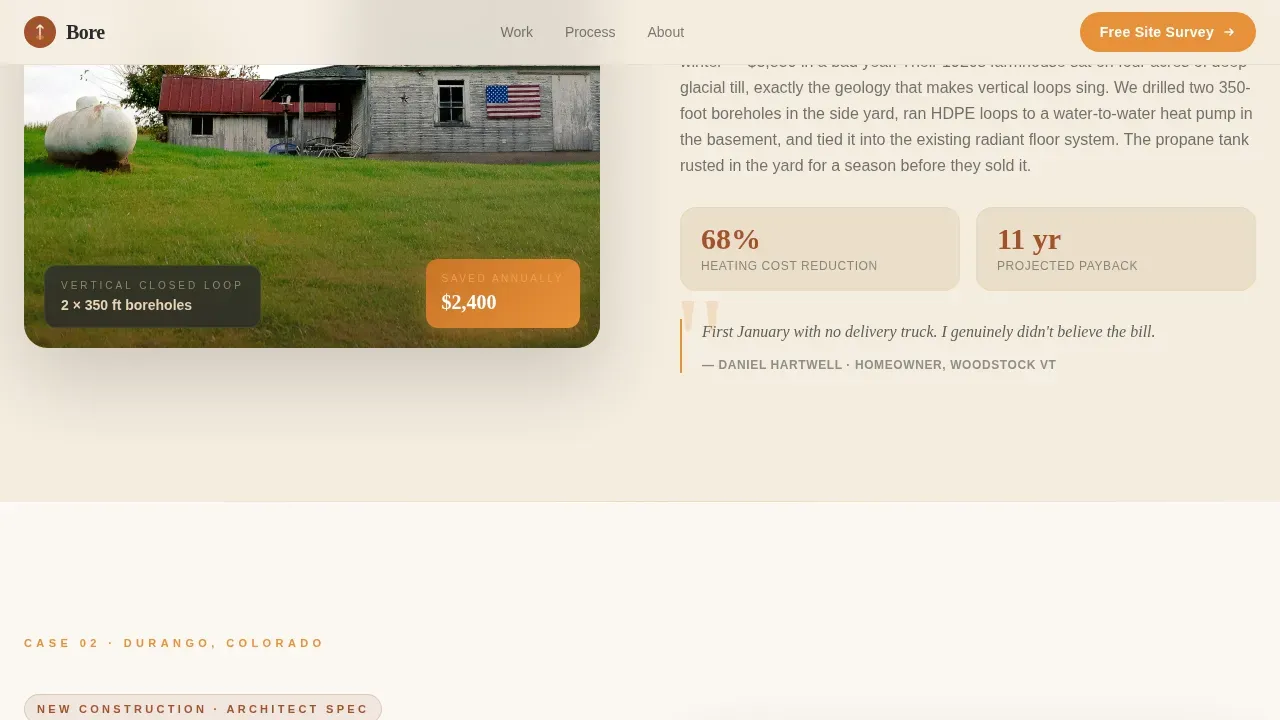
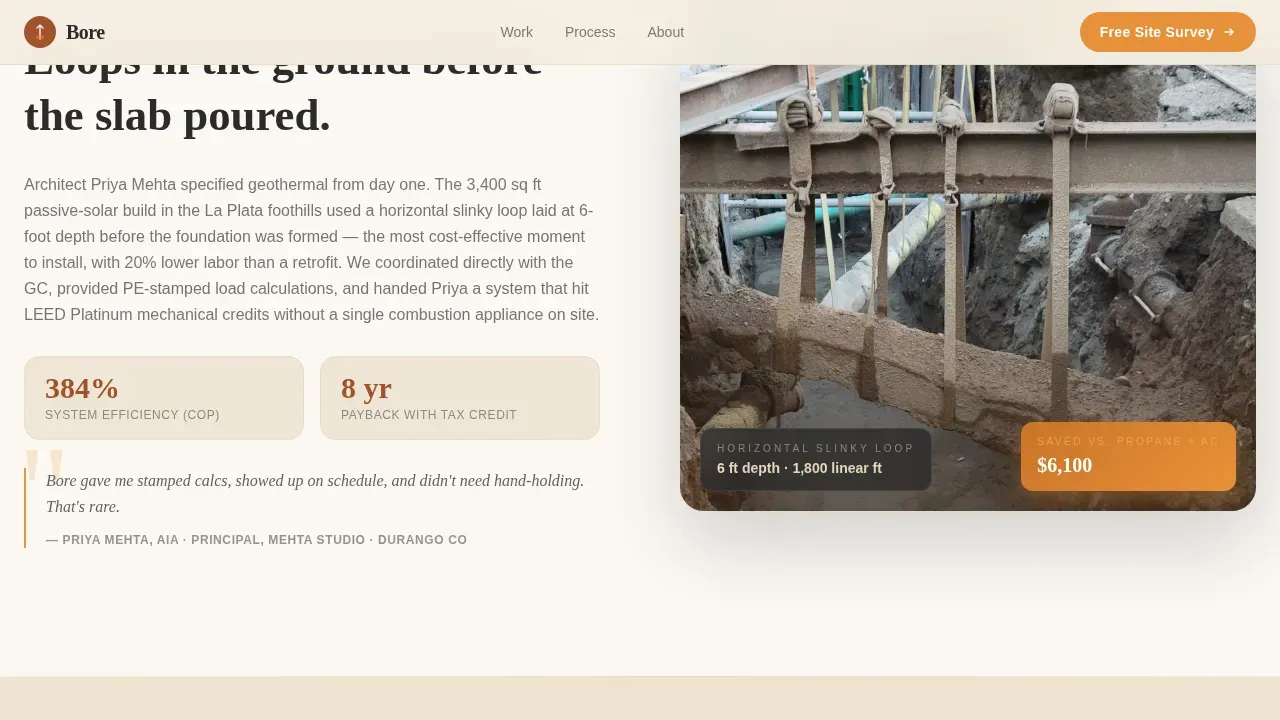
Three alternating sections each tell one complete installation story. The first covers a Vermont farmhouse with an open trench, mud on the drill rig, and a visible propane tank in the background, saving $2,400 per year. The second covers a Colorado new-build with ground loops laid before the slab pour and an architect's spec sheet quoted, saving $6,100 per year. The third covers a small commercial building saving $11,000 per year. Each section escalates in scale and savings, building a compound argument that geothermal resources are available almost everywhere and that the financial case grows with building size.
Five-Step Guided Assessment Quiz
The primary call-to-action leads visitors into a structured, five-step property assessment. Steps collect property type, current heating fuel, approximate square footage, lot size, and zip code. Each step surfaces a micro-insight tied to the visitor's answers, for example noting that propane users in a given county pay 40 percent more per BTU than the national average. The final screen delivers a personalized savings estimate and presents a calendar embed for booking a site survey, requiring no phone call and applying no sales pressure.
Sunset Mesa Color System and Typography
The template uses a four-color palette: deep terracotta (#A0522D) as the primary brand color, sun-bleached sandstone (#E8D5B7) as the background tone, subsurface charcoal (#2B2B2B) for dark elements, and living-heat amber (#E8913A) reserved for calls to action, progress indicators, and interactive highlights. Typography pairs Fraunces serif headlines with DM Sans body text, creating a balance of geological weight and clean utility readability.
Scroll-Triggered Animations and Interactions
The template includes a full suite of scroll-driven animations. The map hero features a heat pulse effect. Each zigzag case study section reveals on scroll using Intersection Observer triggers. The quiz transitions between steps with staggered animations, and each micro-insight fades in as the visitor progresses. These interactions are built with CSS scroll animations and Intersection Observer, keeping the page feeling alive without relying on heavy third-party libraries.
Linear Single-Row Footer
A clean, single-row footer closes the page. It is structured to hold essential contact information, legal links, and brand identity elements in one compact horizontal line, consistent with the Service Utility theme.
Page sections overview
| Section | Purpose |
|---|---|
| Map Hero | Address input with heat-gradient pulse animation and headline reveal |
| Case Study One | Vermont farmhouse narrative, photo left, $2,400/year saved |
| Case Study Two | Colorado new-build narrative, text left, $6,100/year saved |
| Case Study Three | Commercial building narrative, photo left, $11,000/year saved |
| Assessment Quiz call to action | Five-step property quiz with micro-insights and savings estimate |
| Calendar Booking | Embedded scheduler on final quiz screen, no phone call required |
| Linear Footer | Single-row footer with contact and brand details |
Design & branding system
The visual identity follows a Service Utility theme rooted in the Sunset Mesa color system. The palette draws from the imagery of a desert canyon at golden hour, with layers of warm sediment exposed by erosion, each stratum darker and older than the last. The effect is earthy, geological, and ancient-reliable rather than modern-tech slick.
- Colors: deep terracotta (#A0522D) primary, sandstone (#E8D5B7) background, charcoal (#2B2B2B) for dark surfaces, amber (#E8913A) for all calls to action and interactive highlights
- Typography: Fraunces for all headlines (serif weight of old stone) and DM Sans for all body text (clean utility readability)
- Visual style: geological layering metaphor carried through the map hero, heat-gradient overlays, and the earthy tonal progression from light sandstone to deep charcoal as the visitor scrolls down
Mobile & speed optimization
The template is built desktop-first to match the research behavior of homeowners comparing heating systems and architects reviewing specifications. Full mobile support is included. The interaction animations are designed to perform well on mobile by relying on CSS and Intersection Observer rather than heavy JavaScript libraries.
- Desktop-first layout with a responsive breakpoint structure for full mobile support
- CSS scroll animations and Intersection Observer used for all animated elements, keeping the page lightweight
- The five-step quiz is structured to render cleanly on smaller screens, with staggered step transitions that feel smooth on touch devices
How this template helps you convert
Geothermal heat is a considered purchase. Visitors need to understand the technology, see proof it works at their scale, and feel confident before booking. This template is structured to move them through each of those stages in order.
- The map hero creates immediate personal relevance by placing the visitor's own address at the center of the value proposition, turning a general claim about geothermal energy into a specific statement about their property.
- The three case study sections build a compound proof stack. Each story escalates in complexity and savings, demonstrating that the same geothermal systems that serve a rural farmhouse can also handle commercial buildings. By the third section, the visitor has seen the ROI argument at three different scales.
- The five-step assessment converts curiosity into commitment by giving visitors personalized data in exchange for basic property information. The final screen delivers a savings estimate and a calendar embed, removing the phone-call barrier and letting data close the loop.
Other information about this template
The Bore template is designed for the geothermal heating installation niche within the broader specialty construction and clean-energy sector. The following context helps builders and buyers understand the full scope of what this template supports and why its design decisions were made.
- Geothermal heat pumps have a coefficient of performance (COP) of 4 to 5, compared to 2 to 3 for air source heat pumps, making them significantly more efficient in colder climates. This efficiency data point is a natural fit for the case study text blocks and the quiz micro-insights section.
- Geothermal heat pump technology uses electricity to move heat from the ground loop into a building in winter, and from the building back into the ground loop for cooling in summer. A single unit can provide both heating and cooling from the same system.
- The installation process involves drilling boreholes to access geothermal resources below the surface. A drill rig is brought to the site, a borehole is drilled to the appropriate depth, steel casing is set, and the ground loop pipes are installed before backfilling. Drilling deeper produces higher, more consistent temperatures than shallow loops.
- Geothermal heat pump systems are in use across all climate zones in the United States and in buildings of virtually every type, from single-family homes to commercial facilities. They can be retrofitted into existing buildings, supporting a gradual transition from conventional heating fuels.
- Geothermal energy systems do not produce direct emissions. They reduce dependence on conventional fuel sources and contribute to lower carbon output associated with heating and cooling.
- Deep geothermal systems can provide baseload energy 24 hours a day, seven days a week, regardless of weather conditions, making them a reliable renewable energy source for residential and commercial buildings.
- The 2019 GeoVision analysis indicated potential for up to 60 gigawatts of electricity generation capacity from geothermal energy in the United States by 2050. The Enhanced Geothermal Shot analysis later confirmed potential for 90 gigawatts of geothermal electricity-generating capacity by the same date.
- The Cornell University Borehole Observatory was drilled to study the potential to generate heat from strata below the Cornell campus. The borehole reached a final depth of 9,790.5 feet, passing through 150 million years of marine sedimentary strata. Drilling took 54 days and the observatory is now used for long-term observations of pressure, fluids, and heat at depth. Early results focus on identifying which pre-existing fractures in bedrock are most suitable for harvesting geothermal heat.
- A pilot project approved by the Massachusetts Department of Public Utilities installed a geothermal network in Framingham, Massachusetts, including approximately one mile of main pipe and 90 boreholes serving 36 buildings. The project is running through two heating and cooling seasons, and data collected will be used for ongoing evaluation of geothermal energy as an alternative to fossil fuels.
- The template is localized for United States use, with USD pricing, imperial units, and MM/DD/YYYY date format throughout.
- The bore deep earth geothermal heating landing page template is available on the marketplace as a ready-to-customize starting point for geothermal drilling and installation businesses.
- Federal tax credits and state incentives for geothermal heat pump installations may help offset higher upfront costs. The template's case study structure and quiz outcome screen are natural locations to surface these financial details.
- Regular updates to keep the template compatible with evolving platform standards are part of the marketplace support model.
- The page includes embedded videos support in the case study and assessment sections, allowing installers to add walkthrough footage or drill rig process clips to deepen engagement.
- Green energy initiatives at the state and federal level are expanding eligibility and funding for geothermal projects. The template's case study narrative format is well suited to communicate how a given installer's projects align with these broader initiatives.
Theme
Service Utility
Creative direction
Case Study Narrative
Color system
Sunset Mesa
Style
Zigzag/Alternating
Direction
Quiz/Assessment
Page Sections
Map-based Hero with Address Input
Zigzag Case Study Narrative Sections
Five-step Guided Property Assessment
Sunset Mesa Color System
Scroll-triggered Animations and Interactions
Linear Single-row Footer
Related questions
Who is the Bore template designed for?
What sections are included in this landing page template?
Can this template support commercial geothermal projects?
Does the template cover both heating and cooling content?
How does the five-step assessment quiz work?