Creative Freelance Marketplace Landing Page Template
The Hustle Family First Creative Freelance Landing Page Template is a sidebar-companion landing page built for independent creatives who balance serious client work with real family life. It uses a warm Electric Indigo color system, case study narrative flow, and a single charged-magenta call to action to move visitors into a two-step signup, no form, no friction, just proof that flexible creative work is real.
by Rocket studio
Quick summary
This landing page template is built for a creative freelance platform where illustrators, copywriters, motion designers, and brand strategists find project work that respects their hours. The sidebar stays fixed while the main panel scrolls through real freelancer stories. Every section builds trust story by story, and a single call to action fires when the reader is ready to click.
Who this template is for
This template is for the person who left a full time job at an agency to be present at home. It is for the creative professional running a side hustle between school pickups and nap times, and for the seasoned freelancer who refuses to trade bedtime stories for midnight due dates. Most people in this space have done fantastic work for demanding clients, they simply want a platform that values their time the same way they do.
- Independent creatives: illustrators, copywriters, motion designers, and brand strategists who manage client work around caregiving hours
- Solo parents and caregivers building a sustainable side hustle or transitioning it into a full time creative business
- Freelancers at any stage, from early days of finding a first client to experienced professionals raising their rates and protecting their hours
What problem this template solves
Most creative platforms treat availability like a commodity. They expect you to be free all the time, respond within the hour, and treat every due date like a fire drill. That model does not work for a parent, a caregiver, or anyone trying to run their own business with intention. This template solves the trust gap: it shows visitors, before they sign up, that real people with real constraints are doing real, well-paid creative work here. The page earns the click by stacking proof, not promises.
- Visitors arrive skeptical that a flexible creative marketplace can deliver serious projects. The case study narrative format removes that doubt story by story.
- Freelancers with a hard time finding client work that respects their schedule need a platform page that speaks their language directly and makes them feel seen before they commit.
- The page removes friction from the signup process by leading with human stories rather than a long form, so a potential client or a prospective freelancer can reach the call to action feeling confident.
What you get with this template
You get a fully structured, single-page layout built around a fixed sidebar and a scrollable main content panel. Every section is designed, every image placeholder is intentional, and the call to action fires in exactly the right moments. This is not a blank canvas, it is a complete, opinionated page that tells a story from the hero mosaic all the way to the final signup prompt.
- A complete sidebar-companion landing page with a fixed navigation panel, hero section, three case study narratives, a project type grid, social proof block, and a footer
- An Electric Indigo color system with deep indigo sidebar, warm cream canvas, soft violet hover states, and a charged magenta call to action, all pre-applied and ready to customize
- A click-through flow built around a two-step onboarding promise, with the primary call to action and a secondary text link placed at each case study for visitors already convinced
Feature list
This template packs a focused set of built-in components that serve the specific goals of a family-first creative freelance platform. Each one is grounded in the source brief and designed to do a clear job.
Fixed Sidebar Chapter Navigation
The sidebar stays anchored as the visitor scrolls through the page. It displays freelancer first names and project types, for example, Sofia for Brand Identity, Marcus for Editorial, Jenn for Motion, so the reader always knows where they are in the story. Each chapter link highlights on scroll, acting as both a progress indicator and a navigation shortcut. This sidebar is the spine of the entire page experience.
Cinematic Hero Mosaic
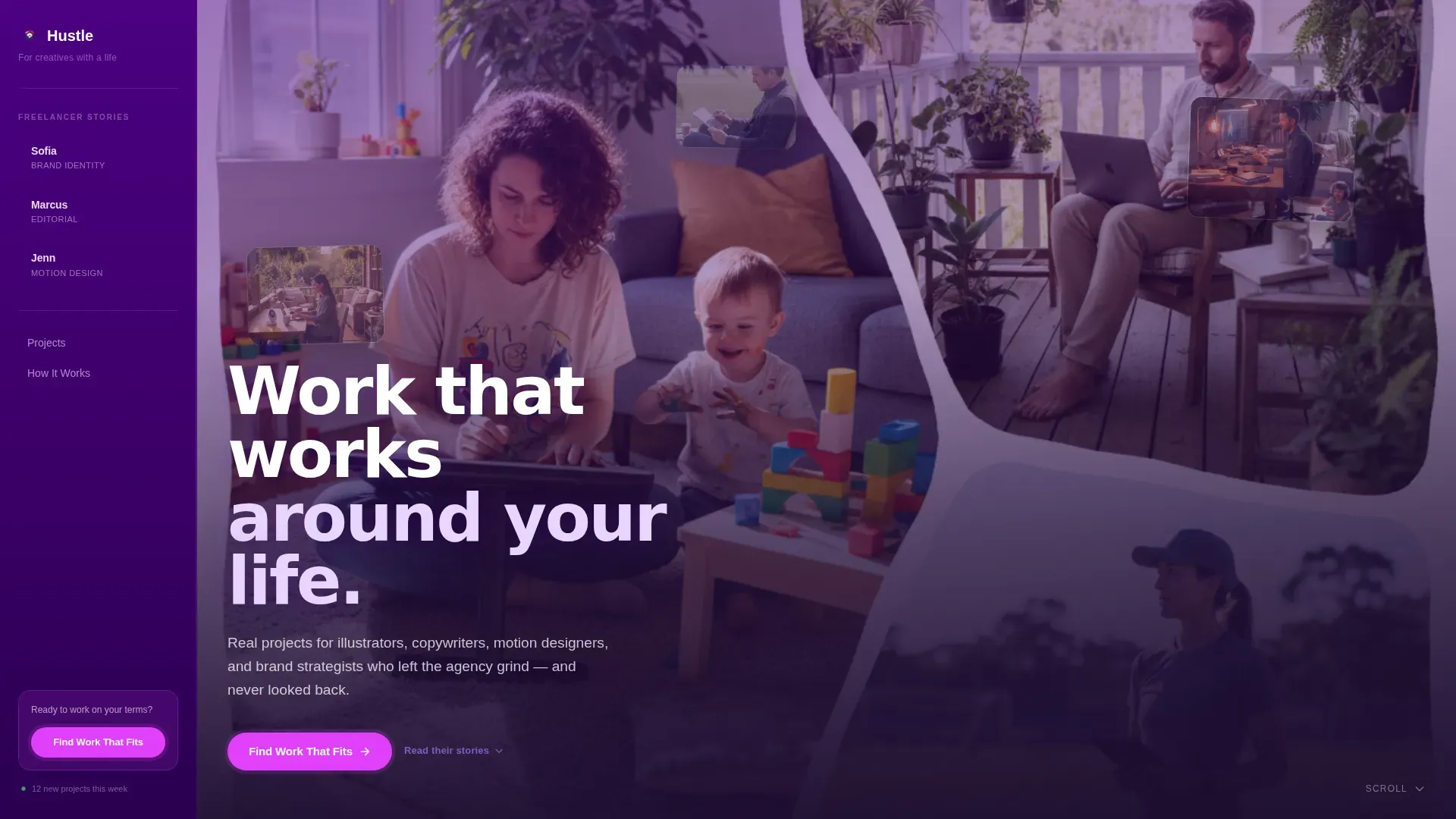
The header is a candid mosaic of real freelancers in their actual workspaces. Images are slightly desaturated with indigo-toned shadows, giving the entire page a warm home-office glow rather than a stock-photo polish. A single headline fades in over the mosaic: "Work that works around your life." This opening sets the tone before a single word of body copy is read. Values-driven hero sections like this communicate a business ethos that makes the visitor feel understood immediately.
Case Study Narrative Scroll
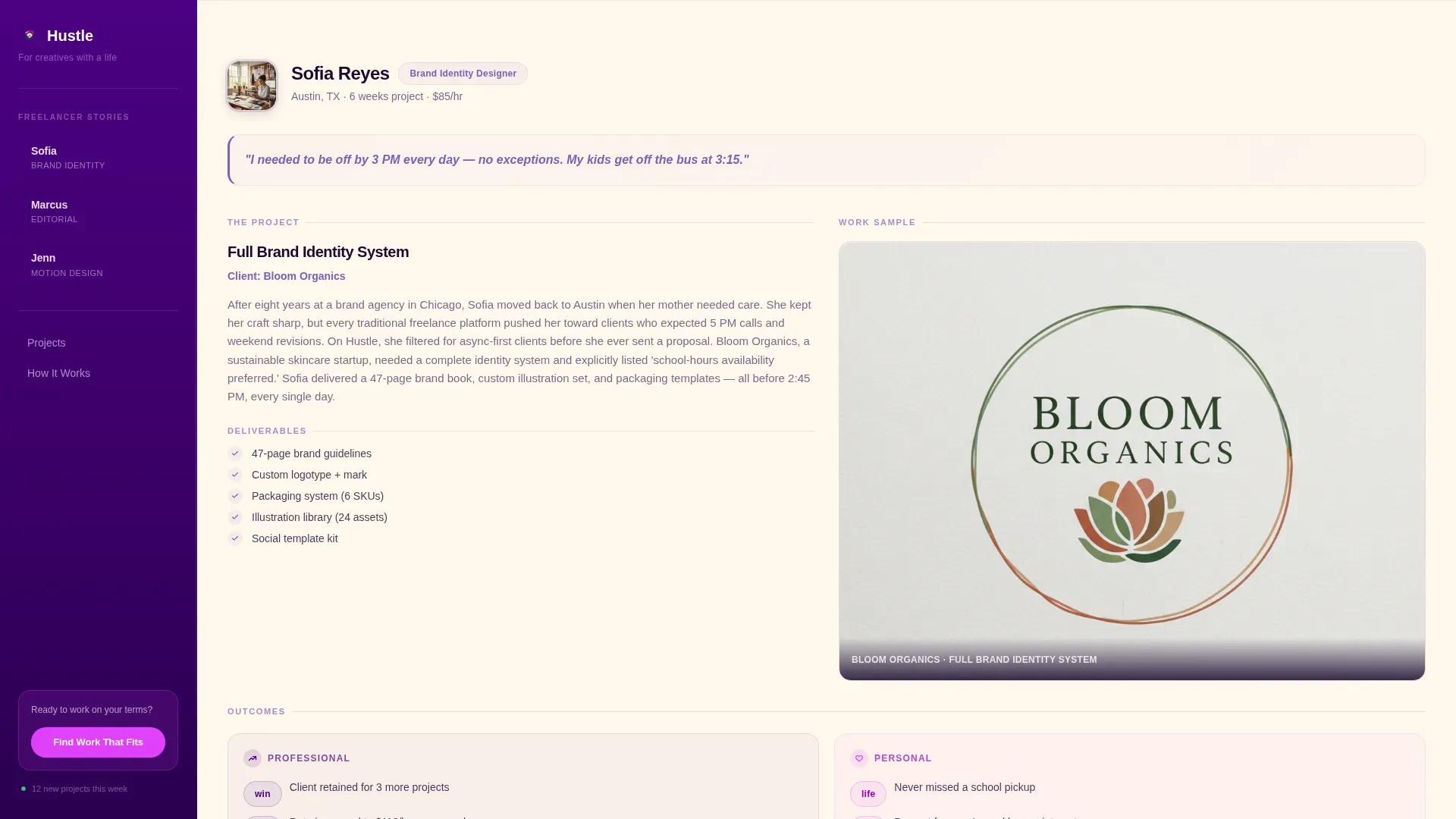
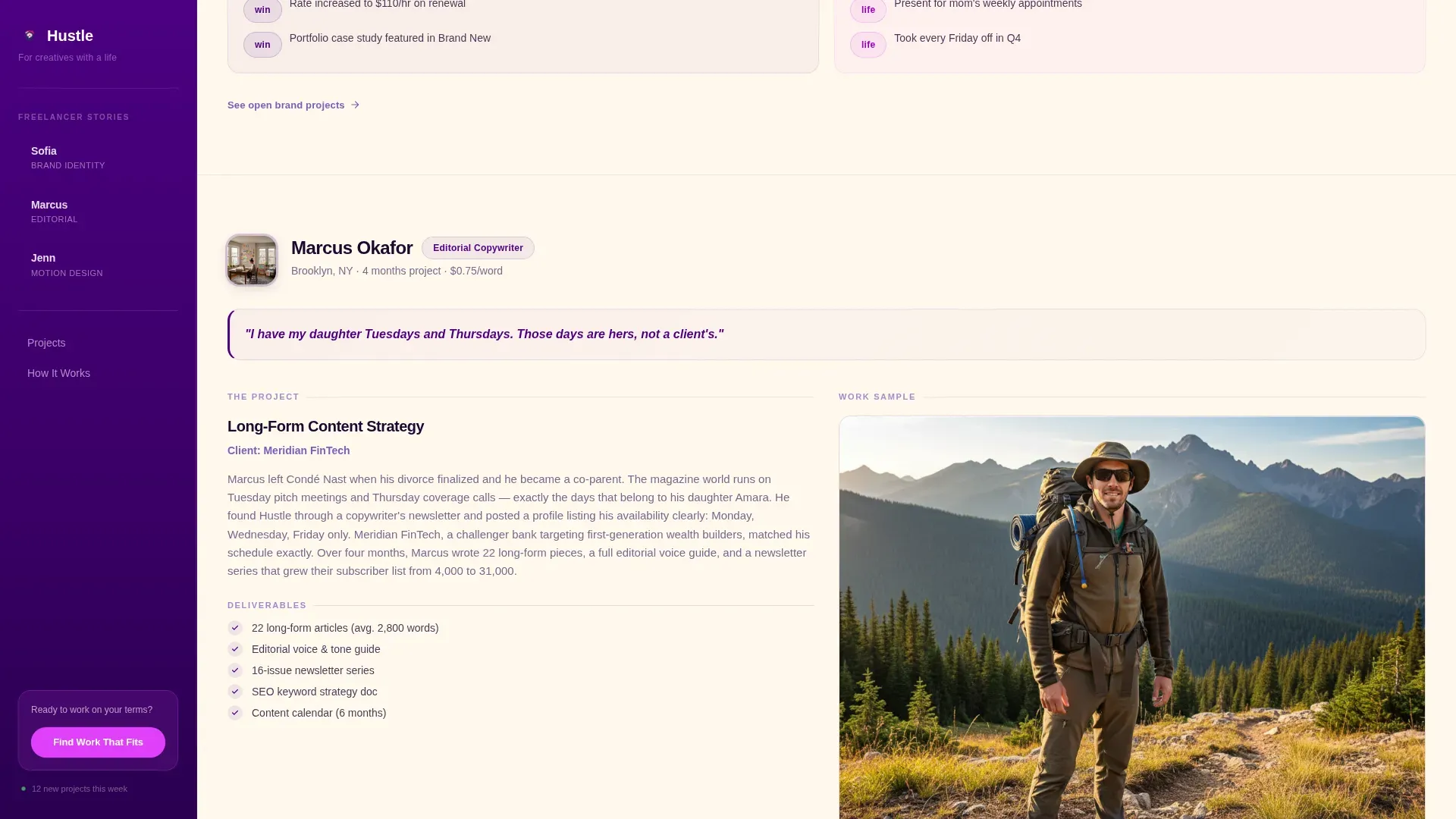
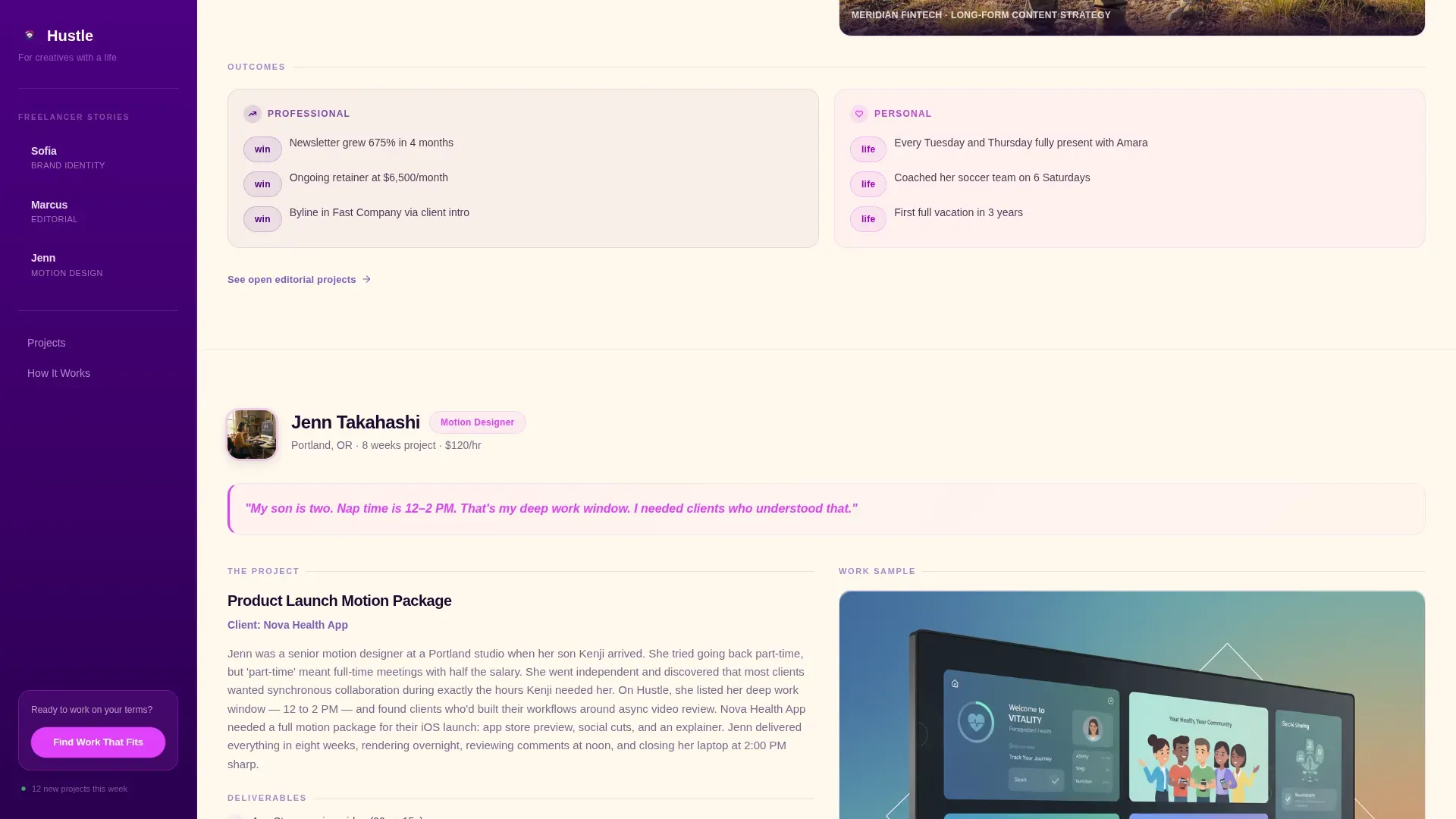
Each case study follows a consistent three-part structure: personal constraint, project landed, and outcome, both professional and personal. For example, a motion designer explains she needed to be off by 3 PM every day, shows the deliverables she produced, and closes with the note that she made every school recital and took Fridays off. This format builds cumulative proof that flexibility and serious creative work are not opposites. Using testimonials and case studies in this way is one of the most effective trust signals a website can offer.
Charged Magenta Call to Action
The primary call to action, "Find Work That Fits", appears first at the end of the hero section and then sits anchored at the bottom of the sidebar throughout the scroll. The contrasting magenta color against the indigo and cream palette makes it impossible to miss without feeling aggressive. A secondary text link, "See Open Projects," sits beneath each case study for visitors who are already convinced. The use of contrasting colors for calls to action is a proven technique for drawing the eye to the most important thing on the page.
Project Type Grid
A dedicated section lists the categories of available work: Brand Identity, Editorial, Motion, and Strategy. This section helps a potential client or a visiting freelancer quickly confirm that their discipline is welcome on the platform. It answers the "is this for me?" question before the visitor has to hunt for the answer.
Social Proof Block
A stats and pull-quote section sits between the case studies and the final call to action. Named freelancers with real outcome metrics, retained clients, increased rates, protected hours, give the platform's claims weight. Trust signals like these, including testimonials and portfolio results, are essential for building credibility on any landing page site.
Page sections overview
| Section | Purpose |
|---|---|
| Hero Mosaic Header | Establish warm, human tone with candid freelancer imagery and headline fade-in |
| Fixed Sidebar Nav | Anchor the reader with chapter links to each freelancer's case study |
| Sofia, Brand Identity | Case study: personal constraint to project outcome, with mini-portfolio embed |
| Marcus, Editorial | Case study: schedule boundaries, deliverables, professional and personal wins |
| Jenn, Motion | Case study: caregiving context, project story, retained client result |
| Project Types Grid | Confirm available creative disciplines for visiting freelancers and clients |
| Social Proof Block | Stats, pull-quotes, and named outcome metrics to reinforce platform credibility |
| Final Call to Action | "Find Work That Fits" magenta button leading to two-step onboarding quiz |
| Footer | Horizontal flow footer with platform links and supporting navigation |
Design & branding system
The Electric Indigo color system is the emotional engine of this page. It is designed to feel like a creative's home office at 9:30 PM, the glow of a monitor in a dim room, purple-blue light across a desk with crayons and contracts. Every color plays a specific role, and none of them compete with the call to action.
- Deep digital indigo (#4B0082) anchors the persistent sidebar and all primary structural elements, soft twilight violet (#7A5FBF) handles hover states and secondary headings, warm lamplight cream (#FFF8EE) fills the main content canvas to keep reading comfortable
- Charged magenta (#E040FB) fires only on calls to action and notification badges, ensuring that every time a visitor sees that color, they know exactly where to click
- Typography is set in DM Sans throughout, warm, human, and highly readable at every size, with deliberate white space in the content canvas to keep the reading experience calm and uncluttered
Mobile & speed optimization
The template is built desktop-first to honor the sidebar-companion layout, with a graceful mobile collapse that preserves the reading experience on smaller screens. The sidebar collapses into a top navigation on mobile, and the case study panels reflow into a single-column scroll. Mobile optimization is important here because family-focused visitors may browse during quick breaks on their phones, the page needs to work wherever they open it.
- Native CSS scroll behavior and IntersectionObserver-based reveal animations keep the interaction layer light and consistent across devices without heavy JavaScript dependencies
- Scroll-blur hero, fadeSlideIn section reveals, and staggered entry effects are built into the template's animation plan, giving the page life without sacrificing readability or load feel
- The sidebar sticky behavior is handled natively, so the chapter navigation remains usable even on mid-range devices browsing over a mobile connection
How this template helps you convert
This landing page is built around a single, crystal clear goal: get the visitor to click "Find Work That Fits." Every section earns that click rather than demanding it. The page works the same way a good conversation works, it listens first, proves its point with stories, and then asks.
- The hero mosaic and fading headline create immediate emotional alignment. The visitor sees real people in real spaces and reads a headline that speaks directly to their situation. That first impression tells them this platform understands what their life actually looks like.
- The case study narrative scroll accumulates proof with each story. By the time the visitor reaches the final call to action, they have read about three different people who share their constraints and who succeeded on the platform. Clicking no longer feels like a risk, it feels like the logical next step.
- The anchored sidebar call to action means the "Find Work That Fits" button is never more than a glance away. The visitor never has to scroll back to the top or hunt for the next step. The entire page is designed so the call to action is always visible, always accessible, and always earned by the content above it.
Other information about this template
This section covers practical context that helps you understand how this template fits into a broader creative freelance workflow, what tools and approaches complement it, and a few things worth knowing before you kick things off.
A side hustle in the creative field rarely stays a side gig for long. For many freelancers, what starts as a few hours of client work on evenings and weekends becomes the foundation of a full time independent career. Transitioning from a side hustle to a full time business requires careful planning, most advisors suggest having at least six months of savings in place before making the leap. Goal setting is part of that process: you need to be crystal clear about how much income you need to generate before your side hustle can replace a full time job. Treat your side hustle like a business from the early days, not a hobby, and the growth tends to follow.
For creatives in the early days of building a web presence, no-code website building tools make it possible to create a professional site without writing a single line of code. No-code platforms enable users to build production-ready sites from simple prompts, and many offer backend integrations and deployment features that save hours of setup time. No-code tools are particularly useful for solopreneurs and small businesses looking to launch quickly while they focus their energy on client work.
Templates are essential for beginners in web design because they speed up the process and remove the blank-page problem. Using a website builder with templates simplifies the entire process for new users who want a polished result without a steep learning curve. A web design side hustle can generate extra income while also building skills that compound over time, freelancing in web design allows individuals to earn money and grow their craft simultaneously. Managing a web design side hustle means wearing multiple hats: designer, project manager, marketer, and sometimes accountant. Finding your first client is often the hardest step; leveraging a personal connection or a friend in your network is one of the most reliable ways to land that first project.
Web designers who run a side hustle alongside a full time job need to organize their schedule carefully. A quick tip: block out specific hours each week for client work, and protect those blocks the same way you would protect school pickup or a dinner with your family. Setting clear due dates and communicating them in writing keeps expectations aligned and reduces the chance of a last-minute fire drill. Most people find that a little bit of structure around their hours prevents the side hustle from bleeding into every corner of their life.
The blog is a practical marketing channel that many creative freelancers overlook. A well-written blog post can bring in potential customers who are searching for exactly the services you offer. A few hours of writing each week can compound into a site that ranks and generates inquiries on its own. If you plan to write regularly, think about how your blog integrates with your social media presence, posting a blog post excerpt across social media platforms extends its reach without requiring a separate content plan. Show notes from a podcast or a video can also double as a blog post, saving time while expanding your content footprint across different marketing channels.
For freelancers building their first website, a few things are worth keeping in mind. The entire page should have a single, clear goal, for example, driving a potential client to book a call or view your portfolio. White space is your friend: minimalist design keeps visitors focused on your value proposition rather than overwhelmed by all that stuff competing for attention. Including belief statements in your service descriptions helps filter clients who share your values, which is just what a family-first freelancer needs to avoid the wrong kind of business. A clear image of yourself in your actual workspace does more for personal branding than a polished studio shot, it signals authenticity to the same kind of clients this platform attracts. Whether you are just starting to start building your online presence or you are an experienced creative looking to refine your site, makes sense to invest time in a template that reflects how you actually work and what you actually value.
This template is the hustle family first creative freelance landing page template, it is designed from the ground up for the creative professional who refuses to choose between doing great work and being present at home. It is not just me saying that the design feels different, the entire creative direction, the color system, the case study format, and the single-goal click-through flow all exist to prove, in a way that makes sense to a tired creative at 9:30 PM, that this platform was built with their life in mind. The page does not try to sell all the time, it earns trust first, and then it asks.
- Goal setting and schedule planning are built into the platform's onboarding promise: the two-step quiz asks about creative discipline and availability pattern, so the work that arrives is work that already fits
- Effective landing pages often include social proof, a clear call to action, and a hero section with an immediate value proposition, this template delivers all three by design
- Fast-loading web templates are essential for a good user experience, and the animation plan in this template uses native browser features to keep the page feeling responsive even on slower connections
- A landing page for family-oriented creative freelancers should emphasize trust, work-life balance, and personal authenticity, this template is built around exactly that principle, from the candid mosaic header to the named freelancer case studies
Theme
Family First
Creative direction
Case Study Narrative
Color system
Electric Indigo
Style
Sidebar Companion
Direction
Click-Through
Page Sections
Fixed Sidebar Chapter Navigation
Cinematic Hero Mosaic Header
Three-part Case Study Narrative
Anchored Magenta Call to Action
Project Type and Social Proof Sections
Electric Indigo Color System
Related questions
Who is this landing page template designed for?
Does this template include a contact form or signup form?
Can I customize the case study content and freelancer names?
How does the fixed sidebar navigation work on mobile?
Is this template suitable for a creative freelance side hustle or portfolio site?