Thyroid Disorder Care Appointment Booking Website Template
A split-screen landing page template built for a wrist-worn thyroid biosensor. It walks visitors through a structured diagnostic audit, comparing episodic lab results against continuous hormonal tracking, then guides them toward booking a fit consultation. The layout uses a Corporate Precision aesthetic with a Slate and Sky color system, Fraunces serif headings, and DM Sans body type.
by Rocket studio
Quick summary
This is a single-page, section-led landing page template designed for a wrist-worn biosensor that tracks thyroid hormone fluctuations in real time. It uses a Checklist and Audit creative direction to walk visitors through their own care gaps, then moves them toward a booking action. The layout is a 50/50 split screen with a Portrait-Centered hero, Corporate Precision styling, and a Slate and Sky color system.
Who this template is for
This template is built for health-tech founders, medical device marketers, and clinical product teams who need to convert a skeptical, informed audience into booked consultations. The tone and structure are calibrated for visitors who already understand thyroid dysfunction and need credibility, not a sales pitch.
- Women in their 30s and 40s who have received inconclusive lab results and are searching for a more complete picture of their hormonal health
- Endocrinologists and functional medicine practitioners who manage patients between quarterly lab appointments and need granular biomarker data to support dosage decisions
- Medical device marketing teams who need a high-trust, clinically framed landing page that bridges technical innovation with user-friendly messaging
What problem this template solves
The thyroid gland plays a crucial role in the regulation of hormonal levels in the human body. Yet standard quarterly lab testing captures only a single data point in a continuous hormonal story. Patients fall into a diagnostic gap: their symptoms are real, but their results appear within normal range. This template addresses that gap directly by framing each scroll checkpoint as a clinical audit question the visitor answers for themselves.
- Episodic lab results miss the fluctuations that happen between appointments, leaving both patients and practitioners without the data they need to act
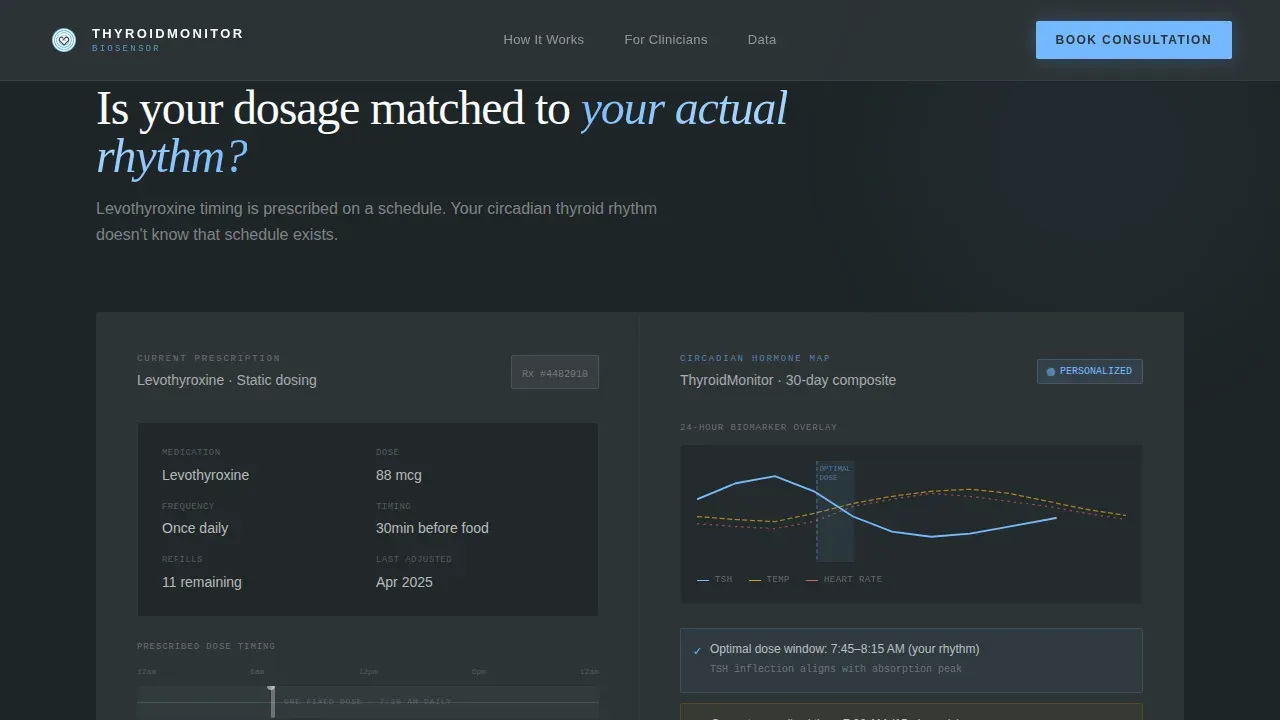
- Static prescriptions are not matched against a patient's actual circadian hormone rhythm, making dosage decisions less precise than they could be
- Landing pages for medical wearables often either over-simplify or over-complicate, this template holds clinical authority and user-friendly messaging in balance simultaneously
What you get with this template
You get a fully structured, single-page layout with five distinct content sections, a multi-step booking widget, and a secondary lead-capture path. Every section is built for a specific conversion moment. The design system is pre-configured and ready to adapt to your brand within the defined Slate and Sky palette.
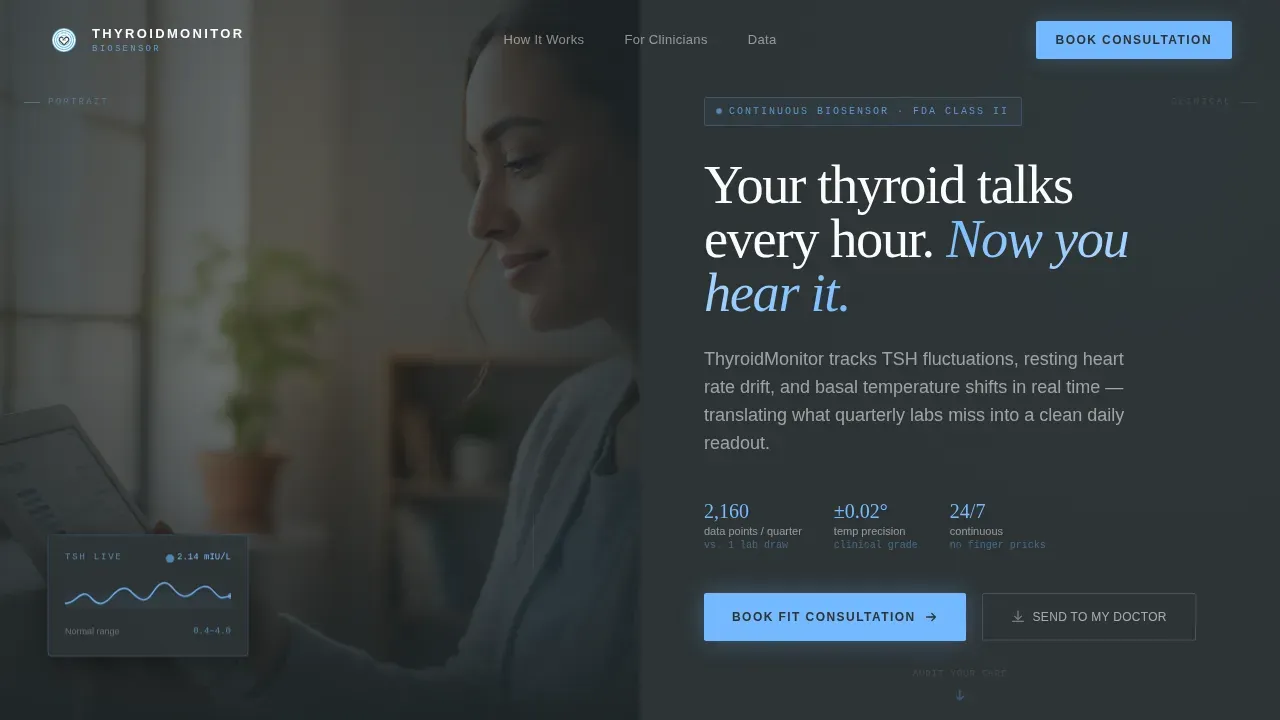
- A 50/50 split-screen hero with a Portrait-Centered layout, a delayed headline fade-in, and a visible TSH trend badge on the device screen
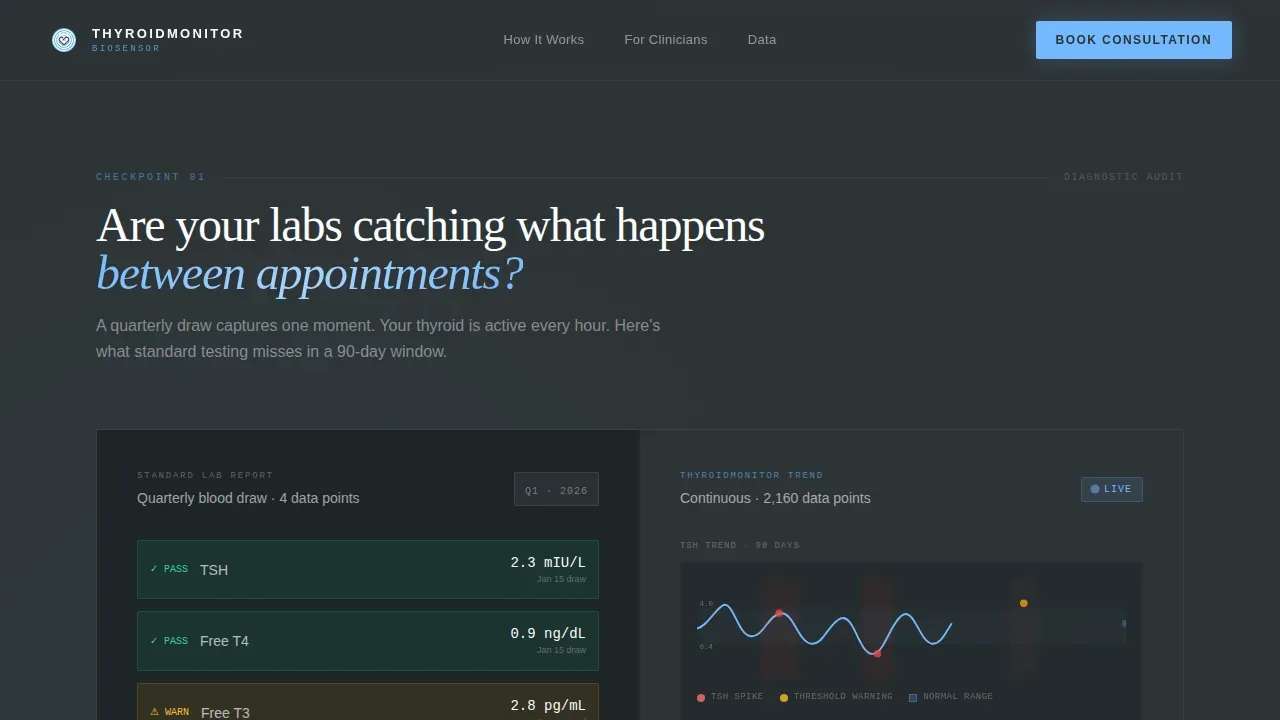
- Three scroll-triggered checkpoint sections that each present a left-versus-right comparison, building cumulative clinical evidence before the call to action appears
- A booking widget with a three-field sequential form and a secondary PDF report generator that captures email and physician name for a clinical summary the visitor can bring to their next appointment
Feature list
This template includes six core design and functional features drawn directly from the source brief. Each one serves the overarching goal of converting a cautious, clinically literate visitor into a booked consultation.
Portrait-Centered Split-Screen Hero
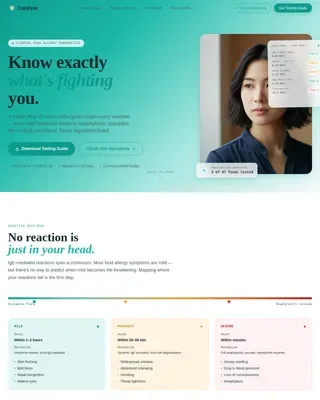
The hero section divides the viewport into two equal panels. One side holds a collarbone-up portrait of a woman in her late thirties wearing the device, wrist raised near her jaw, expression calm and focused. The device screen glows faintly with a real-time TSH trend line. After a two-second delay, the headline fades in beside her. This approach communicates clinical trust before a single word appears.
Checklist and Audit Scroll Structure
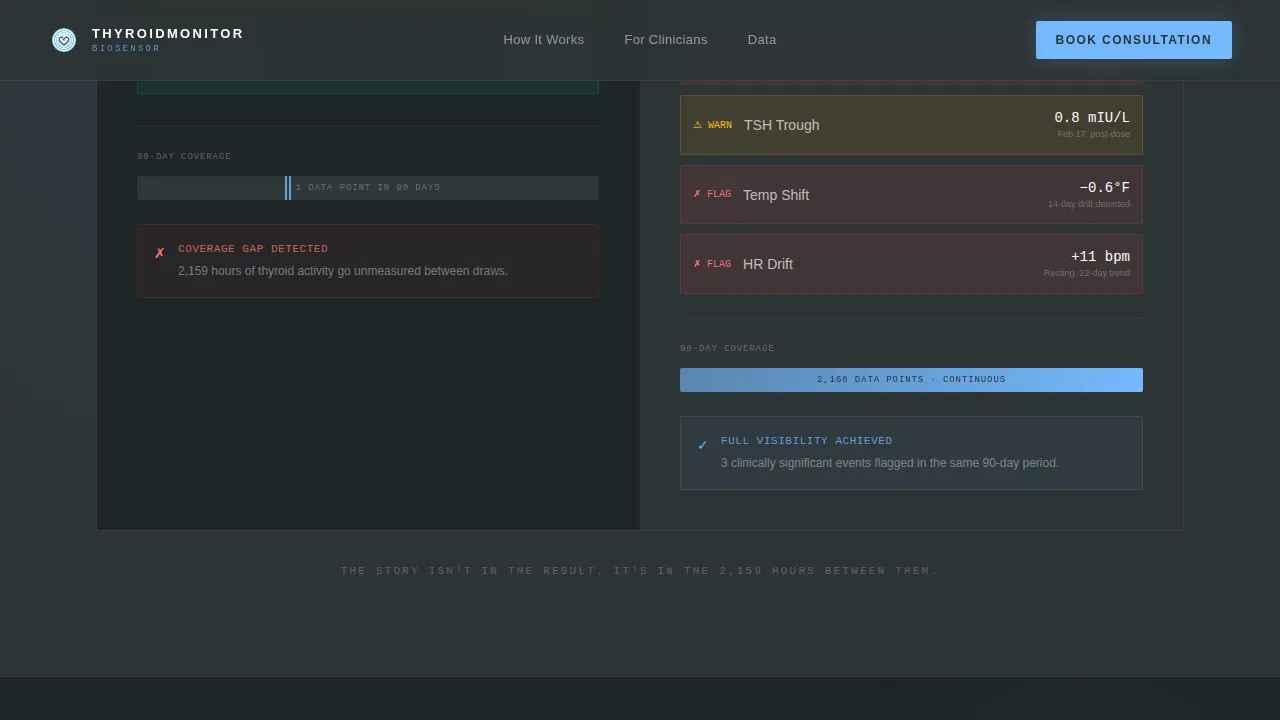
The page unfolds as a diagnostic walkthrough, not a feature list. Each of the three checkpoint sections poses a yes-or-no clinical question, then answers it with a side-by-side comparison. Checkpoint one contrasts a standard quarterly lab report against a continuous 90-day wearable trend. Checkpoint two places a static prescription beside a circadian hormone mapping visualization. Checkpoint three presents three distinct user profiles as spotlight cards. By the time visitors reach the call to action, they have already audited their own care gaps.
Multi-Step Booking Widget
The consultation scheduling form asks three questions in sequence: condition type (Hashimoto's, Graves' disease, undiagnosed, or other), current monitoring method (lab only, at-home kits, or none), and preferred consultation window. This structure reduces form friction while collecting the clinical context needed to personalize the appointment.
PDF Report Generator
A secondary conversion path lets visitors compile their checklist audit results into a one-page clinical summary. The generator captures the visitor's email address and physician name, then produces a document they can bring to their next endocrinology appointment. This path serves visitors who are not yet ready to book but want to take a concrete next step.
Spotlight Card Interactions
The three use-case cards in the third checkpoint section use spotlight hover effects that respond to cursor position. Each card represents one of the three primary audience profiles, the patient with unresolved symptoms, the endocrinologist managing Hashimoto's cases, and the functional medicine practitioner adjusting dosages. The interaction reinforces that this device was built for a specific clinical context, not a general wellness audience.
Corporate Precision Typography System
Fraunces serif typeface handles all primary headings, lending a sense of clinical weight and authority. DM Sans handles body copy, user interface labels, and form fields, keeping data-adjacent text clean and legible. The combination feels diagnostic without being sterile, and informative without being academic.
Page sections overview
| Section | Purpose |
|---|---|
| Hero split screen | Establishes clinical credibility and introduces the device with a delayed headline fade |
| Checkpoint one comparison | Contrasts quarterly lab results with a 90-day continuous biosensor trend |
| Checkpoint two comparison | Compares a static prescription with circadian hormone rhythm mapping |
| Checkpoint three cards | Spotlights three user profiles and their specific monitoring gaps |
| Booking call to action | Houses the three-step consultation widget after clinical evidence is established |
| PDF report generator | Captures email and physician name for a take-to-appointment clinical summary |
| Footer linear row | Closes the page with a single-row linear footer pattern |
Design & branding system
The visual identity follows a Corporate Precision theme that feels like a high-end diagnostic lab in early morning: calibrated, clean, and quietly authoritative. Every color choice reinforces clinical seriousness without tipping into cold or unwelcoming territory.
- Deep clinical slate at hex code #2D3436 anchors primary backgrounds; instrument-panel gray at #636E72 fills secondary surfaces; open-sky blue at #74B9FF highlights data points and interactive elements; and sterile white at #FAFBFC fills content panels and typography fields
- Fraunces serif headings carry clinical weight across section titles and checkpoint questions, while DM Sans body type keeps form labels, data captions, and supporting paragraphs readable and direct
- Scroll-reveal animations, beam-line transitions between split panels, and spotlight hover effects on user-profile cards give the page a sense of precision motion without distracting from the clinical content
Mobile & speed optimization
The template is built desktop-first, which reflects the medical professional context of endocrinologists and functional medicine practitioners reviewing data at a workstation. Full mobile support is included, ensuring the same structured audit experience is accessible across devices. Real-time monitoring means users need to track TSH, T3, and T4 levels wherever they are, and the landing page needs to meet them there.
- Desktop-first layout prioritizes the 50/50 split-screen format and wide-panel checkpoint comparisons, which read most clearly on larger screens
- Full mobile support ensures the booking form, PDF generator, and checkpoint sections reflow cleanly for smaller viewports, with touch-friendly tap targets on all interactive elements
- Server Components handle static content sections to keep initial load lean, while Client Components manage the interactive booking form and PDF generator, keeping dynamic behavior isolated
How this template helps you convert
The conversion architecture of this template is built on a specific principle: clinical credibility must come before the call to action. The booking widget does not appear until the visitor has moved through three checkpoints and, in doing so, has already identified their own care gaps. The ask feels earned, not inserted.
- The Checklist and Audit scroll structure ensures visitors build personal evidence before they reach the primary call to action, so the decision to book a fit consultation feels like a logical next step rather than a sales response
- The secondary PDF report generator creates a low-commitment conversion path for visitors who are not ready to book immediately, capturing email and physician name while delivering something clinically useful they can bring to their next appointment
- Social proof elements including clinical metrics, practitioner endorsements, and device accuracy statistics are positioned throughout the page to overcome the skepticism that medical technology always requires, reinforcing trust at every scroll depth
Other information about this template
This template is built for a single-page, section-led flow in the Health and Medical category, specifically within the Thyroid Disorder Care subcategory. It is designed for the Thyroid Disorder Wearable Monitor niche. The template style is Split Screen (50/50) and the landing page direction is Booking and Scheduling.
The ThyroidSync Precision Biosensor Monitoring landing page template is the named reference for this build. It is catalogued under the intersection of Corporate Precision theme, Checklist and Audit creative direction, Portrait-Centered header concept, and Slate and Sky color system. Buyers searching for this specific template can identify it by those intersection attributes.
Several contextual facts about the science behind thyroid monitoring inform this template's framing and copy direction:
- Biosensors are essential for accessing information about the condition of the thyroid through non-invasive techniques, and biosensors in the form of wearables represent one category of device designed for this purpose
- The thyroid gland is sensitive to electromagnetic radiation, and as exposure to wireless technologies increases, research on potential side effects on the thyroid is expanding alongside interest in continuous non-invasive monitoring
- The specific absorption rate (SAR) is a recognized metric for understanding radiation absorption in thyroid tissues, and the study of radiation distribution in thyroid tissues is significant given the thyroid's sensitivity to radiation exposure
- Artificial intelligence (AI) and machine learning (ML) techniques are anticipated to play a growing role in the analysis of bioelectromagnetic data related to the thyroid; machine learning models can provide faster interpretation of thyroid imaging data than traditional computational approaches
- Thermographic models of the thyroid can assess the response and sensitivity of the thyroid to electromagnetic fields; the temperature of the thyroid is affected by diseases, making thermographic data useful for diagnostic objectives
- Volumetric data are of great importance and may prove valuable for the treatment of a patient; the accurate estimation of the thyroid's volume is critical for both therapeutic and diagnostic purposes
- The finite element method (FEM) is a widely acknowledged computational methodology for analyzing bioelectromagnetic thyroid models, and the combination of different bioelectromagnetic models and analysis techniques might lead to significant improvements in medical equipment
- The fusion of several images can increase the accuracy of thyroid modeling; volumetric data can be obtained through various screening techniques including MRI, CT, and thermal images
- A landing page for a precision thyroid biosensor must bridge high-tech medical innovation with user-friendly messaging; this template is purpose-built for exactly that balance
- Trust indicators such as compliance badge placements for data privacy and endorsements from endocrinologists are structural positions within this template's layout
- The page's above-the-fold area immediately communicates the system's primary benefit through the hero section's device visual and the delayed headline reveal
- Continuous tracking emphasizes the shift from infrequent clinic visits to around-the-clock monitoring of hormone levels, which is the core narrative the checkpoint scroll structure builds toward
Theme
Corporate Precision
Creative direction
Checklist & Audit
Color system
Slate & Sky
Style
Split Screen (50/50)
Direction
Booking/Scheduling
Page Sections
Portrait-centered Split-screen Hero
Checklist and Audit Scroll Structure
Multi-step Consultation Booking Widget
PDF Clinical Report Generator
Spotlight Hover User-profile Cards
Corporate Precision Typography System
Related questions
Can I adapt this template for a different medical wearable product?
Does the template include functional booking or PDF generation logic?
Which audiences does this template's layout and structure serve best?
How does the checkpoint scroll structure support the booking conversion goal?
Is this template designed for both desktop and mobile users?