Specialist Wildlife & Conservation Professional Website Template
Tideline is a masonry-style landing page template built for marine conservation organizations. It follows a Day-in-the-Life scroll narrative, moving visitors through a single conservation day from pre-dawn to golden hour. With a Warm Artisan color system, a UGC photo wall header, and a lead generation structure, it turns curiosity into commitment for volunteers, educators, and donors alike.
by Rocket studio
Quick summary
Tideline is a single-page masonry template designed for marine conservation organizations. It uses a time-stamped Day-in-the-Life scroll to bring the realities of reef surveys, seagrass planting, and ghost net removal to life. The Parchment and Rust color system gives it the worn, honest feel of a field journal left on a dock.
Who this template is for
This template was built for conservation teams who do hands-on coastal work and need a page that reflects that effort honestly. It speaks to organizations with real stories, real volunteers, and a need to connect with people who want to get involved.
- Marine conservation organizations seeking volunteers, educators, or first-time donors
- Coastal nonprofits running shoreline monitoring, reef surveys, or estuary restoration programs
- Small environmental groups that rely on community engagement and grassroots sign-ups
What problem this template solves
Generic nonprofit templates flatten the urgency and texture of field conservation into a wall of polished stock imagery and vague mission statements. That kind of page does not earn trust from a marine biology graduate looking for fieldwork or a retired teacher wanting to give a weekend to something real.
- Visitors leave before they understand the work, so they never take action
- The ask for commitment comes too early, before the visitor has been shown why it matters
- There is no natural path for donors or educators who are curious but not yet ready to volunteer
What you get with this template
You get a fully structured landing page built around a narrative scroll that earns the call to action before it appears. Every section has a clear job: introduce the day, build stakes, and invite the right person to step in.
- A dense UGC photo wall header with warm, slightly overexposed volunteer photography at varied sizes and slight rotations
- Five time-stamped masonry grid sections running from 5:45 AM through golden hour, each mixing photos, volunteer quotes, and data tiles
- A sticky lead capture bar and a secondary downloadable field guide conversion path
Feature list
This section covers the core built-in capabilities of the Tideline template as described in the design brief.
Time-Stamped Day-in-the-Life Scroll
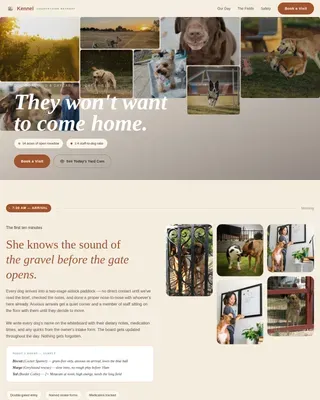
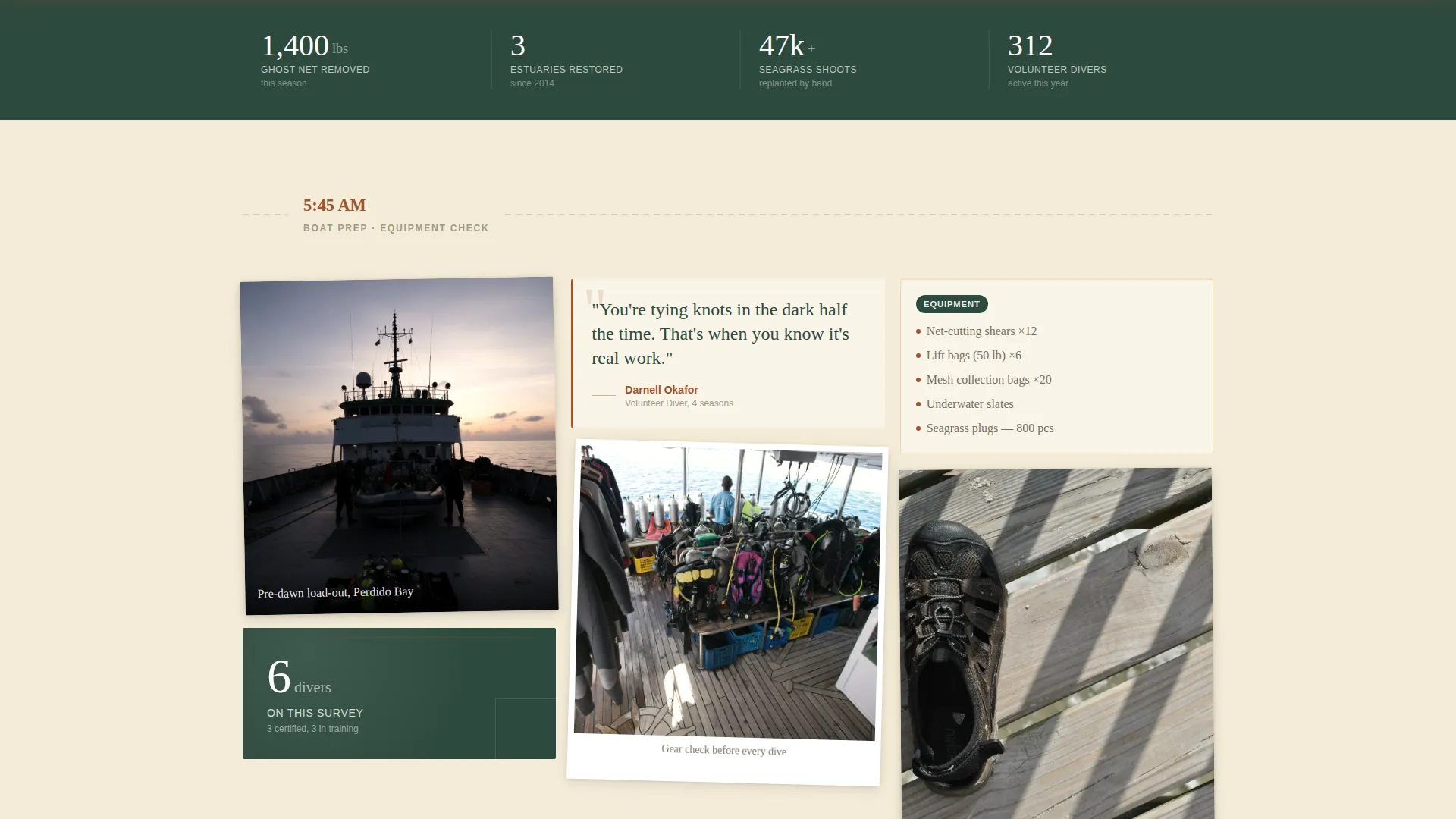
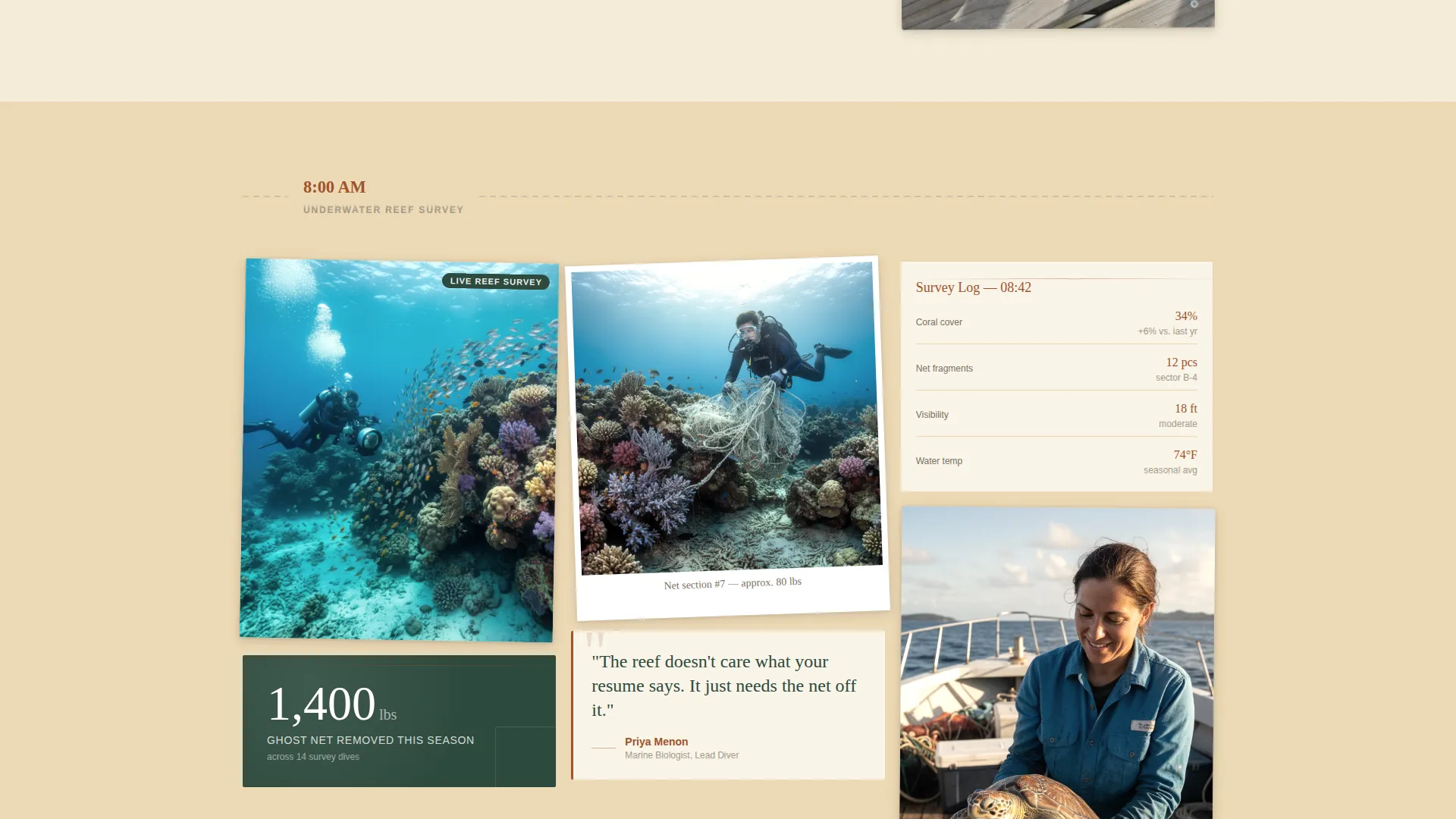
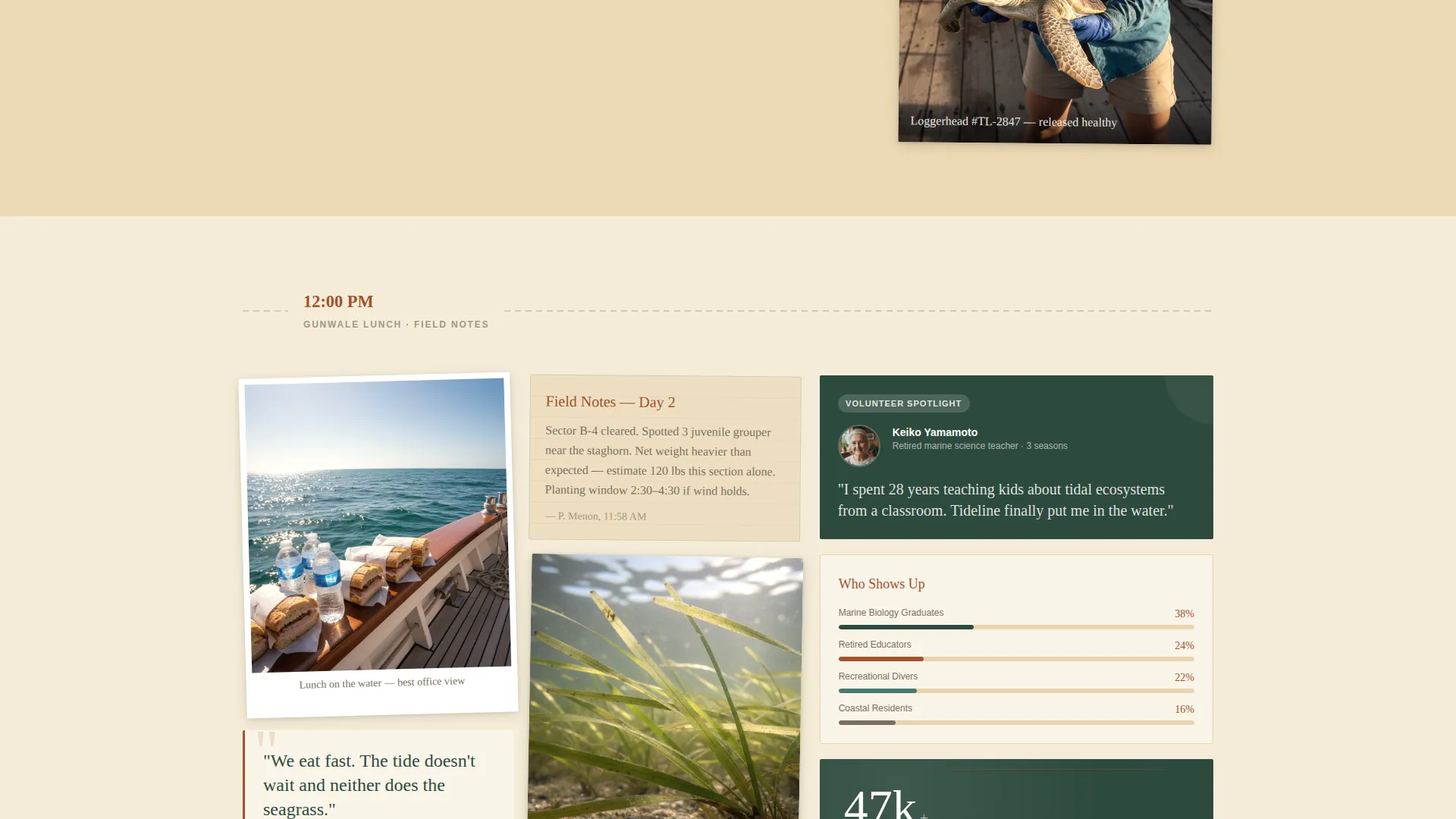
The page is structured around five distinct time blocks: 5:45 AM boat prep, 8:00 AM reef survey, noon field notes on the gunwale, 3:00 PM lab and seagrass planting, and golden hour gear washdown. Each block reshuffles the masonry grid to reflect the mood and pace of that moment in the day.
UGC Photo Wall Header
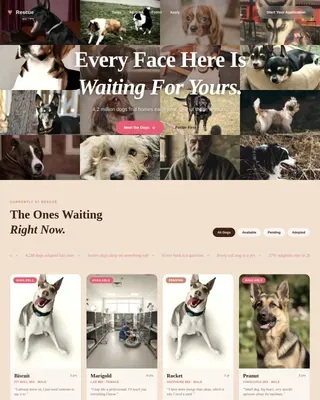
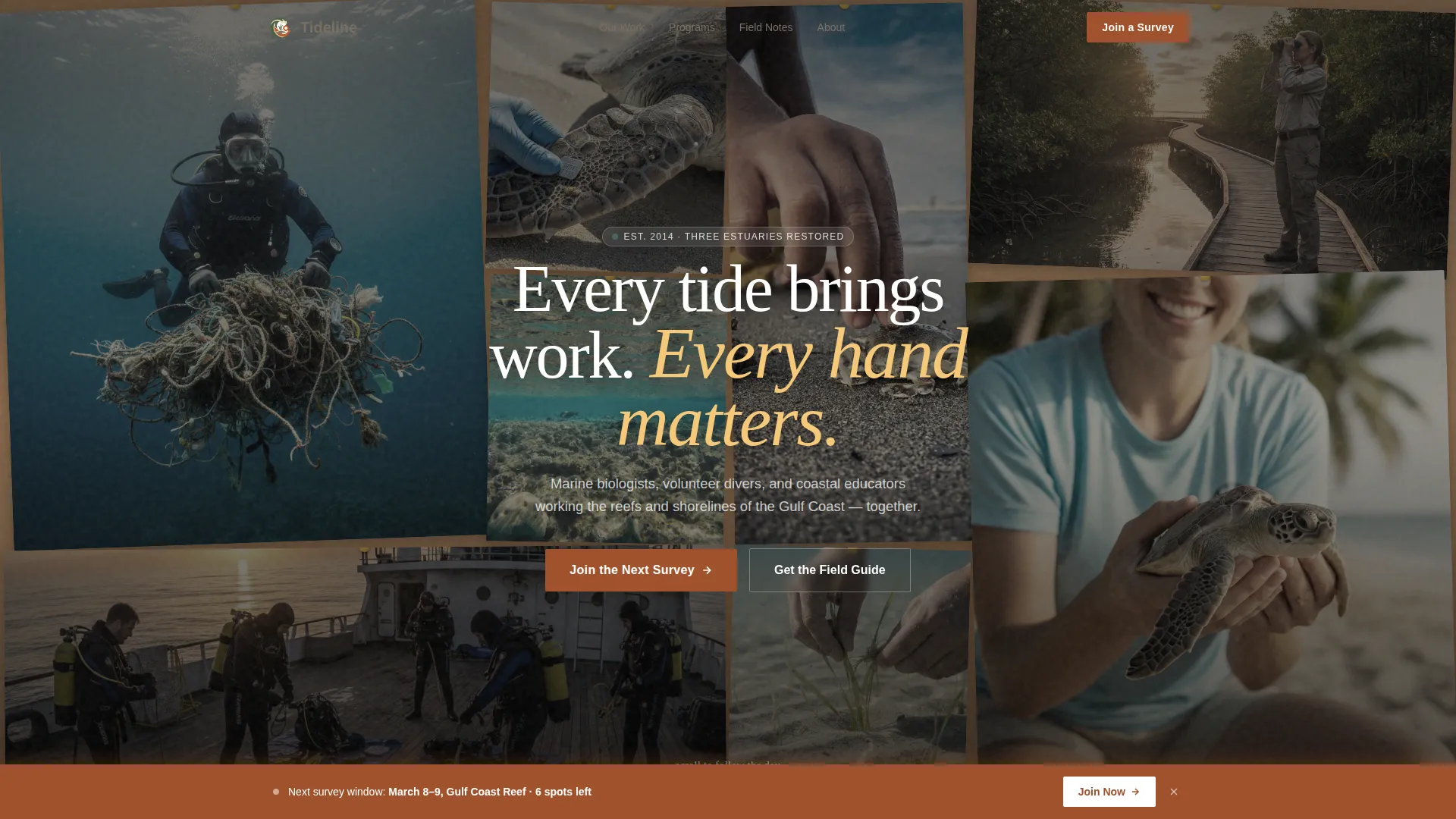
The header is a full-width, edge-to-edge mosaic of volunteer-submitted photographs at varying sizes with slight rotations. Images feel pinned to a corkboard rather than arranged in a studio. A single handwritten-style headline floats over the center cluster.
Sticky Lead Capture Bar
A rust-colored sticky bar appears after the visitor scrolls past the midday section. It contains a four-field form: first name, email, a single-select role dropdown, and a free-text field asking what draws the visitor to the water. The bar earns its appearance by letting visitors experience the work first.
Inline Data Tiles
Small data tiles are embedded within the masonry grid at each time block. These tiles surface concrete impact figures, such as ghost net tonnage removed in a season, giving the scroll measurable weight alongside the personal photography and quotes.
Secondary PDF Conversion Path
A secondary call to action offers a downloadable Estuary ID Guide gated behind just an email address. This catches visitors who are curious but not yet ready to commit to a volunteer role, keeping them in the organization's orbit.
Handwritten-Style Volunteer Quotes
Each time block includes short volunteer quotes set in handwritten-style type. These quotes sit naturally inside the masonry layout alongside photographs, adding a human voice to the visual storytelling without interrupting the scroll rhythm.
Page sections overview
| Section | Purpose |
|---|---|
| UGC Photo Wall Header | Sets the raw, volunteer-driven tone and introduces the core headline |
| 5:45 AM Block | Shows boat prep and equipment checks to open the day's narrative |
| 8:00 AM Block | Delivers underwater reef survey photos and field data cards |
| Midday Field Notes | Captures the human pause point with lunch on the gunwale |
| 3:00 PM Block | Documents lab sample processing and hands-on seagrass planting |
| Golden Hour Block | Closes the day with gear washdown and a sense of earned completion |
| Sticky Lead Bar | Captures volunteer, educator, and donor sign-ups with a four-field form |
| PDF Field Guide call to action | Offers the Estuary ID Guide as a lower-commitment conversion path |
Design & branding system
The Tideline template uses a Warm Artisan theme grounded in a Parchment and Rust color system. The palette is deliberately uneven, with each color assigned a specific role rather than distributed uniformly across the page.
- Sun-dried parchment (#F5ECD7) dominates open space as the primary background, rust (#A0522D) draws the eye to headlines and call-to-action buttons, driftwood gray (#7A7062) keeps body text quiet and readable, and deep kelp (#2E4A3E) marks categories, tags, and data badges
- The masonry grid layout uses varied image sizes and slight rotations to recreate the feeling of photographs pinned to a corkboard or pressed into a field journal
- Typography includes a handwritten-style face for quotes and the hero headline, contrasting with a clean readable face for body copy and data tiles
Mobile & speed optimization
The masonry grid and time-stamped scroll are designed to adapt across screen sizes so the Day-in-the-Life narrative holds together on both desktop and mobile viewports.
- The masonry layout reflows naturally on smaller screens, preserving the visual rhythm of each time block without losing the photo-and-quote pairing
- The sticky lead capture bar is positioned to appear cleanly on mobile after the midday scroll point, keeping the form accessible without blocking content
How this template helps you convert
Tideline is built around a deliberate conversion architecture that delays the ask until trust is established. The scroll does the work of building belief before the form appears.
- The time-stamped Day-in-the-Life narrative builds emotional investment across five sections, so the visitor arrives at the sticky lead bar already connected to the work rather than cold to the ask.
- The two-path conversion structure means visitors who are not ready to volunteer can still convert by downloading the Estuary ID Guide, keeping them engaged without pressure.
Other information about this template
Tideline is categorized under Pet and Animal, with a specific focus on the Wildlife and Conservation subcategory and the Marine Conservation Organization niche. It is a strong fit for coastal nonprofits, estuary restoration groups, and volunteer-driven field science teams.
- The template style is Masonry and Pinterest-inspired, making it visually distinct from standard nonprofit or charity page layouts
- The Warm Artisan theme and field-journal aesthetic make it equally appropriate for annual appeal campaigns, grant-facing pages, or volunteer recruitment drives
- The design brief references a waxed canvas bag, a rusted carabiner, and a hand-labeled specimen jar as tone anchors, keeping the visual language grounded in real fieldwork rather than polished environmental branding
Theme
Warm Artisan
Creative direction
Day-in-the-Life
Color system
Parchment & Rust
Style
Masonry/Pinterest
Direction
Lead Generation
Page Sections
Time-stamped Day-in-the-life Scroll
UGC Photo Wall Header
Sticky Lead Capture Bar
Inline Conservation Data Tiles
Secondary PDF Conversion Path
Handwritten-style Volunteer Quotes
Related questions
Can I use this template for a freshwater or land-based conservation organization?
How does the sticky lead capture bar work on this template?
What is the secondary PDF conversion path included in Tideline?
Is the Tideline template suitable for donor-facing or grant-appeal pages?
What does the masonry grid layout look like in practice?