Ancestral Cooking Academy Landing Page Template
The Pachamanca template is a full-width immersive landing page built for ancestral Peruvian cooking class businesses. It pairs an emotional Origin Story layout with a direct booking flow, using a Warm Artisan visual system in terracotta, cream, deep purple, and gold. Couples, solo travelers, and home cooks are guided from first scroll to seat reservation through storytelling, class cards, and an inline booking module.
by Rocket studio
Quick summary
This is the Pachamanca ancestral peruvian cooking class landing page template. It is a single-page, full-width immersive layout built to convert curious visitors into paying students. The design leans into emotional storytelling through an Origin Story creative direction, a hand-drawn mascot header, and a tightly sequenced booking flow. Every visual and content decision exists to make a visitor feel welcomed before they are asked to spend money.
Who this template is for
This template is built for cooking class operators in Lima and across Peru who want to sell seats directly from their website. It works best for experiences that are deeply rooted in cultural tradition and personal storytelling, not just skill instruction. If your class carries a lineage, a ritual, or a family origin, this layout gives that story room to breathe before it asks for a booking.
- Peruvian cooking class owners selling directly to travelers and locals
- Culinary experience operators targeting couples, solo visitors, and serious home cooks
- Food entrepreneurs who want a booking-ready page without a generic tour-site template
What problem this template solves
Most culinary experience pages look like brochures. They list a price, show a photo, and add a contact form. That approach works for commodity services. It does not work when what you are selling is more than just a meal. The cooking process you teach carries generations of knowledge. The food on the table represents a ritual, not a restaurant order. Generic layouts flatten that story into a bullet point.
- Visitors arrive without context and leave before they trust the offer
- Traditional dishes and ancestral techniques are reduced to menu items with no emotional weight
- Booking friction kills conversions because visitors cannot visualize the full experience before they commit
What you get with this template
You get a complete, structured single-page layout that moves visitors from curiosity to commitment. Every section is purpose-built: the mascot header creates instant warmth, the Origin Story builds trust through narrative, the class cards make the offer concrete, and the inline booking module closes the sale. The template does not require external tools to function as a presentation layer.
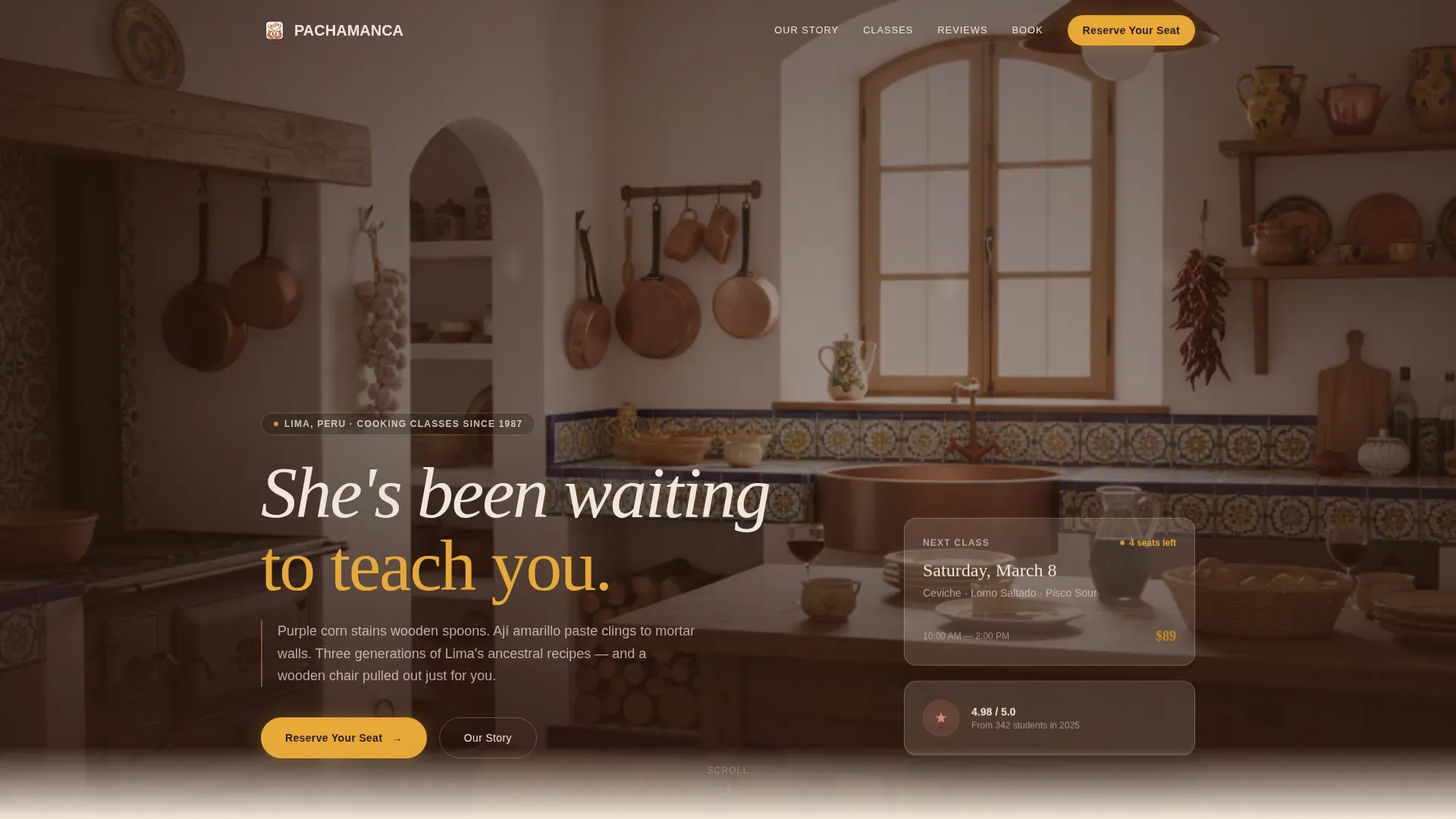
- A full-viewport mascot hero with headline, steam animation, and a live seat-counter card
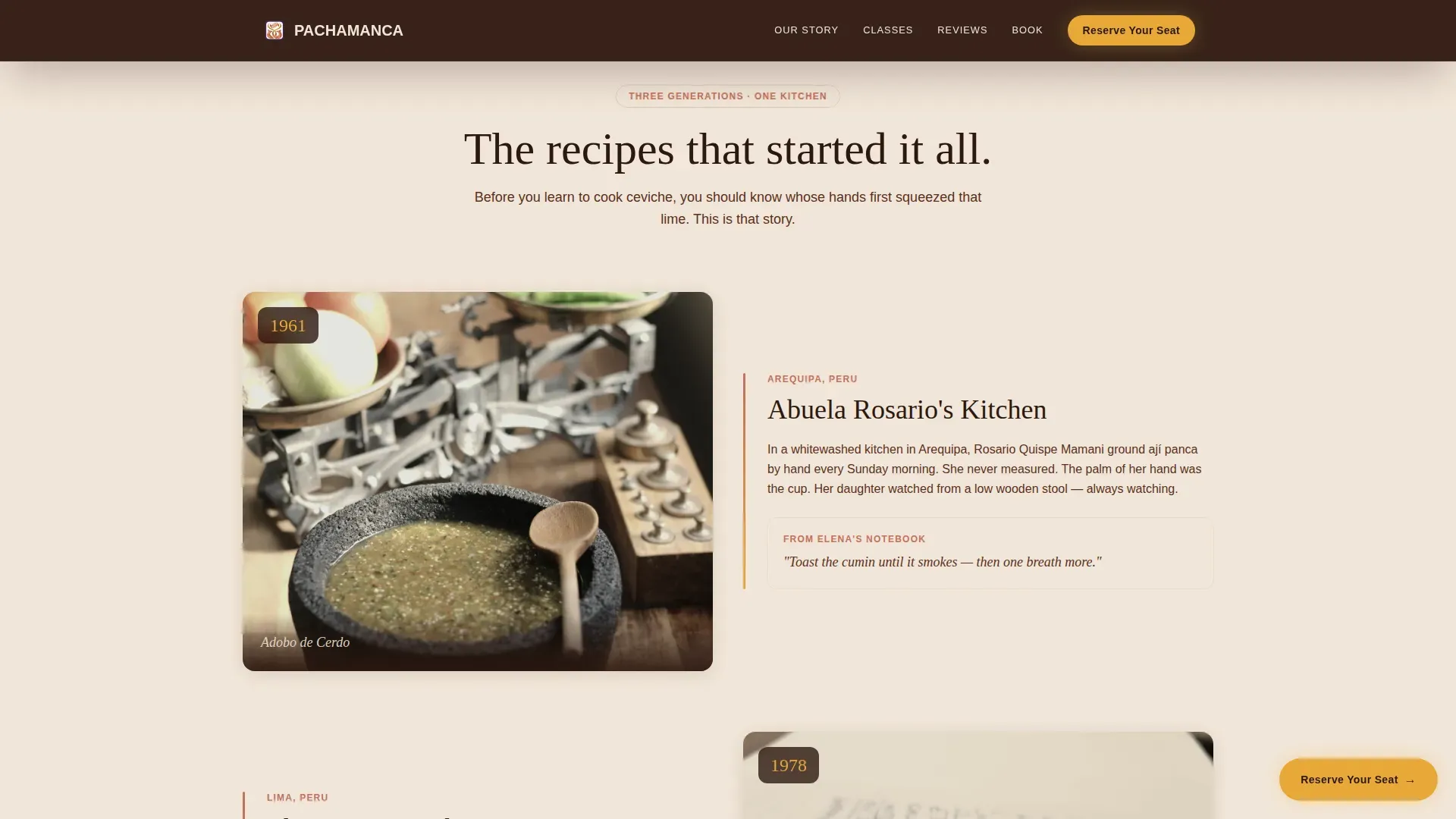
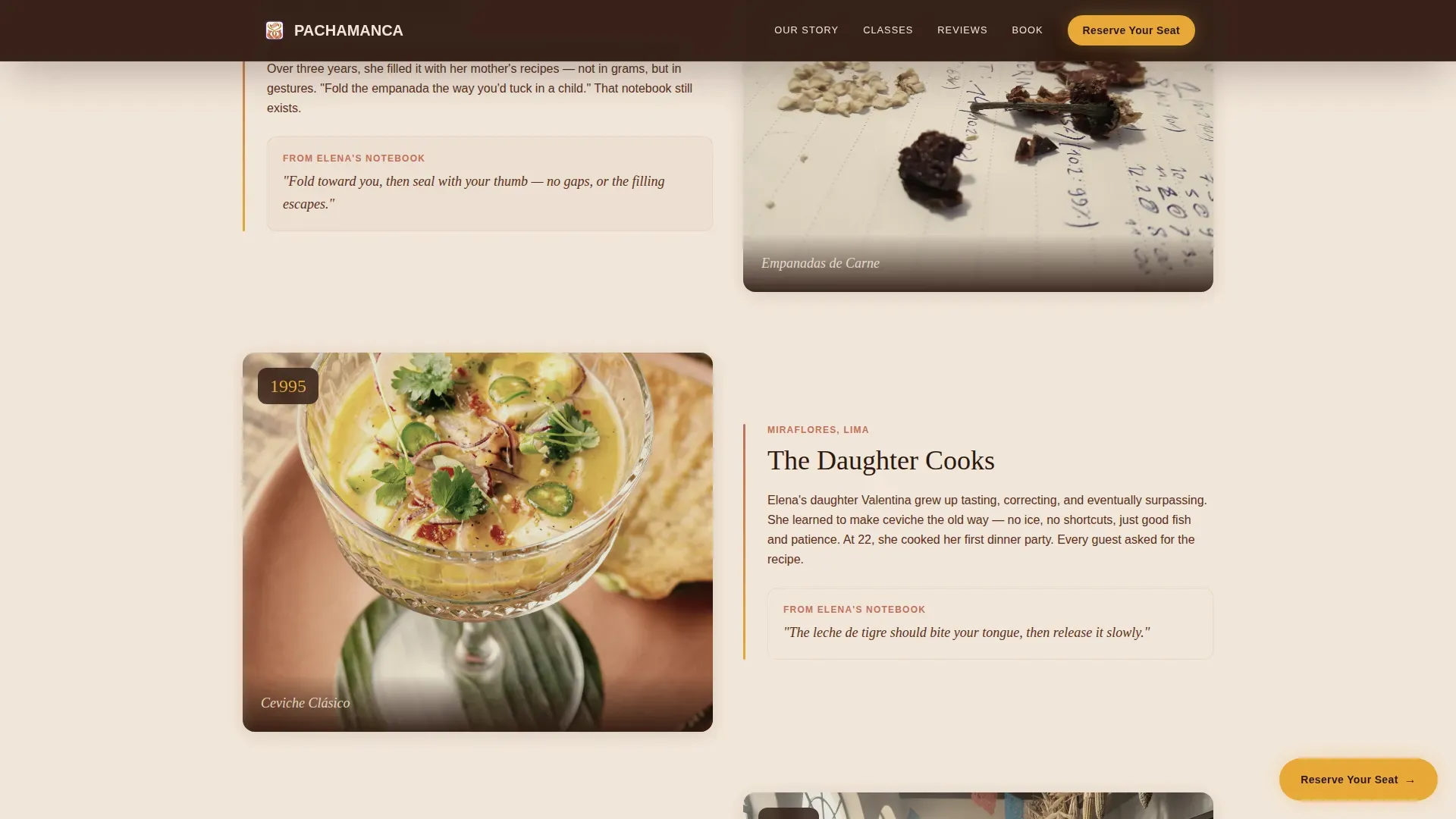
- Four chapter-style Origin Story scroll sections with space for sepia photography and handwritten-style recipe fragments
- Class offering cards with price display, menu details, duration, and dual call-to-action buttons for direct booking and gift purchases
- A testimonials section on a deep purple background with named reviewers, specific dishes mentioned, and star ratings
- An inline booking module with date picker, group size selector (one to six people), dietary flags, and a single payment field
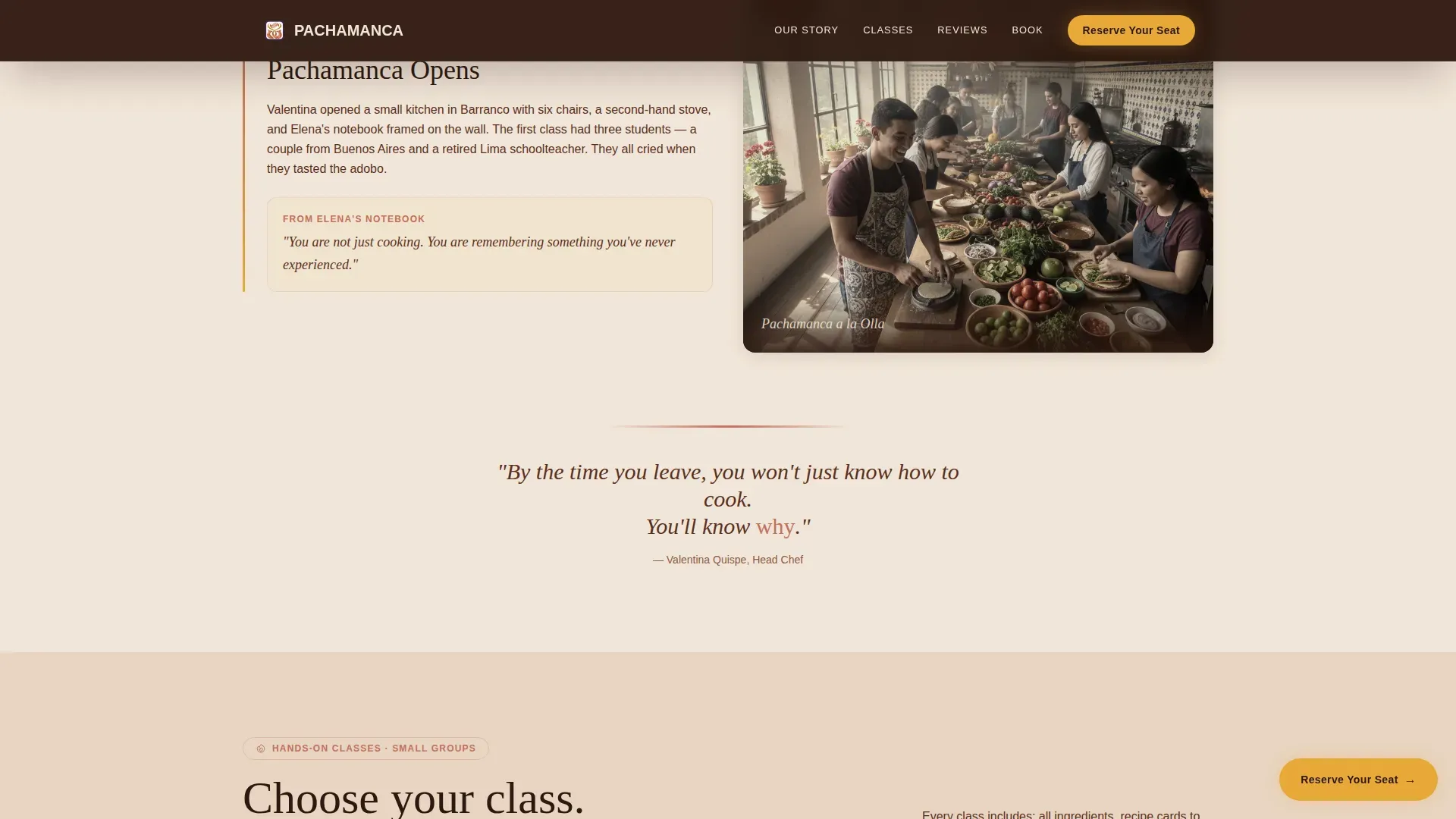
- A sticky gold "Reserve Your Seat" button that activates after the Origin Story resolves on scroll
Feature list
This template includes a defined set of built-in sections, interactive components, and design features drawn directly from the project brief.
Cinematic Mascot Hero Section
The header fills the entire viewport with a hand-drawn abuela character. She holds a steaming pot, her expression is warm and direct, and the headline sits in the rising steam above her. A seat-counter card sits beside her, showing remaining spots in real time. The cooking process begins communicating before the visitor reads a single word of copy.
Four-Chapter Origin Story Layout
Below the hero, four scroll-triggered chapter cards trace the family recipe lineage across decades. Each card pairs sepia-toned photography on the left with handwritten-style recipe fragments on the right. The dishes grow more complex as the story advances. By the end of the sequence, visitors understand that this is more than just a meal. They are joining a continuation of something that started long before the class opened.
Class Offering Cards with Inline Booking
Each class card displays the menu being cooked, the duration, a thumbnail of the finished dish, and pricing in gold. Visitors can click "Reserve Your Seat" to open an inline booking module directly on the page. No redirect. No separate booking site. The module includes a date picker, group size input, dietary flags for vegetarian and celiac needs, and a payment field. A secondary "Gift This Class" path sits beneath each card for couples and birthday buyers.
Sticky Gold Call-to-Action Button
A sticky button labeled "Reserve Your Seat" appears on scroll after the Origin Story section ends. It stays visible as visitors browse class cards and testimonials. The gold color is reserved exclusively for this button and price tags across the template, so every time it appears, the visual signal is immediate and consistent.
Deep Purple Testimonials Section
Four social proof cards sit on a deep purple background. Each card names the reviewer, identifies the specific dish they made, and shows a star rating. This section reinforces the community spirit of the experience and gives undecided visitors real evidence from people who have already shown up, cooked, and eaten.
Seat Scarcity Counter
Each class date in the booking module displays a remaining-seats counter. This component creates natural urgency without manufactured pressure. Visitors see that the next available class has a small group, and that context alone moves decisions forward.
Page sections overview
| Section | Purpose |
|---|---|
| Mascot Hero | Introduce abuela character, headline, and live seat counter |
| Origin Story | Four chapter cards tracing family recipe lineage across decades |
| Class Offerings | Cards with menu, duration, price, and booking or gift call-to-action |
| Testimonials | Social proof cards on deep purple with names, dishes, and star ratings |
| Booking Module | Inline date picker, group size, dietary flags, and payment field |
| Sticky call to action | Persistent gold "Reserve Your Seat" button active after hero resolves |
| Footer | Logo and tagline left, navigation links right, Arc Browser Split pattern |
Design & branding system
The visual identity follows a Warm Artisan theme built around the Desert Rose color system. The palette is drawn from earth-based references: sun-baked clay, chicha morada purple, unbleached cotton, and market-stall gold. The overall feeling is hand-dyed textile, imperfect, and pigmented by the land itself. Typography uses Fraunces for serif headings and Manrope for sans-serif body text.
- Cream (#F2E6D9) dominates backgrounds like unbleached cotton, keeping the page legible and warm
- Terracotta (#C2705B) anchors section headers and dividers with a grounded, earthy authority
- Deep chicha morada purple (#4A1942) appears in the testimonials section and footer for contrast and depth
- Ají gold (#E8A838) is used exclusively for buttons and price tags, creating a clear visual signal for action and value
Mobile & speed optimization
The template is designed desktop-first but carries full mobile responsiveness across all sections. Chapter cards stack vertically on smaller screens. The sticky call-to-action button remains accessible on mobile viewports. The booking module adapts to single-column input on phone-sized screens without losing any functionality.
- Chapter card layout collapses from side-by-side to stacked on tablet and mobile
- Sticky button remains pinned and tappable on all screen sizes
- Booking module fields reflow into a single column on narrow viewports for clean mobile usability
How this template helps you convert
The layout is sequenced to earn the purchase before it asks for it. Visitors do not arrive at a price without first understanding who made the food, why it matters, and what they will actually do inside the class. That sequence is intentional and built into the page structure.
- The mascot hero creates immediate emotional warmth and communicates scarcity through the seat counter, giving visitors a reason to keep scrolling with purpose.
- The Origin Story sequence turns product discovery into personal connection. By the time the class cards appear, the visitor is not comparing prices. They are deciding whether they want to be part of this specific story.
- The inline booking module removes every friction point between decision and purchase. Date, group size, dietary needs, and payment all live on one page. No account creation, no redirect, no second tab.
Other information about this template
This section covers broader context about what this template supports, the culinary traditions it represents, and the experiential tourism landscape it fits within.
Pachamanca is a term from the Quechua language, meaning earth pot or oven. The cooking method uses hot stones buried in the ground to cook marinated meats, native potatoes, broad beans, sweet potatoes, and Andean herbs in a sealed earth pit. The heated stones reach extreme temperatures before the pit is covered with banana leaves, grass, and earth. The result is a slow, communal cooking process that is deeply rooted in Andean tradition and carries genuine cultural significance.
The preparation process is intricate. Participants learn to heat the stones, layer the ingredients, seal the earth oven, and wait. The waiting is part of the ritual. Preparing pachamanca is an act of deep respect toward Pachamama, or mother earth. It is not a restaurant technique. It is a ceremony that indigenous communities have practiced across the Andean region for generations. The pachamanca feast that emerges from the earth is not opened with a knife. It is uncovered with hands, shared between people, and eaten while the community gathers around.
Experiencing pachamanca connects visitors to something that cannot be replicated in a fine dining setting. The cooking method is cooked underground, sealed with the earth itself, and the unique flavors that emerge from that process are unlike anything produced by conventional heat. The meal is more than just a meal. It is a ritual of gratitude, a community gathering, and a hands on experience in one sitting.
The sacred valley region near the urubamba river and the andean highlands surrounding machu picchu are among the places where traditional pachamanca preparation has remained intact across centuries. Discovering pachamanca in its natural context, surrounded by breathtaking views of the andean highlands and the sacred valley landscape, makes the experience more vivid. The sacred valley itself, with its archaeological site clusters and proximity to picchu mountain, provides natural framing for the story that this template tells. Visitors who plan to visit peru often combine cooking experiences with exploration of the historic center, the plaza de armas, or the narrow streets of colonial Cusco. From lima airport, guided experiences can connect travelers to local families across the sacred valley and the andean region within hours.
The template is also well-suited for operators who want to offer a tasting menu alongside the cooking class. A curated tasting menu of classic peruvian dishes, including lomo saltado and guinea pig alongside traditional dishes like causa and ceviche, adds fine dining context to a hands-on format. Peruvian wines and exotic fruits can complement the tasting menu for groups celebrating special occasions or milestone events.
Discovering pachamanca as a visitor requires some planning. Travel insurance is recommended for international guests arriving via lima airport. Comfortable walking shoes or hiking boots are practical for outdoor experiences near archaeological site locations or along paths beside the urubamba river. Many operators let guests move at their own pace through the preparation stages, allowing community gatherings to form naturally as the heated stones do their work underground. Classes that begin with a trip to a local market give visitors a chance to source local ingredients directly from local farmers and local artisans before the cooking starts.
Offering gift options for special occasions, promoting the experience to local families, and working with local tourism operators to reach travelers exploring machu picchu or the sacred valley are all ways this template supports a broader marketing strategy. The layout is flexible enough to serve an intimate Lima class and a larger sacred valley experience. The experience pachamanca offers through this template is one of meaningful connections between food, community, and memory. When the sun sets and the late afternoon light falls on the earth, the entire experience becomes something visitors carry home long after the meal is finished.
- The template supports vegetarian participants through a dietary flag in the booking module, reflecting the flexibility that many cooking classes offer with additional Andean cheese and vegetables
- Guinea pig is one of the traditional proteins included in a classic pachamanca feast, alongside broad beans, native potatoes, sweet potatoes, and marinated meats from local farmers
- Peruvian gastronomy draws from the amazon rainforest, the andean region, and the Pacific coast, and this template's Origin Story structure gives operators room to narrate that full geographic and cultural span
- Andean heritage is expressed throughout the template through visual texture, color, and narrative structure, not just in recipe cards
- The template can support additional sections or cultural workshop content for operators who partner with local artisans or offer craft-based add-ons alongside the cooking class
Theme
Warm Artisan
Creative direction
Origin Story
Color system
Desert Rose
Style
Full-Width Immersive
Direction
Direct Sales
Page Sections
Mascot Hero with Seat Counter
Four-chapter Origin Story Scroll
Class Cards with Inline Booking Module
Sticky Gold Reserve Button
Deep Purple Testimonials Section
Gift This Class Secondary Path
Related questions
What cooking class format does this template support?
Can the template handle both direct bookings and gift purchases?
Is this template suitable for operators outside Lima?
What happens when a class date is nearly full?
Does the template include social proof sections?