Energy Assembly Landing Page Template for Field Contractors
Torque is a single-column landing page template built for energy assembly contractors. It leads with an animated stats wall, walks visitors through a six-phase project lifecycle, and closes with two B2B conversion points: a scoped project form and a downloadable capability statement. The design uses an Engineering Blueprint theme grounded in a Forest Trust color palette.
by Rocket studio
Quick summary
Torque is a precision-built landing page template for energy assembly service companies. It covers the full project lifecycle from mobilization to energization, communicates process discipline through repeating section rhythm, and pushes B2B visitors toward two clear conversion paths. The Engineering Blueprint visual theme reinforces craft, accountability, and field-proven reliability.
Who this template is for
This template is built for subcontractors who do the physical work of bringing energy infrastructure to life. If your crews bolt substations, terminate electrical panels on solar fields, or commission turbine platforms, this page speaks your language and your clients' language.
- Engineering, Procurement, and Construction (EPC) contractors managing tight commissioning deadlines
- Utility program managers overseeing capital budgets across multiple project sites
- Renewable energy developers who need a single subcontractor to hold the full field assembly scope
What problem this template solves
Energy assembly subcontractors often win work on reputation alone because their web presence doesn't communicate process maturity. Procurement teams doing due diligence need more than a phone number. They need proof that a crew shows up the same way on every job.
- No dedicated page to demonstrate phase-by-phase field discipline to skeptical procurement teams
- No structured lead capture built for B2B buyers who need scope details before they'll send an RFP
- No lightweight qualifier to hand procurement contacts a capability statement quickly
What you get with this template
This template delivers a complete single-column landing page layout purpose-built for an energy assembly service. Every section is sequenced to build credibility before asking for contact information.
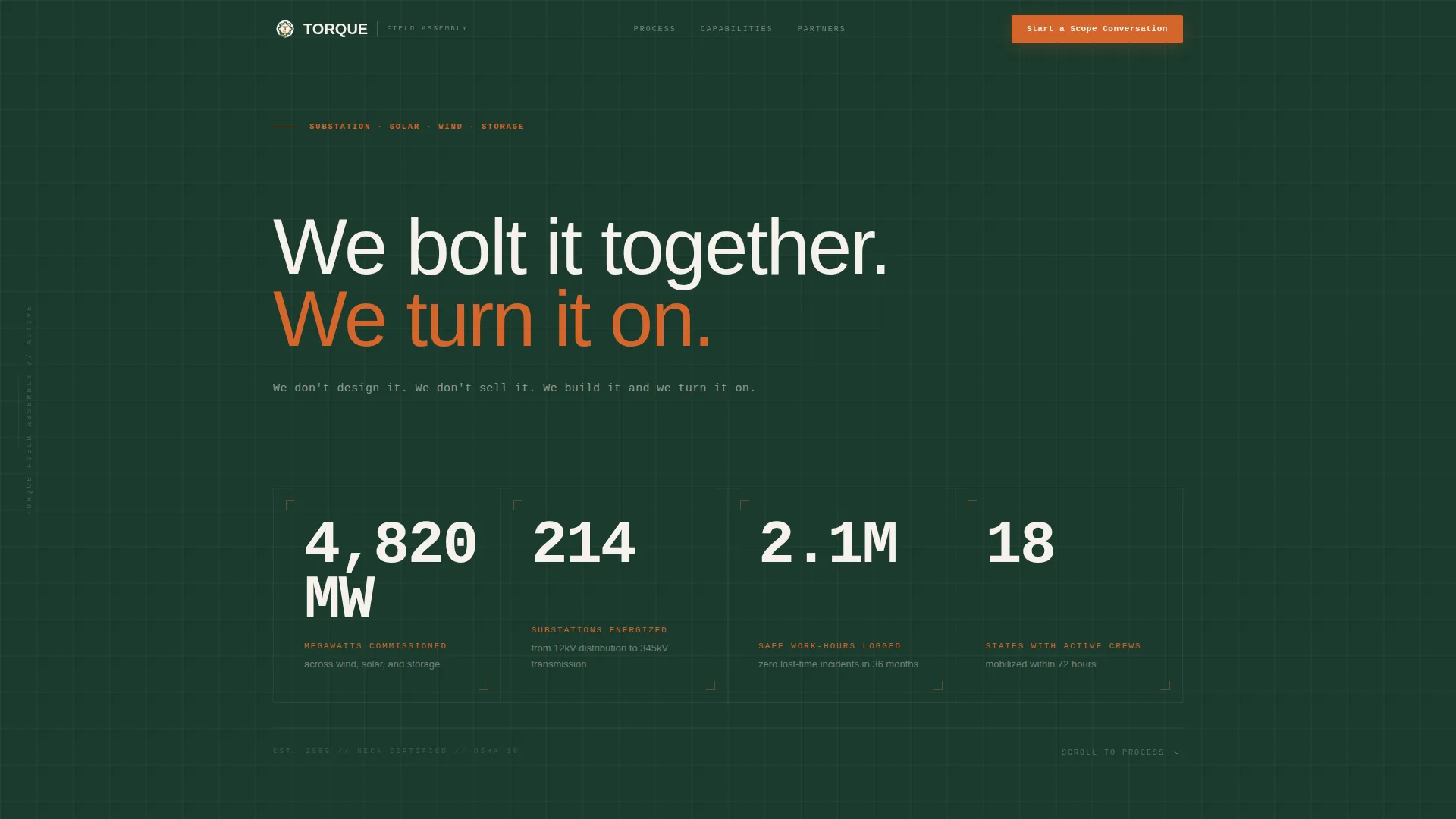
- An animated stats wall header with four upward-counting metrics: megawatts commissioned, substations energized, safe work-hours logged, and states with active crews
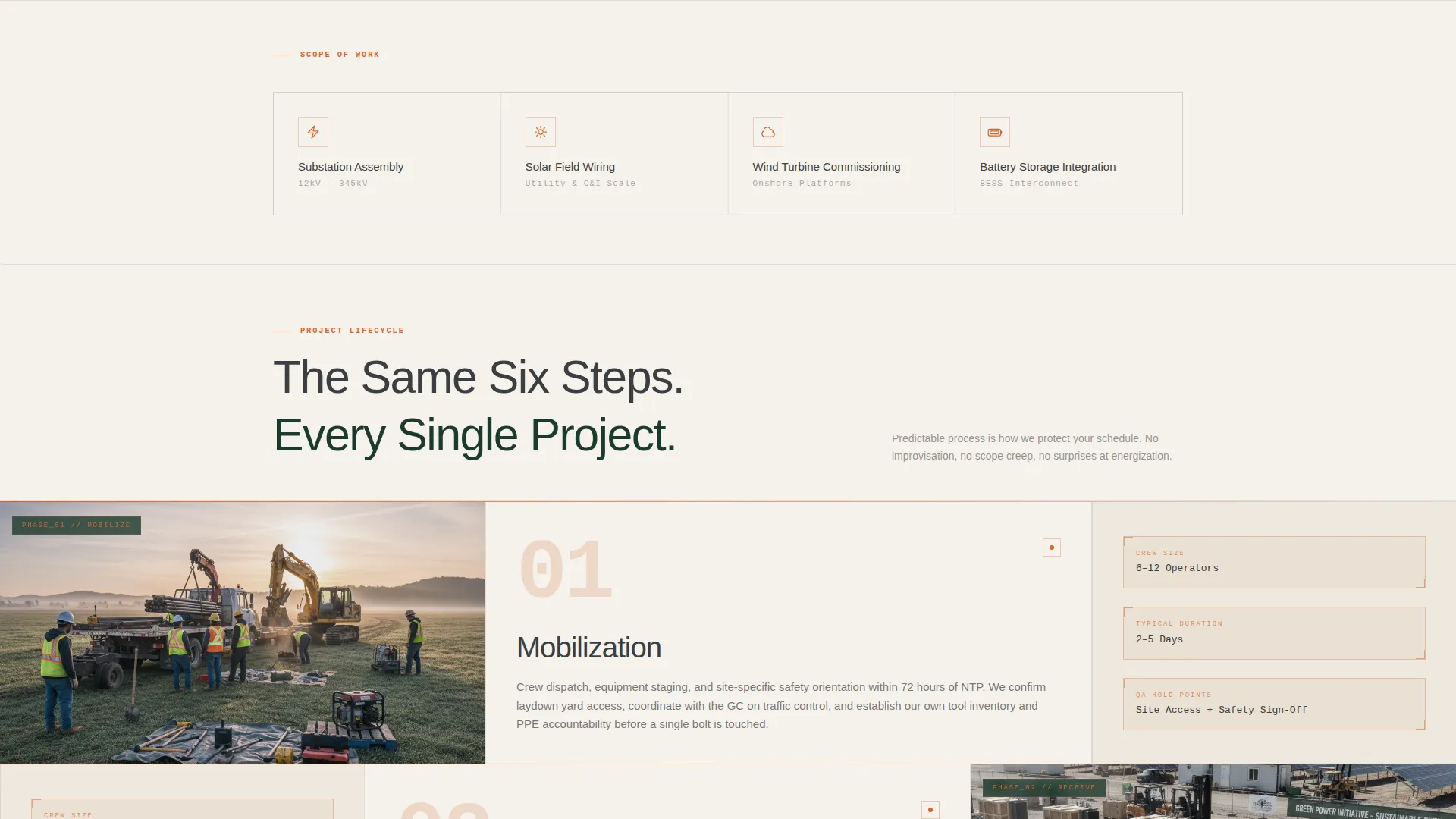
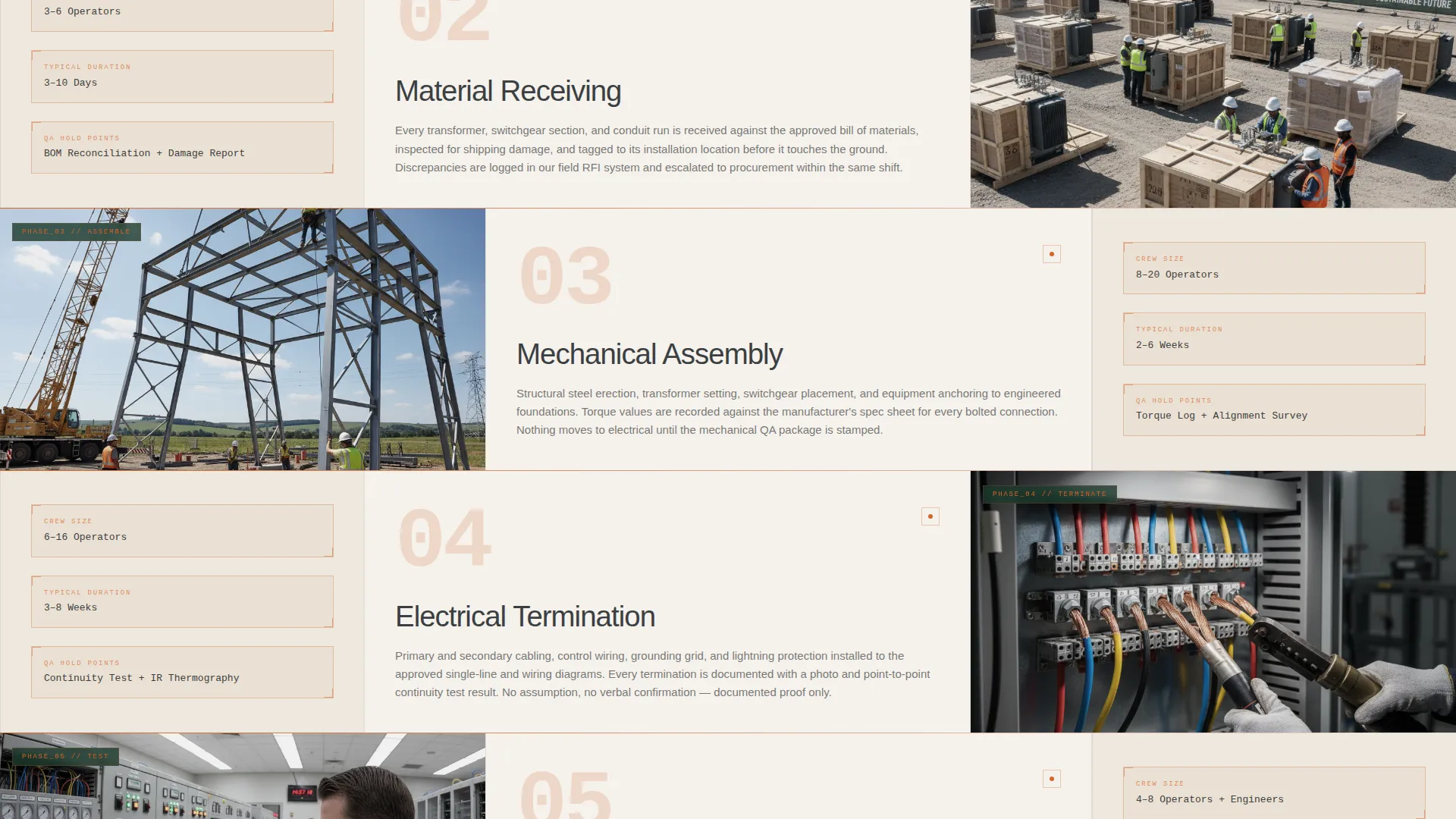
- A six-phase transparent process section with site photography placeholders, plain-scope paragraphs, and key performance indicator (KPI) badges per phase
- Two primary call-to-action (call to action) placements and a gated capability statement PDF download as a secondary lead channel
Feature list
This section describes the core built-in components of the Torque template.
Animated Stats Wall Header
Four oversized counters tick upward against a deep timber green background. Each counter is set in a monospaced engineering typeface and finishes its animation as the visitor's eye naturally reaches it. A single anchor line in vellum white sits below: "We don't design it. We don't sell it. We build it and we turn it on."
Six-Phase Process Scroll
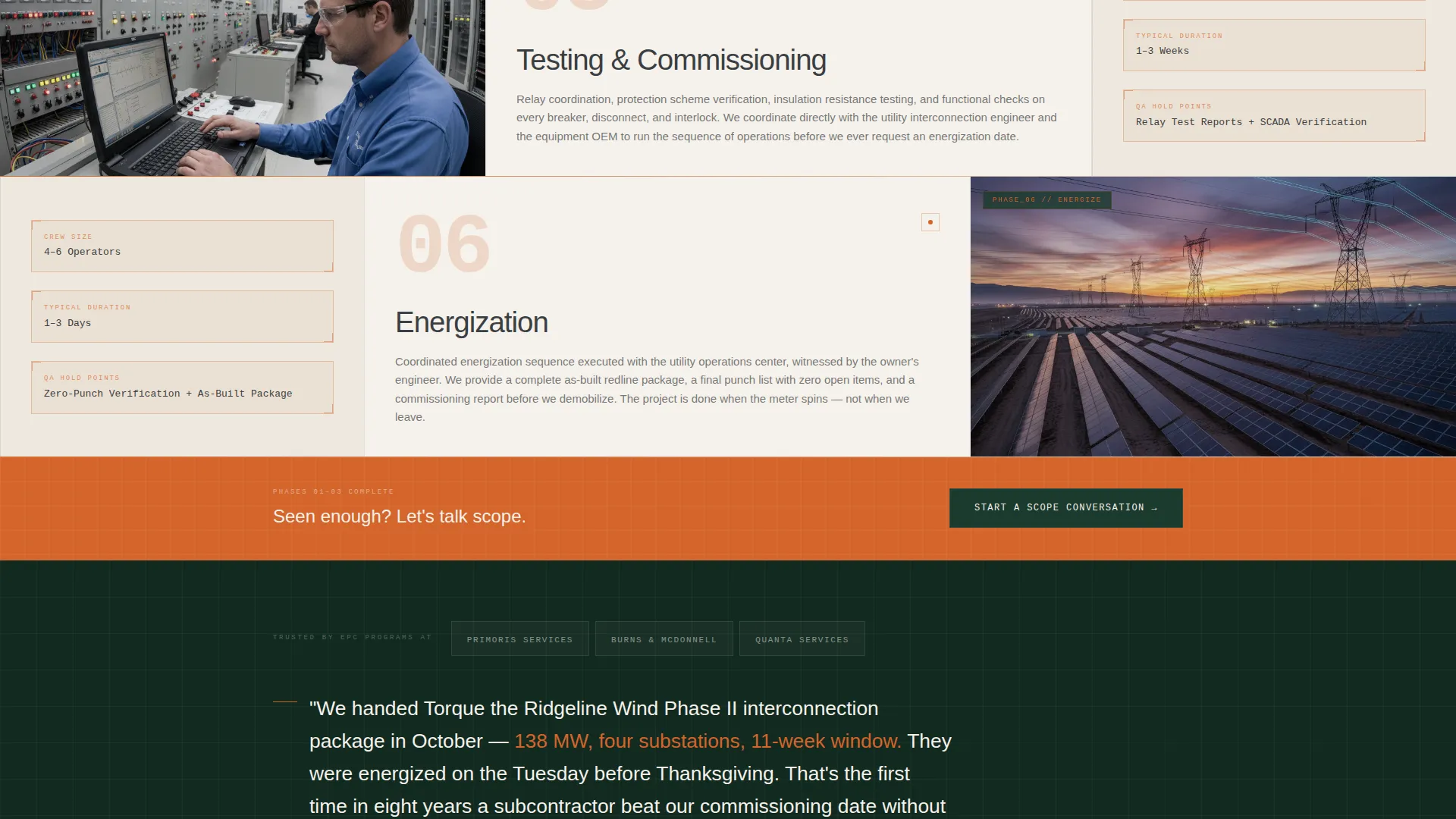
Each of the six project lifecycle phases gets its own section: mobilization, material receiving, mechanical assembly, electrical termination, testing, and energization. Every phase section includes a real site photo on the left margin, a plain-spoken scope paragraph in the center, and a single KPI badge on the right showing crew size, typical duration, and quality assurance hold points.
Social Proof Band
A horizontal mid-page band breaks the process rhythm with three partner logo placements and a pull quote from a utility program director. The quote references a specific project delivered ahead of schedule, giving procurement readers a grounded, peer-level endorsement.
Dual call to action Placement
The primary call to action, "Start a Scope Conversation," appears twice. The first placement floats after the third phase section while the visitor is still in a discovery mindset. The second anchors the footer so it is always within reach at the end of the page.
Scoped Project Lead Form
The contact form collects four fields: company name, project type (substation, solar, wind, or battery storage), estimated megawatt or kilovolt class, and target energization quarter. This focused structure qualifies leads without creating friction.
Capability Statement PDF Gate
A secondary conversion path offers a downloadable capability statement PDF. It is gated behind a single email field, giving procurement teams the spec sheet they need for bid packages while opening a quieter, lower-commitment lead channel.
Page sections overview
| Section | Purpose |
|---|---|
| Stats Wall Header | Opens with four animated performance counters and a single positioning line |
| Phase 1: Mobilization | Shows crew readiness, site setup scope, and mobilization KPI badge |
| Phase 2: Material Receiving | Covers material intake, staging process, and receiving KPI badge |
| Phase 3: Mechanical Assembly | Details structural and mechanical build scope with assembly KPI badge |
| Social Proof Band | Breaks pattern with partner logos and a utility program director quote |
| Phase 4: Electrical Termination | Covers wiring and termination scope with a phase-specific KPI badge |
| Phase 5: Testing | Details pre-energization testing steps and quality hold point badge |
| Phase 6: Energization | Closes the lifecycle with commissioning scope and final KPI badge |
| Primary call to action Form | Captures scoped project inquiries with four qualifying form fields |
| Capability PDF Gate | Offers downloadable spec sheet gated behind a single email field |
| Footer call to action | Repeats the primary call to action to anchor the page close |
Design & branding system
The template uses an Engineering Blueprint theme built on a Forest Trust color system. The palette feels like a marked-up site plan pinned to a field office corkboard, grounded and built on visible craft.
- Deep timber green (#1B3A2D) anchors section backgrounds and major structural breaks
- Survey-stake orange (#D4652A) activates all calls to action and milestone markers
- Vellum white (#F5F1EB) opens breathing room around spec paragraphs and data fields
- Gridline charcoal (#3B3F42) holds body text, labels, and structural dividers steady
Mobile & speed optimization
The single-column layout is naturally suited to mobile viewing. The vertical flow requires no horizontal scrolling or complex grid reflows on smaller screens.
- The stacked section rhythm translates cleanly from desktop to tablet and phone without layout breakage
- Phase sections with left-margin photos and right-margin KPI badges reflow into a vertical reading order on narrow viewports
How this template helps you convert
The page earns the conversion before it asks for it. By the time a visitor reaches the form, they have already seen a crew's process play out phase by phase across a full project lifecycle.
- The stats wall establishes scale and credibility in the first scroll, anchoring trust before any sales language appears
- The repeating phase structure teaches visitors that this company operates the same disciplined way on every job, reducing procurement risk in the buyer's mind
- The dual call to action placement combined with the PDF gate gives buyers two paths: a full scope conversation for ready contacts and a quiet capability statement download for contacts still in the research phase
Other information about this template
This template is categorized under Manufacturing and Industrial, specifically within the Energy Manufacturing niche. It is designed for energy assembly service providers operating in the field construction segment of the renewable and utility-scale power sector.
- Template style: Single Column Flow, making it easy to adapt content without restructuring layout
- The Transparent Process creative direction is the core organizational principle, not just a visual choice
- The Forest Trust color system and Engineering Blueprint theme work together to project field competence rather than corporate polish
- The page is intended to speak directly to procurement decision-makers who evaluate subcontractors on process maturity and safety record
- The capability statement PDF gate is designed as a procurement-friendly touchpoint for bid package researchers who are not yet ready for a direct conversation
Theme
Engineering Blueprint
Creative direction
Transparent Process
Color system
Forest Trust
Style
Single Column Flow
Direction
Partnership/B2B
Page Sections
Animated Stats Wall Header
Six-phase Transparent Process Scroll
Mid-page Social Proof Band
Scoped Project Lead Form
Capability Statement PDF Gate
Dual Call-to-action Placement
Related questions
Who is this landing page template built for?
Can I adapt the six project phases to match my company's actual process?
What does the lead form collect and why?
How does the capability statement PDF gate work?
Is this template limited to one type of energy project?