Expert Mechanical Engineer Profile Pre-Launch & Coming Soon Website Template
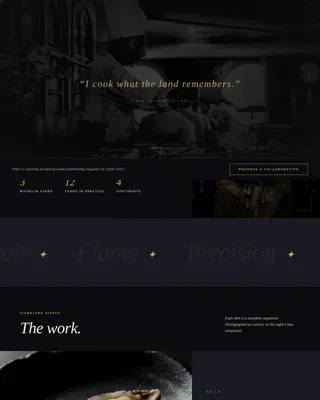
Torque is a dark immersive mechanical engineer career blog landing page template built as a horizontal scroll experience. It captures waitlist signups from engineers hungry for real salary data, honest interview breakdowns, and clear career path guidance. The obsidian and gold design system, gallery walk layout, and scarcity-driven waitlist form make it one of the most focused tools in the personal and resume category.
by Rocket studio
Quick summary
Torque is a horizontal scroll landing page template designed for a mechanical engineering career blog. It pairs a cinematic dark immersive visual system with a structured waitlist capture flow. Engineers at every career stage, from recent student graduates to mid-career professionals targeting engineering manager roles, get a page that speaks their language, respects their intelligence, and earns their email address.
Who this template is for
Torque was built for a very specific reader. The mechanical engineering profession is full of people who know exactly how to solve practical problems with steel and simulation, but who rarely find content that matches that same precision when it comes to career decisions. This template serves the person building that content resource.
- Mid-career mechanical engineers with five to twelve years of experience who are deciding between staying in senior design or moving into engineering management roles.
- Recent student graduates decoding which specializations, finite element analysis, fluid mechanics, heat transfer, mechatronics, actually pay off in the current job market.
- Technicians and early-career professionals evaluating whether the investment in a professional engineering license is worth the cost, time, and stress.
What problem this template solves
Most career resources aimed at mechanical engineers are either too generic or too academic. They explain basic concepts that any working engineer already knows, or they recycle the same advice about communication skills and resume formatting without ever touching real salary numbers, actual interview structures, or honest assessments of career path ROI. Engineers seek substance over marketing fluff in technical content, and this template addresses that gap directly.
The Torque template solves the problem of launching a credible, high-trust career blog without spending months on design. It gives blog creators a ready-made visual identity that communicates authority from the first scroll.
- Engineers landing on the page immediately recognize the aesthetic: precise, industrial, stripped of decoration, and built around real information rather than inspiration-poster platitudes.
- The waitlist flow converts curious visitors into committed early members before a single article is published, building an audience before the content goes live.
- The gallery walk structure previews five distinct content pillars, giving visitors enough detailed information to understand the scope of the blog before they commit to signing up.
What you get with this template
This template delivers a complete horizontal scroll landing page built around five core sections, a persistent waitlist capture bar, and a sample teardown reveal mechanism. Every visual and structural decision in the template reflects the machine-shop aesthetic described in the creative direction: obsidian backgrounds, brushed gold accents, and graphite card surfaces that feel precision-placed rather than decoratively arranged.
The page is desktop-first by design, with a horizontal scroll experience driven by minimal JavaScript and CSS scroll behavior. On mobile devices, the layout falls back to a clean vertical reading flow.
- A hero section with a type-over-image composition, five full-viewport gallery room panels, a sample salary teardown reveal, and a waitlist form with career-stage radio selection.
- A persistent bottom bar carrying the primary call to action through the entire horizontal scroll, so the conversion opportunity is never out of reach.
- A live waitlist position counter and founding member scarcity framing that gives early visitors a concrete reason to act now rather than later.
Feature list
This section covers the core built-in capabilities of the Torque template. Each feature is drawn directly from the template brief and creative direction.
Horizontal Scroll Gallery Walk Layout
The template's defining structural feature is its horizontal scroll architecture. Visitors move left to right through five discrete full-viewport panels, each representing a content pillar of the mechanical engineering career blog. The panels cover Salary Teardowns, Interview Debriefs, Toolchain Reviews, Career Path Maps, and the Professional Engineering License Playbook. Each room has its own hero image, a close-up of a GD&T callout sheet, a thermal stress simulation mid-solve, hands on precision measurement equipment, paired with a three-line content preview. Gold accent lines connect one panel to the next, creating a visual tolerance chain across the full page width. The scroll interaction is implemented with CSS scroll behavior and lightweight JavaScript, keeping the page responsive without heavy library dependencies.
Type Over Image Hero Section
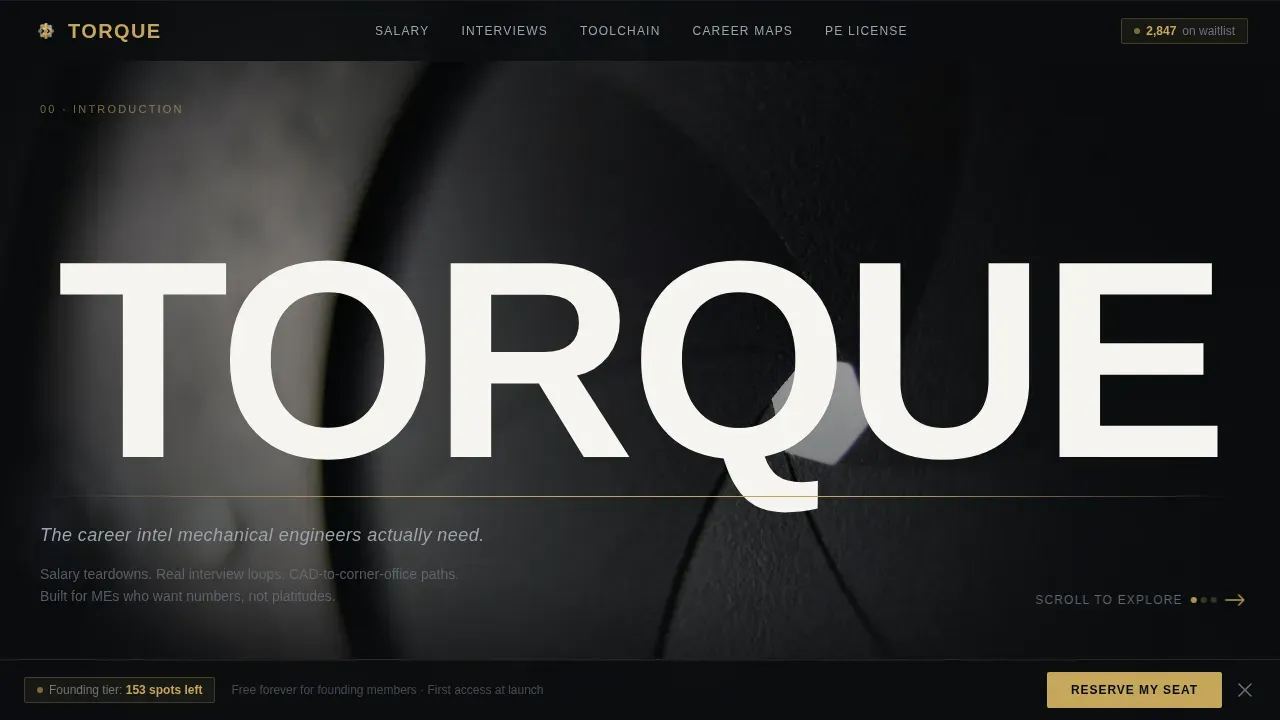
The hero is built as a type-over-image composition. The word "TORQUE" is set in a compressed, ultra-heavy typeface and stretched edge to edge across a full-bleed photograph shot from inside a turbine housing looking outward. The turbine blades radiate outward like a mechanical iris, and the letterforms are partially masked by the metal geometry so that type and structure become a single object. There is no animation on load. The stillness is the statement. A single subline sits beneath the title in bearing-steel silver, establishing the blog's value proposition in one sentence. This hero approach is consistent with what a blog landing page for mechanical engineering needs: technical depth communicated visually before a single word of body copy is read.
Persistent Bottom Bar call to action
A bottom bar carrying the primary call to action travels with the visitor through the entire horizontal scroll. The button label is "Reserve My Seat," rendered in brushed gold against an obsidian background. The bar is always visible, meaning the conversion path is present no matter which gallery room panel the visitor is currently viewing. This persistent interaction layer removes friction from the signup process and ensures that visitors who are ready to commit do not need to scroll back to find a form.
Sample Teardown Reveal Mechanism
A secondary conversion path invites visitors to tap or click "See a Sample Teardown" to unlock a redacted salary breakdown. This prove-before-you-ask mechanic shows one example of the blog's depth without requiring an email address first. Visitors can evaluate the quality and specificity of the data before deciding to join the waitlist. This approach is particularly effective with a mechanical engineering audience, who are trained to evaluate evidence before committing to a conclusion.
Waitlist Form with Career Stage Selection
The waitlist form captures two inputs: an email address and a single radio selection identifying the visitor's career stage. The four options are student, early-career, mid-career, and senior or leadership. This segmentation is built directly into the form, giving the blog creator immediate data on who is joining the waitlist without adding friction to the signup process. A live counter shows the visitor's waitlist position number. Founding member framing promises first access and a permanent free tier when the blog launches.
Obsidian and Gold Design System
The color system is not decorative. Every color in the palette performs a specific structural function. Deep volcanic black (#0B0D0F) covers full-bleed backgrounds. Machined graphite (#1A1D23) defines card surfaces and section dividers. Brushed gold (#C5A55A) appears on headlines and activates on hover states. Bearing-steel silver (#9CA3AF) carries body text. Gold is never used to flood a surface; it edges, underlines, and sparks on interaction, the way a spot-weld catches light in a dim machine shop. Typography pairs Oswald for compressed heavy headlines with DM Sans for body text, combining industrial weight with clean readability.
Page sections overview
| Section | Purpose |
|---|---|
| Hero type-over-image | Sets tone, presents blog identity, no-animation stillness as statement |
| Salary Teardowns room | Previews real compensation data content pillar |
| Interview Debrief room | Previews honest interview loop breakdowns content pillar |
| Toolchain Reviews room | Previews CAD and engineering software analysis content pillar |
| Career Path Maps room | Previews structured career trajectory content content pillar |
| PE License Playbook room | Previews professional engineering license ROI content pillar |
| Sample Teardown reveal | Unlocks redacted salary example to prove content depth before signup |
| Waitlist capture form | Collects email and career stage, shows live counter and founding member framing |
| Persistent bottom bar | Carries Reserve My Seat call to action across full horizontal scroll |
| Minimal centered footer | Closes page with clean, low-distraction link structure |
Design & branding system
The Torque design language is built on restraint. Every visual decision follows the same principle that guides good mechanical engineering: if a component does not perform a function, it should not be there. The result is a page that feels like a precision instrument rather than a marketing asset. Engineers respond to this aesthetic because it mirrors the standards they apply in their own work.
- The four-color palette, obsidian (#0B0D0F), graphite (#1A1D23), brushed gold (#C5A55A), and bearing-steel silver (#9CA3AF), divides cleanly into background, surface, accent, and text roles. No color overlaps into another's function.
- Typography uses Oswald for all compressed heavy headline treatments and DM Sans for body copy. The combination delivers industrial authority in headings and clear readability in longer text passages.
- Gold accent lines connect gallery room panels horizontally, functioning like a tolerance chain that visually links each content pillar to the next. Hover states activate gold on interactive elements, providing clear feedback without animation overhead.
Mobile & speed optimization
Torque is a desktop-first template. The horizontal scroll gallery walk is designed for wide screens where full-viewport panels can display at their intended scale. However, the template includes a mobile fallback that converts the horizontal layout into a standard vertical scroll experience, preserving all content sections and the waitlist form in a readable single-column flow.
- On smaller screens, each gallery room panel stacks vertically, maintaining the hero image and three-line content preview format in a portrait-oriented layout.
- The persistent bottom call to action bar adapts to the mobile viewport, keeping the "Reserve My Seat" button visible throughout the vertical scroll.
- The implementation uses CSS scroll behavior and minimal JavaScript without heavy animation libraries, keeping the interaction layer light and the page load lean.
How this template helps you convert
A waitlist landing page only works if it can convince a skeptical visitor that the content behind the signup is worth their email address. For a mechanical engineering audience, skepticism is the default state. These are people trained to question assumptions, stress-test solutions, and evaluate evidence before drawing conclusions. Torque is built around that mindset.
- The sample teardown reveal lets visitors see real content depth before they commit, directly addressing the "prove it first" instinct that most mechanical engineers bring to any new resource.
- The live waitlist counter and founding member framing create structural scarcity, giving visitors a concrete reason to sign up now rather than bookmark the page and forget about it.
- The five gallery room panels communicate the full scope of the blog's content pillars in a single horizontal scroll, so visitors leave with a complete picture of what they are joining.
Other information about this template
Torque sits at a specific intersection in the personal and resume category: it is designed for a mechanical engineering niche where the audience is highly technical, deeply skeptical of generic career content, and responsive to precision in both design and information. The following points provide additional context for creators evaluating this template.
- Mechanical engineering is a broad discipline. It involves the design, analysis, testing, and manufacturing of physical systems, drawing on physics, mathematics, and materials science. The Torque blog concept specifically addresses the career layer of that discipline, the salary bands, interview structures, and professional development paths that engineering school does not cover.
- The five content pillars built into the gallery rooms reflect real gaps in the mechanical engineering career information landscape. Salary Teardowns address the fact that compensation data in engineering is rarely published with real specificity. Interview Debrief content addresses the reality that interview loops at major industrial and aerospace employers follow formats that most candidates encounter for the first time unprepared. Toolchain Reviews address the rapid expansion of computer-aided design (CAD) software options and the genuine difficulty of knowing which tools to invest time in learning. Career Path Maps address the poorly documented transition from senior design engineer to engineering manager. The PE License Playbook addresses the cost, time, and career ROI questions around the professional engineering license that technicians and early-career engineers ask most frequently.
- Mechanical engineering roles span a wide range: Automotive Engineer, Biomedical Engineer, Manufacturing Engineer, Robotics Engineer, and Project Engineer, among others. Each role has different salary trajectories, different toolchain requirements, and different interview formats. The Torque blog concept is built to serve this breadth of roles with content that is specific rather than general.
- Core responsibilities in mechanical engineering include designing machines and thermal systems, utilizing CAD modeling workflows, running simulations, and creating prototypes for physical testing. Engineers working across these responsibilities need career content that understands the actual texture of the job, not just the job title.
- Key skills required in mechanical engineering include proficiency in CAD, thermodynamics, fluid mechanics, material science, and communication skills for translating technical findings to non-engineering stakeholders. These are the skills that salary data and interview content on the Torque blog would address with actual numbers and real interview question structures.
- Courses in finite element analysis and mechatronics can significantly enhance a student's competitiveness in the current mechanical engineering job market. Understanding dynamics, statics, heat transfer, fluid mechanics, and numerical methods gives engineers the analytical foundation to solve practical problems across aerospace, industrial, and manufacturing contexts. The Torque blog is positioned to help engineers evaluate which of these specializations offers the strongest career ROI for their specific situation.
- Innovative teaching methods are increasingly being adopted in mechanical engineering education, with simulation tools and software providing hands-on experiences that supplement classroom basics. Courses in mechanical engineering are increasingly incorporating machine learning and data analysis topics. Project-based learning is becoming a key component of curricula, and collaboration with industry partners is emphasized to keep programs relevant. The Torque blog complements formal education by covering the career intelligence that curricula typically leave out.
- High-stakes failure analysis in mechanical engineering involves investigating catastrophic accidents and analyzing broken or dangerous equipment. Design flaws in engineering can result in severe injury or death, which is why rigorous testing and quality control are non-negotiable. The manufacturing environment can be noisy, demanding, and unforgiving of errors. Engineers who understand the full weight of their responsibility are exactly the audience Torque is built to serve.
- Mechanical engineers increasingly leverage their skills in AI applications, focusing on areas like robotics and automation. Mechatronics combines mechanical engineering with electronics and computer science, making it highly relevant for AI and technology-adjacent roles. Machine learning can be integrated into mechanical engineering projects to enhance modeling and analysis. Courses in programming languages like Python and MATLAB are becoming important for engineers who want to work at the intersection of mechanical systems and intelligent software. Understanding fluid mechanics and thermodynamics is also critical for engineers involved in AI-driven simulations. The Torque blog, as a career resource, is positioned to help engineers evaluate which technology-adjacent skills are worth developing based on real job market data.
- AI-powered no-code tools now enable creators to build applications and content platforms without traditional programming skills. No-code platforms can handle backend integrations and deployment automatically, reducing the time required to develop and launch a blog like Torque. AI can assist in generating code from natural language prompts, simplifying the development process for non-technical creators. This means the person building the Torque blog concept can focus on the content, the career intelligence, and the community, while using available no-code tools to handle the build and deployment side. AI in development can also enhance scalability and maintainability as the audience grows.
- Expert testimonials and industry accreditations can boost credibility in engineering content. A blog in this niche can strengthen trust over time by incorporating endorsements from working engineers, references to recognized professional bodies, and data sourced from verifiable industry surveys.
- The torque dark immersive mechanical engineer career blog landing page template is categorized under Personal and Resume, Mechanical Engineer Profile subcategory, and is specifically designed for the mechanical engineering career blog niche.
- A blog landing page for mechanical engineering in innovative fields must prioritize technical depth, visual demonstration, and a clear value proposition. Torque delivers all three through its gallery walk structure, sample teardown reveal, and obsidian-and-gold design system.
- Fast loading speed and mobile optimization are important for technical content aimed at engineers. The template uses CSS scroll behavior and minimal JavaScript to keep the interaction layer light and efficient.
- Networking with professionals in mechanical engineering can significantly increase chances of securing internships and job opportunities. Joining professional engineering clubs provides valuable insights on resume writing and interview techniques. Taking the Fundamentals of Engineering Exam is a key step toward obtaining a professional engineering license. These are exactly the kinds of career development topics the Torque blog is designed to cover with real data and practical guidance.
- Effective time management is crucial for completing assignments and understanding complex engineering concepts, especially for student readers and early-career professionals managing multiple learning priorities simultaneously.
- Understanding dynamics and statics is essential for mechanical engineers who need to analyze internal forces and motion in systems. These foundational skills support the ability to perform accurate calculations across structural, thermal, and fluid domains.
- Mechanical engineers work in environments ranging from office-based design work to laboratories, manufacturing floors, and on-site project installations. This range means that career content needs to address different physical and organizational contexts, not just abstract career ladder advice.
- The interaction model of the Torque template, combining horizontal gallery scroll with hover-activated gold states and a persistent call to action bar, is designed to engage desktop users in a way that feels exploratory rather than transactional. Each interaction reinforces the blog's positioning as a high-quality, precision-built resource.
- Sensors, data acquisition systems, and embedded control systems are increasingly part of the mechanical engineer's toolkit, particularly in roles that intersect with industrial automation and robotics. Career content addressing these technology areas can assist engineers who want to develop skills that lift their market value.
- Prototyping, physical construction, and hands-on experiences remain central to mechanical engineering practice even as simulation software becomes more powerful. Students and early-career engineers who develop strong prototyping skills alongside their modeling competencies are better positioned to perform across a wide range of industrial environments.
- The creativity required in mechanical engineering product design is often undervalued in career discussions. Engineers who can develop innovative solutions while maintaining precision and quality in their calculations and specifications tend to have stronger career trajectories. The Torque blog is positioned to explore these less-discussed dimensions of the profession.
- Security in online content platforms matters for creators building audience trust. Visitors sharing their email address with a waitlist need to feel confident that their data will be handled responsibly. While specific backend security measures depend on the platform the creator uses to deploy this template, the minimal data collection model, email and a single radio selection, limits the surface area of data handling from the start.
- The Torque template is appropriate for creators who want to launch a career content platform in the mechanical engineering space, build an audience before publishing, and communicate their content quality through design and a sample reveal before asking for a commitment.



Theme
Dark Immersive
Creative direction
Gallery Walk
Color system
Obsidian & Gold
Style
Horizontal Scroll
Direction
Waitlist/Coming Soon
Page Sections
Horizontal Scroll Gallery Walk
Type Over Image Hero
Persistent Bottom Call to Action Bar
Sample Teardown Reveal
Scarcity-driven Waitlist Form
Obsidian and Gold Design System
Related questions
Who is the Torque template designed for?
Does the page work on mobile devices?
What does the sample teardown reveal section do?
How does the waitlist scarcity mechanic work?
Can this template be adapted for other technical niches?