Confidential IP Investigation Landing Page Template
The Trace Confidential IP Investigation landing page template is built for intellectual property investigation firms serving Fortune 500 legal teams and IP portfolio managers. It pairs an editorial magazine aesthetic with a frequently asked question-driven scroll structure, a live metrics header, and a confidential assessment form. Every section is designed to build authority, signal discretion, and move serious prospects toward a consultation.
by Rocket studio
Quick summary
Trace is a single-page landing page template for intellectual property investigation firms. It opens with an authority-first metrics dashboard, then guides visitors through a series of editorial frequently asked question sections that answer the hard questions senior legal professionals ask before engaging outside services. The page closes with two clear conversion paths: a confidential assessment form and a gated evidence brief download.
Who this template is for
This template is built for firms that sell trust before they sell services. If your business operates at the intersection of legal strategy, brand protection, and cross-border investigation, Trace speaks the language your prospects already use internally.
- General counsel and IP portfolio managers at large consumer brands or pharmaceutical companies who need a vendor page that matches their standards
- Outside litigation teams preparing for trade secret trials who want to quickly assess whether a firm's evidence process can hold up in federal court
- IP investigation agencies that want a polished online presence reflecting the weight and confidentiality of the work they do
What problem this template solves
Most professional services pages describe what a company does. They list capabilities, post a contact form, and wait. That approach fails completely for high-stakes intellectual property work, where the person making the decision is a trained skeptic who will not disclose sensitive details to a firm they do not already trust. This template solves the credibility gap before it becomes a barrier.
- Prospects arrive with hard questions and leave without answers on generic pages, so this template answers those questions in sequence, building confidence through demonstrated expertise rather than stated claims
- The page structure removes the obligation to navigate away, keeping visitors focused on a single goal: booking a confidential assessment
- Without a trusted, professional online presence, a firm risks losing serious business to competitors whose website better reflects their actual competence
What you get with this template
This template gives you a complete, ready-to-deploy landing page built around a single conversion goal. Every section, component, and design decision reflects the editorial and legal gravity the Trace brief demands.
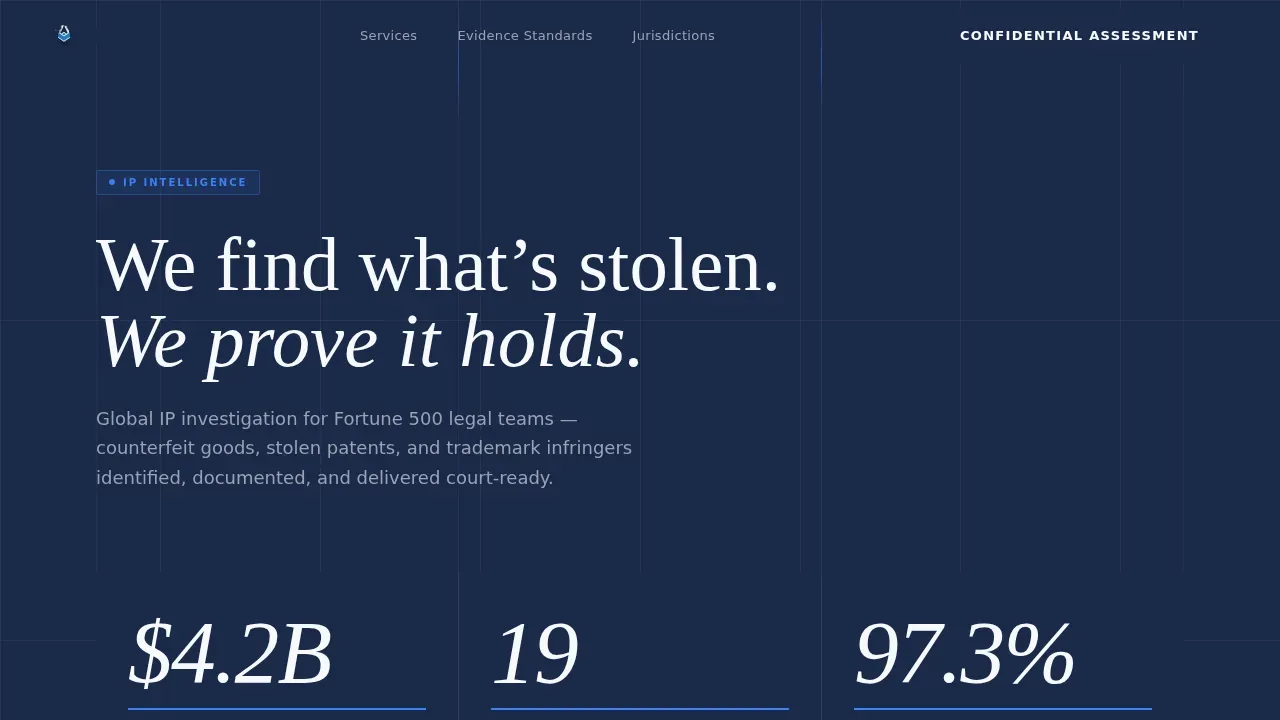
- A metrics-first hero section with three oversized stat blocks, animated signal-blue underlines, and a firm editorial subhead that immediately communicates authority
- Five editorial frequently asked question sections written in magazine-feature prose, each posed as a real question a general counsel would ask during a first call, with embedded case metrics displayed in signal-blue
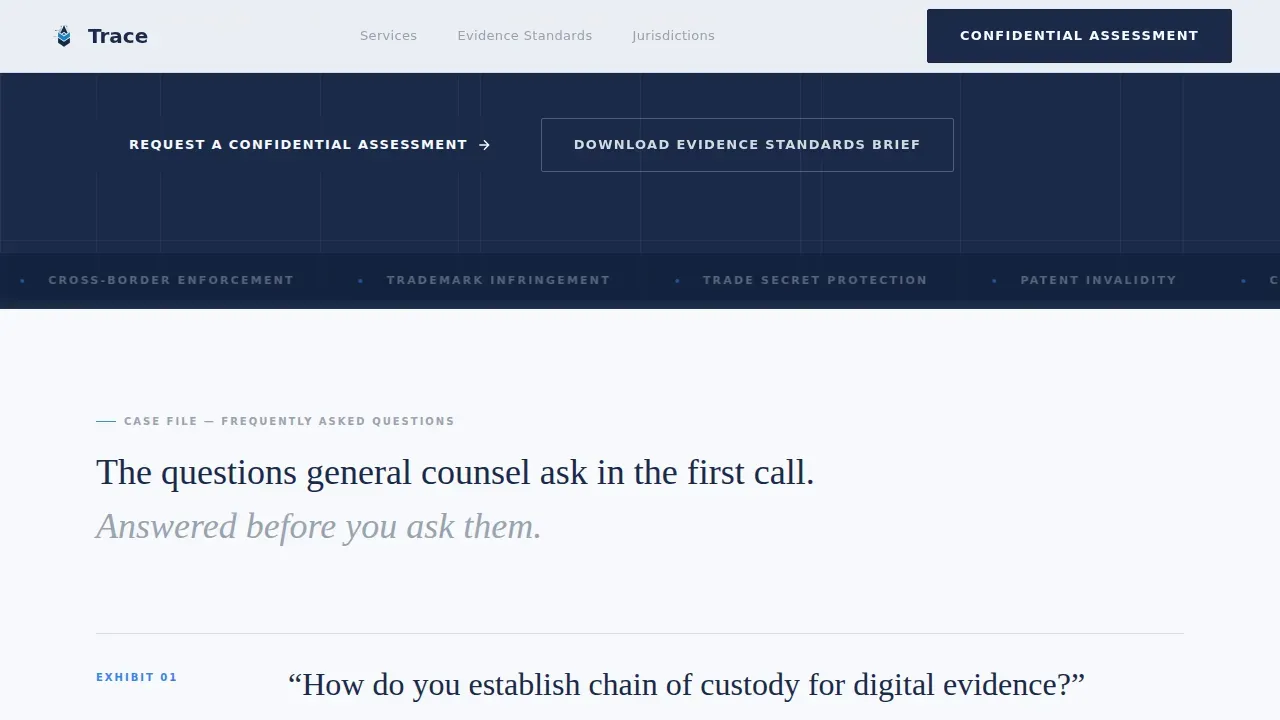
- A dual conversion system: a primary confidential assessment form with a role dropdown and infringement description field, plus a secondary email-gated download for the Evidence Standards Brief
Feature list
This template is built around a set of deliberate structural and visual features that serve a specific type of professional services page. Each one is described below.
Live Metrics Dashboard Header
The header opens with three oversized editorial stat blocks set in large serif type against deposition navy. Each number carries a thin signal-blue underline that animates on load, mimicking a data-feed confirmation. The subhead below reads as a firm closing statement. This is the first thing visitors see, and it immediately frames the company as a results-producing firm with verifiable numbers rather than a typical agency talking about its process.
frequently asked question-Driven Scroll Architecture
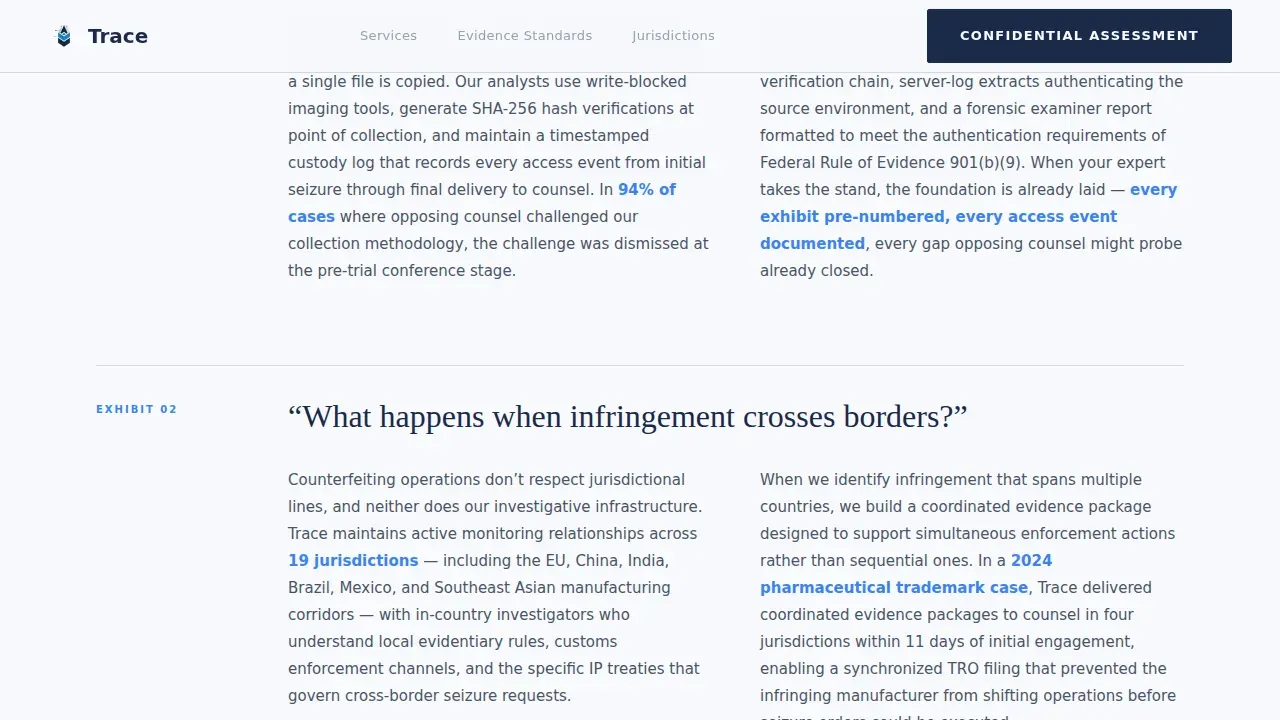
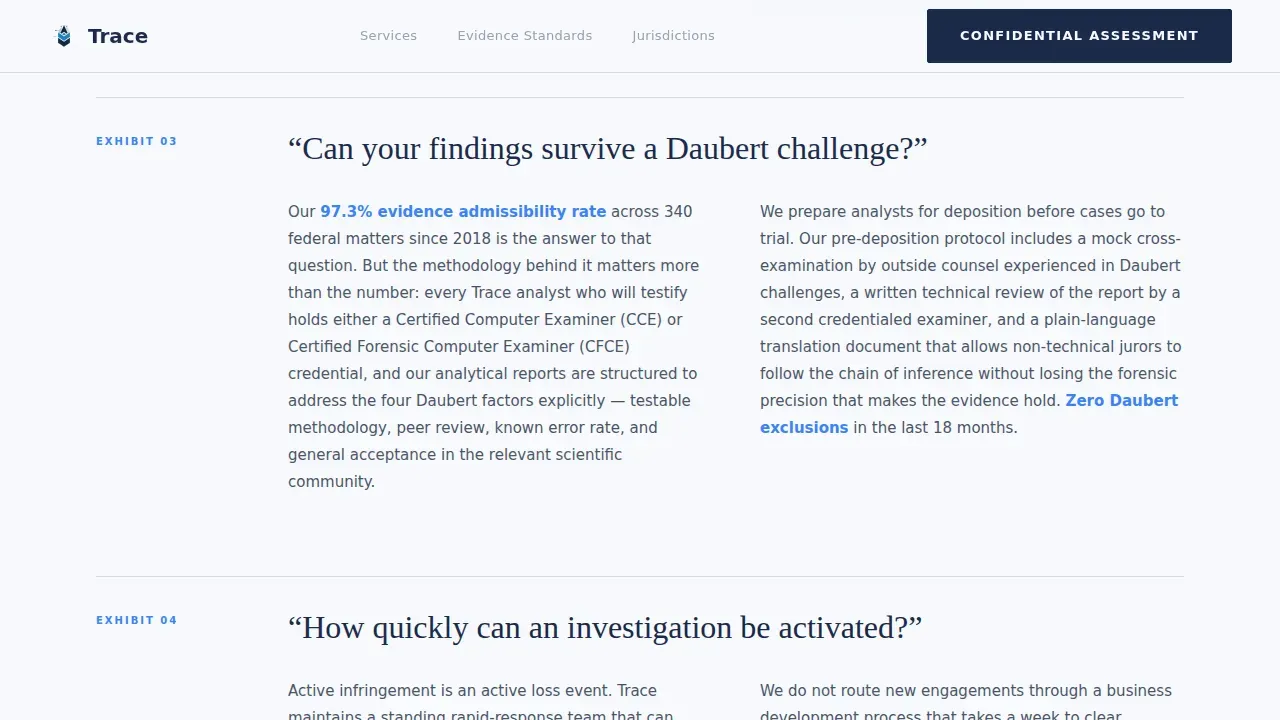
After the header, every major page section is structured as an editorial question-and-answer block. Each question spans the full column width as a headline. The two-paragraph answers that follow embed case metrics in signal-blue to anchor the claims visually. This format mirrors a long-form investigative article and creates a scroll rhythm where each question raises the stakes and each answer demonstrates deeper competence. Visitors who reach the call to action have effectively pre-qualified themselves through their own curiosity.
Confidential Assessment Form
The primary conversion form asks for company name, the inquirer's role via a structured dropdown, a brief description of the suspected infringement, and preferred contact method. The form is intentionally short. Simplified lead forms that request only essential details reduce friction and encourage submissions, especially from cautious legal professionals who are careful about what confidential information they disclose to third parties before a formal engagement is in place.
Secondary Gated Download Path
The page offers a second conversion path for prospects who are not ready to engage directly. The "Download Our Evidence Standards Brief" section requires only a work email address. This low-commitment entry point lets cautious visitors access valuable materials without fully disclosing their situation, while positioning the firm as a publisher that operates at the same standard it investigates. The download link and email gate are built into the page layout.
Editorial Typography and Color System
The template uses Fraunces, an editorial serif typeface, for all headlines, stat blocks, and pull quotes. DM Sans handles body text, form labels, and interface elements. The color palette is four values: open-sky white for generous margins and page backgrounds, briefing-paper gray to separate editorial columns, deposition navy for headers and dominant text, and signal-blue reserved exclusively for links, data highlights, and interactive states. This disciplined palette means every colored element carries intentional weight.
Scroll-Reveal and Animation Layer
A medium-weight animation layer governs the page's interactive feel. Stat underlines pulse on load. frequently asked question sections reveal on scroll. The cursor-confirm animation on metrics reinforces the sense that the data is live. These details are achieved with minimal JavaScript, keeping the interactive layer purposeful rather than decorative.
Page sections overview
| Section | Purpose |
|---|---|
| Metrics Hero Header | Display three authority stat blocks with animated signal-blue underlines and editorial subhead |
| frequently asked question Block One | Answer "How do you establish chain of custody for digital evidence?" with embedded case data |
| frequently asked question Block Two | Address "What happens when infringement crosses borders?" across 19 monitored jurisdictions |
| frequently asked question Block Three | Respond to "Can your findings survive a Daubert challenge?" with admissibility rate evidence |
| Primary call to action Form | Collect company name, role, infringement description, and preferred contact method |
| frequently asked question Block Four | Cover "How quickly can an investigation be activated?" with response process details |
| frequently asked question Block Five | Explain "What makes your evidence different from standard discovery?" with methodology context |
| Evidence Brief Download | Offer gated PDF download requiring only a work email address |
| Closing Authority Section | Reinforce the firm's positioning with a final call to action tied to the confidential assessment form |
| Linear Footer | Single-row footer with essential links and minimal navigation |
Design & branding system
The visual identity is built on a Corporate Precision theme. Every design decision reinforces the sensation of opening a sealed case file on a polished conference table. The palette and typographic choices are not decorative. They are functional signals of credibility.
- The four-color Cloud Canvas system uses open-sky white (#F7F9FC) for page backgrounds and margins, briefing-paper gray (#D4D9E1) for editorial column separators, deposition navy (#1B2A4A) as the dominant header and text color, and signal-blue (#3B82F6) reserved strictly for links, data highlights, and interactive states
- Fraunces serif drives the editorial weight of headlines and stat blocks, while DM Sans provides clean legibility for body paragraphs, form elements, and interface labels
- Navigation is removed from the header to keep visitors on the page and directed toward the single goal of starting a consultation, which is consistent with best practice for high-trust landing pages where removed navigation prevents users from leaving before they convert
Mobile & speed optimization
The template is designed desktop-first, reflecting that its primary users are enterprise legal professionals working at workstations. Full mobile responsiveness ensures that visitors who access the page from a phone or tablet receive a complete, functional experience. Mobile optimization is necessary to ensure the form and evidence upload functions work seamlessly on any device.
- The frequently asked question scroll sections and stat blocks reflow cleanly on smaller screens, preserving hierarchy and readability without collapsing editorial context
- The confidential assessment form and the gated download section are fully functional on mobile devices, so prospects can contact the firm or access materials regardless of the device they are using
How this template helps you convert
An effective landing page must instantly build trust, highlight expertise, and emphasize absolute discretion. This template is structured around a single conversion goal and uses every design and content decision to move a qualified prospect toward that goal.
- The metrics dashboard creates immediate authority above the fold, so visitors understand within seconds that this is a firm with documented results, not a generalist agency making unsupported statements
- The frequently asked question-driven editorial scroll answers hard questions before the form appears, which means by the time a prospect reaches the "Request a Confidential Assessment" call to action, they have already read compelling evidence of the firm's competence and are primed to act
- The dual-path conversion system captures both ready-to-engage prospects through the primary form and research-stage visitors through the gated evidence brief download, so the page generates qualified leads at multiple levels of intent
Other information about this template
This section covers additional context that helps buyers understand the full scope and fit of the Trace template, including how it handles legal and confidentiality considerations, how it compares to general templates, and how it can be adapted once deployed.
- The page is designed to facilitate secure reporting of sensitive information. Submissions are treated as confidential. The form prominently explains that all inquiries are handled on a confidential basis, which is essential for prospects who need assurance before they disclose details about a trade secret matter or ongoing infringement concern.
- A clearly accessible link to a privacy policy should accompany this page. A privacy policy is a legal document that outlines how a business collects, uses, and protects personal information from users. Using a privacy policy template can help businesses comply with data privacy laws that require transparency about data handling practices. Businesses must update their privacy policies whenever their data processing activities change to remain compliant with legal requirements.
- A non-disclosure agreement (NDA) is a legal document designed to protect confidential information shared between parties. A well-drafted NDA ensures that confidential information remains protected for a specified period, typically five years. Legal document templates can streamline the process of creating essential agreements like NDAs and privacy policies, and firms deploying this page may wish to link relevant documents alongside the assessment form.
- Confidential information must be identified as such at the time of disclosure to ensure its protection. Confidential information should be disclosed only on a confidential basis and for a limited purpose. This page is structured to communicate those standards visually and in writing before any prospect is asked to share details.
- Employees who handle inquiries generated by this page should sign employment agreements that outline their obligation to protect the company's confidential information and intellectual property assets. Access to confidential information should be restricted to employees who need it for their job functions. Companies should conduct exit interviews to ensure that departing employees do not retain access to confidential information.
- The duty to protect confidential information continues for a specified period after the termination of the agreement. A confidentiality policy should include training and education efforts to prevent accidental disclosures. Training courses for new employees should include the company's intellectual property policy to ensure understanding and compliance.
- Security badges, including SSL certificates and security icons, must signal that data transmission is encrypted and safe. The page layout includes space for security indicators that signal a secure submission channel to visitors. Key elements include a compelling headline focusing on intellectual property protection and strong trust indicators, such as security badges.
- The template is a standalone web page created specifically for a professional services engagement campaign. It is not a multi-page website. Common mistakes on landing pages include having too many calls to action and unclear value propositions. This page avoids both: it has one primary call to action and one secondary path, and the value proposition is stated immediately in the metrics header.
- Using a drag-and-drop website builder to deploy this template can simplify the process of adapting the layout to a specific firm's brand. A/B testing is an essential tool that allows you to test new ideas and elements on your landing page to discover what resonates best with your audience. It is important to test your landing pages to improve their effectiveness over time.
- Landing pages with video can increase conversions by 86%. The template layout includes a section that can support a video embed for firms that want to add a short credentials or process overview video to their page. Adding a video is optional and does not affect the core conversion structure.
- This template can support data collection through the assessment form and the gated download field. A privacy policy must detail how data is stored and who can access it, along with explicit opt-in checkboxes for data processing. The page layout includes space for an opt-in notice adjacent to both form elements.
- The page structure can be used to track users through the dual-path conversion system, allowing the firm to distinguish between prospects who request an assessment and those who download the evidence brief. Understanding why visitors arrive at your landing page gives you a better sense of your target audience and what their needs are.
- Matching your primary headline to the ad or email call to action provides a seamless transition for the visitor. The Trace template's metrics-first headline is designed to match the authority framing of outbound campaigns targeting general counsel and IP portfolio managers. Compelling calls to action that stand out are crucial for effective landing pages, and the signal-blue accent color is used exclusively to draw attention to interactive states and action elements.
- The page can serve as a professional online presence for an intellectual property investigation agency that operates across multiple jurisdictions. Companies should offer incentives for employees who create and report valuable intellectual property internally, and a strong company culture that values confidentiality can be reinforced through ongoing education and strong offboarding policies. Exit interviews should remind departing employees of their confidentiality obligations and ensure they return or destroy all company information.
- The Trace Confidential IP Investigation Landing Page Template is available on this platform and is listed under Professional Services and Private Investigation. Ongoing awareness and education efforts about the company's intellectual property policy can help prevent accidental disclosures, and this template gives firms the online foundation to communicate those standards to the outside world. The template is classified under the trace confidential ip investigation landing page template product listing on this site.
- Facebook and other social channels can drive traffic to this page. The open graph title and description fields are pre-configured so that when a link to the page is shared on Facebook or other platforms, the post displays a professional preview consistent with the firm's positioning. The page is built so that its social preview materials match the authority tone of the landing page itself.
Theme
Corporate Precision
Creative direction
FAQ-Driven
Color system
Cloud Canvas
Style
Editorial/Magazine
Direction
Partnership/B2B
Page Sections
Live Metrics Authority Header
Faq-driven Editorial Scroll
Confidential Assessment Form
Gated Evidence Brief Download
Editorial Typography and Brand System
Scroll-reveal Animation Layer
Related questions
Can I customize the frequently asked question questions on the page?
Does the template include the assessment form and gated download?
Is the template suitable for a firm that handles trade secret litigation support?
What design changes can I make after deploying the template?
How does the dual conversion path work?