Trail is a split-screen landing page built for Jeep specialist mechanics. It pairs a blueprint-style drivetrain configurator with stat-first credibility sections, a Jeep-native symptom selector, and a streamlined booking flow. Every section is designed to move Jeep owners, from weekend wheelers to high-mileage daily drivers, from first scroll to confirmed bay slot.
by Rocket studio
Loading preview…
Quick summary
Trail is a precision-built, split-screen (50/50) landing page template for Jeep specialist repair shops. It opens with an interactive drivetrain configurator, escalates trust through hard-number impact sections, and closes with a frictionless booking flow. The design speaks the language of Jeep culture: platform-specific, technically grounded, and built to convert road-worn owners into booked service appointments.
Who this template is for
This template is made for automotive repair businesses that specialize in Jeep vehicles. It fits shops that want to signal deep platform knowledge and fill their service bays with qualified bookings rather than general car repair inquiries.
High-mileage vehicle service providers targeting daily drivers and pre-expedition overlanders
What problem this template solves
Generic automotive service websites fail Jeep owners. They do not speak to platform-specific failure points, and they do not build the specialized trust that a Jeep owner needs before handing over their vehicle. Most shops lose bookings because their site feels like it was built for any car, not for a specific rig.
Jeep owners cannot find repair services that speak their language, so they bounce to a competitor
Shops that list every service equally train no trust and win no big jobs
Booking forms that ignore vehicle model and mileage create friction and lower conversion rates
What you get with this template
Trail delivers a complete, ready-to-deploy landing page structure. Every section has a defined purpose, from the animated hero to the booking form, so you spend time customizing details rather than creating layouts from scratch.
A blueprint-schematic hero with a Jeep platform configurator and live stats panel
A stats-first impact section with split-screen proof photos escalating from routine repair to full drivetrain builds
Theme
Engineering Blueprint
Creative direction
Stats-First Impact
Color system
Midnight Blue
Direction
Booking/Scheduling
Page Sections
Blueprint Drivetrain Configurator Hero
Stats-first Split-screen Sections
Jeep-native Symptom Booking Flow
Services Escalation Bento Grid
Platform-tagged Social Proof Gallery
Sticky Amber Call to Action
Related questions
Who is the Trail template built for?
Can I customize the platform selector and symptom list?
Does the booking form pre-fill from the configurator?
Is this template suitable for running targeted ad campaigns?
How does the 'Not Sure What's Wrong?' path work?
A Jeep-native symptom selector booking flow with a pre-filled vehicle form and a "Not Sure What's Wrong?" diagnostic intake path
Feature list
This section covers the core built-in features that define the Trail landing page and deliver its conversion power.
Interactive Drivetrain Configurator
The hero opens as a schematic-style exploded diagram of a Jeep drivetrain rendered in blueprint line art. Visitors select their platform, choosing from TJ, JK, JL, XJ, WJ, or Gladiator, and the diagram reassembles into their specific model. The panel then populates live stats: common failure points for that chassis, recommended service intervals, and the shop's completed job count per platform. Each selectable component pulses faintly, guiding the user's attention like a heartbeat on a diagnostic monitor.
Stats-First Impact Sections
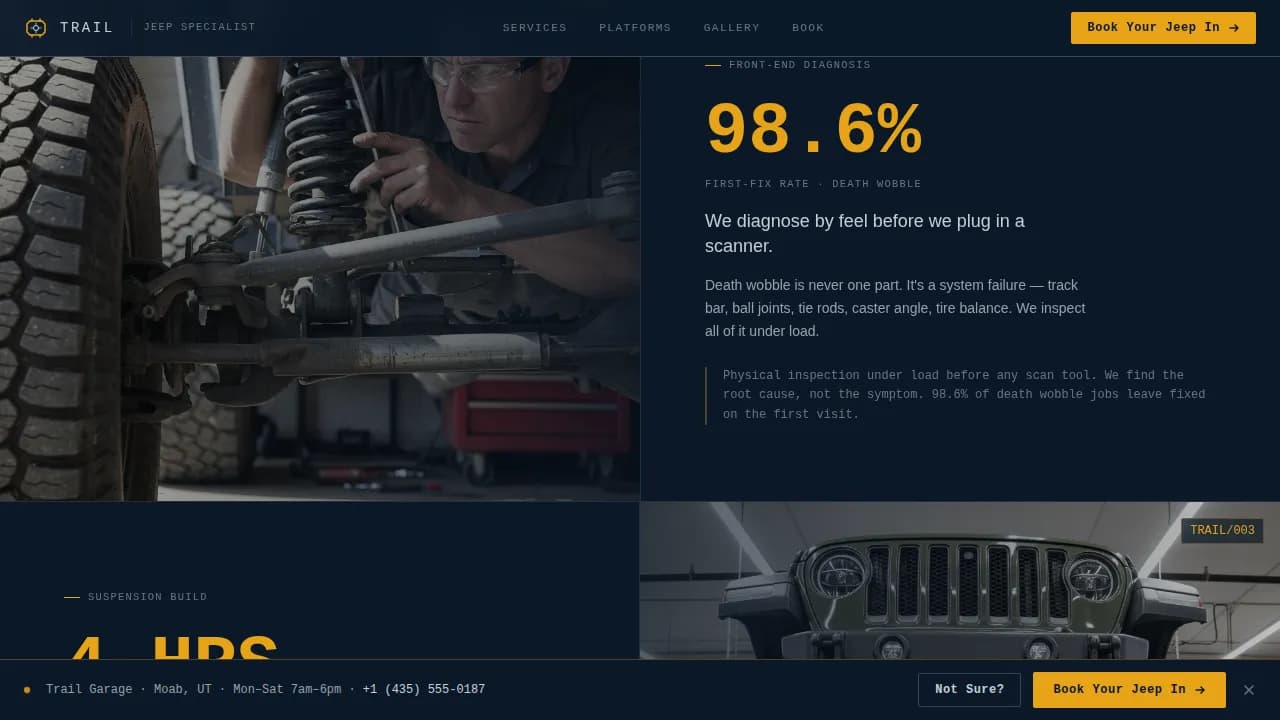
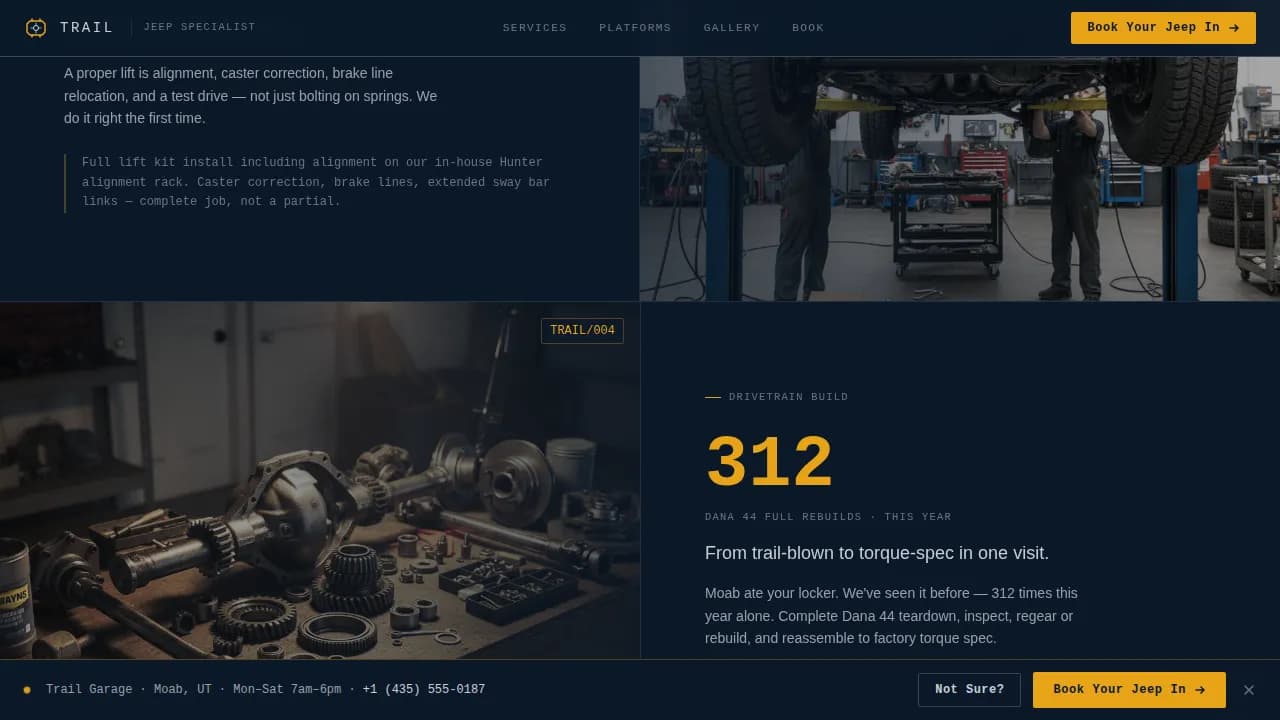
Every scroll stop opens with a hard number before any explanation lands. Examples include figures like "14,287 axle seals replaced," a 98.6% first-fix rate on death wobble diagnoses, and a four-hour average turnaround on lift kit installs. The left panel holds the stat and a single proof sentence. The right panel shows the corresponding work: a photo of gloved hands shimming pinion bearings, a time-lapse of a full Dana 44 rebuild, or a before-and-after of a frame restoration. Each section escalates from routine maintenance to full drivetrain builds, training visitors to trust small jobs before they book the large ones.
Jeep-Native Booking Flow
The scheduling flow is built around Jeep owner language. It asks for model and year first, then mileage, then a symptom selector using terms Jeep owners actually use: "death wobble," "transfer case grinding," "check engine / misfire," "lift and alignment," and "pre-trail inspection." The configurator interaction in the hero pre-fills the vehicle selection in the booking form, reducing friction to a single confirmation. A secondary path, "Not Sure What's Wrong?", opens a quick diagnostic intake with a photo upload field so owners can send dash-light photos or undercarriage images ahead of their appointment.
Services Escalation Bento Grid
The services section is structured as a bento grid that moves from routine maintenance through to full drivetrain builds. This escalation sequence is intentional: it trains visitors to trust the shop on small jobs so they feel confident booking the large, high-value repair services. Each bento card carries enough detail information to signal specialist knowledge without overwhelming the reader.
Social Proof and Completed Work Gallery
A before-and-after gallery is tagged by platform, showing real completed jobs organized by chassis. Customer quotes use Jeep-native language so owners reading them immediately recognize the shared experience. Completion stats per chassis and first-fix rate metrics appear alongside testimonials to provide layered, specific credibility rather than generic five-star ratings.
Sticky Diagnostic Amber Call to Action
The primary call to action, "Book Your Jeep In," follows the visitor as a sticky element throughout the page. It is rendered in diagnostic amber so it stays visible against the deep navy background at every scroll position. This ensures the conversion goal is always one tap away, whether the visitor is reviewing stats, exploring services, or reading testimonials.
Page sections overview
Section
Purpose
Hero Configurator
Platform selector with blueprint drivetrain diagram and live stats
Stats-First Impact
Hard-number credibility with split-screen proof photography
Services Escalation
Bento grid from routine maintenance to full drivetrain builds
Booking Flow
Pre-filled Jeep-native symptom selector and bay slot picker
Diagnostic Intake
Photo upload "Not Sure?" path for owners unsure of their issue
Social Proof Gallery
Platform-tagged before-and-after jobs with chassis-specific quotes
Footer
Linear single-row footer with contact and navigation links
Design & branding system
Trail's visual identity follows an Engineering Blueprint theme. It reads like a factory service manual viewed under a fluorescent drop light: precise, mechanical, and trustworthy in the way only proven competence can be. Every color and type choice is functional, not decorative.
Color palette: deep shop-floor navy (#0B1929) for backgrounds, technical schematic blue (#1B3A5C) for panels, machined silver (#C8CED6) for text and line work, and diagnostic amber (#E8A317) reserved for calls to action, hover states, and callout numbers
Typography: JetBrains Mono for stats and labels to reinforce the technical precision feel; Manrope for body copy and headings to keep longer text readable and approachable
Visual style: blueprint line art, exploded drivetrain diagrams, pulse animations on selectable components, scroll-triggered stat counters, and high-contrast split-screen photo panels
Mobile & speed optimization
The template is designed desktop-first to support the configurator's interaction complexity, with full mobile responsiveness built in. Fast loading time is essential for a mobile-first audience, and images across the landing page are structured for speed without sacrificing the visual quality that builds trust.
Desktop-first layout optimized for the configurator and split-screen sections, scaling cleanly to tablet and phone viewports
Simplified booking form structure on mobile to reduce friction for users requesting a quote or scheduling a service
Scroll-triggered animations are handled by client components, keeping static sections lean and fast to render
How this template helps you convert
An automotive landing page built around a single focused objective outperforms a general service website every time. Trail is designed to guide each visitor from curiosity to confirmed booking through a deliberate conversion path.
The configurator primes the visitor by making the experience feel personal. Selecting a Jeep model and seeing chassis-specific failure points and job counts creates immediate relevance, making the visitor feel the shop understands their specific vehicle before they read a single line of body copy.
The stats-first sections build layered trust incrementally. Visitors move through hard numbers backed by visual proof, escalating from oil changes and axle seal counts to full Dana 44 rebuilds. By the time they reach the booking form, the shop's repair quality and experience have already been demonstrated, not just claimed.
The pre-filled, Jeep-native booking form removes every unnecessary barrier. Visitors who interacted with the configurator arrive at the form with their vehicle model already selected. The symptom selector uses the exact language Jeep owners use, so the process feels designed for them specifically rather than copied from a generic car repair website.
Other information about this template
Trail is positioned within the Automotive and Transport category, specifically the Jeep Services subcategory. It is relevant for any Jeep specialist shop looking to improve booking volume through a focused, credibility-first landing page rather than a sprawling multi-page website. The template's local focus is strong: the design, language, and service structure are calibrated for USA-based shops serving the US Southwest trail culture, using imperial measurements and USD pricing conventions throughout.
The template supports ad campaigns by functioning as a dedicated landing page with a single conversion goal, making it a natural destination for paid search or social traffic targeting Jeep owners by platform or symptom
Vehicle prices, finance details, and dealership-level stock information displayed on the site are fully customizable; shops can add their own price points, finance options, or current promotional details directly in the template
The page's structure supports a strong local focus by allowing the shop to highlight its location, contact phone number, and service area, making it easy for Jeep owners nearby to stay connected and reach out
Brands and accessories referenced in testimonials or service cards can be customized to match the shop's actual product lines, including items like Dana 44/60 axles, lockers, and long-travel suspension kits
The template is a strong starting point for shops that want to explore paid ad campaigns or improve the effectiveness of existing digital marketing by delivering a purpose-built, conversion-focused destination
Durability and reliability are central themes woven through the copy structure; the template gives shops the tools to highlight these values through real job counts, first-fix rate metrics, and platform-specific service details
Shops can customize the symptom selector, service cards, and bento grid details to match their actual repair services, ensuring every section of the page reflects what the expert team genuinely delivers
The template's journey from configurator hero through stats, services, and booking is designed to feel like a natural progression, not a sales funnel, keeping the user experience grounded in practical automotive knowledge