Emergency Medicine Cost Estimator Website Template
The Triage ED Efficiency Estimator emergency medicine EMR landing page template is built for emergency department leaders who need one clear screen to manage every patient, bed, and clock. It opens with a live ROI estimator, walks prospects through a transparent 90-day implementation plan, and drives conversions with a persistent amber call-to-action throughout the scroll.
by Rocket studio
Quick summary
This template serves ED medical directors, charge nurses, and hospital CIOs evaluating an emergency medicine software platform. It leads with an interactive estimator that calculates real throughput gains before asking for a demo. Every section is built around radical transparency, showing exact timelines, honest integration details, and named peer metrics to earn trust fast.
Who this template is for
This template is tailored for healthcare professionals who operate in high-stakes emergency care environments. It speaks directly to the people making multi-year software decisions under real clinical pressure.
- ED medical directors tracking door-to-disposition times and patient throughput
- Charge nurses managing forty-bed departments across night shifts
- Hospital CIOs evaluating integration risk after previous EMR rollouts
What problem this template solves
Emergency departments still rely on whiteboards, disconnected intake workflows, and fragmented systems that hide patient severity until it becomes a crisis. Staff are forced to make critical triage decisions with incomplete information, which increases the risk of errors and worsens patient outcomes. This template addresses that pain directly by showing prospects exactly how the platform solves it.
- Disconnected systems create dangerous gaps in patient visibility and care continuity
- Inconsistent intake processes make it hard to catch urgency signals early
- Vague vendor promises fail hospital CIOs who have watched EMR implementations fail before
What you get with this template
You get a full hub-and-spoke landing page with an anchor navigation system and five spoke sections, each answering the questions your most skeptical buyers are already carrying. The template is designed to convert through transparency, not pressure.
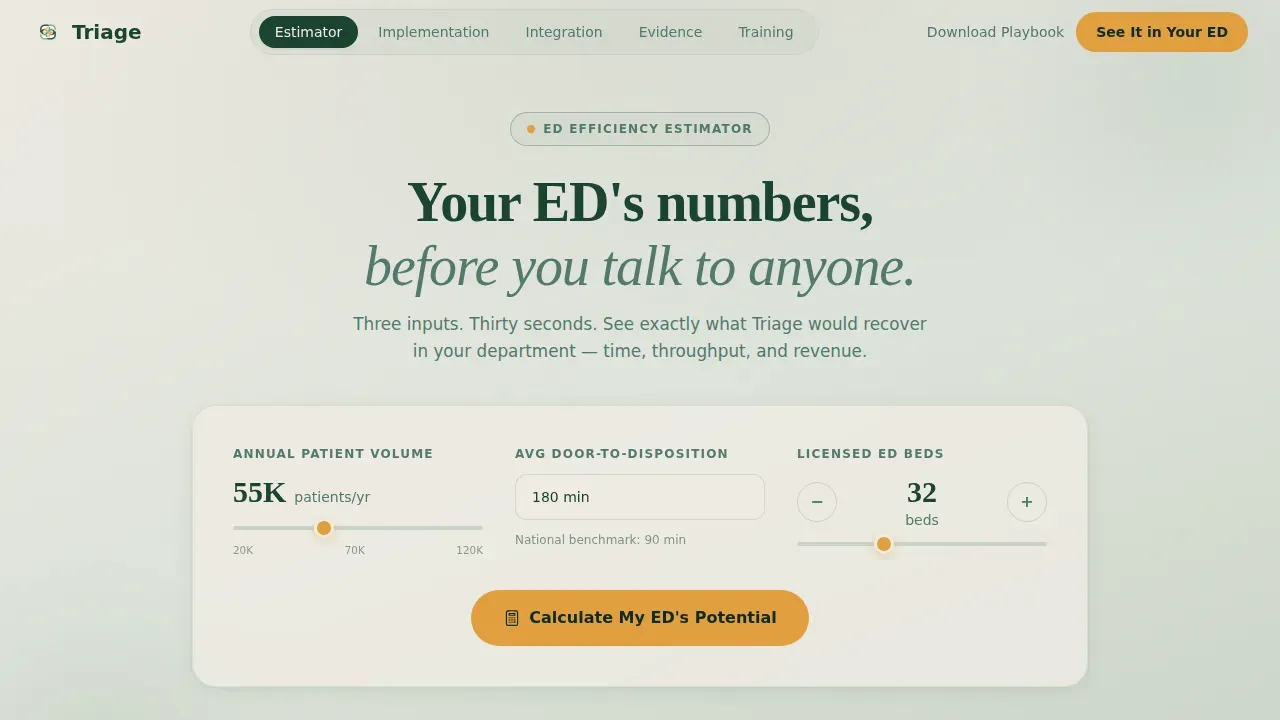
- A live ED Efficiency Estimator with animated ROI outputs above the fold
- Five anchor-linked sections covering Implementation, Integration, Training, Go-Live, and Optimization
- A secondary lead capture path gated around an Implementation Playbook PDF download
Feature list
This template packages every element an emergency medicine software company needs to build trust, reduce sales friction, and move a cautious buyer from curiosity to a scheduled demo.
Live ED Efficiency Estimator
The header tool takes three inputs: annual patient volume via slider, current average door-to-disposition time via dropdown, and number of beds. It returns projected time savings, estimated throughput increase, and a dollar figure for reduced left-without-being-seen revenue loss. The numbers animate upward like a vitals monitor finding a pulse, making the value case before any scroll happens.
Transparent 90-Day Go-Live Roadmap
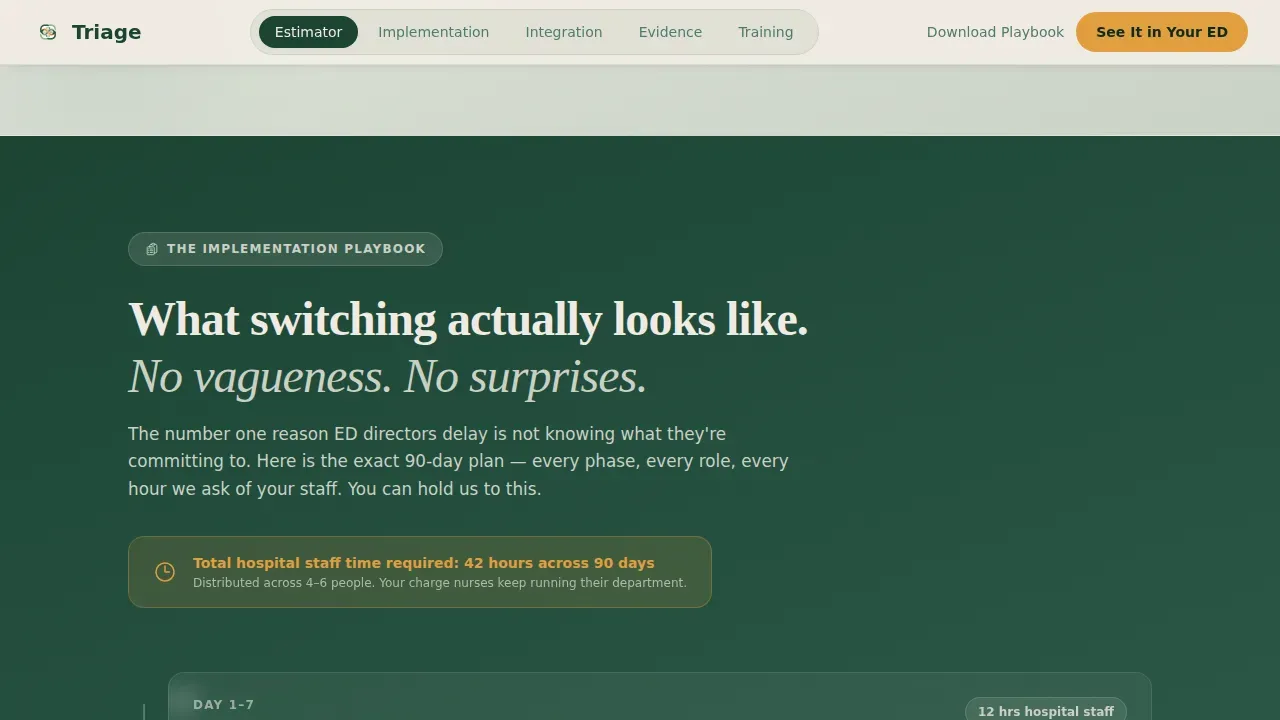
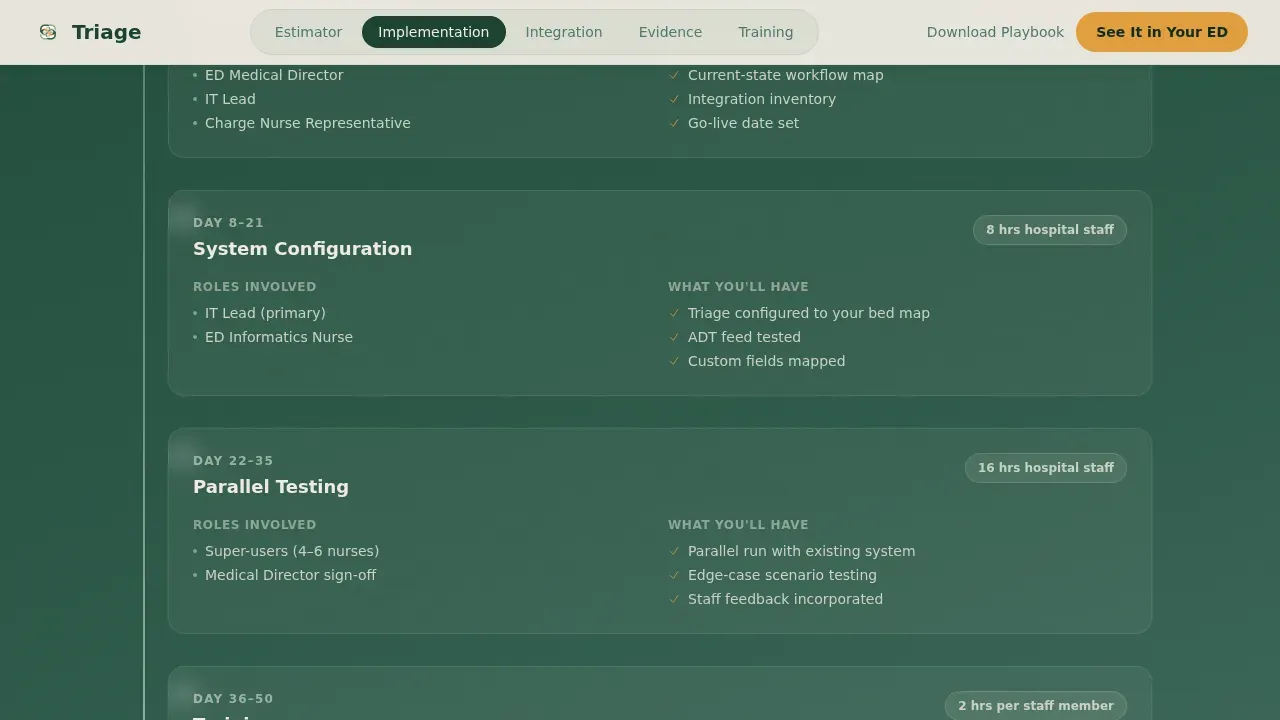
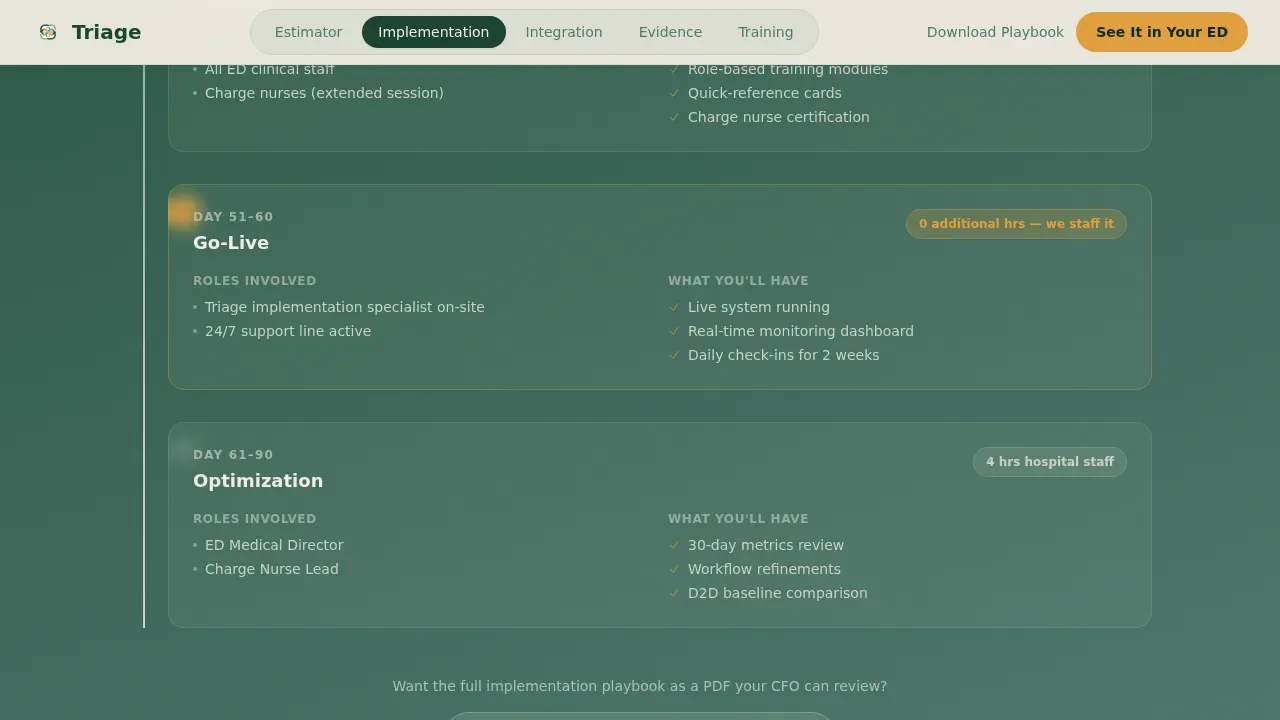
The Implementation section shows the exact timeline, the exact roles involved, and the exact number of hours required from hospital staff. No vague promises. Each milestone is presented as something the prospect can hold the vendor to, which is a critical trust signal for healthcare professionals who have lived through failed rollouts.
Anchor Navigation System
A sticky anchor nav follows the scroll and links directly to each spoke section. The primary call-to-action button appears in alert amber and persists across all sections, giving the visitor a clear next step at every moment. This system reduces friction and improves consistency of the conversion path.
Peer Evidence and Case Metrics Section
The Evidence section surfaces named hospital departments with bed counts, specific time savings, and quoted triage nurses and medical directors. Real numbers tied to real department sizes serve as the strongest argument for a skeptical CIO evaluating risk on a new system.
Secondary Lead Capture Path
Visitors who are not ready to demo can download the Implementation Playbook, a gated PDF requiring name, title, hospital name, and ED bed count. This lower-commitment path captures decision-makers who need to carry the conversation to their CFO, broadening the funnel without diluting the primary call-to-action.
Integration Status Section
The Integration section shows real timelines for connecting the platform with existing electronic health record systems. It is designed to integrate transparently with clinical workflows, addressing the urgency of connectivity that every hospital CIO raises. A live integration status indicator builds additional confidence in system reliability.
Page sections overview
| Section | Purpose |
|---|---|
| Hero Estimator Tool | Calculate ROI before scroll |
| Implementation Roadmap | Show exact go-live timeline |
| Integration Details | Honest connectivity timelines |
| Evidence and Metrics | Peer hospital proof points |
| Training and Go-Live | Staff hours and milestones |
Design & branding system
The visual system uses a Forest Trust color palette built to feel like calm after a long clinical shift. Gradients move from deep evergreen to sage across section backgrounds, never harsh. Text lives in evergreen on light grounds and birch white on dark grounds.
- Core palette: deep evergreen (#1B4332), calm sage (#52796F), morning fog (#CAD2C5), warm birch white (#F0EBE3), and alert amber (#E09F3E) reserved for interactive elements only
- Typography: DM Sans for body and interface copy, Fraunces for display headings
- Animation: counter animations on the estimator, scroll reveals per section, staggered entries on spoke sections
Mobile & speed optimization
The template is built desktop-first to match how ED directors and CIOs review software on workstations. A solid mobile fallback ensures the experience holds on any device.
- Server Components handle all static sections for fast initial load
- Client Components are scoped to the live estimator and interactive elements only
- The anchor navigation and sticky call-to-action remain functional across screen sizes
How this template helps you convert
The conversion architecture is layered intentionally. The estimator does the persuasion work before any call-to-action appears. By the time a visitor sees their own department numbers, the next step feels obvious.
- The estimator delivers a personalized ROI result that makes the platform's value concrete before the visitor scrolls past the hero
- The Transparent Process structure answers every objection a healthcare buyer carries, reducing the need for a sales call to earn basic trust
- The dual-path call-to-action captures both demo-ready buyers and CFO-stage researchers, making the template effective across the full buying committee
Other information about this template
This template is grounded in how triage systems actually work in clinical settings. The Emergency Medical Triage System Template is designed to streamline the process of assessing and prioritizing patients in emergency medical settings. It is critical in high-pressure environments where quick decision-making directly affects patient outcomes.
Customizable triage forms can improve workflow efficiency in emergency departments. Using customizable triage forms at the point of intake can ensure urgent cases are prioritized promptly. The triage form template allows for seamless export or connection of submitted data to a hospital's electronic health record system. Integrating customizable triage forms with electronic health record systems can enhance continuity of care.
Additionally, the template reflects how AI is reshaping triage care. AI can enhance the triage process by providing structured decision support under high cognitive load and time pressure. AI frameworks can assist in the rapid assessment and prioritization of patients in emergency settings, improving patient outcomes. AI systems can support clinicians by generating actionable risk estimates during the triage process, even with incomplete information. AI-driven tools can improve the accuracy of triage assessments by minimizing inter-rater variability among clinicians.
Similarly, multi-agent AI triage research is relevant context for this template. ED-Triage-Agent (ETA) is a multi-agent AI framework designed to augment clinical decision-making in emergency triage. ETA operates in two phases: pre-triage assessment and post-vital classification. The first phase involves autonomous patient intake through a conversational agent collecting structured symptom histories. The second phase involves collaborative acuity assessment where specialized agents prioritize patients for vital sign collection. ETA preserves clinician autonomy by providing interpretable recommendations linked to clinical guidelines. The framework supports prioritization decisions under partial information, which is critical in emergency settings.
- The triage ed efficiency estimator emergency medicine emr landing page template is built for B2B enterprise healthcare SaaS sales cycles
- The template is tailored for organizations that need to communicate implementation transparency as a competitive advantage
- Consistent use of peer evidence and named metrics helps address the severity of decision risk that hospital CIOs carry
- The template can be customized to reflect specific department sizes, intake workflows, and care protocols
Theme
Soft Gradient
Creative direction
Transparent Process
Color system
Forest Trust
Style
Hub & Spoke (Anchor Nav)
Direction
Click-Through
Page Sections
Live ED Efficiency Estimator
Transparent 90-day Go-live Roadmap
Persistent Anchor Navigation
Peer Evidence and Case Metrics
Dual-path Conversion Architecture
Integration Status and Timeline Section
Related questions
Who is this landing page template designed for?
What does the estimator tool in the header actually do?
Can the triage form and intake sections be customized?
How does the template handle prospects who are not ready to demo?
What makes this template different from a standard healthcare landing page?