Judiciary & Legal Blog Website Template
Tribunal is a single-column landing page template built for international legal institutions hosting formal sittings and proceedings. It pairs a cinematic Great Hall hero with an editorial serif layout to establish institutional authority before asking visitors to register. The design follows a Civic Service aesthetic: parchment tones, restrained typography, and a structured event-registration flow suited to sovereign delegates and international law practitioners.
by Rocket studio
Quick summary
Tribunal is a single-column landing page template designed for international tribunals and formal legal institutions. It opens with a half-page Great Hall photograph and an editorial title block, then guides visitors through mandate, agenda, speakers, and registration. The layout earns trust through institutional gravity before presenting any call to action.
Who this template is for
This template is built for organizations operating within the framework of international public law. It serves institutions that need a formal digital presence for a specific sitting, hearing, or proceeding rather than a general institutional website.
- Foreign ministry legal advisers and agents-general preparing for formal hearings
- Intergovernmental organization representatives and amicus practitioners seeking observer access
- International law fellows and academic observers attending proceedings for the first time
What problem this template solves
Most event registration pages prioritize convenience over credibility. For an international tribunal, that order must be reversed. Visitors need to understand the weight of the sitting before they are asked to reserve a seat.
- Generic event templates lack the formal register and institutional visual gravity that sovereign delegates expect
- Multi-purpose registration layouts bury the mandate and agenda under promotional copy
- Standard page designs cannot convey the procedural tradition and consequence that define international legal proceedings
What you get with this template
You receive a complete single-column landing page structured around the Vision and Mission creative direction. Every section flows in oratorical order: premise, evidence, and appeal. The registration form and secondary subscription path are both included.
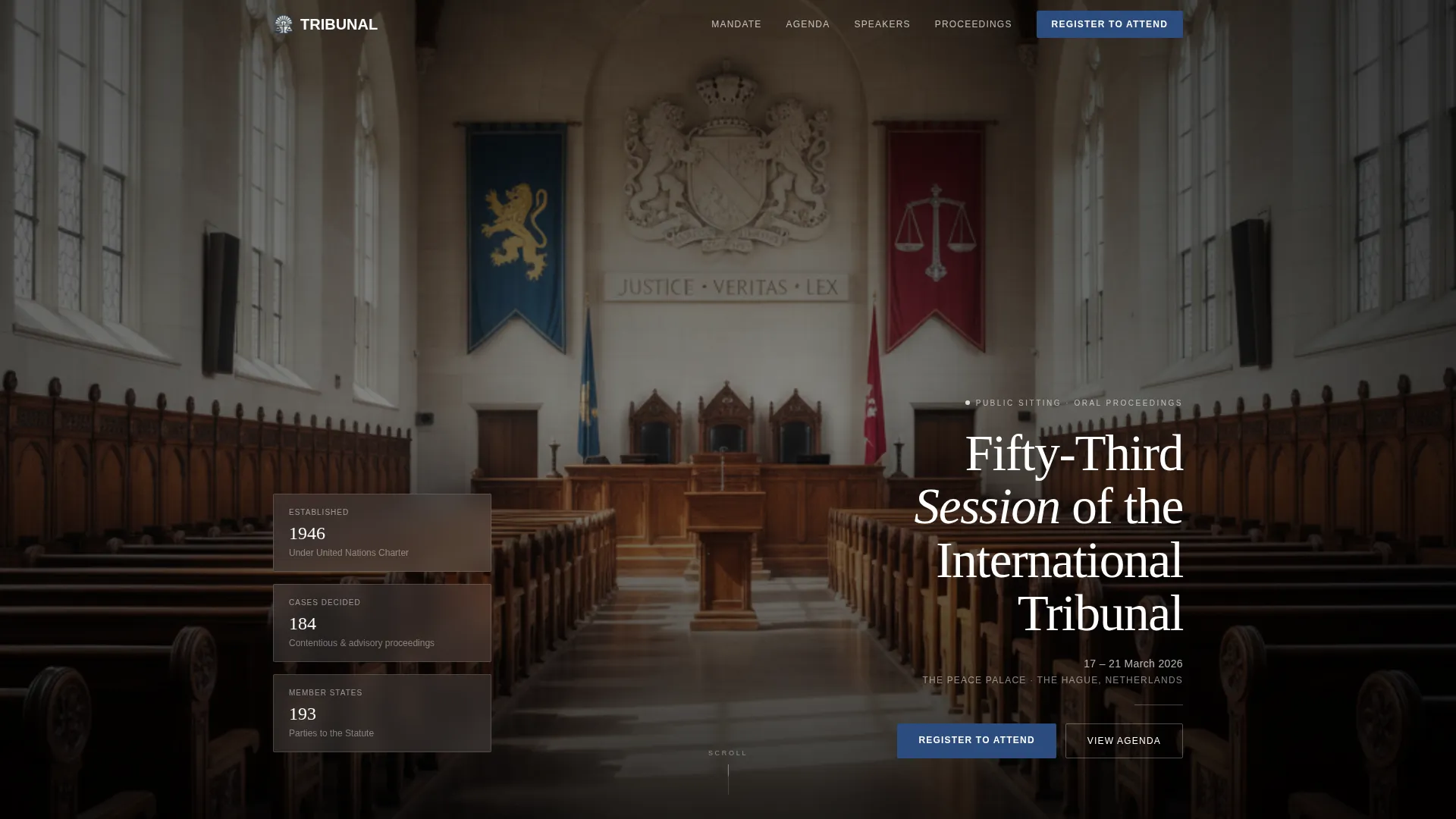
- A half-page hero with a cinematic Great Hall photograph, editorial serif title, date, location, and a prominent registration call to action
- A mandate and mission section featuring a treaty-language blockquote, followed by sitting-day agenda blocks and formal speaker portrait cards with biographical paragraphs
- A structured registration form collecting full legal name, institutional affiliation, delegation or observer status via radio buttons, country of nationality, and dietary requirements, plus a secondary "Subscribe to Proceedings" path
Feature list
This section details the core built-in components delivered with the Tribunal landing page template.
Half-Page Hero Composition
The hero occupies the top half of the viewport. The left two-thirds hold a photograph taken from the back of the Great Hall of Justice, showing rows of dark-wood benches, a raised dais, and flanking flags. The right third carries the event title in a large editorial serif, the date and location in deliberation gray, and the primary "Register to Attend" button in justice blue.
Treaty-Language Mandate Block
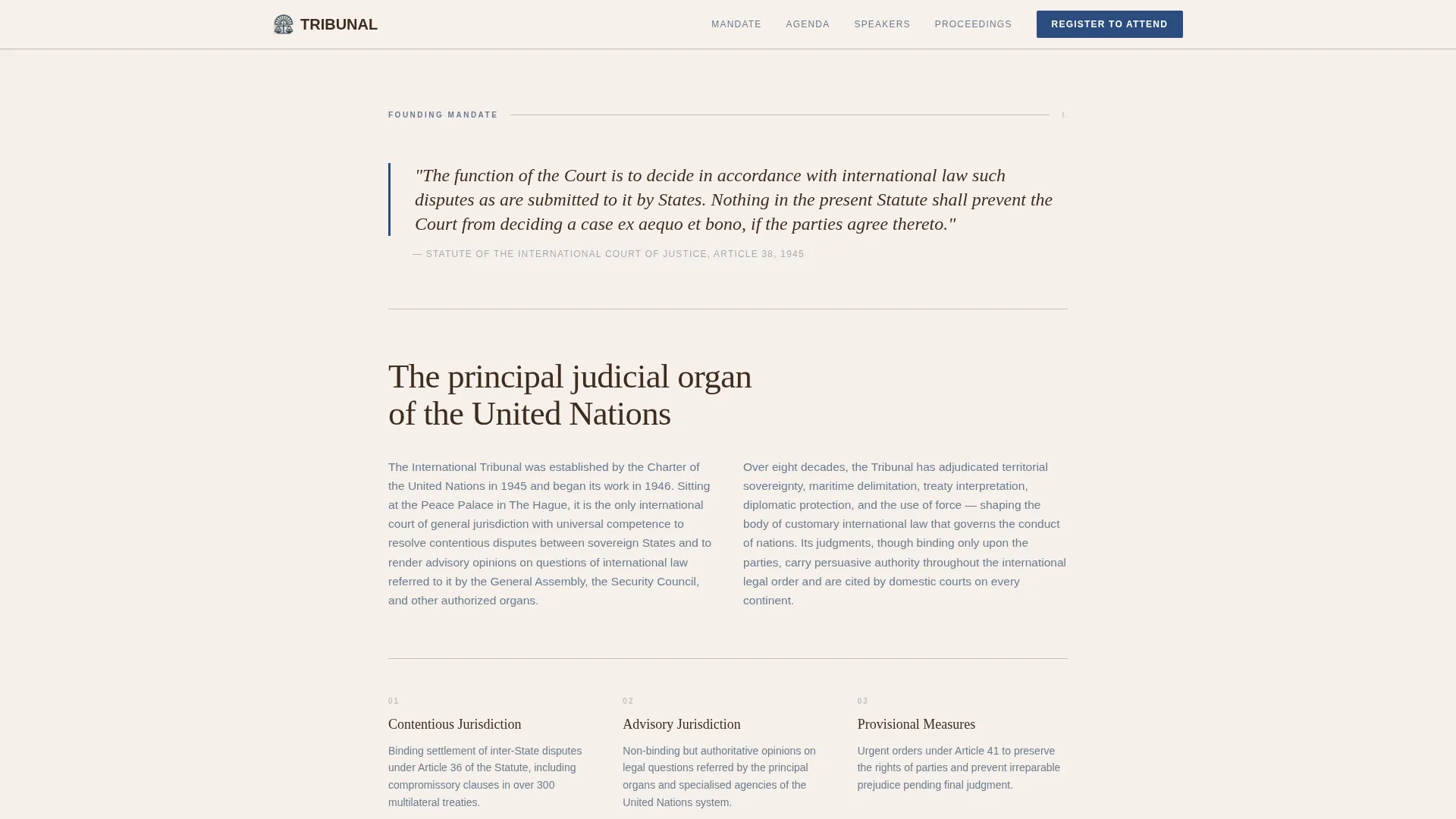
The scroll opens with the tribunal's founding mandate quoted in original treaty language, set as a formal blockquote. This section establishes institutional authority before any logistical detail appears. Purpose paragraphs follow to connect the historical mandate to the specific sitting.
Structured Sitting-Day Agenda
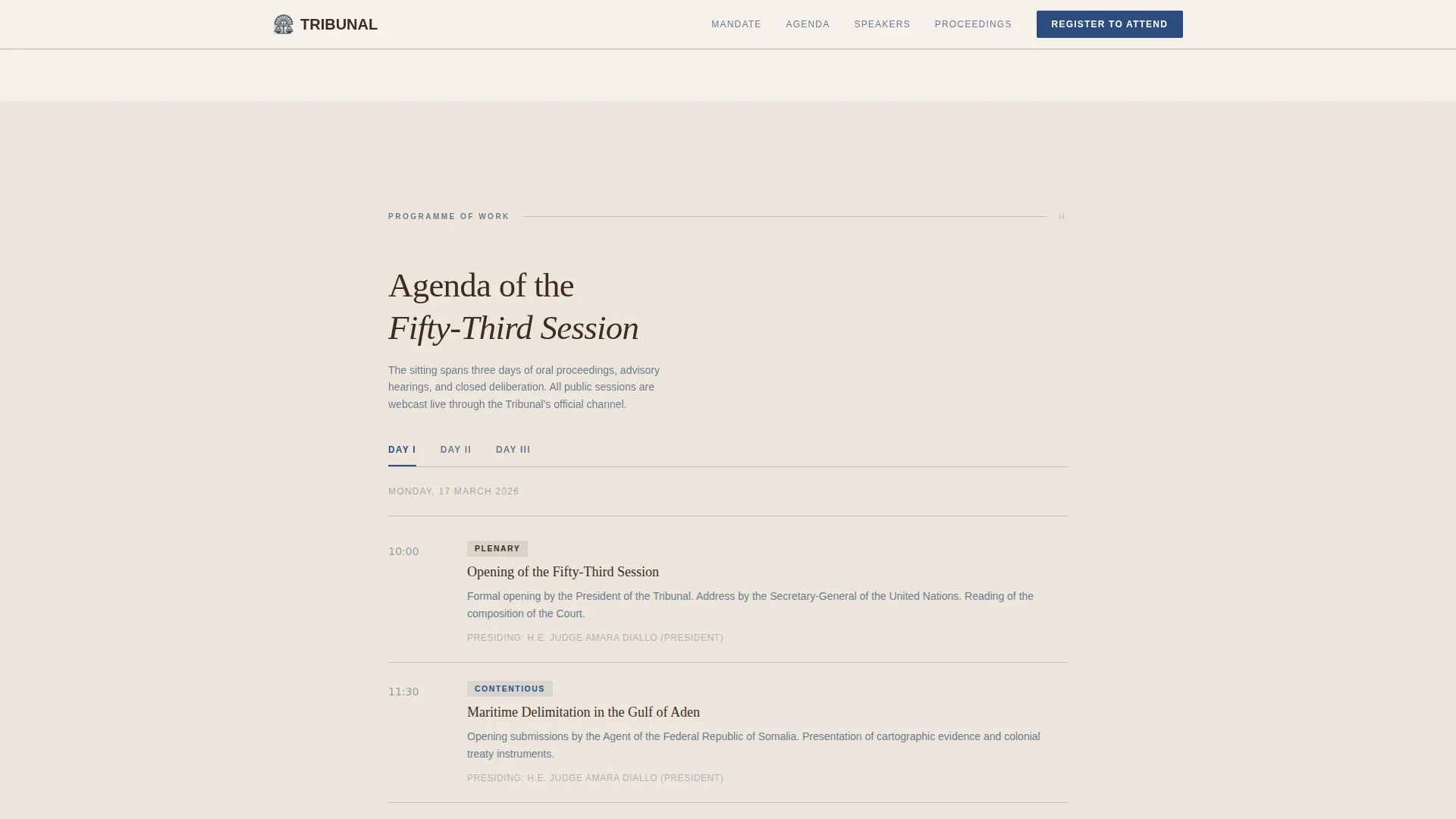
The agenda section breaks the event into individual sitting days. Each day entry includes a session title and the presiding judge. The layout keeps the schedule readable at a glance while maintaining the formal register of a published programme of proceedings.
Formal Speaker Portrait Cards
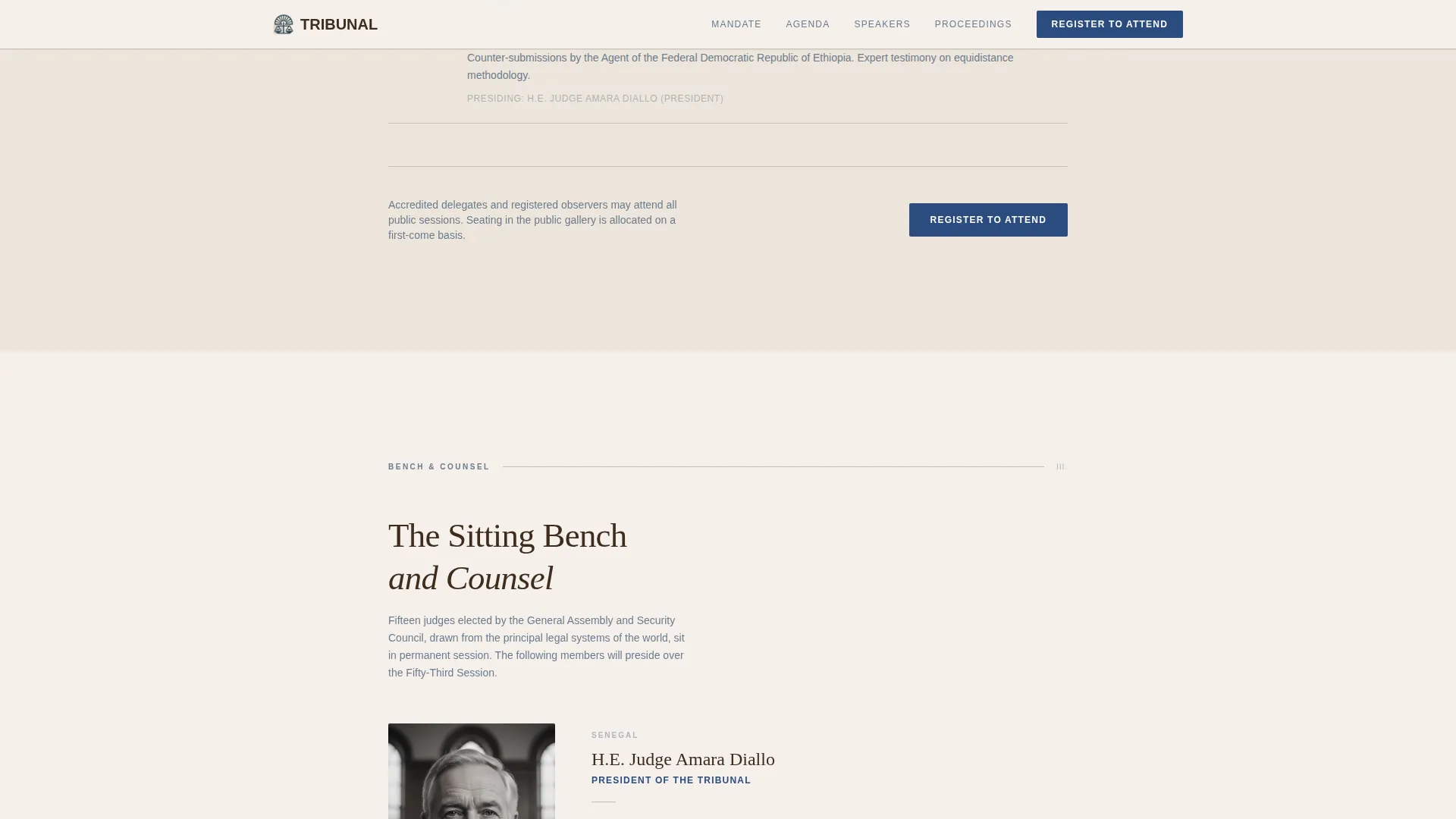
Each keynote speaker is presented as a formal judicial portrait with a full biographical paragraph. A subtle grayscale-to-color animation activates on scroll, giving each portrait a considered reveal that matches the measured pace of the page.
Multi-Field Registration Form
The registration section includes fields for full legal name, institutional affiliation, delegation or observer status via radio buttons, country of nationality, and dietary requirements for the judicial reception. A secondary "Subscribe to Proceedings" option is available for those unable to attend in person.
Repeating Call-to-Action Placement
The "Register to Attend" button appears three times: in the hero, after the agenda, and at the close of the page. This placement follows the oratorical rhythm of the template, surfacing the action only after sufficient institutional context has been established.
Page sections overview
| Section | Purpose |
|---|---|
| Hero with Registration | Establish institutional gravity and surface the primary call to action |
| Mandate and Mission | Present the founding treaty language and the sitting's institutional purpose |
| Sitting-Day Agenda | Break the event into day-by-day sessions with presiding judges |
| Keynote Speaker Portraits | Introduce formal speakers with judicial portraits and biographical paragraphs |
| Registration Form | Collect delegate details and offer a secondary subscription path |
| Footer | Provide a linear single-row close with institutional links |
Design & branding system
The Tribunal template follows a Civic Service theme built on the Cloud Canvas color system. The palette reads like a legal brief printed on heavy cotton stock: restrained, weighty, and earned. Typography pairs Fraunces, an editorial serif, for headings with DM Sans for body text.
- Parchment white (#F5F0EB) as the dominant background, deliberation gray (#6B7B8D) for body text and dividing rules, and chamber oak (#3E2C1E) for headings and navigation
- Justice blue (#2B4C7E) reserved exclusively for interactive elements, links, and the registration button to keep the action hierarchy clear
- Generous whitespace throughout each section lets gravity accumulate section by section rather than competing for attention
Mobile & speed optimization
The template is designed desktop-first, reflecting the working habits of legal professionals who draft memorials and review proceedings on full-size screens. The layout remains fully responsive for smaller viewports.
- Single-column flow adapts cleanly to tablet and mobile screen widths without restructuring the section order
- Low-to-medium animation intensity uses scroll-triggered fade-in reveals and a subtle parallax effect on the hero photograph, keeping motion purposeful rather than decorative
- Server components handle static content sections, keeping JavaScript to a minimum across the page
How this template helps you convert
The Tribunal template earns registration by building institutional authority first and presenting logistics second. The conversion sequence mirrors the oratorical rhythm of a formal proceeding.
- The hero photograph and editorial title immediately signal consequence, giving visitors a reason to read further before any ask is made
- The mandate block, agenda, and speaker portraits accumulate credibility section by section, so the registration form appears only after the sitting's significance is fully understood
- Three strategically placed "Register to Attend" buttons capture intent at the moment it peaks, without interrupting the institutional narrative that built it
Other information about this template
The Tribunal template sits within the Government and Public category under the Judiciary and Legal subcategory, specifically targeting the international tribunal niche. It is a strong fit for institutions that need a single, authoritative digital touchpoint for a formal sitting rather than a full multi-page institutional website.
- The footer follows a linear single-row pattern, keeping the page close as understated as the rest of the layout
- Scroll-linked section reveals and the grayscale-to-color portrait animation add motion interest while respecting the formal, low-distraction tone
- The template supports English-language content in a formal register, with date formatting suited to international institutional contexts such as DD Month YYYY
- Social proof elements including founding year, cases decided, and member state counts can be incorporated into the mandate section to reinforce institutional standing
Theme
Civic Service
Creative direction
Vision & Mission
Color system
Cloud Canvas
Style
Single Column Flow
Direction
Event Registration
Page Sections
Half-page Hero with Editorial Title Block
Treaty-language Mandate Blockquote
Sitting-day Agenda Blocks
Judicial Portrait Speaker Cards
Multi-field Delegate Registration Form
Repeating Contextual Call-to-action Buttons
Related questions
Who is the primary audience for this template?
Can the registration form handle both delegates and observers?
Is this template suitable for a recurring annual sitting or a one-time event?
Does the template include the hero photograph?
Can the color palette or typography be adjusted for a different institution?