Mental Health & Psychiatry Professional Website Template
A single-page landing page built for behavioral health group practices that need to convert three distinct audiences at once. It leads with vital-sign-style statistics, walks visitors through clinician depth and specialty breadth, and closes with a low-friction intake form. The result is a page that earns trust with data before it ever asks for a name.
by Rocket studio
Quick summary
This landing page template is designed for multi-specialty mental health group practices. It opens with two hard numbers displayed like a hospital monitor readout, then guides visitors through clinician credentials, specialty areas, availability data, and an intake form. Every section builds confidence before asking for anything.
Who this template is for
This template serves group practices that treat more than one condition and see more than one type of referral source. It is built for teams who want to prove capacity and speed before they ask a visitor to fill out a form.
- Behavioral health group practices with psychiatrists, psychologists, and licensed therapists under one roof
- Practice administrators targeting self-referred adults, primary care physician referrals, and employee assistance program partnerships
- Clinical directors who want their intake process to feel organized and welcoming rather than clinical and cold
What problem this template solves
Adults searching for a therapist often sit on a waitlist for months. HR directors and primary care physicians need a referral partner they can trust on the first click. A generic practice website rarely answers the two questions both audiences ask immediately: "Do you have availability?" and "Can you handle my specific situation?"
- Visitors leave before contacting a practice because they cannot find clear proof of capacity or specialty coverage
- Referral partners such as physicians and HR directors need professional credibility signals before they commit to a warm handoff
- A long or confusing intake form creates emotional friction that stops motivated visitors from completing the first step
What you get with this template
You get a fully structured, single-page landing page with five content sections plus a footer. Each section is laid out in a zigzag alternating format so statistics and explanatory text sit side by side without competing. The page is ready to customize with your own numbers, clinician bios, insurance logos, and intake form fields.
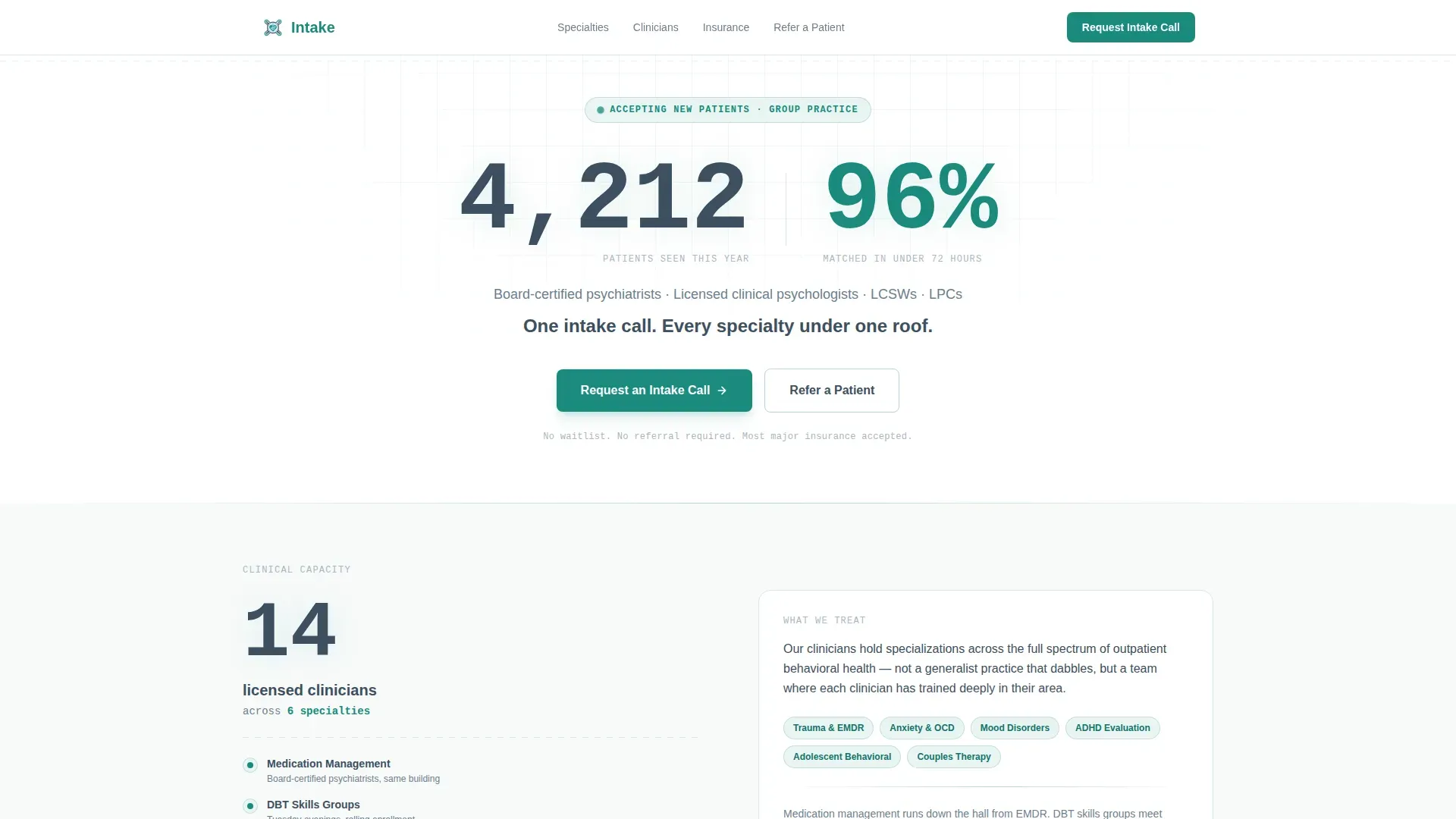
- A stats-forward hero section with a giant centered headline, two key performance figures, and a primary call-to-action button
- Four zigzag content rows covering clinician count, specialty descriptions, availability, triage process, clinician bios, and an insurance and referral grid paired with the intake form
- A linear single-row footer and three instances of the "Request an Intake Call" call to action placed at the hero, after the clinician section, and at the footer
Feature list
This template includes purpose-built components that work together to move a hesitant visitor toward a single clear action.
Stats-First Zigzag Layout
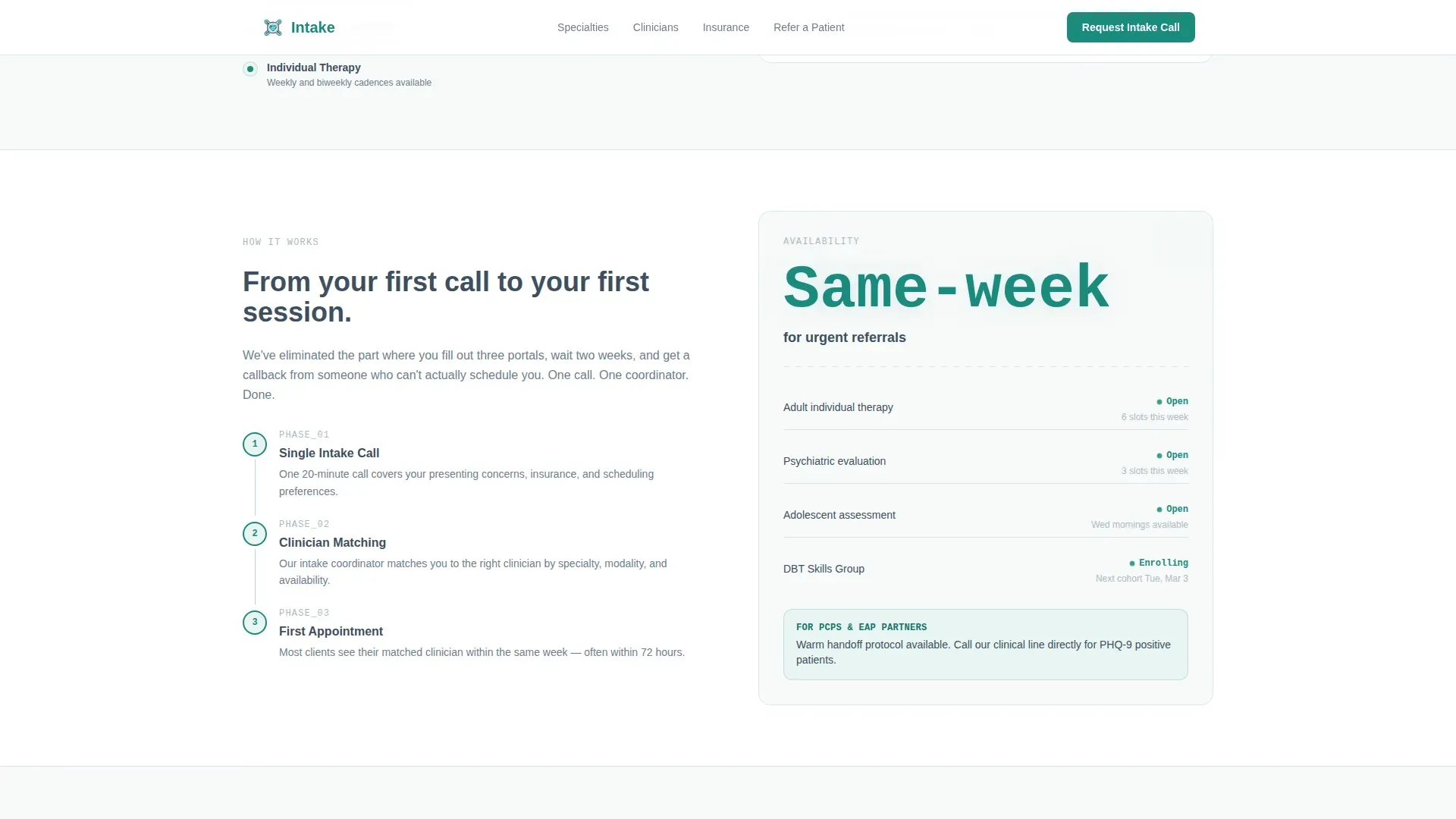
Each alternating row leads with a bold number on one side and a supporting paragraph on the other. The layout creates a rhythm that feels like reading a dashboard, starting with hard data and softening into personal narrative as the visitor scrolls.
Vital-Sign Hero Headline
The hero section uses no images or illustrations. Two large statistics sit centered on a white field, styled to read like a monitor readout. A subline beneath them names the practice credential stack in quiet graphite text.
Clinician Bio Section with Modalities
Clinician cards display real treatment modalities alongside credentials. Hover states are included to encourage exploration without cluttering the page at rest.
Low-Friction Intake Form
The form collects first name, preferred contact method, insurance carrier, and one optional free-text field. There is no diagnosis language and no clinical jargon. Form validation is built in so visitors are guided, not blocked.
Insurance and Referral Partner Grid
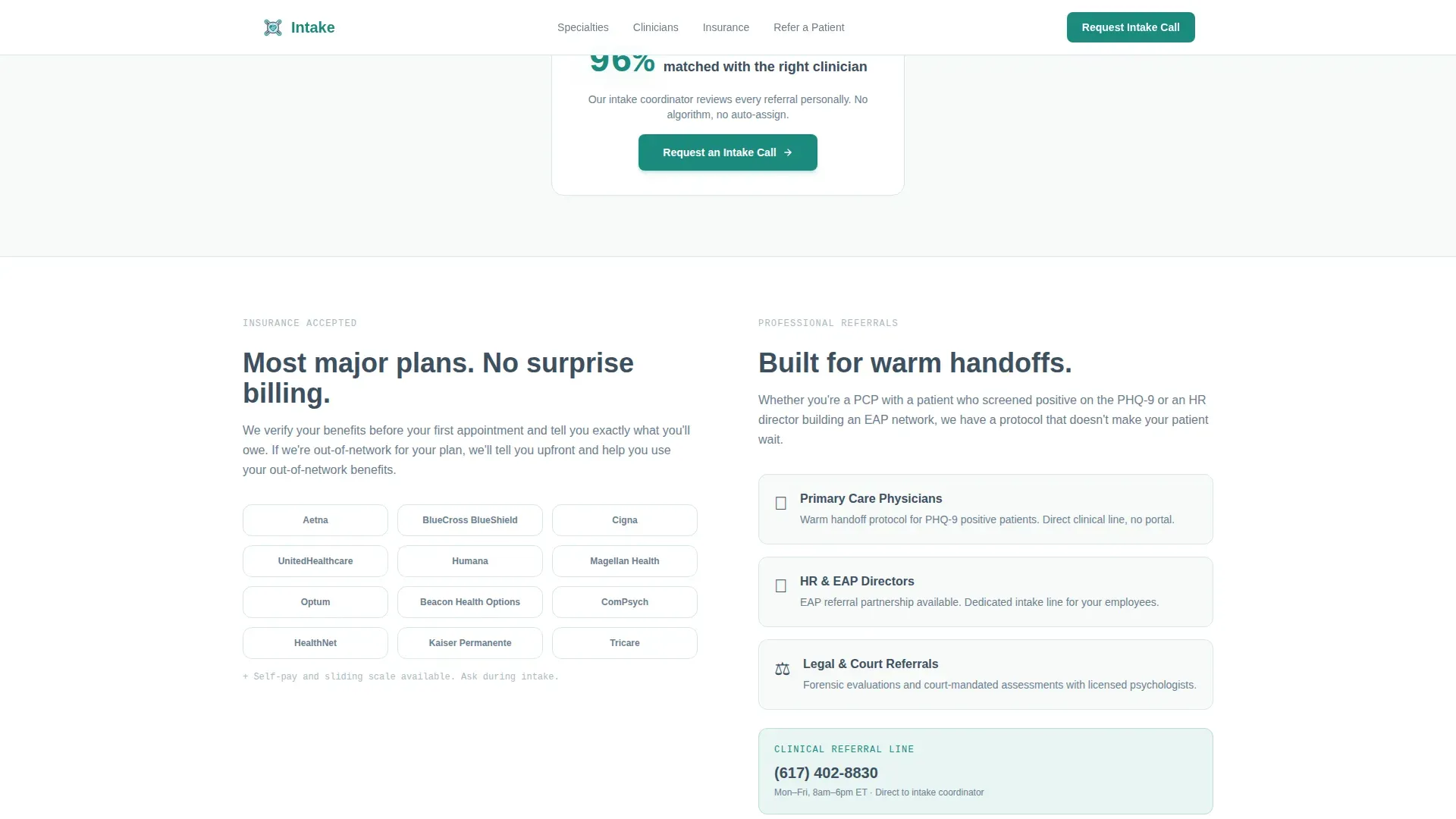
A dedicated grid section displays insurance logos and referral partner information in a clean, quiet layout. This section addresses a key objection for both self-referred adults and physician referral sources.
Scroll-Reveal Animation System
Sections animate into view as the visitor scrolls, with staggered reveals and stat counter animations on the key figures. Clinician card hover states add a final layer of interactivity.
Page sections overview
| Section | Purpose |
|---|---|
| Hero Stats Headline | Opens with two large performance statistics and the primary intake call to action |
| Clinicians and Specialties | Left stat block shows clinician count; right paragraph names the six specialty areas |
| Availability and Triage | Right stat block shows same-week availability; left explains the triage and matching process |
| Bios and Match Rate | Left shows clinician bios with modalities; right displays the 96% match stat and second call to action |
| Insurance and Form | Left grid shows insurance logos and referral partners; right contains the intake request form |
| Linear Footer | Single-row footer with the third and final call-to-action instance |
Design & branding system
The Medical Clarity visual theme keeps every surface clean and purposeful. White dominates section backgrounds, graphite carries body text, frost blue marks content dividers, and teal appears only where the eye needs to act. The result reads like a freshly organized clinical environment that signals competence without feeling sterile.
- Color system: clinical white (#F8FAFA) for backgrounds, soft graphite (#3D4F5F) for body text, pale frost blue (#D6E8EE) for dividers and accents, and confident teal (#1A8A7D) reserved for buttons, progress indicators, and key statistics
- Typography: Plus Jakarta Sans for headings and bold stat figures, DM Sans for body copy, and JetBrains Mono for stat number labels to reinforce the data-readout aesthetic
Mobile & speed optimization
The landing page is built desktop-first, with strong mobile adaptation across all sections. The intake form is specifically designed to work cleanly on smaller screens so visitors on a phone can complete it without zooming or horizontal scrolling.
- Static content sections use server components to keep load light; the form and counter animations use client components only where interactivity is required
- Scroll-linked animations and stat counters are designed to run at medium intensity, keeping the experience smooth without overwhelming the page
How this template helps you convert
The page is structured to reduce every layer of hesitation before the form appears. Emotional friction is treated as the real obstacle, so the design answers capacity, breadth, and speed questions first.
- The hero statistics prove operational scale immediately, so the visitor does not have to search for evidence that the practice has availability
- The zigzag specialty and bio sections build clinical trust section by section, matching the visitor's growing confidence as they scroll
- The intake form appears only after four trust-building sections, and it asks only for what is necessary, keeping the barrier to submission as low as possible
Other information about this template
This template is category-matched to the Health and Medical niche with a specific focus on the Mental Health and Psychiatry subcategory. It is designed for the behavioral health group practice use case and carries an intersection match score of 13, indicating strong alignment between the template structure and the niche requirements.
- The template targets three distinct conversion audiences in one page flow: self-referred adults, primary care physicians seeking warm handoff partners, and HR directors evaluating employee assistance program referral relationships
- The Stats-First Impact creative direction is intentional: data leads narrative throughout, which suits both clinical referral partners who evaluate on evidence and individual visitors who need reassurance before they share personal information
- The page type is a single-page lead generation landing page, not a multi-page website, so all conversion paths point to one action: requesting an intake call
- Animation intensity is set to medium, with scroll reveal, stagger effects, and stat counter animations included; hover states are active on clinician cards

Theme
Medical Clarity
Creative direction
Stats-First Impact
Color system
Arctic White
Style
Zigzag/Alternating
Direction
Lead Generation
Page Sections
Stats-first Zigzag Layout
Vital-sign Hero Headline
Clinician Bio Cards with Hover States
Low-friction Intake Form
Insurance and Referral Partner Grid
Scroll-reveal Animation System
Related questions
Can I replace the hero statistics with my own practice numbers?
Is this template designed for a solo practitioner or a group practice?
How many times does the primary call to action appear on the page?
Can the intake form fields be adjusted to match our intake process?
Does the page address both individual patients and professional referral sources?