Handmade Noodle Workshop Booking Landing Page Template
Tsuyu is a warm, immersive landing page template built for udon and soba shops that offer handmade noodle workshops and private dining events. It features a full-bleed photo hero, a masonry card grid that tells a craft-to-community story, a sticky booking bar, and two conversion paths, one for public sessions, one for private group bookings.
by Rocket studio
Quick summary
Tsuyu is a single-page, card-grid landing page template designed for artisan noodle restaurants and workshop studios. It pairs immersive overhead food photography with a masonry grid layout, a sticky call-to-action bar, and two lightweight booking forms. The result is a page that feels as warm and deliberate as a hand-thrown ceramic bowl, and converts visitors into workshop registrants.
Who this template is for
This template is built for food and beverage businesses that blend dining with experience. It suits any operator who wants to move guests from passive browsing to active booking without a complex website build.
- Udon and soba shop owners offering public weekend workshops for groups of two to twelve guests
- Private event coordinators and corporate planners who want a dedicated inquiry path for team outings, birthday dinners, and celebration bookings
- Independent restaurant operators and food-experience studios looking for a ready-made landing page that reflects the craft behind every bowl
What problem this template solves
Most food and beverage landing pages default to a static menu display. They show dishes but fail to communicate the hands-on, sensory story that makes a noodle-making workshop worth booking. Potential guests arrive curious and leave without acting because the page never earns the click.
- There is no clear conversion path separating a casual lunch visitor from a guest ready to reserve a private workshop
- Visual layouts that feel generic or overly digital undermine the artisanal positioning that commands premium pricing
- Workshop operators juggling public sessions and private event inquiries have no single page that handles both without confusion
What you get with this template
The template delivers a fully structured single-page layout ready to customize. Every section serves a specific role in moving a visitor from discovery to booking, and the visual system is consistent from top to bottom.
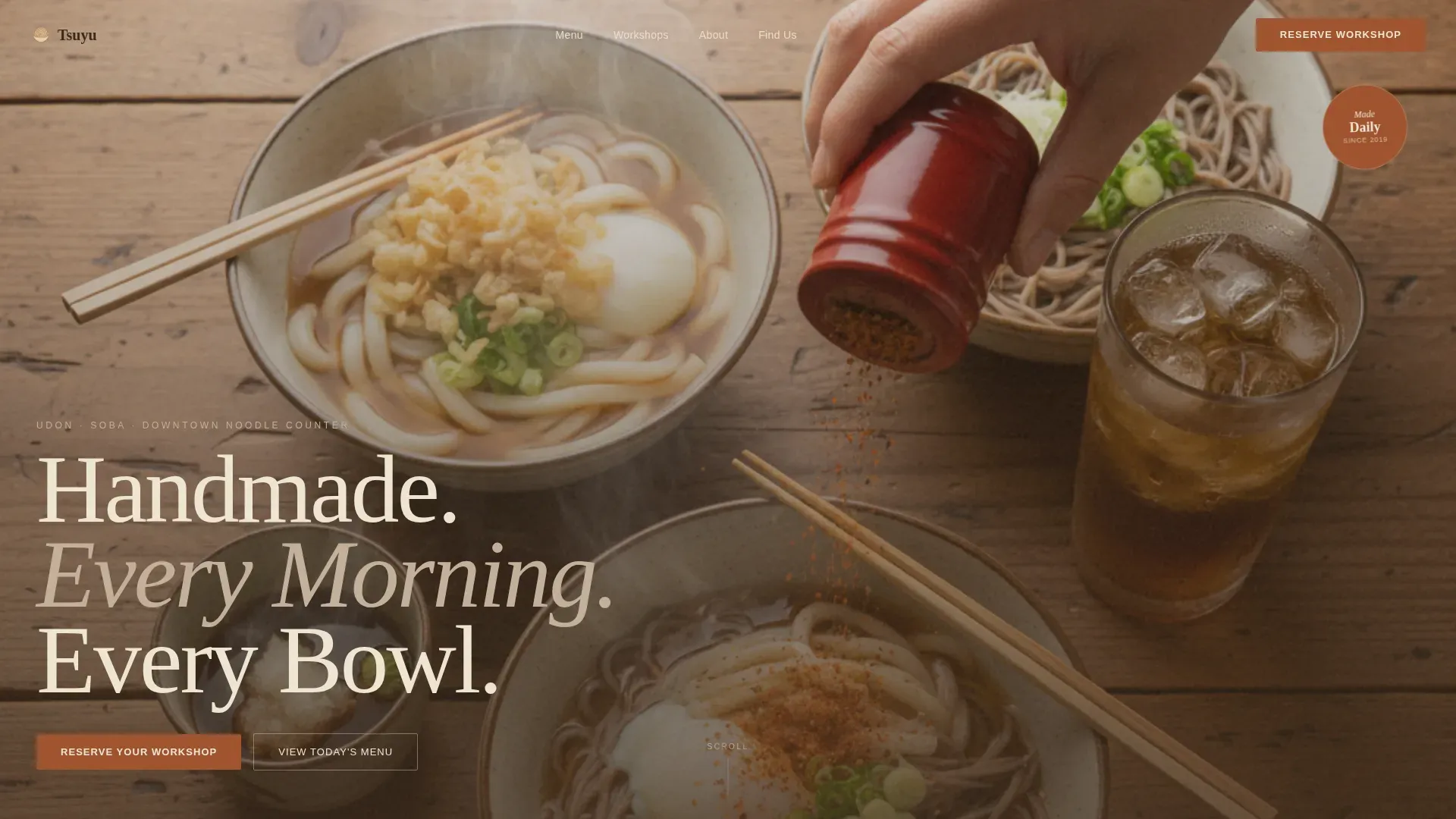
- A full-bleed hero section with an overhead food photograph, a GSAP fade-in headline, and a floating "Made Daily" badge
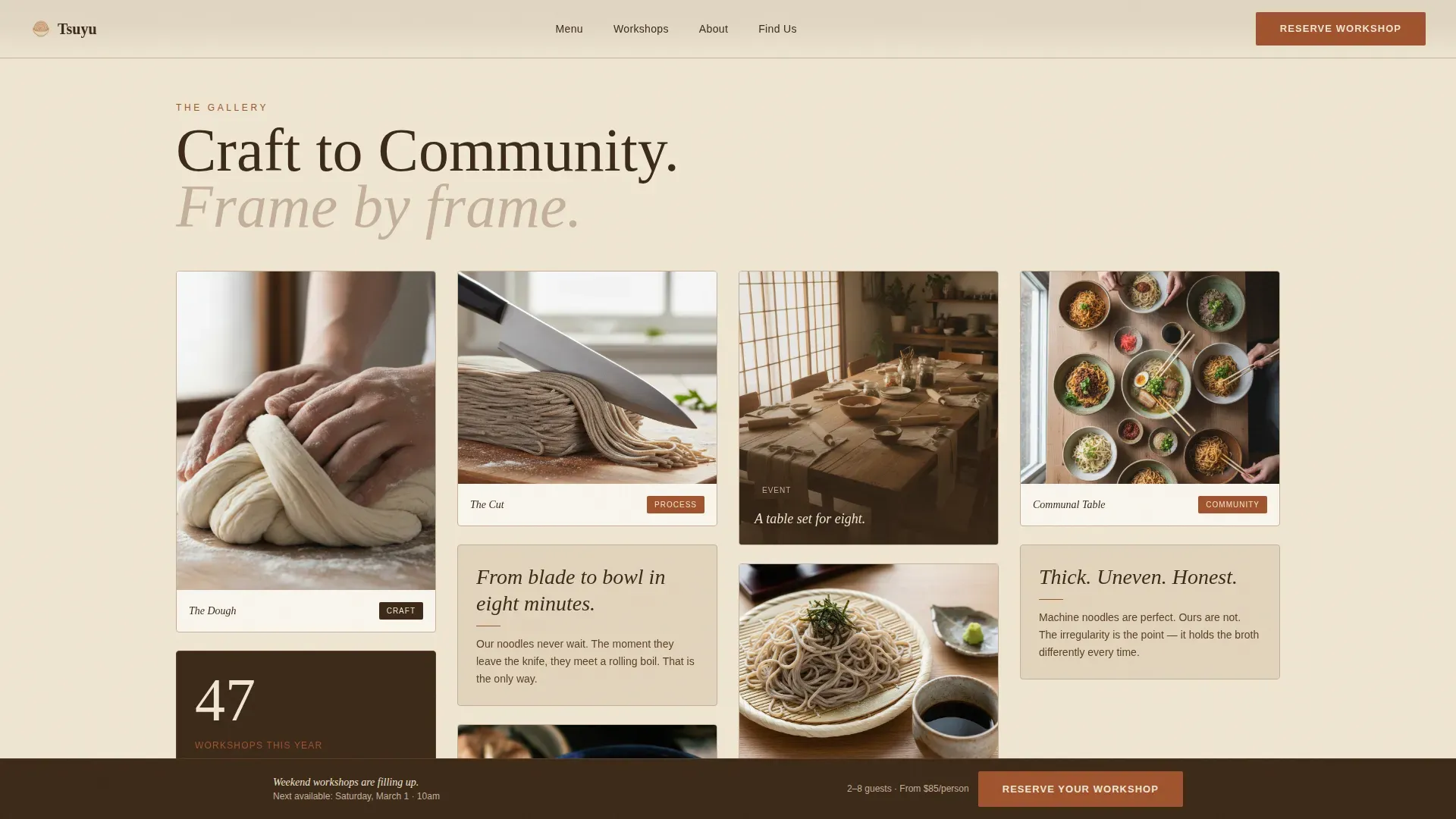
- A masonry card grid that builds a visual narrative from kitchen process to finished dishes to workshop event scenes, with intentionally varied card heights for an organic, gallery-walk rhythm
- A sticky bottom call-to-action bar labeled "Reserve Your Workshop" that appears after the first scroll fold, plus a secondary "Book a Private Noodle Night" inquiry card embedded in the grid
Feature list
This template was designed with specific interactive and visual capabilities that align with the needs of a workshop booking landing page. Each feature below is grounded in the source brief.
Full-Bleed Overhead Hero Section
The hero opens with a high-quality photograph shot from directly above a communal wooden table. Three steaming bowls of udon and soba are arranged asymmetrically. Chopsticks rest mid-motion, condensation beads on a glass of cold mugicha, and the headline "Handmade. Every Morning. Every Bowl." fades in over the steam using a GSAP animation. A floating badge reading "Made Daily" reinforces the craft-first message immediately on load.
Masonry Card Grid with Gallery Walk Layout
The card grid is the emotional engine of the page. Each card is a framed moment: flour-dusted hands pressing dough, a knife cutting soba noodles at a precise angle, a workshop table set for eight with aprons folded at each seat. Cards vary intentionally between tall portrait and wide landscape formats, creating an organic masonry rhythm. As visitors scroll, the narrative shifts from kitchen craft to finished dishes to community event scenes, building desire without a single paragraph of explanation. Card hover states include a subtle tilt animation for tactile feedback.
Dual Booking Conversion Paths
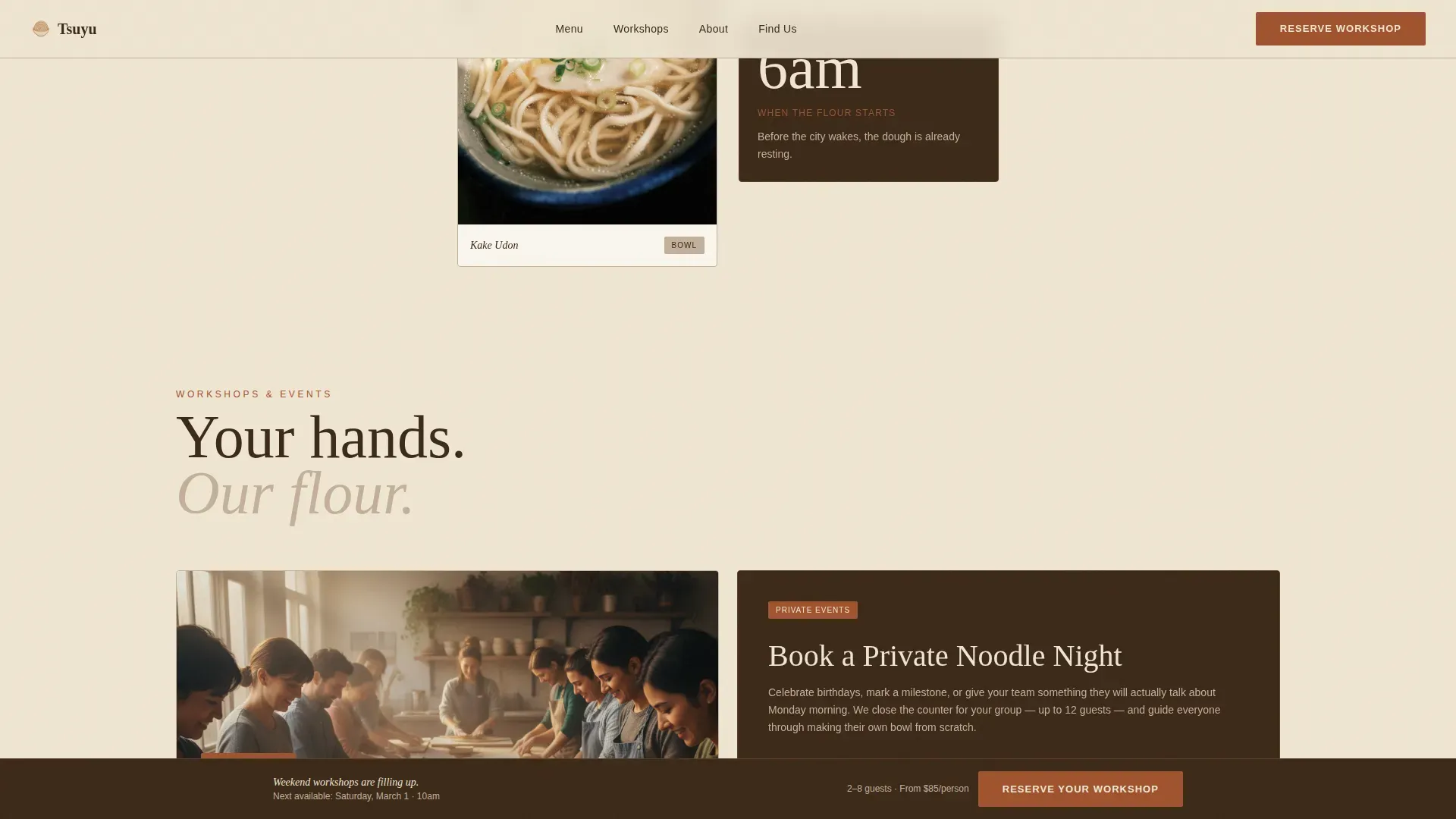
Two distinct booking flows are built into the page. The primary path is anchored in a sticky bottom bar that appears after the first scroll fold. Clicking opens a lightweight modal form with a date picker showing available Saturday and Sunday sessions, a group size selector from two to twelve guests, a toggle between udon-making and soba-making experiences, and fields for name and phone number. The secondary path is an event-specific card embedded near the grid's center, labeled "Book a Private Noodle Night," with a short inquiry form aimed at corporate and celebration bookings.
Animated Testimonials Section
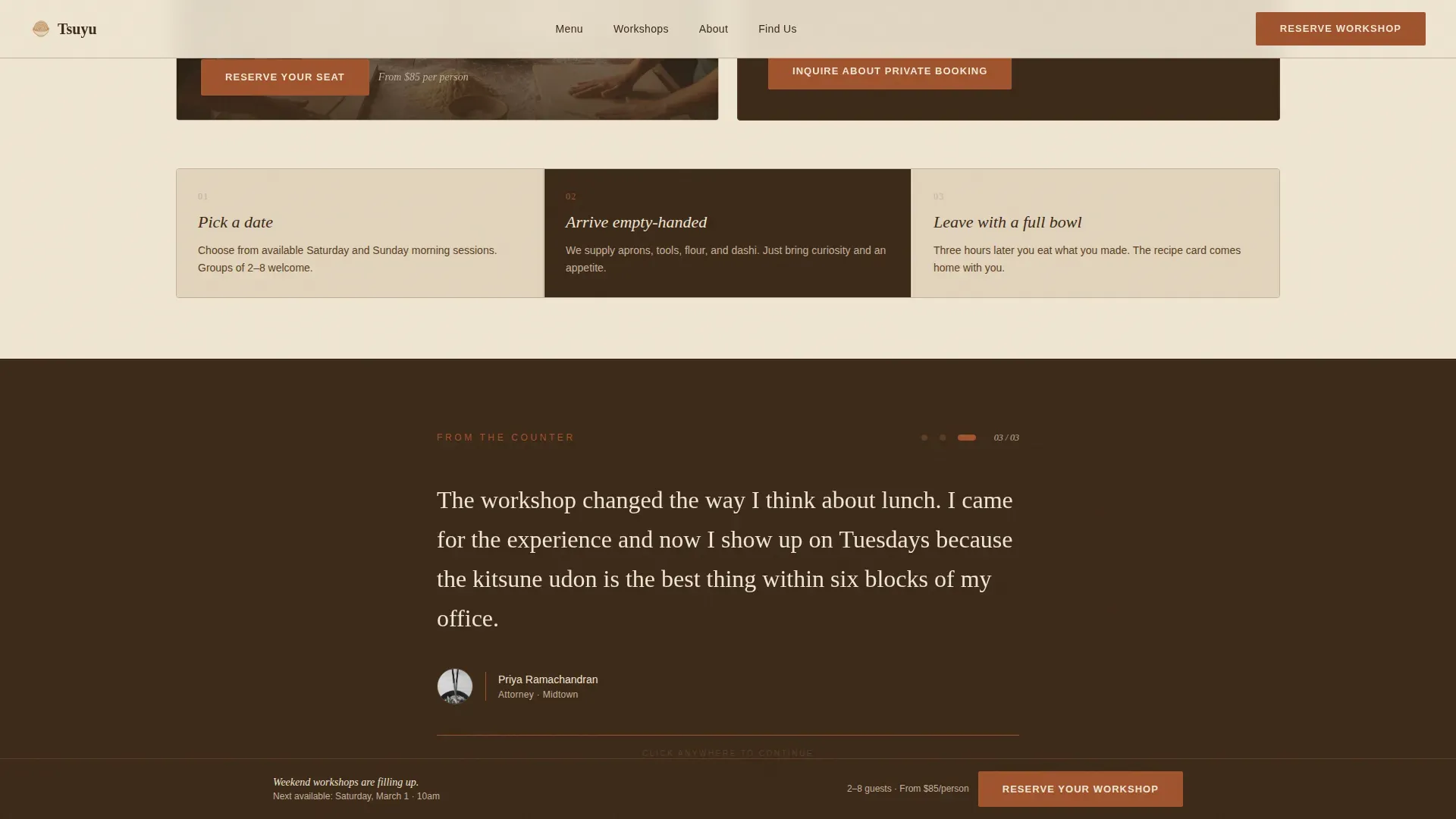
The page includes a testimonials section displaying three guest reviews. The animation uses a word-blur reveal that advances on click, making the social proof feel alive rather than static. Authentic guest voices build trust and reassure prospective workshop attendees that the experience delivers on the sensory promise the photography sets up.
Embedded Social Proof Metric Card
A dedicated card inside the masonry grid displays a single standout metric: "47 workshops this year." This figure anchors credibility without requiring visitors to hunt for reviews. It signals an active, well-attended program and reinforces the decision to book before the form even appears.
Sticky Call-to-Action Bar
The sticky bar appears after the user scrolls past the first fold and remains visible throughout the page. It keeps the primary booking action one tap away at all times. On mobile, this is especially useful because food discovery happens on phones and the booking moment can occur at any point in the scroll journey.
Page sections overview
| Section | Purpose |
|---|---|
| Full-Bleed Hero | Opens with overhead food photography and a fade-in headline to set the sensory tone immediately |
| Masonry Card Grid | Builds a craft-to-community visual narrative through varied-height framed moment cards |
| Workshop Booking Cards | Hosts the public session form and the private event inquiry in the same visual flow |
| Testimonials Row | Delivers word-blur animated guest reviews to build trust through authentic social proof |
| Social Proof Metric | Embeds a single "47 workshops" count card inside the grid for at-a-glance credibility |
| Sticky call to action Bar | Keeps "Reserve Your Workshop" visible throughout the scroll journey on all devices |
| Footer | Displays horizontal dot-separated links in a clean, minimal pattern |
Design & branding system
The visual identity follows an Organic Flow theme built on the Parchment and Rust color system. Every design choice references the tactile warmth of a hand-thrown ceramic bowl sitting on a worn hinoki counter. Nothing feels sharp or digital, even the dividers and card borders carry that deliberate imperfection.
- Typography pairs Fraunces serif display headlines with DM Sans body text, creating contrast between the artisanal and the legible, headlines carry the emotional weight, body text keeps the practical details clear
- The four-color palette works in specific roles: unbleached wheat parchment (#F0E6D3) washes across backgrounds, aged soy-dark walnut (#3B2818) anchors all body text, oxidized iron rust (#A0522D) marks interactive elements and hover states, and soft buckwheat husk (#C4B09A) softens card borders and dividers
- GSAP-powered animations include stagger reveals on scroll, a parallax effect in the hero section, card hover tilts, and word-blur testimonial transitions, all using GPU-accelerated transforms for smooth motion
Mobile & speed optimization
This template was built mobile-first because food discovery and workshop browsing happen predominantly on phones. The layout, interaction patterns, and call-to-action placements all account for smaller screens and touch input.
- The masonry grid adapts gracefully from a rich multi-column desktop layout to a clean single-column mobile feed, preserving the narrative arc from craft to community on every screen size
- The sticky call-to-action bar is sized and positioned for thumb-reach on mobile, keeping the booking action accessible without requiring a scroll back to the top
- Native CSS smooth scroll is used throughout, and all animations rely on GPU-accelerated transforms only, keeping motion smooth without layout-blocking operations
How this template helps you convert
The conversion strategy works by letting the photography and narrative do the persuading before any form appears. By the time the sticky bar is visible, visitors have already imagined their hands in the flour. The structure earns the click rather than demanding it.
- The hero section establishes an immediate sensory connection using overhead food photography and a craft-forward headline, creating emotional investment in the experience before any pricing or logistics appear
- The masonry card grid builds a scroll-driven narrative that moves from kitchen process to finished noodles to community workshop scenes, so visitors understand the full arc of what they are booking, not just a class, but a shared meal they helped prepare
- The dual conversion paths address two distinct guest types simultaneously: the sticky bar captures spontaneous workshop interest from individual guests, while the embedded "Book a Private Noodle Night" card gives corporate and celebration planners a dedicated, low-friction inquiry route without interrupting the main booking flow
Other information about this template
This section covers additional context about the craft traditions, culinary world, and design philosophy that informed this template's development. It also addresses remaining thematic details relevant to buyers exploring this niche.
- Soba noodles originated during the Edo period in Japan and were a fast, affordable food enjoyed across all social classes. Today, the art of making soba noodles is a significant cultural practice, reflecting the dedication and skill of artisans known as shokunin, craftspeople who pursue perfection in every cut.
- Tsuyu, the traditional dipping sauce made from dashi, soy sauce, and mirin, is an essential part of the soba dining experience. The name connects directly to the flavor at the heart of every workshop: guests dip their handmade soba into tsuyu broth after cutting their own noodles, completing the craft-to-table arc.
- Soba noodle making workshops are available across Japan, including in Shinano Town in Nagano Prefecture, which is celebrated for its local buckwheat production. The process participants follow in those workshops, dough making, kneading, rolling, and cutting, mirrors the narrative this template tells through its card grid.
- After completing a noodle-making session, participants typically enjoy their handcrafted soba served with tempura and tsuyu broth for dipping. This moment, from bare hands in flour to a delicious bowl at the table, is the emotional peak this template builds toward.
- Traditional Japanese cooking workshops offer hands-on experiences that go far beyond the recipe. Participants can also learn to prepare tofu, mochi, and other traditional foods. Mochi-making workshops often include pounding glutinous rice and filling the dough with sweet red bean paste. Tofu-making workshops typically involve blending soybeans, shaping the mixture, and pressing it into blocks. These broader workshop formats can also be promoted using this template's dual-path booking structure.
- Artisanal Japanese cuisine emphasizes the dedication and craftsmanship of chefs. Kaiseki cuisine, for example, is a traditional multi-course meal that showcases seasonal ingredients and the chef's skills. Restaurants like Hyotei in Kyoto have been serving kaiseki for generations, emphasizing seasonal ingredients in every dish.
- The culinary landscape in Japan is deeply layered. Sushi, ramen, tempura, hot pot, and grilled dishes each carry their own ritual and presentation. A sushi restaurant may feature nigiri shaped with vinegared sushi rice, fatty tuna thinly sliced across the grain, sea urchin served on a small wooden box, and sashimi arranged with green onion and red miso on the side. A tempura restaurant builds its menu around vegetables, seafood, chicken, pork, and eggs coated in a light batter and fried to a delicate crunch. Red vinegar, salt, and soy sauce are the quiet constants across many of these traditions.
- The world of Japanese dining also includes ramen shops where a deep bowl of soup anchored by pork or chicken broth defines the meal, izakayas serving grilled meat and sake in the evening, and tea ceremony spaces where the ritual of preparation carries as much meaning as the taste of the drink itself. Counter seats at a soba bar, low tables in a tatami room, and open kitchen counters all offer different framings of the same hospitality.
- Japan's food culture extends far beyond Tokyo. Kyoto is home to many restaurants serving refined kaiseki. Near Kyoto Station, visitors can eat their way through decades of culinary tradition in a single afternoon. In rural Japan, seasonal ingredients and local producers define the menu, and many restaurants built around those relationships earn michelin star recognition for their commitment to craft. International visitors to Japan often cite the food as the most memorable part of their trip. The four seasons drive menu changes across the country, and chefs prepare entirely different dishes in spring, summer, autumn, and winter.
- Beyond the noodle counter, the wider Japanese food world encompasses sashimi cut from deep sea fish like gizzard shad, nigiri shaped over rice grains by hand, and raw tuna served at a sushi restaurant with a small saucer of soy sauce and wasabi. Medium fatty tuna, known as chutoro, and richer fatty tuna, known as otoro, are prized cuts at any serious sushi counter. Sea urchin, or uni, is often served in a small wooden box lined with washi paper. These references appear across restaurant menus throughout Japan, from michelin star dining rooms to casual counter seats near busy train stations.
- The Organic Flow design theme used in this template draws from the same visual language as washi paper, hand-thrown ceramics, and worn natural surfaces. Local artists in Japan have long used similar earthy palettes, combining soft buckwheat husk tones, rust-red glazes, and deep walnut browns, to make objects that feel rooted in place and time. The template carries that same philosophy into a digital format.
- Shinto practices and shinto deities have long been woven into Japanese food culture. Many restaurants and food markets still maintain small shrines, and seasonal offerings reflect those connections. Tatami mats and low tables remain a feature of traditional dining spaces, and the quiet ritual of a tea ceremony continues to influence how many Japanese chefs think about preparation and presentation. These cultural layers give the noodle workshop experience a depth that goes beyond the recipe, and this template is designed to evoke that depth from the first scroll.
- This template can support a booking landing page for any food experience business that wants to communicate artisanal craft, cultural depth, and a clear path to registration, all without requiring code. The Tsuyu handmade noodle workshop booking landing page template is a purpose-built starting point for that work. Unicorn Platform provides this template as part of its modern, minimalist collection of mobile-optimized booking landing pages. Using a ready-made template simplifies the process significantly, allowing operators to launch quickly and focus on the food rather than the build. No-code and low-code tools make it possible to customize the layout, swap in your own photography, update the menu, and connect a booking or payment flow without writing a single line of code.
Theme
Organic Flow
Creative direction
Gallery Walk
Color system
Parchment & Rust
Style
Card Grid (Modular)
Direction
Event Registration
Page Sections
Full-bleed Overhead Hero with Animated Headline
Masonry Card Grid with Narrative Arc
Dual-path Workshop Booking System
Word-blur Animated Testimonials
Sticky Call-to-action Bar for Ongoing Conversion
Related questions
Who is this template designed for?
What booking features are included in the page?
Can I use this template for a restaurant that also offers workshops?
Do I need coding skills to customize this template?
What makes this template different from a standard restaurant page?