Elite Motorsport Fabrication Landing Page Template
The Chassis landing page template is built for professional race car fabricators who need to turn a browser into a booked consultation. A viewport-wide Before/After Slider opens every visit with raw drama. An Interactive Explorer gallery lets visitors walk through every build stage. A persistent "Spec Your Build" call to action closes the loop and drives high-value leads to a structured intake flow.
by Rocket studio
Quick summary
Chassis is a gallery and detail landing page template designed for precision race car builders. It opens with a draggable Before/After Slider splitting a bare donor shell from a finished livery build, then guides visitors through an interactive, stage-by-stage gallery of completed vehicles. Every section is built to move a serious buyer toward one goal: booking a consultation.
Who this template is for
This template speaks directly to fabricators and workshop owners who commission full race car builds for paying clients. It works equally well for teams stepping into first-time ownership and professional outfits needing a rapid turnaround on a backup chassis. The visitor this page addresses already understands the racing world. They are not browsing for inspiration. They are evaluating a fabricator before making a significant financial commitment.
- Gentleman drivers commissioning GT4 or GT series car builds
- Amateur racing teams transitioning from arrive-and-drive to full vehicle ownership
- Professional outfits needing a backup chassis delivered in a fixed window
What problem this template solves
Most race car builders rely on word of mouth or outdated portfolio sites that bury the quality of their work under slow-loading images and unclear calls to action. A landing page for a precision race car builder must convey high performance, engineering expertise, and exclusivity to convert high-value leads. This template solves that gap directly.
- Visitors leave before understanding the full scope of a build, because the story is never told clearly
- Generic contact forms reduce trust instead of building it, especially for high-value commissions
- Builders struggle to show range across disciplines without a structured gallery model
What you get with this template
You get a single, section-led page that moves visitors from curiosity to commitment. The layout is created around a dark fabrication bay aesthetic with a Ruby and Chrome color system, and every interactive element is designed to hold attention and enable the right next step for a serious buyer.
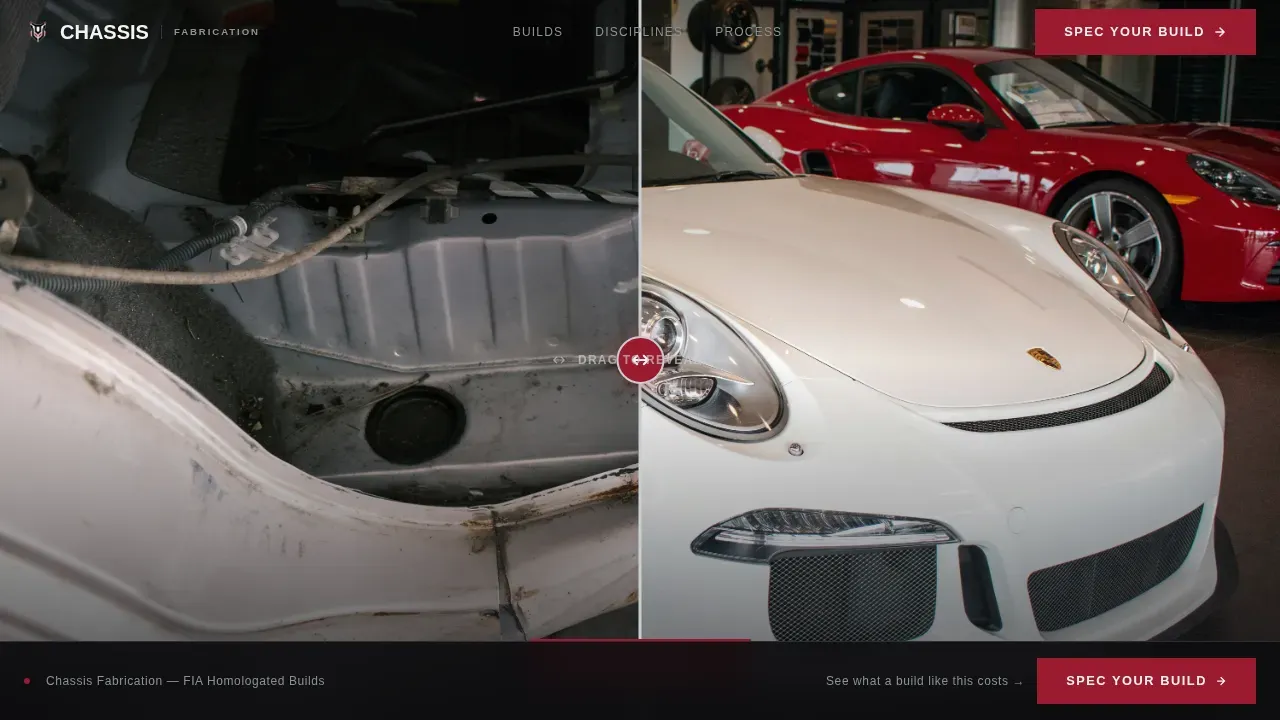
- A viewport-wide Before/After Slider hero section with a chrome drag handle and ruby accent
- An expandable build gallery where each car opens into a six-stage build story with engineer-level annotations
- A process timeline, team principal quote block, and a persistent "Spec Your Build" call to action bar
Feature list
The Chassis template includes a focused set of interactive and structural features, each created to serve a fabricator's commercial goals without unnecessary complexity.
Before/After Hero Slider
The header splits the full viewport between a stripped donor shell and a completed race car in full livery. The visitor drags a chrome vertical bar with a ruby accent to reveal the transformation themselves. No headline appears until the slider is touched, at which point the tagline resolves in technical white. This interaction immediately communicates the quality of work and the scale of the build process.
Expandable Build Story Gallery
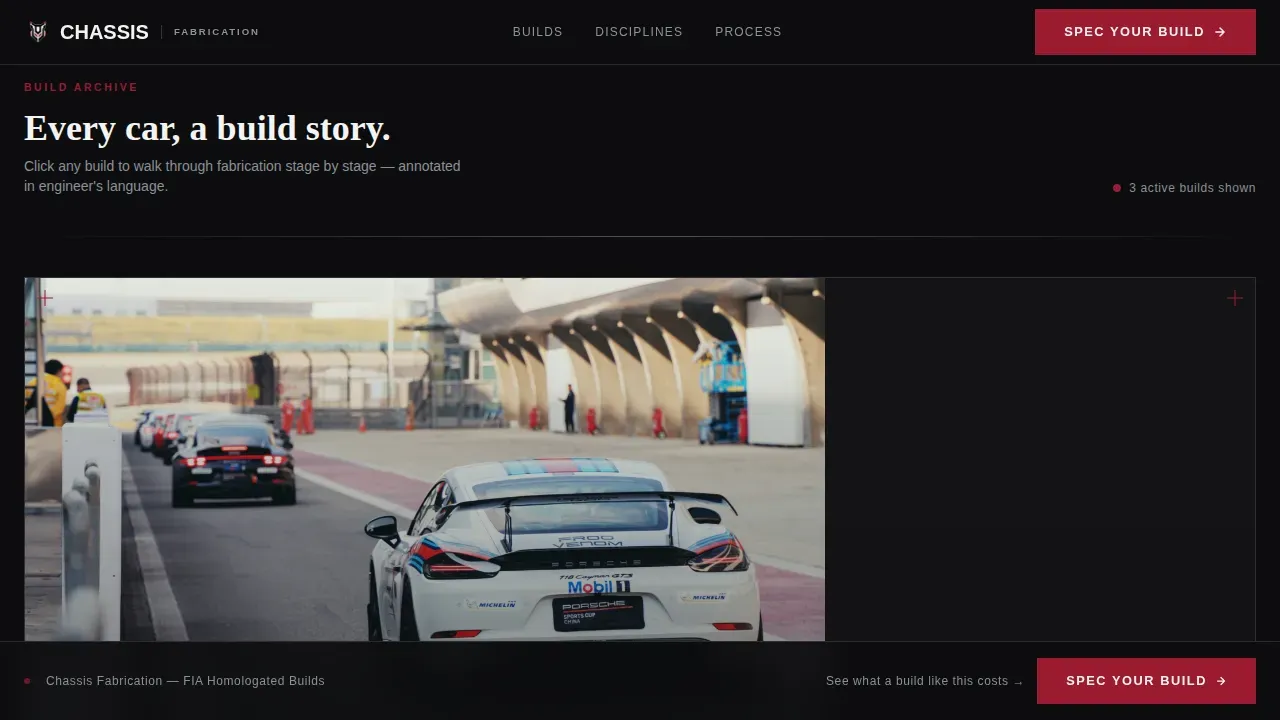
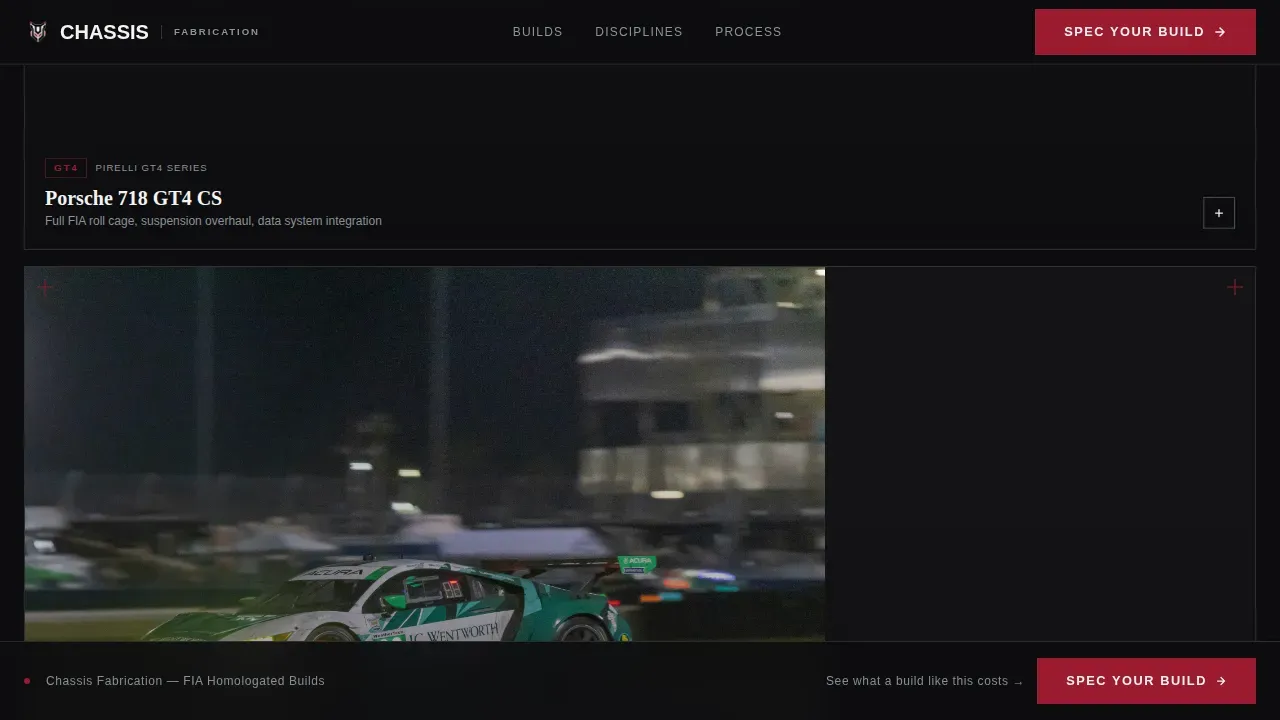
Each car thumbnail in the gallery row expands into a full detail view rather than opening a lightbox. Visitors rotate through six build stages: bare shell, cage fabrication, mechanical assembly, wiring and plumbing, paint and livery, and final shakedown. Each stage carries a short annotation written in engineer's language, covering torque specs, material grades, and weight deltas. This model of storytelling gives a serious racer the technical confidence to move forward.
Stage-by-Stage Build Annotations
Every expanded build card displays engineer-level notes at each stage. These annotations reference real construction details such as tubing wall thickness, suspension pickup geometry, axle uprights positioning, and bolt torque values. The annotations are formatted as spec callouts in ruby on chrome, matching the visual language of the rest of the page and reinforcing the precision brand at every scroll point.
Discipline Range Proof Section
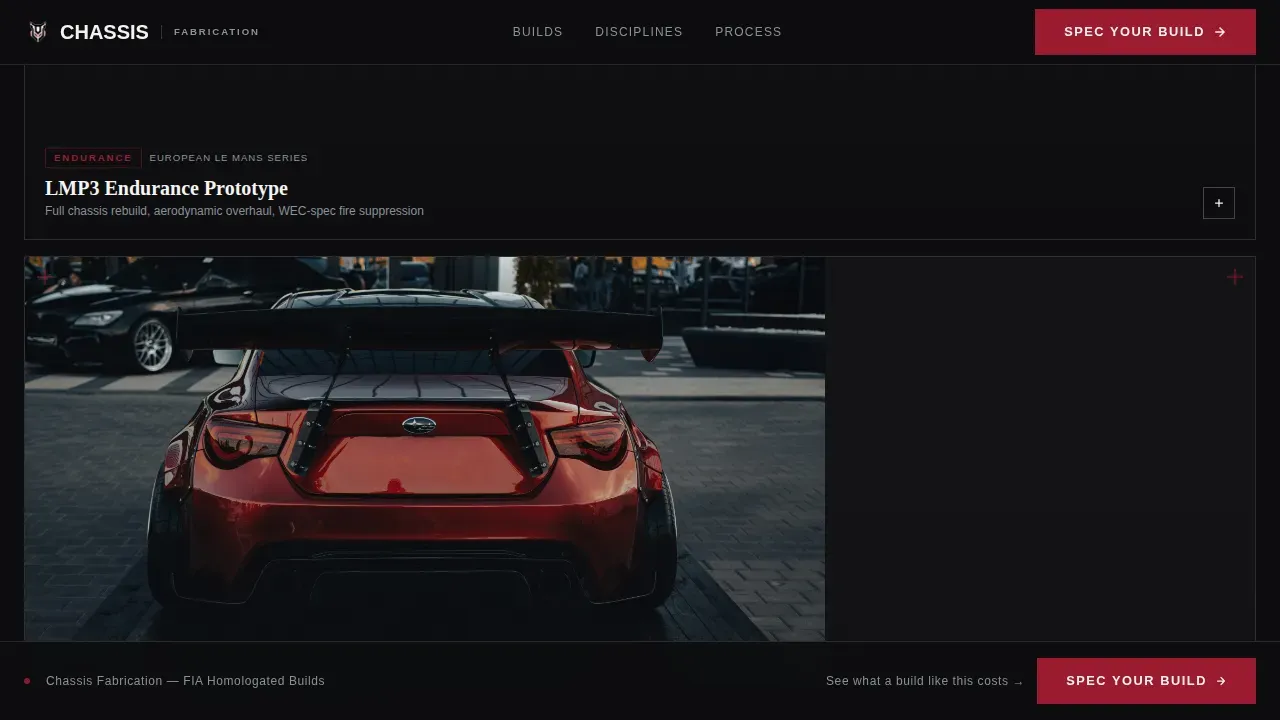
A dedicated section covers three distinct build disciplines without stating the word "range" explicitly. The endurance prototype, hillclimb special, and historic rally restoration each appear as their own build card. This section proves the workshop can complete different category builds to the same standard, which is a key trust signal for any new client evaluating the fabricator for the first time.
Process Timeline and Social Proof Block
A four-phase build timeline shows the client journey from initial spec through to final shakedown. Beneath it, a single team principal quote provides the social proof point that moves hesitant buyers. The quote block uses Fraunces display type on a technical white panel, standing out clearly against the dominant dark background. This section closes the build story before the final call to action appears.
Persistent "Spec Your Build" Call to Action Bar
After the second gallery card, a fixed bottom bar appears and stays visible as the visitor scrolls. It carries the primary call to action in ruby on chrome. The bar does not contain a form. Instead, it clicks through to a sequential intake page where the visitor selects their discipline, donor vehicle, budget range, and target series in order. This keeps the landing page clean and frictionless.
Page sections overview
| Section | Purpose |
|---|---|
| Before/After Hero | Opens with draggable shell-to-livery slider |
| Build Gallery Row | Expandable per-car build story cards |
| Stage Annotation Panels | Engineer notes per build stage |
| Disciplines Proof | Endurance, hillclimb, and historic rally range |
| Process Timeline | Four-phase client journey overview |
| Team Principal Quote | Social proof from a named team contact |
| Persistent call to action Bar | Fixed "Spec Your Build" bottom action bar |
| Closing call to action Section | Final button click-through to intake page |
Design & branding system
The visual identity follows a Corporate Precision theme. Deep pit-lane black dominates all background surfaces. Polished chromium silver carries borders, dividers, and secondary type. Competition ruby appears exclusively on interactive states, calls to action, and spec callouts. Technical white opens up data panels and spec-sheet sections so numbers and annotations stay readable and breathe properly.
- Typography: DM Sans for body and interface text, Fraunces for display headings and pull quotes
- Color system: #0D0D0F black backgrounds, #9B1B30 ruby accents, #C8CDD0 chrome borders, #F4F4F2 technical white data surfaces
- Visual tone: a sealed transporter under halogen, mirror-finish dark panels interrupted by a single red accent stripe
Mobile & speed optimization
The template is built desktop-first, reflecting the reality that gentleman drivers and team principals researching a commission typically work from a desktop or large-format display. The page layout scales correctly to tablet and mobile viewports. Interactive elements such as the Before/After Slider and the expandable gallery cards adapt to touch input without losing their core functionality.
- Desktop-first layout with responsive scaling to tablet and mobile breakpoints
- Touch-compatible slider drag and card expansion for mobile visitors
- Server Components power static sections; Client Components handle interactive elements to manage rendering load correctly
How this template helps you convert
The page is structured as a click-through flow, not a form-capture page. Every element points toward one action: clicking through to the intake booking page. The build gallery, the timeline, the quote, and the persistent bar all serve that single commercial goal.
- The Before/After Slider creates immediate emotional investment. Visitors who drag the handle have already committed a physical action, which makes them more likely to continue scrolling and reach the call to action.
- Each build detail panel ends with a secondary nudge reading "See what a build like this costs," which scrolls the visitor down to the closing section. This keeps momentum moving forward rather than letting attention break at any point in the scroll.
- The persistent bottom bar ensures the primary call to action stays visible at every scroll depth, so the visitor never has to wait or scroll back up to find it.
Other information about this template
This template sits within the Automotive and Transport category, specifically the Vehicle Customization and Modification subcategory, with a niche focus on professional race car fabrication. It is designed as a gallery and detail landing page with an Interactive Explorer creative direction. The template style is well suited to builders who want to display finished work at a level of detail that matches the quality of the work itself.
The design and content model draws on established principles for high-value motorsport service pages. A clear headline communicating precision engineering is positioned as the core unique selling proposition. The call to action uses direct language and a contrasting ruby color to draw attention without visual clutter. The intake flow keeps the consultation request to a short sequential form covering discipline, donor vehicle, budget, and target series, which reduces friction for high-value prospects.
The template supports the kind of structured build showcase that designers working in racing reference when they use computer-aided design software to model a vehicle before cutting steel. Just as designers often use tools like SolidWorks to model a complete chassis before fabrication begins, this page model allows a fabricator to present their process with the same level of order and precision. Software used to manage race car construction projects typically involves numerous sequential tasks, and the four-phase timeline section of this template reflects that structured approach visually.
The build annotation model also draws on practices common to scratchbuilt chassis design communities, where chassis galleries serve as reference material for retro racing chassis designs. Scratchbuilt chassis are often constructed from materials like brass and steel, and their weight distribution and structural integrity are as critical to track performance as they are to the story being told on this page. Designers working on precision slot cars, for example, understand that chassis design significantly affects the car's performance on the track, and the same logic applies to how a fabricator presents their work to prospective clients.
- Intersection match score: 13, indicating a strong alignment between the Ruby and Chrome color system, the Interactive Explorer creative direction, and the Gallery and Detail template style
- The template is localized for English UK motorsport terminology with references appropriate for GBP-priced commissions
- Animation intensity is high: the before/after slider drag, build stage expansion, and scroll-linked reveals are all core to the visitor experience
- The page does not include an embedded contact form; all lead capture happens on the linked intake page
Theme
Corporate Precision
Creative direction
Interactive Explorer
Color system
Ruby & Chrome
Style
Gallery + Detail
Direction
Click-Through
Page Sections
Before/after Viewport Hero Slider
Interactive Six-stage Build Explorer
Discipline Range Proof Section
Four-phase Process Timeline
Persistent Ruby Call to Action Bottom Bar
Corporate Precision Design System
Related questions
Does this template include the intake booking page?
Can I add more build cards to the gallery section?
Is the Before/After Slider touch-compatible on mobile?
How many build stages does each gallery card support?
Can I update the color system to reflect a different brand identity?