3D & Product Design Portfolio Pricing Website Template
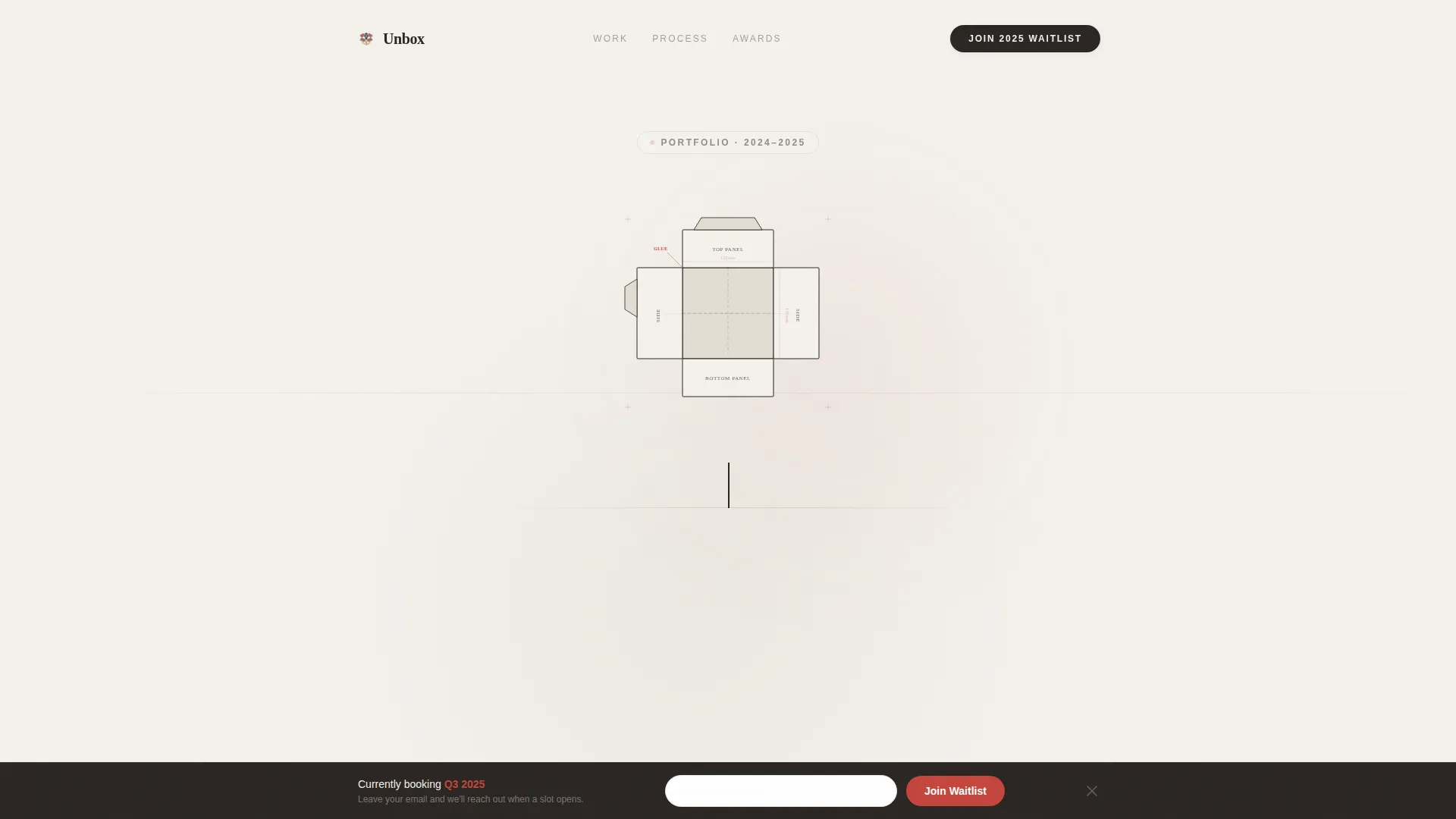
Unbox is a bento grid landing page built for packaging designers who lead with awards and close with waitlists. An animated line-drawn package unfolds in the header, a trophy-case grid showcases CPG and spirits work with expandable case studies, and a sticky email capture turns scarcity into sign-ups. The result is a portfolio that reads like a body of evidence.
by Rocket studio
Quick summary
Unbox is a single-page portfolio template for packaging designers whose work earns industry recognition. The bento grid layout displays award-winning projects at variable tile sizes, lets visitors expand case studies in place, and closes with a waitlist conversion bar. Every design decision reflects the tactile, material-led world of shelf-ready packaging work.
Who this template is for
This template is built for packaging designers who have real awards to show and limited client slots to fill. It speaks directly to practitioners who move between structural design, brand identity, and production decisions.
- Freelance packaging designers managing a selective client roster
- Boutique studio owners pitching CPG brand managers and spirits founders
- Award-recognized designers ready to communicate scarcity and demand
What problem this template solves
Most portfolio templates treat all work as equal. A packaging designer's portfolio needs to communicate hierarchy: the award-winning project deserves more space than the exploratory concept. It also needs to convert visitors who arrive ready to hire, not just browse.
- Generic grid layouts flatten the difference between standout and supporting work
- There is no built-in mechanism to signal that capacity is limited and demand is real
- Expandable case studies are rarely built into portfolio templates without navigation away from the page
What you get with this template
You get a complete, single-page portfolio landing page with every major section pre-built and ready to populate with your own work and credentials. The template is structured around three conversion layers: proof, demand signal, and capture.
- An animated header with a line-drawn dieline unfolding into a finished 3D box
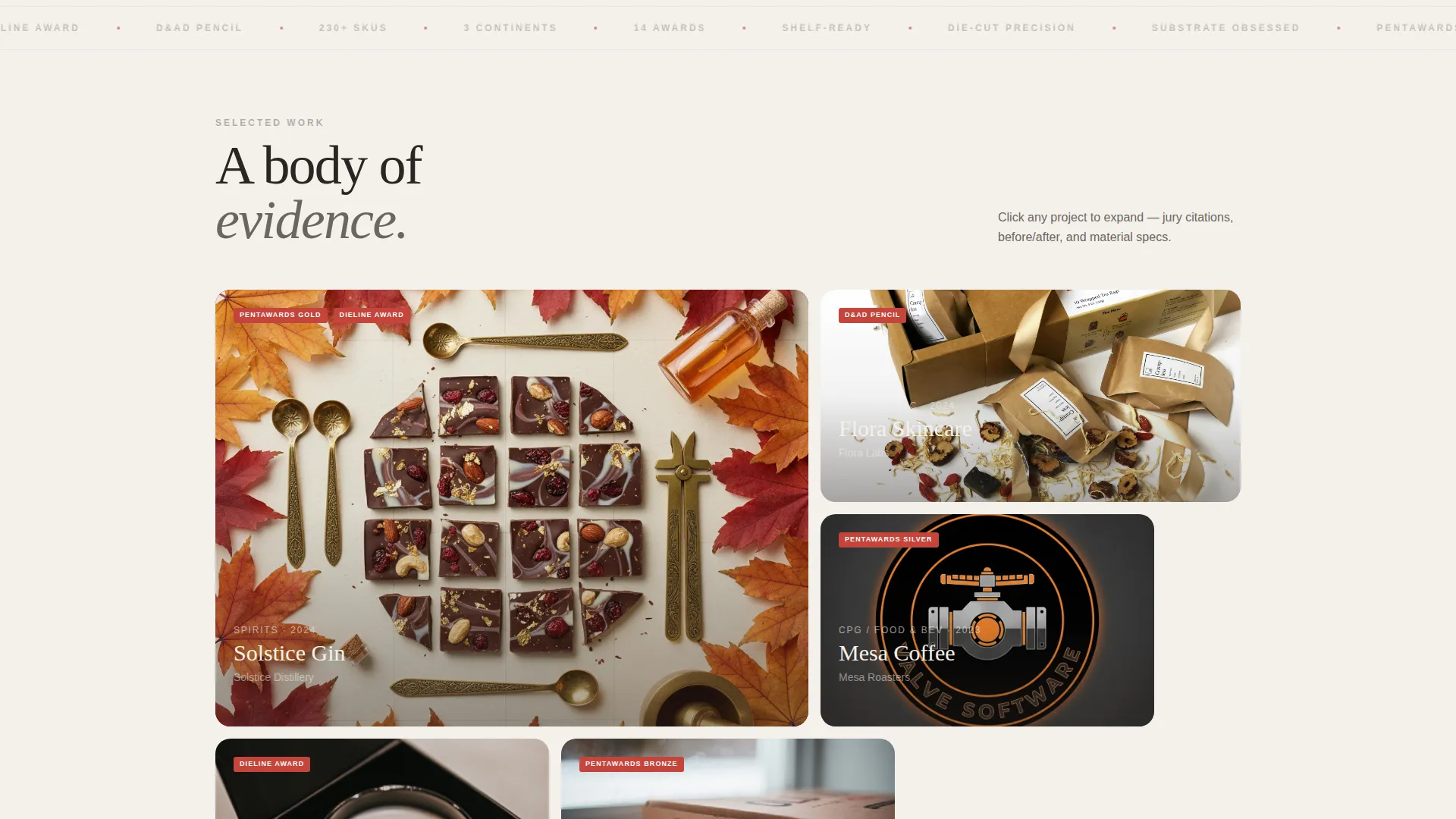
- A variable bento grid with award badge markers and in-place case study expansion
- A sticky waitlist bar and a secondary agency-facing case study request path
Feature list
A paragraph introducing the feature set: Every feature in Unbox is designed to support the specific workflow of a practicing packaging designer, from the first impression in the header to the final email capture at the bottom of the scroll.
Animated Dieline Header
A line-drawn structural dieline animates in real time as the page loads. Fold lines spread open, glue tabs are labeled, and registration marks pulse subtly. The net then refolds into a finished 3D rotating box, and the headline types itself along the fold crease.
Variable Bento Project Grid
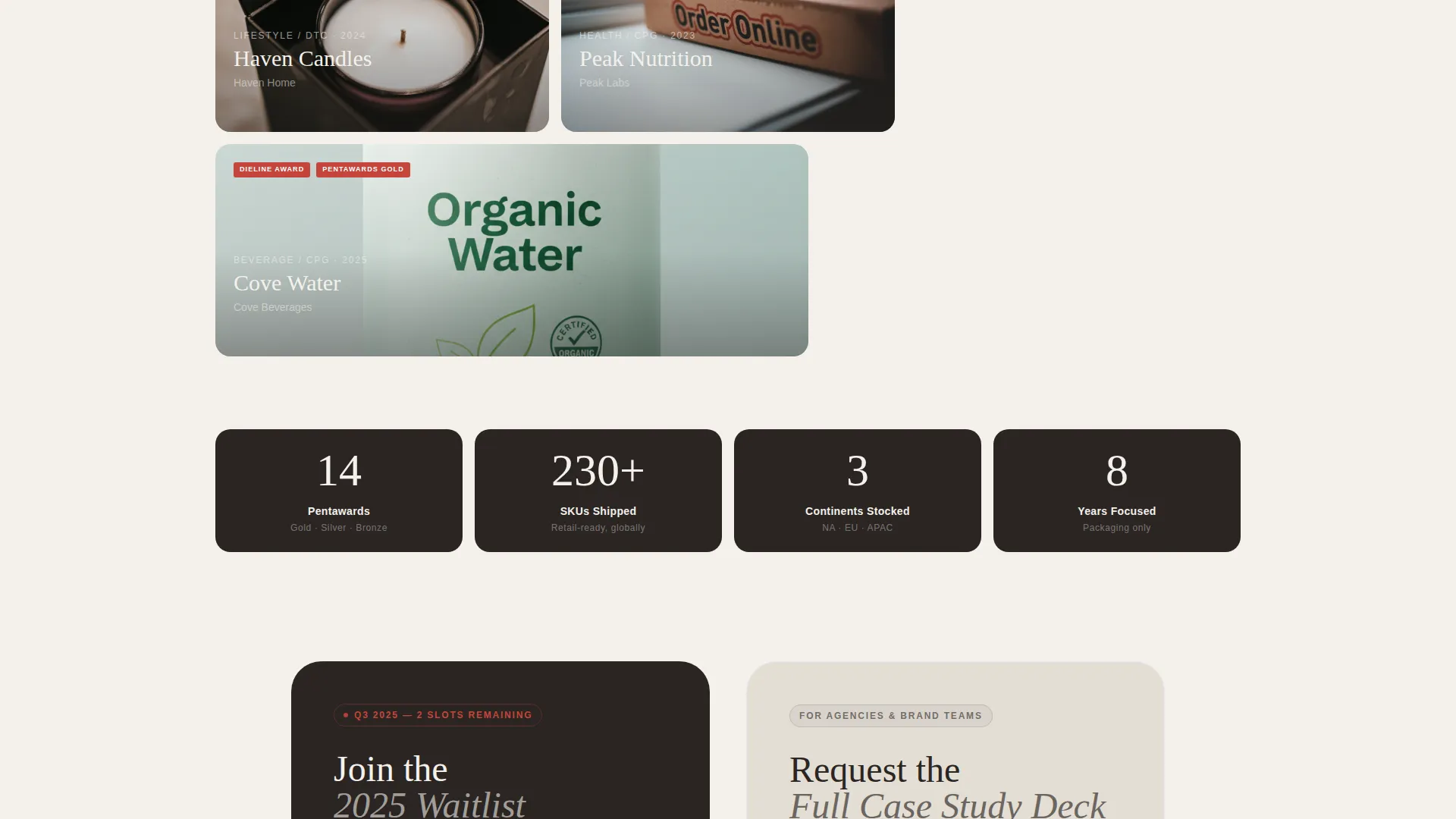
Project cells are not uniform. Award-winning work occupies double-wide or double-tall tiles. Each cell carries a small red award badge. Clicking any cell expands it in place, revealing the jury citation, a before-and-after brand comparison, and a tight material-detail crop.
In-Page Stat Interstitials
Single-stat panels are placed between grid clusters. Each number counts up as it enters the viewport. These interstitials act as credibility checkpoints, reinforcing the designer's scope of work without interrupting the visual flow of the grid.
Sticky Waitlist Email Capture
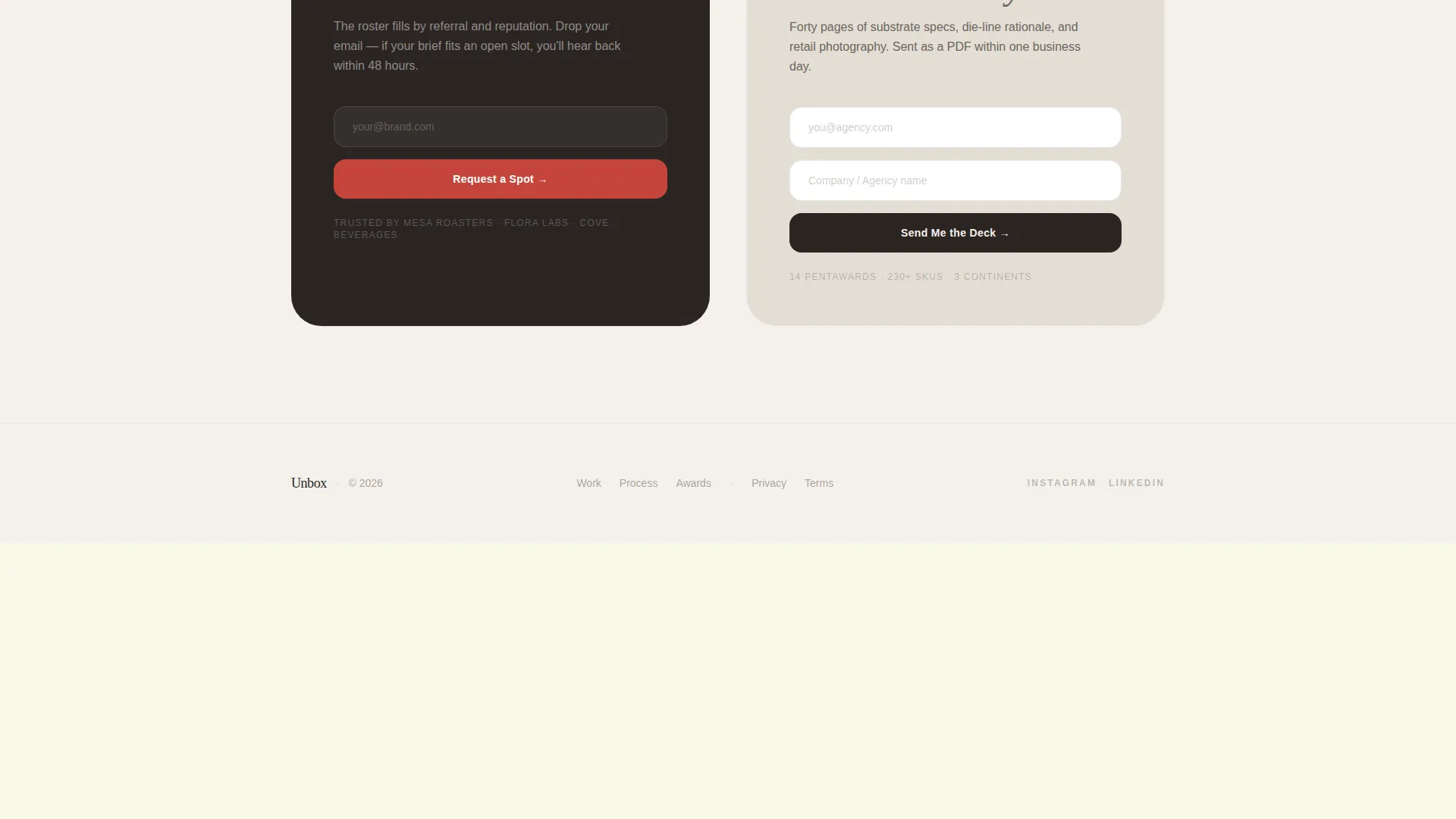
A single-field email bar appears as a sticky element after the visitor scrolls past the third section. Microcopy reads "Currently booking Q3, leave your email and we'll reach out when a slot opens." The bar stays accessible without blocking content.
Agency Case Study Request Path
Below the main grid, a secondary conversion path invites agencies to request the full case study deck. The form collects an email address and company name. This separates agency-level inquiries from individual client waitlist sign-ups.
Scarcity-Driven Conversion Structure
The page is structured so that awards build proof, interstitial stats reinforce demand, and the waitlist closes the loop. The 2025 roster framing and "Q3 booking" microcopy make the scarcity message feel factual rather than manufactured.
Page sections overview
| Section | Purpose |
|---|---|
| Animated header hero | Introduce the designer with a structural dieline animation and typed headline |
| Award bento grid | Display project work with variable tile sizing and red award badges |
| In-page stat panels | Reinforce credibility with counting-up statistics between grid clusters |
| Expanded case study | Show jury citations, before-and-after brand views, and material detail on click |
| Sticky waitlist bar | Capture email leads with scarcity-led microcopy after the third scroll |
| Agency request path | Collect agency inquiries via email plus company name form |
Design & branding system
The visual identity follows a Lens and Frame theme built on the Cloud Canvas color system. The palette is drawn from the environment of a professional product photography studio: neutral enough to let the packaging work speak, warm enough to feel handcrafted.
- Core colors: gallery white (#F4F1EC), warm shadow gray (#6B6560), matte board cream (#E3DDD4)
- Accent color: exhibition red (#C4453C), used exclusively for award badges and hover states
- Typography and layout feel architectural, with precise structure that mirrors structural packaging design thinking
Mobile & speed optimization
The template is designed to remain legible and navigable on smaller screens. The bento grid and animated header are built with mobile viewing in mind, so the experience holds together whether a visitor arrives from a desktop or a phone.
- Bento grid tiles reflow cleanly on narrower viewports without losing the award badge markers
- The sticky waitlist bar remains accessible on mobile without covering critical content
- The animated dieline header is designed to complete within the first viewport without requiring interaction
How this template helps you convert
The page is structured as a deliberate sequence. Each layer builds on the last, moving the visitor from curiosity to confidence to action.
- The animated header and award-badged grid establish the designer's credibility before any text is read in depth
- Counting-up stat interstitials reinforce the scale and recognition of the body of work as the visitor scrolls
- The sticky waitlist bar and scarcity microcopy give a motivated visitor an immediate, low-friction action to take
Other information about this template
This template is a strong fit for packaging designers who work across consumer packaged goods, beverage and spirits, and direct-to-consumer product categories. The award-recognition creative direction makes it particularly suited to designers who have received recognition from programs such as Pentawards, the Dieline Awards, or D&AD. The scarcity-first conversion structure is well matched to designers who want to control inbound volume rather than simply attract it. The bento grid layout is also a practical format for studios that handle a diverse range of structural formats, from folding cartons to rigid boxes to flexible packaging.
- Works well for designers whose client base includes CPG brand managers launching new stock-keeping units
- Suited to practitioners who work with boutique spirits founders and direct-to-consumer brands
- The waitlist and agency dual-path structure supports both individual client and studio-level inquiry management
Theme
Lens & Frame
Creative direction
Award & Recognition
Color system
Cloud Canvas
Style
Bento Grid
Direction
Waitlist/Coming Soon
Page Sections
Animated Dieline Header
Variable Bento Project Grid
Counting-up Stat Interstitials
Sticky Waitlist Email Bar
Agency Case Study Request Form
Scarcity-driven Page Structure
Related questions
Can I show different types of packaging work in the same grid?
How does the in-place case study expansion work?
Is the sticky waitlist bar always visible while scrolling?
Can agencies and individual clients use the same landing page?
Does this template work best only for designers with major award recognition?