Education Foundation Landing Page Template
Uplift is a modular card-grid landing page built for education access community foundations. It speaks directly to school district superintendents, corporate giving directors, and local business owners. The Desert Rose color system, a serif manifesto hero, and flip-card pillars work together to move visitors from conviction to partnership inquiry in a single, purposeful scroll.
by Rocket studio
Quick summary
Uplift is a single-page foundation template designed to open conversations with the people who can move resources toward first-generation college students. It pairs a scroll-revealed manifesto hero with a modular flip-card grid, a bento-style impact stats section, and a partnership inquiry form. The result is a page that feels like a commencement ceremony and reads like a call to action.
Who this template is for
This template speaks to organizations closing the college opportunity gap for students in underserved communities. It is built for teams that need to earn the trust of decision-makers before asking for a commitment.
- Education access foundations and college-readiness nonprofits seeking partnership leads
- Development teams targeting school district superintendents and corporate CSR (Corporate Social Responsibility) directors
- Community foundations that want their impact data to tell a story, not just fill a table
What problem this template solves
In many communities, guidance counselors carry caseloads of hundreds of students. Scholarship deadlines pass without notice. Families navigating college applications have no map. A foundation working in this space needs a page that earns credibility fast and makes the ask feel meaningful, not transactional.
- Partners and donors land on pages that look like grant forms, not movements
- Impact numbers exist in PDFs nobody downloads and reports nobody reads
- The partnership ask gets buried or feels disconnected from the mission story
What you get with this template
You get a fully structured, single-page layout that moves visitors through conviction, evidence, and invitation. Every section serves a purpose in that narrative arc.
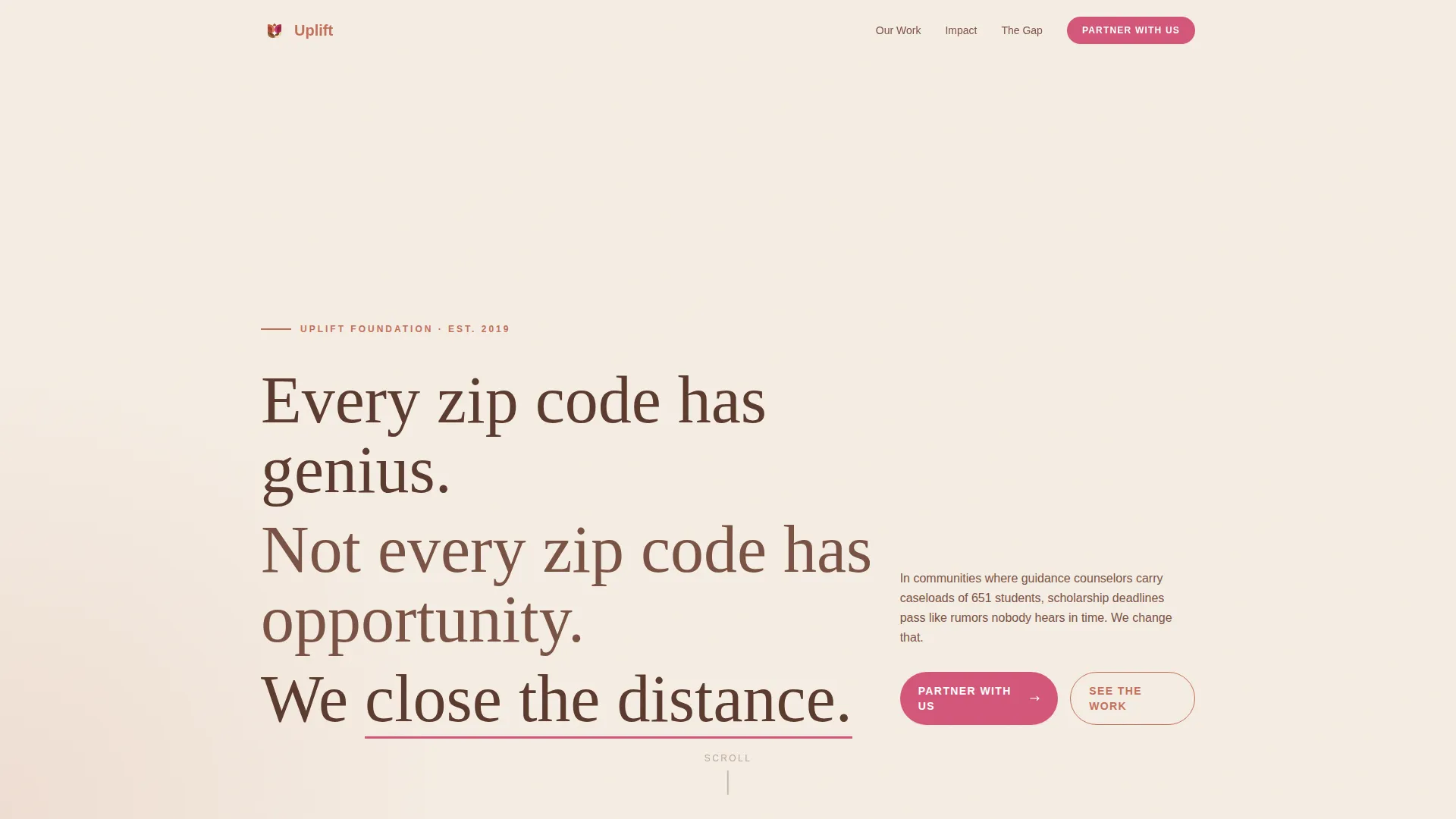
- A full-viewport manifesto hero with line-by-line scroll-reveal animation and a magenta accent underline on the closing phrase
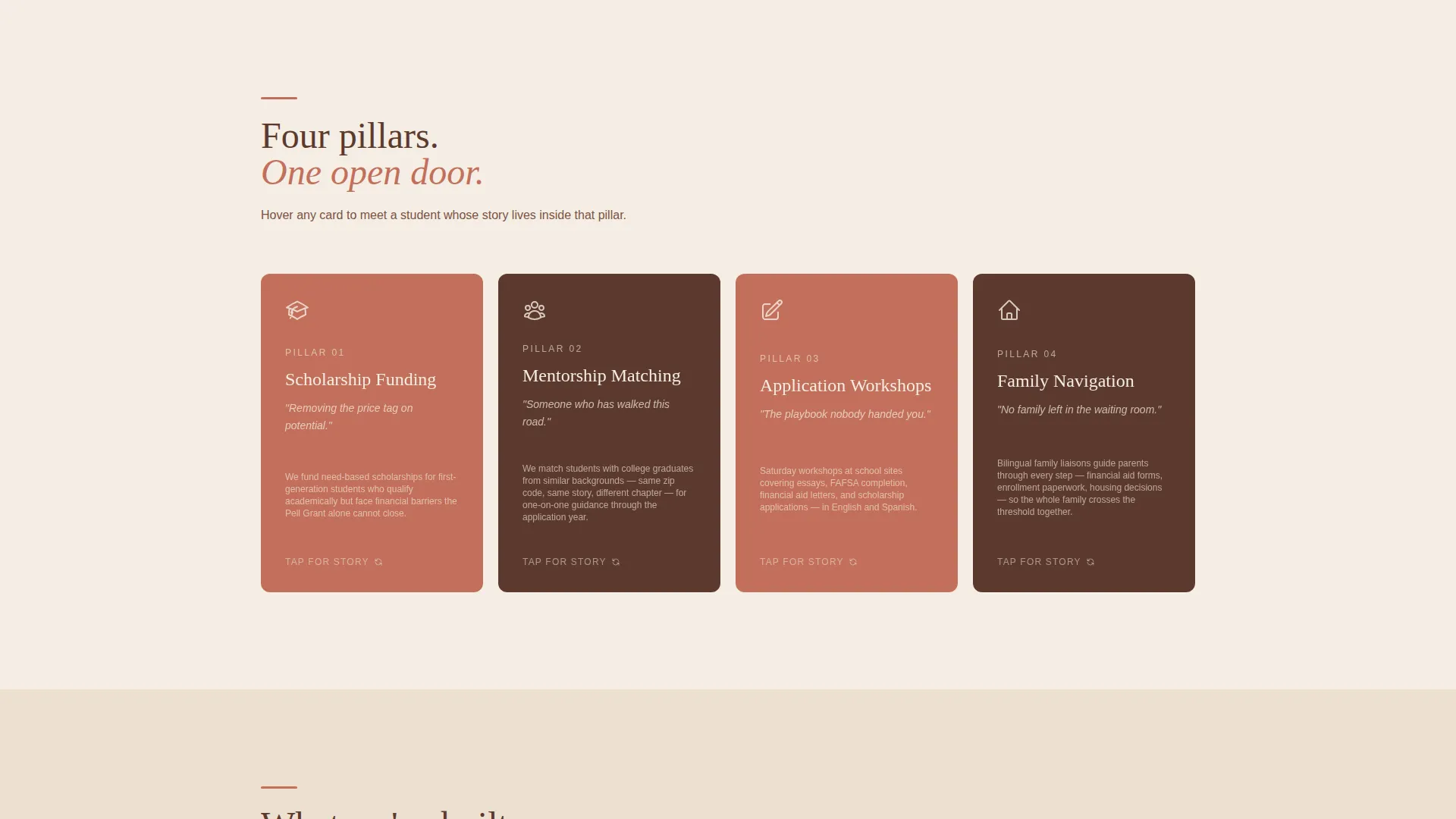
- A four-card flip grid representing scholarship funding, mentorship matching, application workshops, and family navigation support, with student stories and outcome numbers on the reverse
- A lead generation form card embedded in the final grid row, plus a secondary "Download Our Impact Report" call to action
Feature list
This template's capabilities are grounded in its source brief. Every feature below reflects a built component described in the project details.
Scroll-Reveal Manifesto Hero
The hero fills the full viewport with large Fraunces serif type on parchment cream. Text lines appear one by one as the visitor scrolls, creating a breathing rhythm before the page opens downward. Cactus bloom magenta underlines the closing phrase for emphasis.
Flip-Card Pillars Grid
Four modular cards each represent a pillar of the foundation's work. On hover, each card flips to reveal a single student story paired with a specific outcome number. The staggered grid entrance animation reinforces the sense of a mosaic being built.
Bento-Style Impact Stats Section
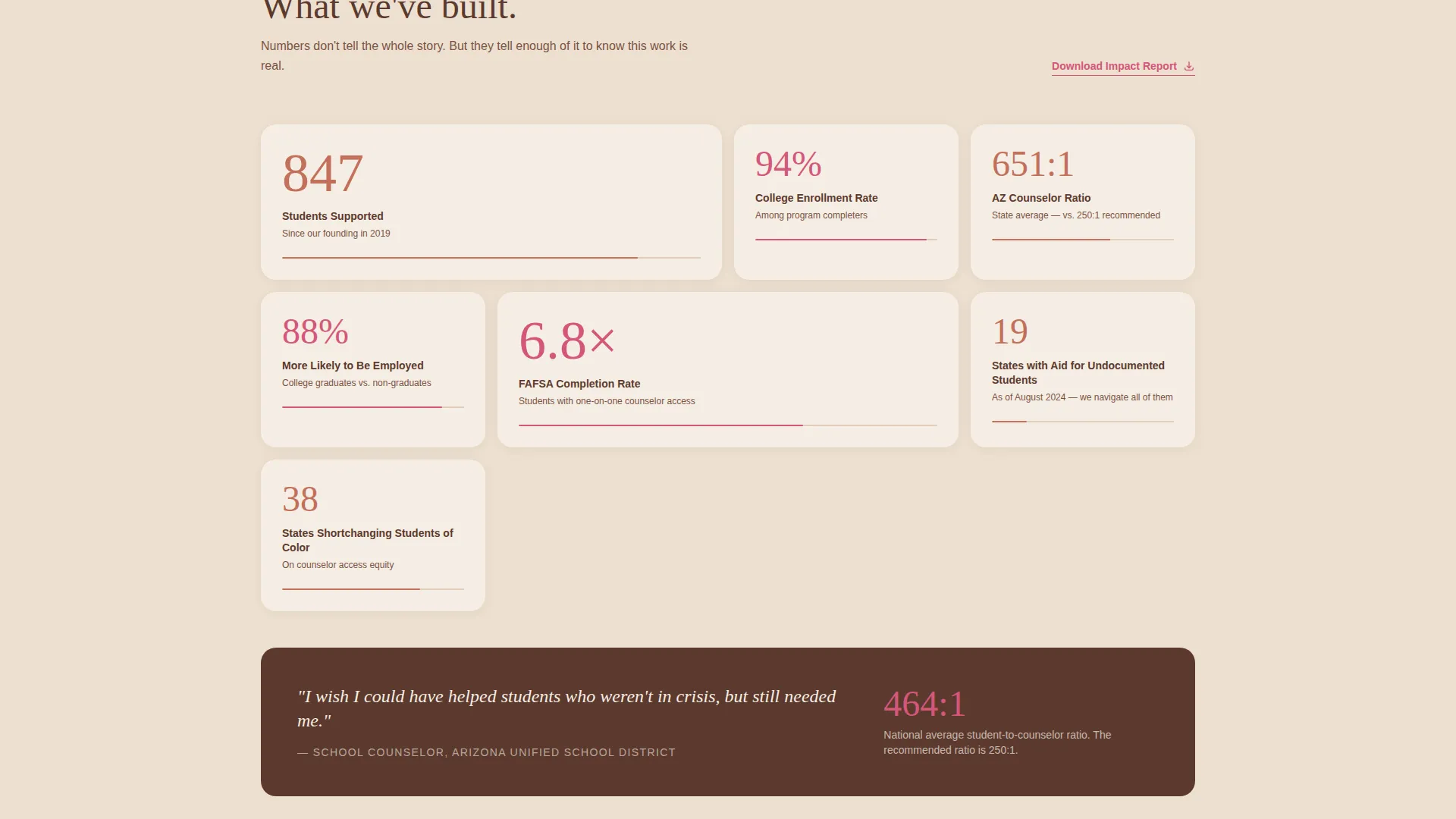
Key data points surface in a bento-style grid layout. Impact numbers such as FAFSA completion rates, post-graduation employment figures, and counselor-to-student ratios appear in cactus bloom magenta to draw the eye exactly where it needs to land.
Equity Gap Narrative Section
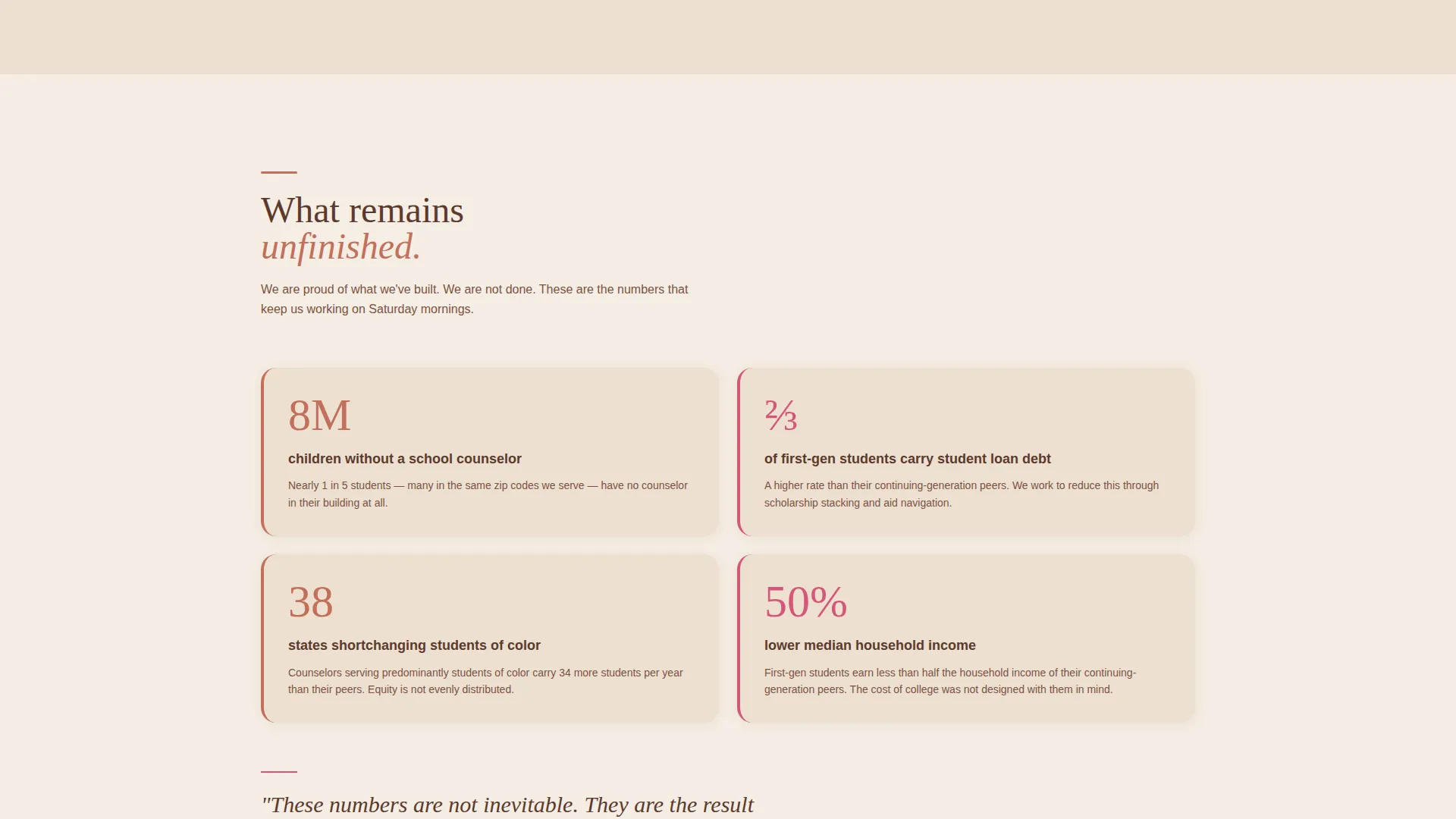
A dedicated "What Remains" section frames the unfinished work in plain language. This section shifts the page's arc from evidence to invitation, showing visitors that the foundation is honest about what still needs doing.
Embedded Partnership Form Card
The inquiry form sits inside a grid card that is visually equal to the surrounding impact cards. It asks for name, organization, a role dropdown (school leader, corporate partner, individual donor, or other), and one open field: "What draws you to this work?" This framing makes partnership feel like joining a community rather than completing paperwork.
Secondary Impact Report Download
A second call to action offers "Download Our Impact Report" for visitors who are not yet ready to fill out the form. This gives cautious but interested visitors a low-commitment way to stay connected to the foundation's story.
Page sections overview
| Section | Purpose |
|---|---|
| Manifesto Hero | Opens with a full-viewport scroll-revealed serif statement |
| Pillars Flip Grid | Four cards showing foundation work pillars and student outcomes |
| Impact Evidence Bento | Displays key statistics in a scannable data grid |
| What Remains Narrative | Frames unfinished equity work as an open invitation |
| Partner call to action Row | Embeds the inquiry form alongside impact cards in the final row |
| Impact Report call to action | Secondary download path for visitors not ready to commit |
| Footer | Logo and tagline on the left, navigation links on the right |
Design & branding system
The visual identity follows a Civic Service theme rooted in the Desert Rose color system. Every color choice carries meaning. The palette feels earthy, dignified, and alive with quiet urgency.
- Parchment cream (#F5EDE3) grounds every background; terracotta (#C2705B) anchors headlines and section dividers; adobe brown (#5C3A2E) carries body text with weight
- Cactus bloom magenta (#D4567A) appears only on buttons, impact numbers, and the hero accent underline, so the eye lands exactly where action lives
- Typography pairs Fraunces serif for headlines with DM Sans for body text, creating a contrast between ceremony and clarity
Mobile & speed optimization
The template is built desktop-first, reflecting the reality that superintendents and CSR directors most often review materials on laptops and tablets. The layout adapts cleanly for smaller screens without sacrificing the narrative flow.
- Card grid reflows into a single-column stack on mobile so flip interactions remain usable on touch devices
- Server Components handle static content while Client Components manage animations, keeping the interactive sections responsive without overloading the page
How this template helps you convert
Every structural decision on this page is designed to reduce friction and build trust before the ask arrives. The page does not open with a form. It opens with a statement.
- The scroll-reveal hero creates emotional investment before any call to action appears, so visitors arrive at the form already aligned with the mission.
- Flip cards surface student stories and outcome numbers together, giving corporate partners and school leaders the evidence they need to justify their interest internally.
- The embedded form card sits visually equal to impact cards, so filling it out feels like joining the work rather than responding to a solicitation.
Other information about this template
This template is part of a broader set of community-focused foundation layouts designed for nonprofit and civic organizations. A few additional details worth noting:
- The page is localized for a United States context, with English copy, USD references, and a desert Southwest visual sensibility drawing from Arizona and Utah landscapes
- The footer follows a split layout with the foundation logo and tagline on the left and navigation links on the right
- Animation intensity is set to high by design, with scroll-triggered reveals, card flips, and staggered grid entrances all included as built behaviors
- The template is well-suited for organizations preparing annual giving campaigns, partnership drives, or community impact report launches
Theme
Civic Service
Creative direction
Vision & Mission
Color system
Desert Rose
Style
Card Grid (Modular)
Direction
Lead Generation
Page Sections
Scroll-reveal Manifesto Hero
Flip-card Pillars Grid
Bento-style Impact Stats Section
Equity Gap Narrative Section
Embedded Partnership Form Card
Secondary Impact Report Download
Related questions
Who is the primary audience this landing page is built to reach?
Can I customize the flip cards with my own student stories and outcome numbers?
What does the partnership inquiry form ask visitors to provide?
Is there an option for visitors who are not ready to fill out the form?
Can this template be adapted for a foundation outside the desert Southwest context?