Curated Antique Pottery Landing Page Template
Kiln is a single-page antique pottery landing page template built for curators, dealers, and collectors who sell rare ceramics online. It blends countdown urgency, overlapping vault-release cards, and a Collector's Tier upsell into one cohesive scroll experience. The Neo-Retro Cloud Canvas palette and Dutch Golden Age still-life photography direction make every piece feel like a discovery worth acting on immediately.
by Rocket studio
Quick summary
Kiln is a curated vault release landing page template designed for antique pottery and china dealers who need more than a standard shop layout. It combines a cinematic hero countdown, layered vault-release card sections, a floating Collector's Tier upsell banner, and per-piece scarcity signals into one gallery-quality, scroll-driven page. The result feels less like a product listing and more like an auction room two minutes before the hammer falls.
Who this template is for
This template speaks directly to people who deal in objects with history. Whether you source from estate sales, European dealers, or private collections, Kiln gives your inventory the presentation it deserves. Interior designers, serious collectors, and boutique dealers all find a home here.
- Antique pottery and china dealers who sell hand-sourced porcelain, transferware, and stoneware through timed vault releases and need urgency built directly into the page layout.
- Interior designers and stylists hunting statement ceramic pieces for editorial shoots, who make quick decisions based on visual quality and provenance clarity.
- Collectors and gallery buyers chasing specific patterns, marks, or eras who respond to scarcity signals, per-piece viewer counts, and authenticated provenance dossiers.
What problem this template solves
Rare ceramics deserve a presentation that matches their rarity. Generic shop pages bury exceptional pottery under flat grids and stock-style layouts. Buyers who understand the difference between Kangxi blue-and-white porcelain and a reproduction need a page that signals expertise before a single word is read. Kiln solves the gap between gallery-quality inventory and gallery-quality presentation.
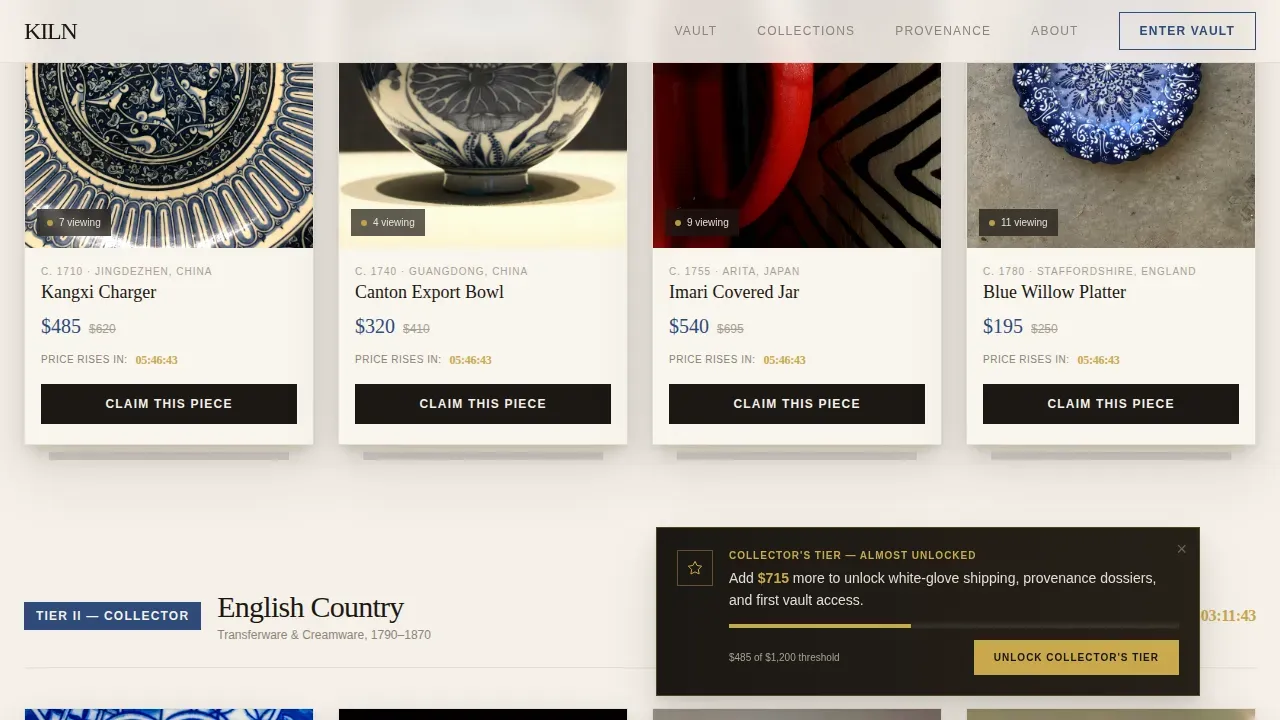
- Urgency is invisible on standard pages. Kiln builds countdown timers and live viewer counts directly into every vault-release card, so the scarcity that already exists in your inventory becomes visible to every visitor.
- Collector trust is hard to establish digitally. Provenance dossier callouts, condition-report details, and testimonial fragments tucked between card layers replicate the trust signals of a real dealer relationship.
- Upselling feels clunky in traditional layouts. The floating Collector's Tier banner appears contextually, at the exact scroll depth where your rarest and most valuable pieces are revealed.
What you get with this template
Kiln is a fully structured landing page template with every section, interaction, and visual detail defined in the brief. You receive a ready-to-adapt layout that brings together cinematic still-life art direction, live-countdown interactivity, and an overlapping card system that rewards the scroll.
- Six purpose-built page sections covering the hero countdown, vault releases, Collector's Tier banner, testimonials, rare pieces, and a split footer, each designed with the antique ceramics audience in mind.
- A complete visual identity system built on the Cloud Canvas color palette, Fraunces serif display typography, and DM Sans body text, delivering a Neo-Retro gallery aesthetic that positions your pottery as collectible art.
- High-interactivity components including GSAP ScrollTrigger staggered card reveals, per-card micro-countdowns, a cart-threshold floating banner, hover states in fired-gold, and live viewer counts per piece.
Feature list
The following features are built into the Kiln template as described in the source brief. Each one serves a specific conversion or presentation function for the antique pottery and ceramics dealer audience.
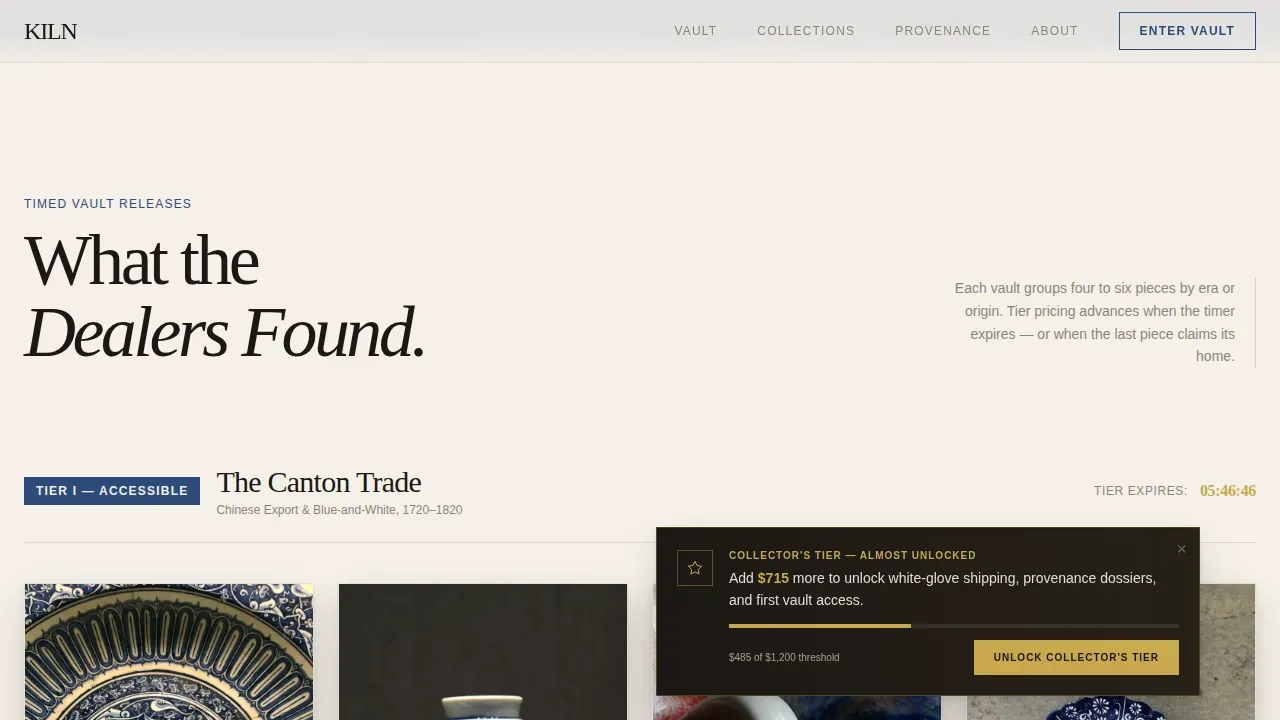
Cinematic Hero with Countdown Timer
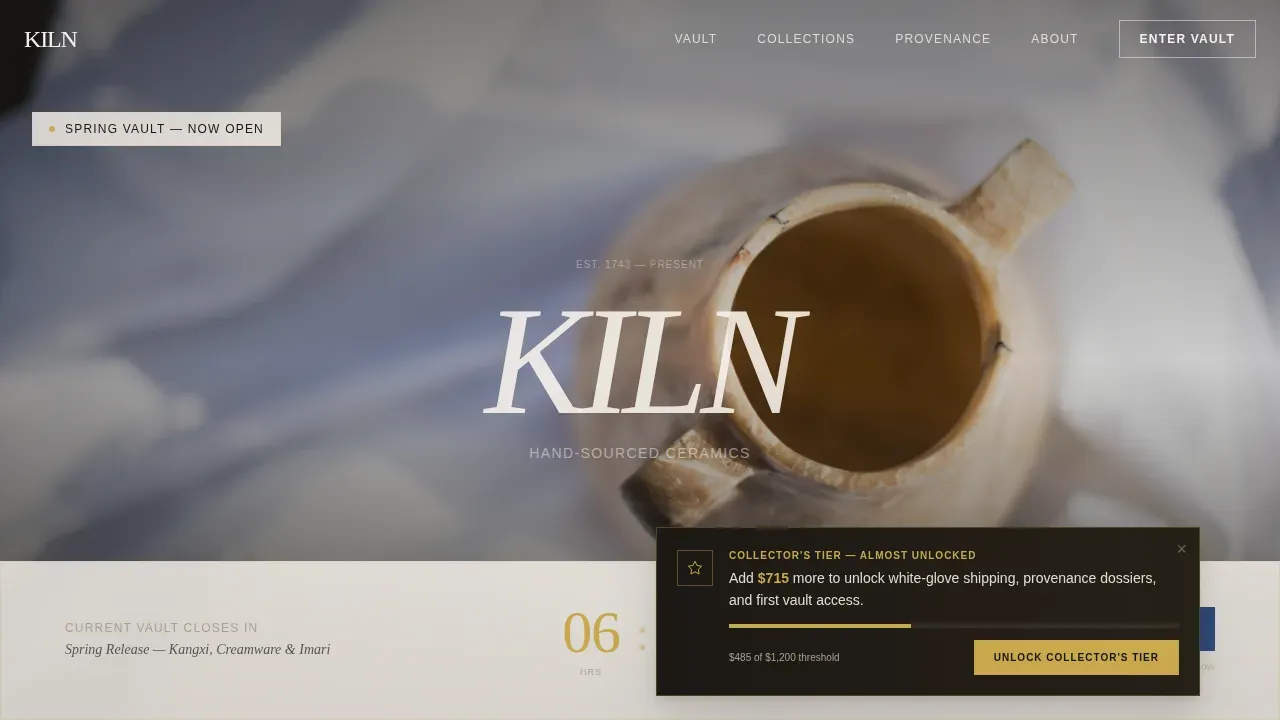
The hero section opens on a close-up still-life photograph styled after Dutch Golden Age painting. Three ceramic pieces, including a Kangxi blue-and-white charger, a creamware jug, and an Imari bowl, are arranged on rumpled Irish linen and shot from slightly above. A countdown timer floats over the image in fired-gold serif numerals against a translucent parchment band. No headline competes with the objects. The timer and the still-life create auction-room tension from the first frame.
Vault Release Cards with Micro-Countdowns
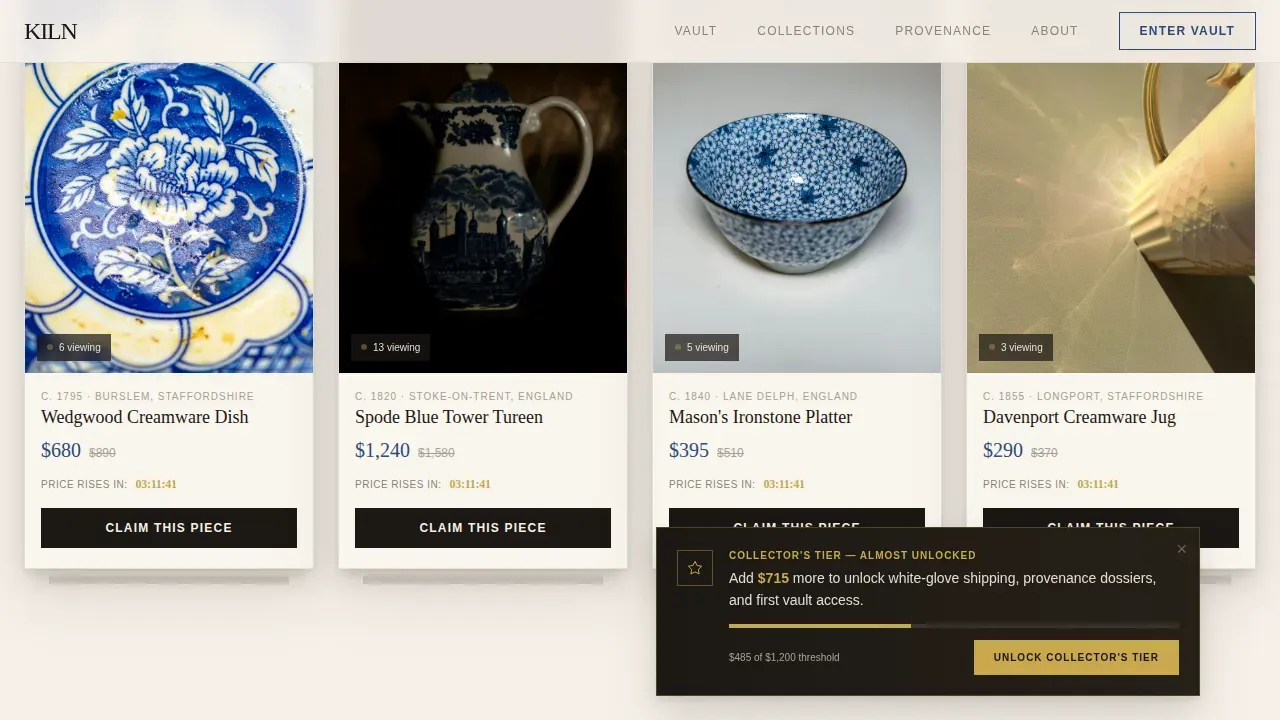
Below the hero, layered and overlapping cards slide into view using GSAP ScrollTrigger staggered animation. Each card group represents a curated vault release of four to six ceramic pieces grouped by era or origin. Every card carries its own micro-countdown showing hours remaining at the current tier price. Card edges overlap deliberately, letting visitors glimpse the next piece before they arrive at it. The scroll becomes an act of discovery, moving from accessible ironstone platters toward rare majolica and early Delft.
Floating Collector's Tier Upsell Banner
A contextual floating banner appears when visitors reach the rarest pieces in the page scroll. The banner targets buyers who already have items in their cart or on their wishlist, offering a Collector's Tier upgrade that unlocks free white-glove shipping, a provenance dossier for every piece, and first-access to the next vault release. The cart threshold trigger is the activation condition. The primary call to action reads "Unlock Collector's Tier" in fired-gold and appears at precisely the right moment in the scroll journey.
Per-Piece Scarcity and Social Proof Signals
Every individual vault-release card shows a live viewer count, displaying how many collectors are currently viewing the same piece. A secondary call-to-action button, "Claim This Piece," sits on each card for a single click-to-cart interaction. A small line beneath each timer shows when current-tier pricing expires. Together these signals replicate the feel of a competitive auction room and reward decisive buyers without resorting to heavy-handed copy.
Testimonial Layers Between Cards
Testimonial fragments from past buyers are embedded between card layers, styled like handwritten dealer notes tucked into a flat-file drawer. Quotes are specific and pattern-aware, for example: "I've never found a complete Willow set in this condition." This placement reinforces scarcity and authenticity without breaking the visual rhythm of the page. The testimonials sit at the same scroll depth as the transitional moments between vault releases.
Split Footer with Logo and Navigation
The footer follows a split layout with the brand logo and tagline on the left and navigation links on the right. This clean separation keeps the page grounded without adding visual noise. The footer does not compete with the gallery content above it.
Page sections overview
| Section | Purpose |
|---|---|
| Hero Countdown | Opens with a cinematic still-life photograph and a floating fired-gold countdown timer to create immediate auction-room tension |
| Vault Release Cards | Overlapping, layered card groups reveal curated ceramic collections by era or origin, each with its own micro-countdown and tier pricing |
| Collector's Tier Banner | A floating upsell banner appears contextually at the scroll depth of the rarest pieces, offering white-glove shipping and provenance dossiers |
| Buyer Testimonials | Specific collector quotes are embedded between card layers like dealer notes, reinforcing authenticity and scarcity signals |
| Rare Pieces Showcase | Escalating rarity section with per-card "Claim This Piece" calls to action, live viewer counts, and current-tier pricing timers |
| Arc Split Footer | Logo and tagline on the left, navigation links on the right, clean and unobtrusive |
Design & branding system
Kiln uses a Neo-Retro visual identity that feels like a curator's flat-file drawer translated into a web page. The Cloud Canvas color system layers soft parchment over muted stone, with flashes of hand-painted cobalt blue peeking through where cards overlap and shift. Sections stack like saucers in a cabinet, each casting a subtle shadow on the one beneath. Fired-gold is reserved for the moments that demand a decision: hover states, countdown numerals, pricing callouts, and the primary call-to-action button.
- Color palette: Soft parchment (#F5F0E8), kiln-ash gray (#A8A093), cobalt underglaze blue (#2E4A7A), and fired-gold accent (#C9A84C) for hover states, timers, and pricing callouts.
- Typography: Fraunces (serif display) for headings and countdown numerals; DM Sans (sans-serif) for body copy and card descriptions, pairing gallery weight with reading clarity.
- Visual style: Neo-Retro with Dutch Golden Age still-life photography direction; overlap and layering at the structural level; linen backdrops, muted stone, and warm side-light photography create the feel of lifting a piece from tissue paper in a quiet back room.
Mobile & speed optimization
The template is desktop-first by design. The target audience, interior designers and serious collectors, typically browses on large screens during editorial shoots, studio sessions, or research hours. The layout, typography scale, and card overlap system are calibrated for wide viewports where the full layered composition reads as intended.
- Desktop-first layout priority: Card overlap depth, countdown timer placement, and the floating Collector's Tier banner are all optimized for large-screen viewing, where the full Neo-Retro gallery aesthetic is most legible.
- Performance architecture: Server Components handle static content sections such as the hero photograph, typography, and footer. Client Components manage the interactive elements: live countdown tickers, viewer counts, and the cart-threshold banner trigger. This division keeps the interactive-heavy page responsive.
How this template helps you convert
Every scroll decision in Kiln is a conversion decision. The template is engineered around three compounding conversion levers: auction-room urgency, escalating rarity, and a contextual upsell that appears only when a buyer is already engaged. The result is a page where the design itself earns the click, not the copy.
- Countdown urgency at every level. The hero countdown sets the tone at entry. Per-card micro-countdowns keep that urgency alive through every vault release group. When current-tier pricing expires visibly and a line beneath the timer shows live viewer counts, the cost of waiting becomes concrete. This is the same principle that makes a real auction room work, applied to the scroll.
- Escalating rarity rewards the scroll. Accessible ironstone and transferware pieces appear first, lowering the entry point. As visitors scroll deeper, the pieces shift toward rare majolica, early Delft, and estate-sourced porcelain. The overlapping card edges let buyers glimpse what is beneath before they arrive, creating forward momentum that keeps the page session alive.
- The Collector's Tier upsell converts cart-builders into high-value buyers. Visitors who are already adding pieces encounter the floating banner at exactly the moment they reach the rarest items. The offer, white-glove shipping, a provenance dossier, and next-vault first-access, is meaningful to serious collectors. The cart threshold makes the upgrade feel earned rather than pushed.
Other information about this template
Kiln sits at the intersection of the visual arts, luxury antique commerce, and high-interactivity web design. Understanding the broader world of ceramics, pottery history, and collector culture helps explain why each design decision in this template exists and how it can serve a range of related use cases.
Antique pottery serves as a historical record, reflecting the cultural practices and social structures of the societies that created them. The artistic styles and techniques used in antique pottery can provide insights into the technological advancements and aesthetic values of past cultures. When you present a piece of Kangxi porcelain or an early Staffordshire figure on a page like this, you are presenting centuries of civilization compressed into a glaze and a form. The template's editorial photography direction and provenance dossier callouts honor that weight.
Contemporary artists often draw inspiration from antique pottery, using it as a foundation to explore modern themes and cultural narratives. The process of creating pottery has historically been a communal activity, fostering social bonds and cultural identity among participants. Antique pottery often embodies the spiritual beliefs and rituals of the cultures that produced it, serving as a medium for expressing religious and cultural identity. The preservation and study of antique pottery contribute to our understanding of historical trade routes and cultural exchanges between different civilizations, including those spanning Asia, England, and the Americas.
The world of studio pottery and antique ceramics overlaps in fascinating ways. A studio potter today who trains at a university program, studies historical techniques such as wood firing, or researches the work of potters from London and York galleries, draws from the same deep well of clay craft that produced the pieces Kiln is designed to sell. Pottery creation techniques include hand-building, wheel-throwing, and slip-casting. Kilns are essential for firing pottery, and different types of kilns can affect the final outcome of the pieces. Wood firing is a traditional technique that can create unique surface effects and colors on the clay. The choice of clay body influences the workability and final appearance of pieces. Glazing techniques vary widely, affecting both the aesthetic and functional qualities of the pottery. Potters often experiment with different firing temperatures and atmospheres to achieve desired effects in their work. The process of creating pottery involves multiple stages, including shaping, drying, firing, and glazing. Pottery techniques can be influenced by cultural traditions and personal artistic expression, including self expression developed through years at a school of craft or a university ceramics program.
Curating pottery collections involves selecting pieces that reflect a cohesive theme or aesthetic. The display of pottery can enhance the visual appeal of a space and create a narrative around the collection. Pottery collections can be curated based on cultural significance, historical context, or personal stories associated with the pieces. The arrangement of pottery in a collection can influence how viewers perceive the individual pieces and their relationships to one another. Lighting plays a crucial role in showcasing pottery collections, as it can highlight textures and colors. Curators often consider the scale and proportion of pottery pieces when displaying them to create a balanced visual experience. Incorporating elements like background colors or complementary decor can enhance the presentation of a pottery collection. Thematic exhibitions can provide context for pottery collections, allowing viewers to engage with the pieces on a deeper level. This is as true for a museum gallery in New York or London as it is for a digital page structured like Kiln.
Digital tools can enhance the design process for pottery by allowing artists to create and visualize their designs before physical production. Using digital templates can help potters keep track of their kiln and firing schedules efficiently. No-code and low-code platforms can empower potters and dealers to create their own online stores and manage their sales without needing technical skills. Digital marketing strategies can help pottery artists reach a wider audience and promote their work effectively. AI-powered applications can assist potters in marketing their work by providing tools for creating production-ready pages without extensive coding knowledge.
Creating a landing page for a kiln-curated vault release of antique pottery requires blending exclusivity and history with modern design principles. Each piece in the vault should have a title, a short description emphasizing history, and a price or a clear details button. A minimalist design is essential to allow the pottery to stand out. Fast loading speed is important for the page to prevent potential buyers from leaving. Landing page templates can help showcase antique pottery effectively. Templates can be customized to highlight unique pieces of antique pottery. Using a well-designed landing page can enhance the presentation of antique pottery collections. Aesthetic design elements are important in landing page templates for antique pottery. Digital tools can assist in creating visually appealing landing pages for antique pottery.
High-resolution photographs should be provided to showcase each piece's texture and imperfections. The goal of the landing page is to make the visitor feel they are discovering a rare treasure. Clear pricing and details should be included, such as dimensions and condition reports for each item. Scarcity indicators such as "Only 1 Available" should be used to enhance urgency. A countdown timer or live stock counter should indicate limited availability of pieces in the vault. A certificate of authenticity should be included to build trust with collectors. Each piece must be confirmed for authenticity regarding age, origin, and condition. A single focused call-to-action should be used, such as "Secure Your Piece" or "Join the Waitlist." Using testimonials from past collectors can help ease buyer friction and build credibility. Urgency can be created using a countdown timer for timed releases to foster a sense of time pressure. To market antique pottery online effectively, high-quality images are essential to showcase the details and craftsmanship of the pieces. Creating engaging product descriptions that tell the story behind each piece can enhance customer interest and connection. Building a unique brand identity can differentiate your antique pottery offerings in a competitive online marketplace. Incorporating storytelling elements in marketing can create a deeper emotional connection with potential buyers. Offering educational content about the history and significance of antique pottery can attract and inform potential customers. Engaging with online communities and forums related to pottery can help build a loyal customer base and increase visibility.
The american ceramic society, along with museum collections and university ceramics programs, has long championed the art of pottery as both craft and cultural record. From the university studios of New York and Boston to the gallery shows of London and beyond, potters and ceramic artists continue to shape how we understand clay, fire, and form. International artists working in ceramics draw on personal histories rooted in their communities, their cultures, and their relationships with earth and materials. The exhibition explores that happen in major gallery spaces, from York to London, often present artworks that have influenced entire generations of clay workers and collectors alike. A second edition of a vault release on a page like Kiln can carry the same anticipatory energy as the opening day of a museum exhibition, with the added clarity of a countdown and a "Claim This Piece" button.
The Kiln template is not just for antique dealers. It can serve any gallery owner, ceramics artist collective, or studio potter group running timed sales, seasonal vault releases, or special exhibition drop events. The potter's wheel, the kiln, the glaze, and the fire all feed into a lineage of ceramic creation that spans every civilization and continent. Whether you are presenting ceramic pieces from Asia, England, or the Americas, or running a seasonal collection drop inspired by a museum exhibition, this template gives your inventory a stage worthy of its stories.
- The template suits dealers sourcing from estate sales, European gallery networks, private collections, and auction houses.
- It can adapt for any ceramics seller running timed vault drops, seasonal releases, or curated collection launches.
- The overlapping card style works equally well for a studio gallery, a group of international artists selling together, or a solo ceramics artist with a timed release of new pots.
- The visual system and interaction model can support shop pages for tiles, sculpture, artworks, and other clay-based objects alongside traditional pottery and porcelain.
- The template is desktop-first but the component architecture allows for responsive adaptation across screen sizes.
- The kiln curated vault release antique pottery landing page template is available on this platform as part of the Auction and Collectibles template library.
Theme
Neo-Retro
Creative direction
Limited Time
Color system
Cloud Canvas
Style
Overlap/Layered
Direction
Upsell/Upgrade
Page Sections
Cinematic Hero with Fired-gold Countdown
Layered Vault Release Card System
Floating Collector's Tier Upsell Banner
Per-card Scarcity and Viewer Count Signals
Embedded Testimonial Dealer Notes
Related questions
Who is the Kiln template best suited for?
Can I customize the color palette and typography?
How does the countdown timer work across the page?
Does the Collector's Tier banner appear automatically?
Can this template support ceramics categories beyond antique pottery?