Verified Offset Carbon Brokerage Landing Page Template
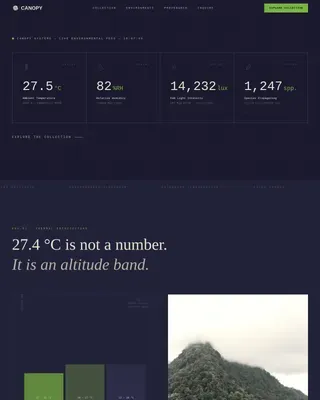
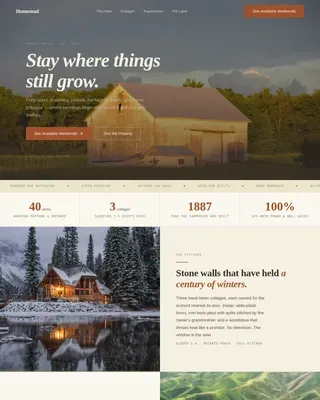
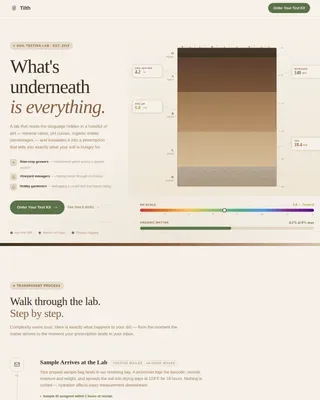
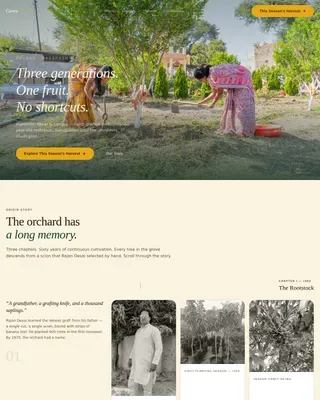
Offset is a full-width immersive landing page template built for verified carbon credit brokerages. It connects reforestation and carbon offset projects with compliance buyers through a living map header, room-by-room scroll architecture, and an inline four-step purchase flow. The design follows a Japanese Zen color system with restrained mineral tones, generous negative space, and high-impact project imagery that builds trust before the transaction.
by Rocket studio
Quick summary
Offset is a single-page, full-width immersive landing page template designed for a verified carbon credit brokerage. It opens with a living satellite-style map, guides visitors through canopy-level project rooms, and closes with a pricing atrium and an inline purchase flow. The template is built to make purchasing carbon credits feel transparent, grounded, and credible.
Who this template is for
This template is designed for B2B-focused carbon credit brokerages that need to build trust quickly with sophisticated buyers. It speaks to organizations operating across both compliance markets and the voluntary carbon market, where credibility and project transparency are everything.
The ideal users of this template include:
- Sustainability officers at mid-cap manufacturers facing Scope 3 reporting deadlines who need to identify and retire verified carbon credits efficiently
- ESG fund managers building net-zero portfolios who need clear project details, vintage data, and registry confirmation before committing capital
- Airline procurement teams purchasing carbon offset volume at scale, who need a fast path from project discovery to bulk order
What problem this template solves
Buyers in carbon markets face a persistent trust gap. The process of purchasing carbon credits often feels opaque: credentials are buried, project documentation is hard to find, and the link between a forest in the Congo Basin and a financial instrument on a compliance desk is never clearly drawn. Greenwashing concerns are real, and organizations need immediate proof of credit integrity before they act.
This template solves that problem by putting the forest first and the instrument second:
- It replaces abstraction with immersion, showing canopy-level imagery, soil health data, and registry certification before any pricing appears
- It makes the compliance framework visible by pairing the carbon offset project on one side of a vertical split with the credit instrument on the other, so buyers can trace the full chain
- It removes friction from the purchase path by containing the entire transaction in an inline four-step flow, so organizations can go from selecting a project to previewing a retirement certificate without leaving the page
What you get with this template
This template delivers a complete, production-ready landing page structure for a carbon credit brokerage. Every section is purposefully sequenced to move a buyer from awareness to purchase while building the trust that carbon markets demand.
Included in the template:
- A full-viewport living map header with pulsing moss-green project nodes scaled to available tonnage, covering active carbon offset projects across multiple continents
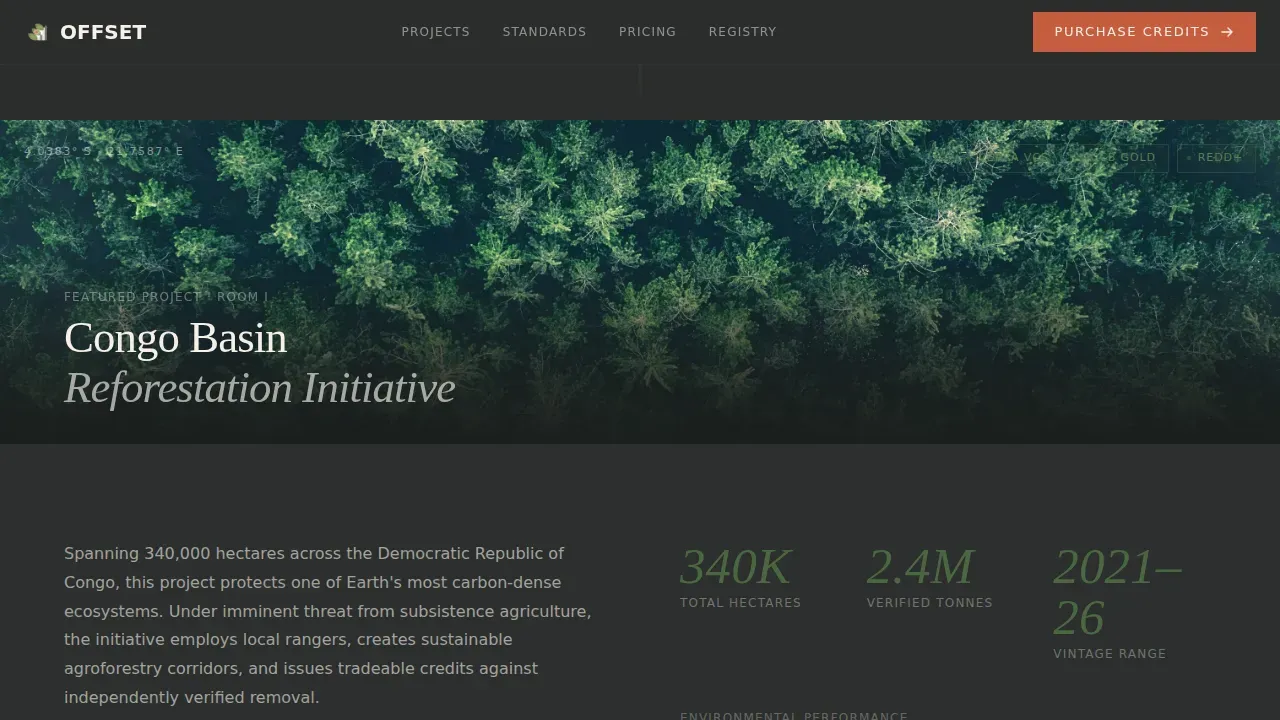
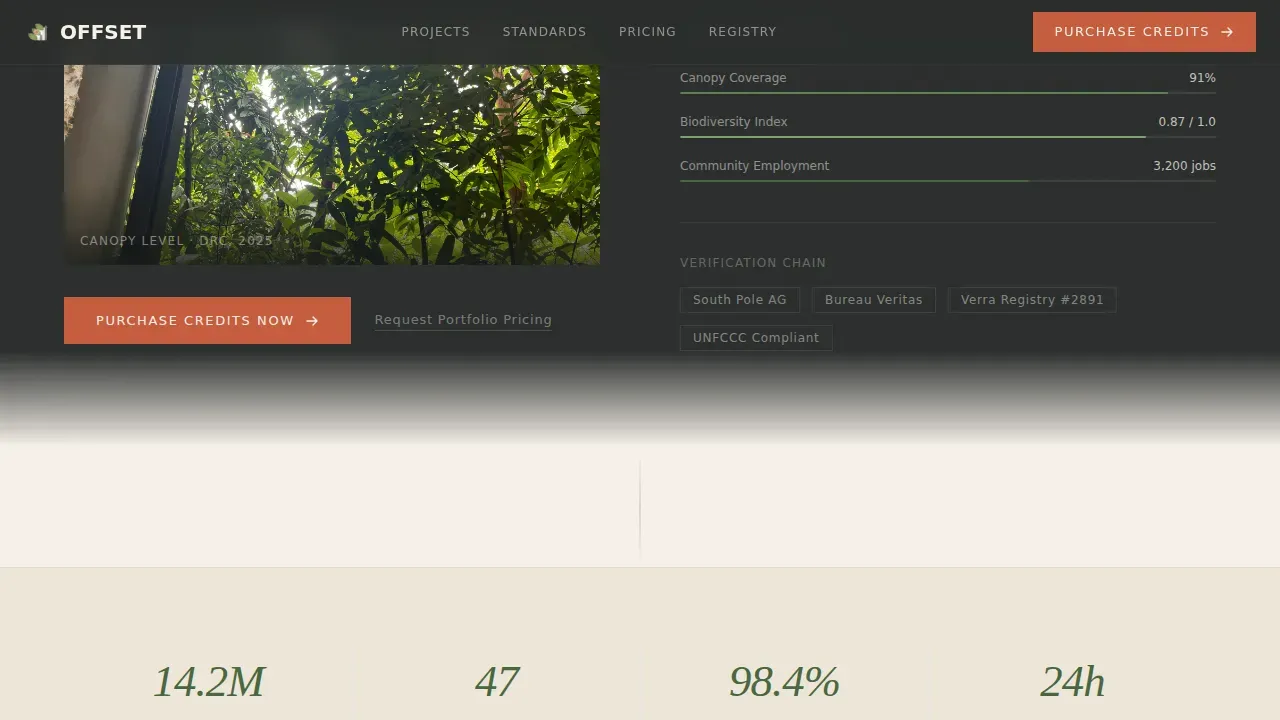
- A Project Room section where satellite imagery crossfades to canopy-level photography, accompanied by soil health indicators, registry certification badges, and project-level detail
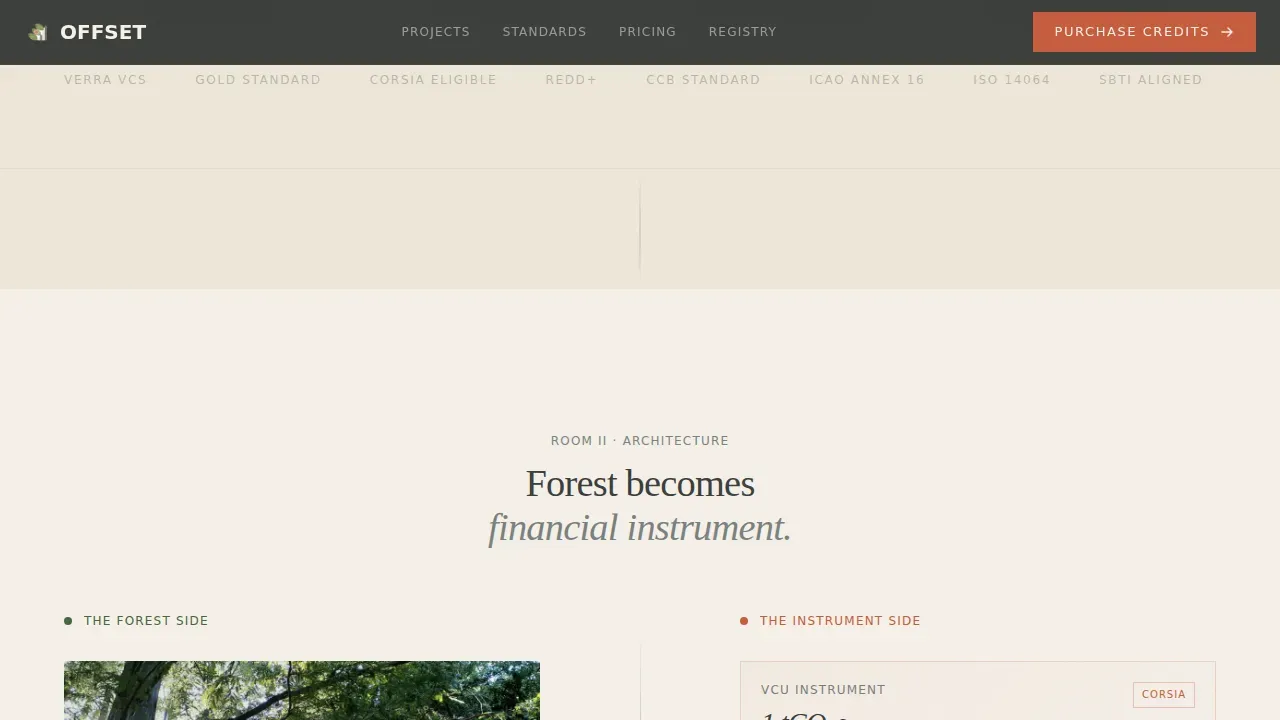
- A Compliance Bridge section built as a vertical split connecting the carbon offset project narrative to the financial credit instrument, supporting understanding across forest and finance
- A Pricing Atrium with floating live inventory cards showing vintage year, volume, standard, and price per tonne in persimmon accent
- An inline four-step purchase flow covering project selection, vintage year, tonnage entry, and retirement certificate preview with no page reload
- A linear single-row footer pattern completing the page architecture
Feature list
This template was developed with specific features that support the complex trust requirements of verified carbon credit brokerage services.
Living Map Header with Pulsing Project Nodes
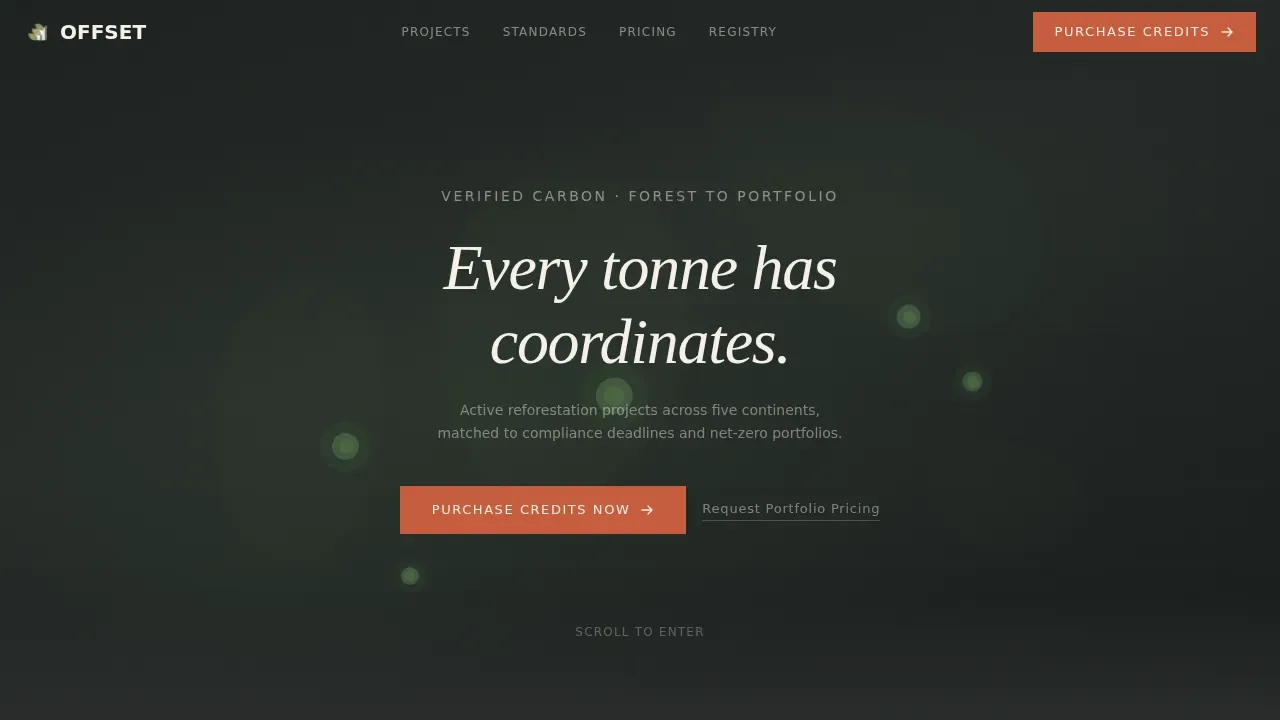
The header occupies the full viewport and renders a satellite-style map in muted Zen tones. Active carbon offset projects pulse as soft moss-green circles, scaled to reflect the tonnage available at each location. The Congo Basin glows. Mangrove restoration along the Sundarbans and Patagonian grassland projects in south america are visually present. A single line of text fades in: "Every tonne has coordinates." This opening creates an immediate sense of scale and geographic specificity that written headlines cannot replicate.
Room-by-Room Scroll Architecture
Each major section of the page is designed as a distinct room the visitor walks through. Generous negative space acts as the threshold between rooms, like passing through a garden gate. This spatial and architectural creative direction keeps the scroll unhurried and deliberate, giving buyers enough time with each idea before the next one appears. The architecture supports understanding at the pace that complex climate action decisions require.
Project Room with Crossfade Imagery and Registry Credentials
The first scroll room pulls the visitor from the map into a single project. Satellite imagery crossfades to canopy-level photography, supported by soil health data and registry certification. This section demonstrates the verified carbon standard behind each credit by showing the project documentation visually rather than as a footnote. Buyers can see the environment they are investing in before they see a price.
Compliance Bridge Section
The second room uses a vertical split layout. One side presents the carbon offset project and its reductions narrative. The other side presents the corresponding credit instrument, showing how a verified tonne of captured carbon dioxide becomes a tradeable asset. This architecture helps sustainability officers and ESG fund managers connect forest-level emission reductions to balance-sheet-ready compliance credits.
Pricing Atrium with Live Inventory Cards
The third room is the pricing atrium. Inventory cards float in space and display vintage year, volume, certification standard, and price per tonne highlighted in persimmon. This format gives buyers the range of available credits at a glance and supports informed decisions without overwhelming detail. Cards can represent a curated mix of nature-based projects, renewable energy credits, and other project types across the portfolio.
Inline Four-Step Purchase Flow
The purchase flow opens inline when the primary call to action is clicked. Buyers select a project, choose a vintage year, enter their required tonnage, and preview a retirement certificate, all in four steps with no page reload. A secondary text link beneath the primary call to action routes bulk buyers to a custom portfolio pricing inquiry. This structure supports organizations purchasing carbon credits at both standard and enterprise scale.
Page sections overview
| Section | Purpose |
|---|---|
| Hero Map Header | Establishes geographic scope and project credibility at first glance |
| Project Room | Immerses buyers in canopy-level detail and registry verification |
| Compliance Bridge | Connects forest-based carbon offset to tradeable credit instrument |
| Pricing Atrium | Displays live inventory cards with vintage, volume, and price |
| Inline Purchase Flow | Guides buyers through a four-step transaction with certificate preview |
| Page Footer | Closes the page with a clean single-row linear pattern |
Design & branding system
The visual identity follows a Garden and Growth theme interpreted through a Japanese Zen color system. Every color choice is deliberate, earned by the context in which it appears, and contributes to the restrained, mineral tone of the overall environment.
The design system includes:
- A four-color palette: raked sand white (#F5F0E8) for backgrounds, moss after rain (#4A6741) reserved for growth indicators and project imagery, wet river stone (#3B3F3E) for text and deep background sections, and persimmon (#C65D3E) used exclusively for price tags, calls to action, and live inventory counts
- Typography built on Fraunces for serif display headings and DM Sans for body text, creating a combination that feels editorial, trustworthy, and easy to scan at compliance-desk reading speed
- High-intensity animation including pulsing map nodes, crossfade scroll transitions, counter animations on tonnage figures, and room-to-room transition effects, all delivered through CSS-first methods and IntersectionObserver for smooth performance without heavy dependencies
Mobile & speed optimization
The template is built desktop-first to serve its primary audience of compliance desk professionals and ESG fund managers who review materials on large screens. A mobile-responsive fallback is included so that users accessing the landing page on other devices receive a properly structured experience.
Key optimization details:
- CSS-first animation approach avoids heavy JavaScript dependencies while preserving the visual richness of the pulsing map, crossfade imagery, and counter effects
- IntersectionObserver drives scroll-triggered room transitions and element reveals, keeping the page feeling alive without forcing unnecessary resource loads
- The inline purchase flow is contained within the page, so there are no full page reloads during the transaction, reducing drop-off between steps
How this template helps you convert
This template is engineered to convert high-consideration B2B buyers by building trust before asking for action. Carbon markets require a different kind of persuasion. Buyers are not impulse purchasers. They are sustainability officers, fund managers, and procurement leads who need to demonstrate environmental responsibility to their own stakeholders before committing.
The conversion path works in three clear steps:
- The living map and project rooms establish credibility by showing the actual carbon offset projects, their registry status, their geographic coordinates, and their soil and canopy-level reality, before any price is mentioned. By the time a buyer reaches the pricing atrium, they have already walked through the canopy and held the verification in their hands.
- The Compliance Bridge section removes the abstraction gap between forest and finance. It visually connects emission reductions in a reforestation project to the credit instrument that a compliance desk can retire. This supports the understanding that purchasing carbon credits through this brokerage is a traceable, verifiable act of climate action, not a speculative one.
- The inline purchase flow removes the friction that causes drop-off. Four steps, no page reload, and a retirement certificate preview close the gap between intent and transaction. The "Request Portfolio Pricing" text link beneath the primary call to action ensures that bulk buyers are not lost. Every user type has a clear next step.
Other information about this template
This template was developed at the intersection of carbon markets and immersive web design, and it carries a specific set of design and content decisions that reflect where carbon credit brokerage services need to go in 2026 and beyond.
Key additional context for buyers evaluating this template:
- The template is built for the verified carbon standard context, where project registration, independent auditing, and registry tracking are the norm. Projects developed under the Verified Carbon Standard (VCS) Program, the world's most widely used greenhouse gas crediting program, must undergo a rigorous assessment process before credits are issued. Each Verified Carbon Unit (VCU) represents one metric tonne of carbon dioxide reduced or removed from the atmosphere, and the Verra registry tracks the generation and retirement of all VCUs for full transparency.
- The American Carbon Registry is one of several recognized programs that project proponents use for project registration and credit issuance. The template's project room and compliance bridge sections are structured to accommodate the display of multiple registry credentials, including Gold Standard and other recognized bodies, helping buyers identify which standard governs each credit they are purchasing carbon credits under.
- The portfolio of carbon offset projects supported by this template's pricing atrium can represent a wide range of project types. These include nature based projects such as reforestation and deforestation prevention, renewable energy projects, landfill gas capture initiatives, methane capture projects that convert waste emissions into usable energy, and energy efficiency upgrades in buildings and industries. This range gives companies the ability to build balanced portfolios that mix project types, geographies such as south america and central Africa, and vintages.
- Methodology developers and project proponents operate under methodology requirements defined by their chosen registry. The template's compliance bridge section creates a visual structure where methodology requirements, project activities, and emission reductions can be clearly attributed, supporting project documentation display without requiring buyers to navigate away.
- The voluntary carbon market faces real challenges around data fragmentation, which increases transaction costs and makes it harder for organizations to assess credit quality. The Carbon Crediting Data Framework (CCDF) is an emerging standard aimed at solving this problem by giving carbon markets a common language for credit data and enhancing transparency across the ecosystem. This template's design anticipates that transparency by making registry status, vintage, and project credentials visible at every stage of the buyer journey.
- Other service providers operating alongside a brokerage, including auditors, methodology developers, and other stakeholders such as local communities in project regions, benefit when the landing page clearly attributes project activities and distinguishes between the project proponent's role and the broker's role. The compliance bridge section creates space for that distinction.
- The template's persimmon accent color is used specifically for calls to action, price displays, and live inventory counts. It does not appear in project imagery or informational text. This deliberate restraint ensures that every touch of color signals an action or a live data point, helping users identify where to engage next.
- Local laws and local communities are relevant context for carbon offset projects that generate co-benefits such as improved livelihoods and biodiversity preservation. The project room section of this template provides space to surface these environmental benefits alongside registry credentials, giving buyers the full picture of what their climate action investment supports beyond the removal of other ghg emissions from the atmosphere.
- The template supports organizations seeking carbon neutrality by providing a full purchase path from project discovery to retirement certificate. Reducing emissions that cannot be avoided through verified carbon offset purchases is a recognized step toward corporate sustainability goals, and this template creates the structure to make that process credible, traceable, and accessible to new buyers who need to make informed decisions quickly.
Theme
Garden & Growth
Creative direction
Spatial & Architectural
Color system
Japanese Zen
Style
Full-Width Immersive
Direction
Direct Sales
Page Sections
Living Map Header with Pulsing Project Nodes
Room-by-room Scroll Architecture
Project Room with Crossfade Imagery and Registry Credentials
Compliance Bridge Vertical Split Section
Pricing Atrium with Live Inventory Cards
Inline Four-step Purchase Flow
Related questions
What types of carbon offset projects does this template display?
How does the inline purchase flow work?
Is this template suitable for both compliance and voluntary carbon market buyers?
How does the template address trust and greenwashing concerns?
Can this template support bulk or enterprise carbon credit purchasing?