Expert Stroke Rehabilitation Landing Page Template
Recover is a hub-and-spoke landing page template built for a clinical stroke recovery nutrition program. It opens with a live nutrition assessment calculator, then guides visitors through five methodology sections covering metabolic assessment, texture mapping, meal architecture, medication-nutrient interactions, and caregiver protocols. A twelve-question quiz funnel earns trust before asking for an email.
by Rocket studio
Quick summary
Recover is a single-page, anchor-nav landing page template designed for a dietitian-led post-stroke nutrition program. It leads with an interactive calculator that delivers real-time sodium targets and anti-inflammatory food scores. Transparent, scroll-revealed methodology sections build clinical trust, while a multi-step quiz funnel converts visitors into program clients or qualified referrals.
Who this template is for
This template is built for practitioners and programs operating at the intersection of clinical nutrition and stroke recovery care. It speaks equally well to solo dietitians and to multidisciplinary rehab teams.
- Registered dietitians offering post-stroke nutrition programs who need to demonstrate clinical depth before asking for a commitment
- Adult children managing a parent's modified-texture diet remotely, who need clear guidance and a way to share resources with the care team
- Speech-language pathologists seeking a structured referral pathway to a dietitian who understands dysphagia-grade protocols
What problem this template solves
Post-stroke clients face a specific and frightening problem: they leave the hospital with a list of restrictions but no actionable plan for the kitchen. Generic nutrition websites offer nothing that speaks to this fear. This template gives a stroke recovery nutrition program a page that matches the clinical weight of the situation.
- Survivors eight weeks post-discharge need more than food lists. They need a program that shows its reasoning, and this template reveals methodology section by section.
- Caregivers managing dietary restrictions from a distance have no easy way to loop in a professional. The secondary "Send This to My Care Team" path solves that directly.
- SLPs looking for a dietitian partner need evidence of modified-texture competence before they refer. The texture mapping and assessment sections provide exactly that.
What you get with this template
The template delivers a complete, production-ready landing page structure with high interactivity and a disciplined visual system. Every section is purpose-built for the stroke recovery nutrition context.
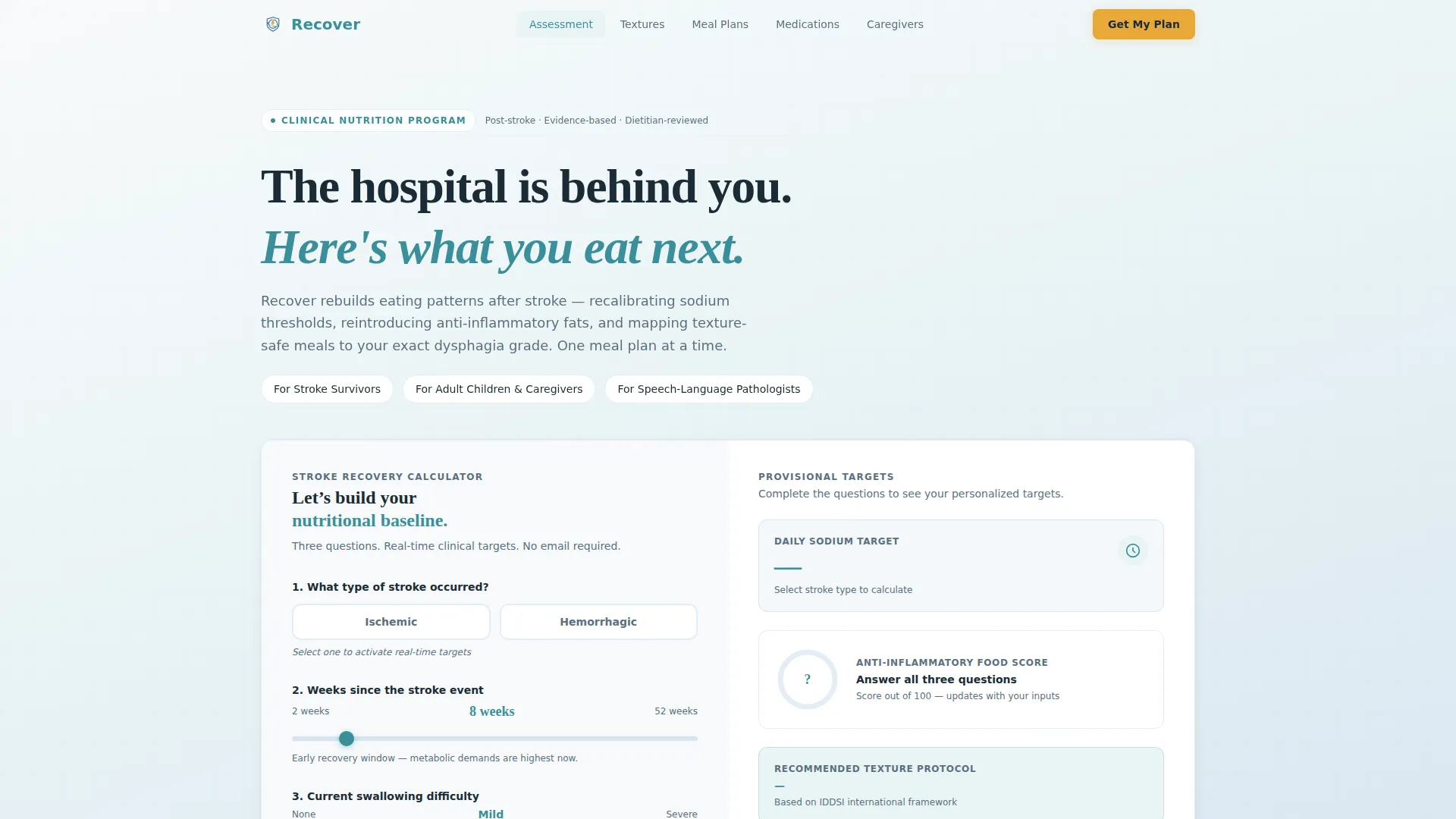
- A live stroke nutrition calculator in the hero section, updating sodium targets and anti-inflammatory food scores in real time as visitors answer three starter questions
- Five anchor-navigated methodology spokes, each showing clinical reasoning, a sample deliverable, and a real outcome metric
- A twelve-question multi-step clinical intake quiz that reveals personalized nutritional risk factors before requesting an email address
Feature list
A short paragraph introduces this section: each feature below is drawn directly from the template brief, reflecting what the layout and its interactive components actually deliver.
Live Stroke Nutrition Calculator
The hero section hosts a real-time calculator with three visible starter inputs: stroke type, weeks since the event, and swallowing difficulty level on a slider. As inputs change, the right half of the viewport updates a provisional daily sodium target and an anti-inflammatory food score instantly, proving clinical competence before a single line of copy is read.
Twelve-Step Clinical Intake Quiz
After the initial calculator questions, the primary call to action expands into a full twelve-question clinical intake. Questions cover current medications, pre-stroke diet patterns, food allergies, dysphagia grade, cooking independence, and caregiver availability. Each question appears one at a time, with a teal progress bar keeping the visitor oriented throughout.
Dual Lead-Capture Paths
The primary path, "Get Your Recovery Nutrition Plan," moves the visitor through the full intake. A secondary path, "Send This to My Care Team," lets the visitor email the assessment link directly to a family member or speech-language pathologist, capturing two leads from a single visit without any friction.
Anchor Navigation Hub and Spoke Layout
A fixed anchor navigation bar links directly to five methodology spokes: Metabolic Assessment, Texture Mapping, Meal Architecture, Medication-Nutrient Interactions, and Caregiver Protocols. Visitors can jump to the section most relevant to them without scrolling through content that does not apply.
Transparent Methodology Sections
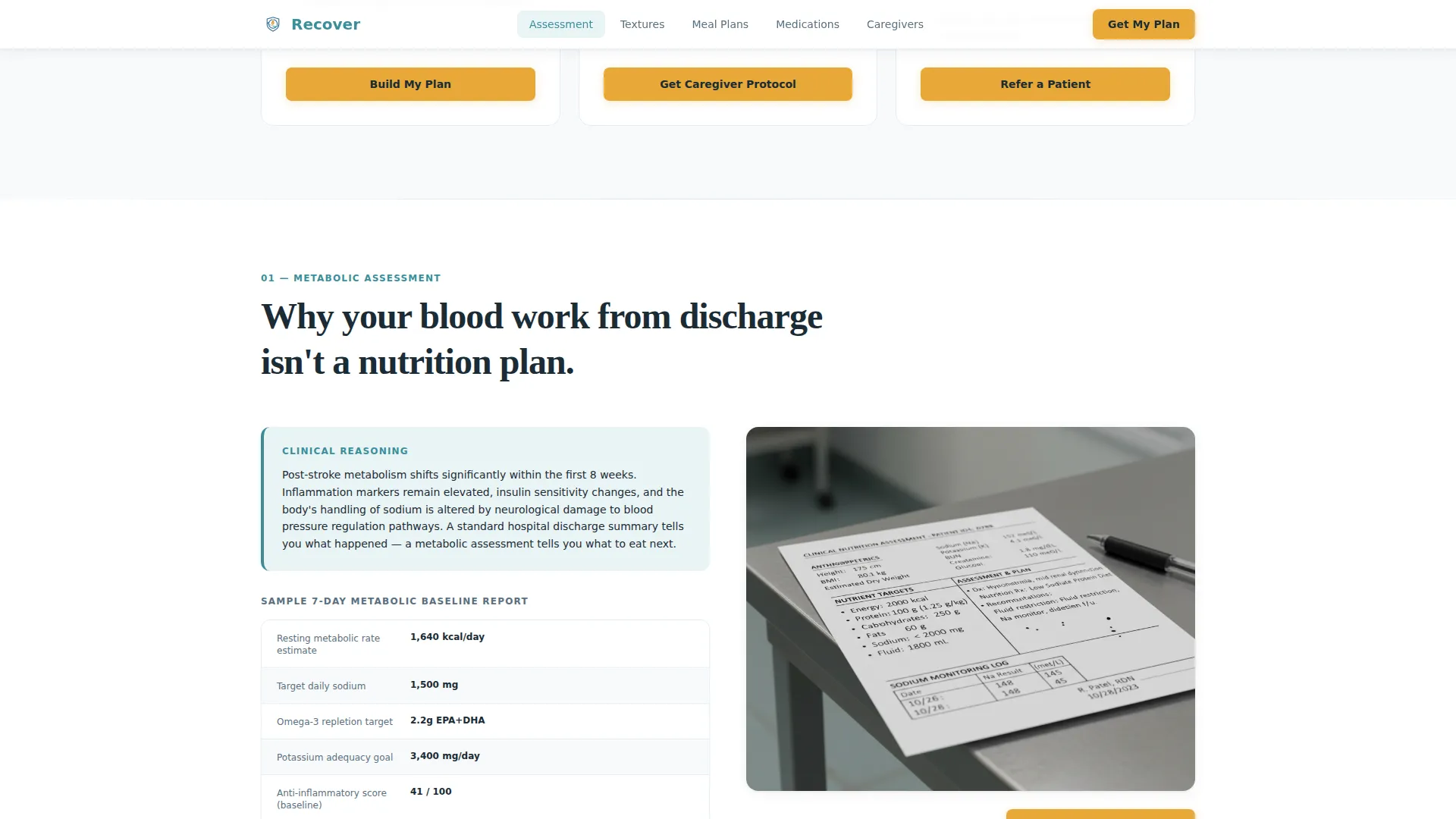
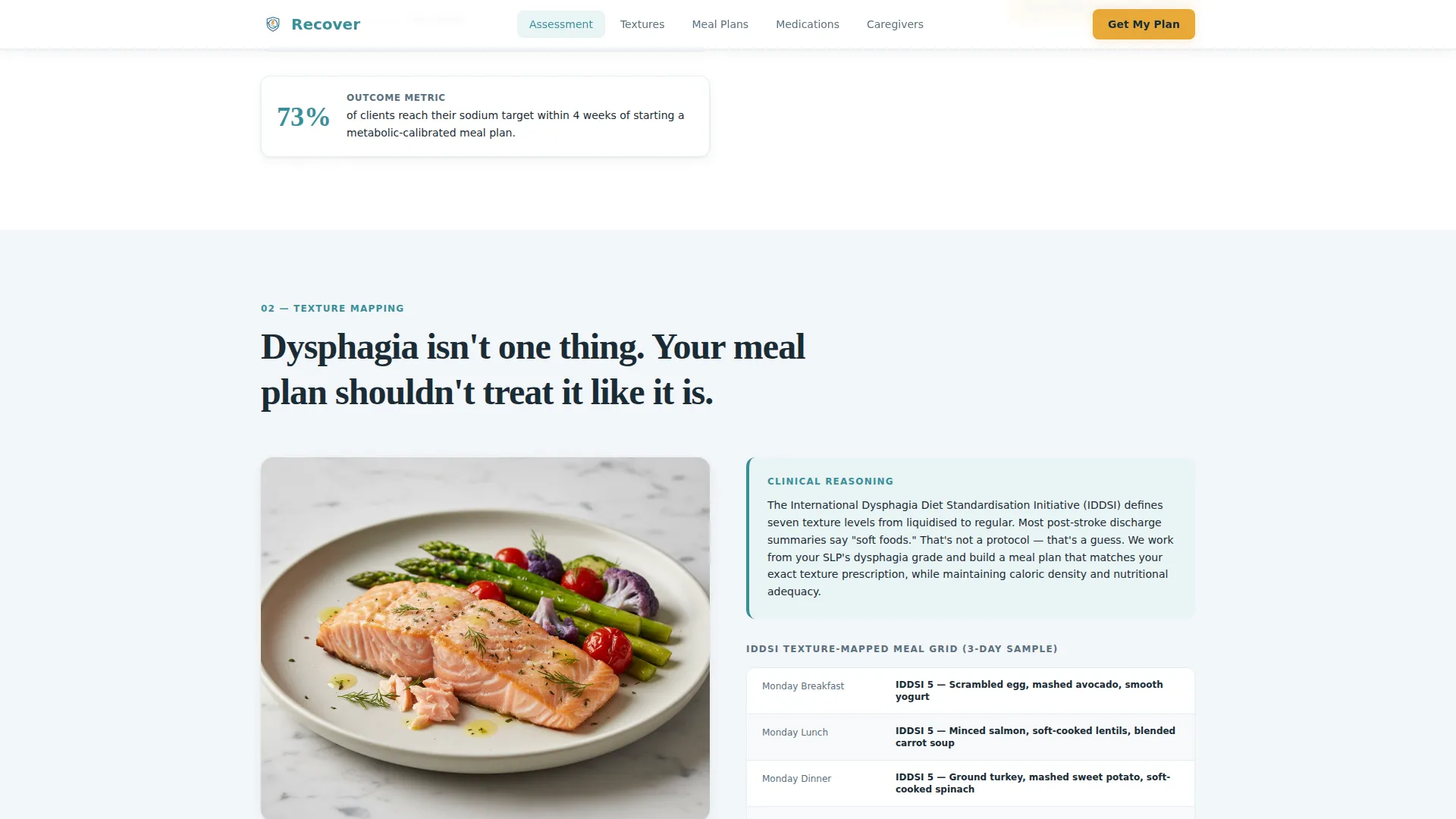
Each spoke section follows the same three-part disclosure structure. It opens with clinical reasoning, presents an exact deliverable such as a sample seven-day meal grid with macro breakdowns, and closes with a real outcome metric. This pattern builds trust by showing the work rather than claiming results.
Three-Path Audience Cards
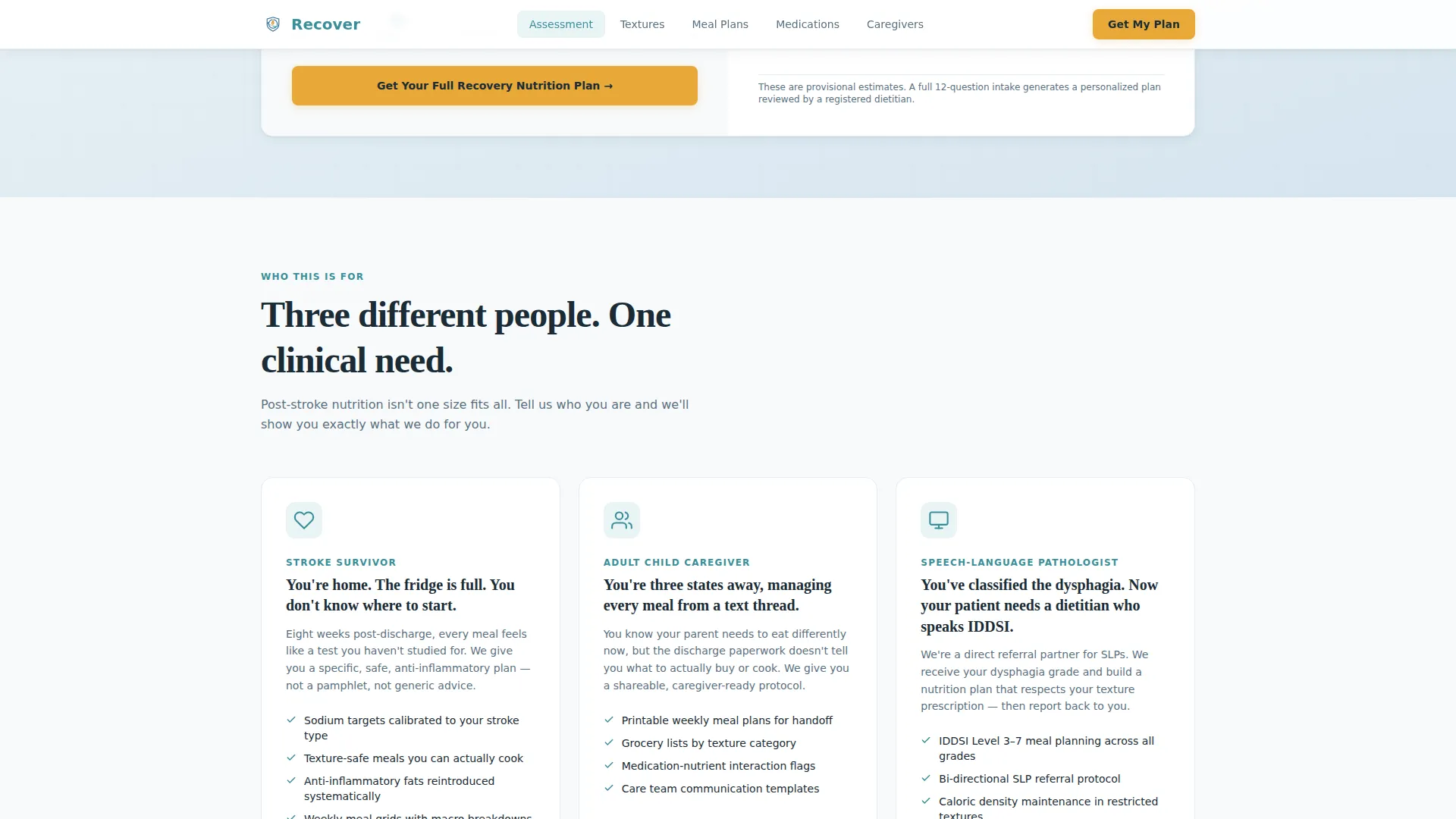
A dedicated "Who This Is For" section presents three identity cards: Survivor, Caregiver, and Care Team. Each card speaks directly to that visitor's context and directs them toward the most relevant section or action, reducing friction for every audience type arriving on the page.
Page sections overview
| Section | Purpose |
|---|---|
| Hero Calculator | Live sodium and anti-inflammatory score tool as entry point |
| Who This Is For | Three-path ICP cards for survivor, caregiver, and care team |
| Metabolic Assessment | Clinical reasoning, sample deliverable, and outcome metric |
| Texture Mapping | Modified-texture protocol methodology with sample grid |
| Meal Architecture | Combined meal planning and medication-nutrient interaction spoke |
| Quiz Intake Funnel | Twelve-question clinical intake with one-at-a-time step flow |
| Footer | Logo and tagline left, navigation links right |
Design & branding system
The visual identity follows a Medical Clarity theme built on an Arctic White color system. The palette is designed to feel sterile enough to earn clinical trust and warm enough to feel human at the same time.
- Arctic White (#F8FAFB) dominates all backgrounds; steady-pulse teal (#3A8F9A) carries headings and anchor navigation; soft catheter-blue (#D6E4F0) holds supporting text containers
- Warm reassurance amber (#E8A838) appears exclusively on calls to action and progress indicators, so every actionable element glows distinctly against the white and teal layout
- Typography pairs DM Sans for body text and interface labels with Fraunces, a display serif, for primary headings, giving clinical structure a note of human warmth
Mobile & speed optimization
The template is built desktop-first, since the live calculator benefits from full viewport space. A complete mobile fallback ensures all sections, the quiz, and the anchor navigation remain fully usable on smaller screens.
- Static methodology sections are structured as server components, keeping initial load lean while reserving client-side rendering for the calculator and quiz only
- The multi-step quiz flow and scroll-reveal animations are designed to perform cleanly on mobile without sacrificing the step-by-step question pacing that drives quiz completion
How this template helps you convert
Every design and layout decision in Recover is oriented toward earning trust before asking for action. The conversion architecture moves in a deliberate sequence.
- The live calculator delivers immediate, personalized clinical value in the hero section, giving visitors a concrete reason to stay and explore before reading a single testimonial or bio.
- The transparent methodology spokes lower resistance by disclosing the program's full clinical process, removing the uncertainty that typically stops a post-stroke visitor from committing.
- The dual lead-capture paths ensure that even visitors who are not ready to commit personally can still enter the funnel by forwarding the assessment to a caregiver or care team member.
Other information about this template
This template is suited to US-based programs using imperial measurements and standard US clinical terminology. It is built with English as the primary language. A few additional notes are worth knowing before you build.
- The template uses DM Sans and Fraunces typefaces, both available via Google Fonts, and requires no paid font licensing for standard web use
- Scroll-reveal animations and quiz step transitions are set to a medium intensity, keeping the page lively without overwhelming visitors in a sensitive recovery context
- The footer follows an Arc layout pattern with the logo and tagline on the left and navigation links on the right, keeping the exit experience clean and on-brand
- This template is appropriate for dietitians, rehab nutrition programs, hospital outpatient departments, and private practice clinicians working in the stroke recovery care niche
Theme
Medical Clarity
Creative direction
Transparent Process
Color system
Arctic White
Style
Hub & Spoke (Anchor Nav)
Direction
Quiz/Assessment
Page Sections
Live Stroke Nutrition Calculator
Twelve-step Clinical Intake Quiz
Dual Lead-capture Paths
Anchor Navigation Hub and Spoke Layout
Transparent Methodology Sections
Three-path Audience Cards
Related questions
Can I use this template if I am not a dietitian myself?
Does the live calculator require a third-party service or paid subscription?
How does the secondary 'Send This to My Care Team' path work?
Is this template a good fit for a speech-language pathologist referral program?
Can the twelve-question quiz content be customized?