Clinical Obesity Wellness Landing Page Template
The Gauge Clinical Biosensor Obesity Care landing page template is a zigzag, single-page lead generation layout built for wrist-worn metabolic wearables. It pairs clinician expert panels with device capability breakdowns, opens with a floating patient data card, and drives action through a role-qualified modal form and a secondary white paper download path. Clinical authority compounds with every scroll.
by Rocket studio
Quick summary
This is a single-page, zigzag lead generation template designed for a clinical biosensor in the obesity care space. It opens with a floating patient data snapshot card, then alternates between clinician expert commentary and device capability panels. Each section builds clinical authority until the final call to action feels like the only responsible next step.
Who this template is for
This template is built for health technology teams and clinical device brands that need to earn trust from medically trained audiences before asking for a commitment. The page communicates at the level those audiences expect: precise, unhurried, and evidence-led.
- Bariatric surgery teams that need to explain remote post-operative monitoring to institutional decision-makers and patients simultaneously
- Endocrinology practices and metabolic medicine groups communicating continuous monitoring value to sprawling patient panels managing insulin resistance and metabolic syndrome
- Clinical wearable startups targeting GLP-1 protocol patients who want body composition data that goes beyond body weight shown on a scale
What problem this template solves
Quarterly lab draws leave clinicians and patients with wide gaps in metabolic data. Between appointments, shifts in lactate levels, glucose concentrations, and inflammatory markers go unobserved. A landing page that simply lists device specs cannot close that trust gap with a bariatric surgeon or an endocrinologist.
- Clinicians need layout structures that mirror how they evaluate evidence: expert commentary first, device capabilities second, credentials visible throughout
- Patients deep into a GLP-1 protocol need empathy alongside data, proof that body weight on a scale is not the whole story, and that biosensor measurements tell a more complete picture
- Clinical device brands need a lead qualification system that separates clinicians from patients from researchers before collecting contact information, so follow-up is relevant from the first email
What you get with this template
The template delivers a fully structured, section-led single-page layout with every visual component described in the source brief. No section is generic. Every panel has a defined purpose within the clinical narrative arc.
- A hero section built around a floating patient data snapshot card showing a Day 212 visceral fat trendline, resting metabolic rate data, and a patient quote, with dual calls to action below the headline
- Three zigzag expert pairs alternating left-aligned clinician commentary with right-aligned device capability breakdowns, followed by a quantified metrics bar and a final lead generation section with a role-qualified progressive disclosure modal
- A sticky mobile call to action bar and a secondary white paper download path that captures email from visitors not yet ready to request clinical access
Feature list
This template contains the following purpose-built components. Each one is described here so you know exactly what you are getting before you open the file.
Floating Patient Data Hero Card
The hero section replaces a traditional stock-photo banner with a data snapshot card. The card floats over the arctic white background and displays a Day 212 monitoring label, a visceral fat trendline drawn in teal, a rising resting metabolic rate readout, and a verbatim patient quote beneath. Name, age, and protocol details are typeset beneath the quote. The specificity of the data is designed to stop scroll because it reads like a real patient's health turning a corner, not a marketing illustration.
Zigzag Expert Panel Layout
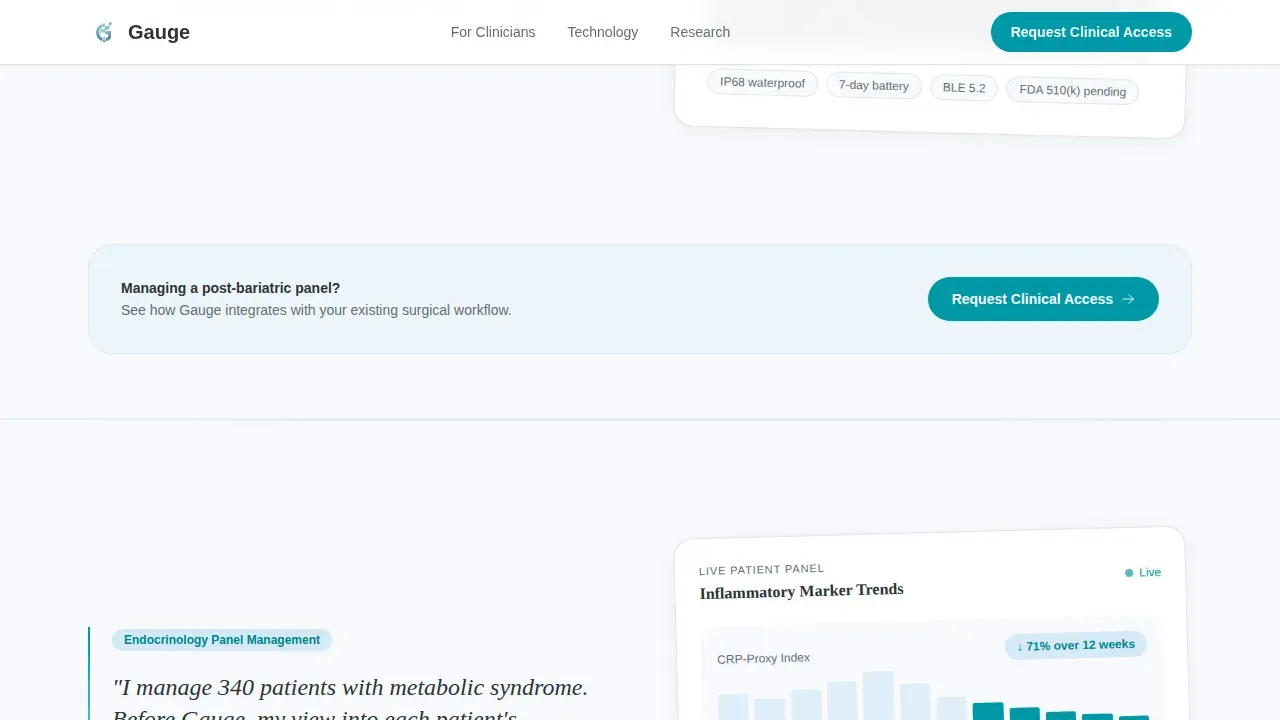
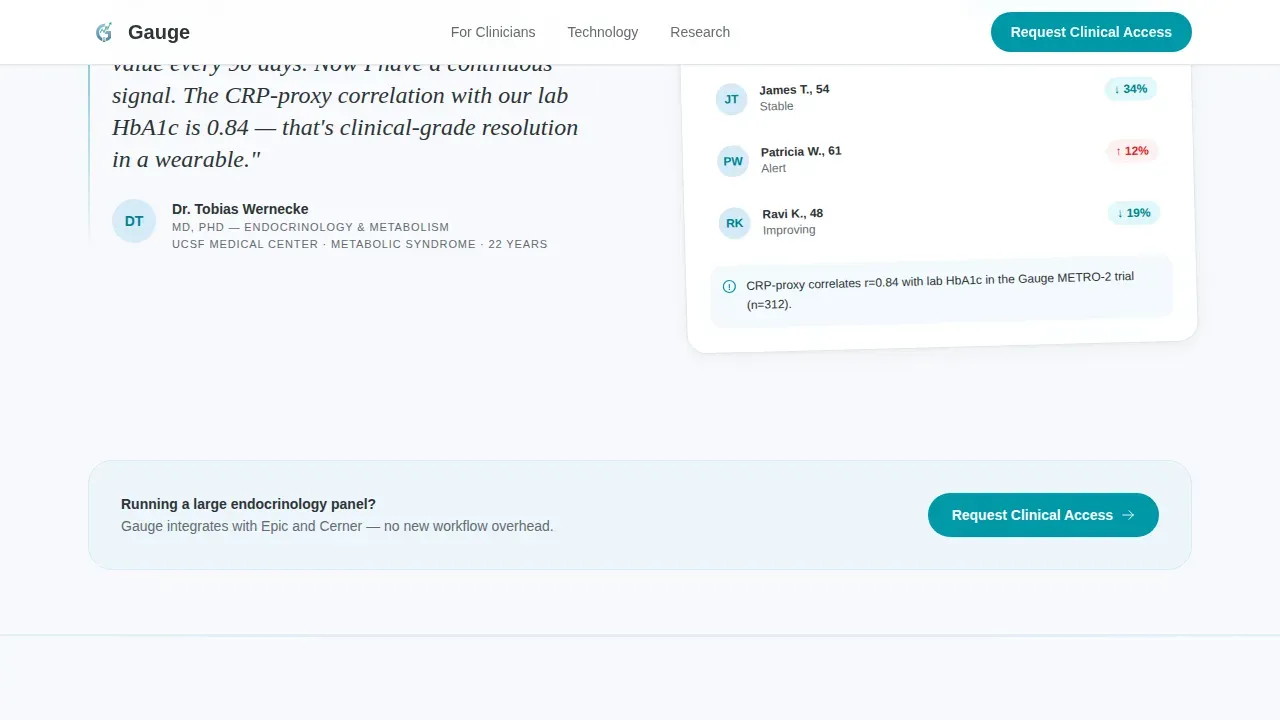
Three alternating panel pairs make up the body of the page. Each pair positions a clinician's commentary on one side and a device capability graphic on the opposite side. The first pair features a bariatric surgeon's perspective on weekly visceral fat data paired with an exploded bioimpedance spectroscopy diagram. The second pair presents an endocrinologist's view on inflammatory marker correlation alongside a sample dashboard showing C-reactive protein proxy trends. The third pair adds a GLP-1 specialist's voice next to a body composition metrics breakdown. Each expert's credential is typeset small and precise: institution, specialty, and years practicing. The scroll mimics the experience of attending a grand rounds lecture where evidence compounds with every speaker.
Role-Qualified Lead Generation Modal
The primary call to action, labeled "Request Clinical Access," opens a progressive disclosure modal form. The first field is a role selector with three options: Clinician, Patient, or Researcher. After role selection, the form presents name and institution or care provider fields, followed by a single open question: "What metric matters most to you?" This structure keeps friction low while qualifying intent before any follow-up contact occurs.
Secondary White Paper Download Path
Visitors who are not ready to request clinical access are served a secondary conversion option. A "Download the White Paper" prompt captures an email address in exchange for a peer-reviewed efficacy summary. This two-path structure means the page converts at two levels of readiness, capturing researchers, skeptical clinicians, and early-stage patients who need more evidence before committing.
Quantified Metrics Bar
Between the final expert zigzag pair and the closing call to action, a horizontal metrics bar presents social proof in numerical form. The bar displays counts for patients monitored, clinical sites active, and total data points collected. This component anchors clinical authority in concrete figures rather than adjectives, matching the evidence standards that medical audiences apply to any claim they encounter.
Sticky Mobile Call to Action Bar
On mobile viewports, a fixed bottom bar maintains the "Request Clinical Access" prompt throughout the scroll. This ensures that a clinician reviewing the page on a smartphone between appointments never loses sight of the primary conversion path, regardless of which section they are reading.
Page sections overview
| Section | Purpose |
|---|---|
| Hero data card | Opens with floating patient trendline snapshot and dual calls to action |
| Expert pair one | Bariatric surgeon commentary paired with biosensor diagram |
| Expert pair two | Dashboard CRP-proxy trends paired with endocrinologist voice |
| Expert pair three | GLP-1 specialist paired with body composition metrics panel |
| Quantified metrics bar | Displays patients monitored, clinical sites, and data points |
| Final call to action section | Role-qualified modal form and white paper download path |
| Footer row | Linear single-row footer with minimal navigation |
Design & branding system
The visual identity follows an Educational Guide theme. Every color, typeface, and spacing decision is calibrated to feel like a clinical environment where nothing hides and everything is legible at a single glance.
- Arctic white (#F7F9FC) fills the open backgrounds, charcoal-slate (#2D3436) is used for all body text to achieve a peer-reviewed abstract reading quality, and pale glacier blue (#D6EAF8) colors all data card backgrounds and section dividers
- A single decisive teal (#0097A7) is reserved exclusively for interactive elements, trendline graph highlights, and call to action buttons, providing a warm focal point without breaking the clinical register
- Fraunces serif handles all display headlines for an authoritative editorial feel, while DM Sans manages all body copy for high legibility at small sizes across desktop workstation screens
Mobile & speed optimization
The template is designed desktop-first to match the workstation review habits of clinical audiences, but it includes specific mobile provisions so the page does not lose patients or researchers arriving on smartphones.
- Scroll-triggered reveal animations bring each expert panel into view progressively, preventing cognitive overload on smaller screens where all content would otherwise load simultaneously
- The sticky bottom call to action bar on mobile ensures the "Request Clinical Access" button remains visible throughout the scroll without requiring the user to return to the top of the page
- Server components handle all static sections for a fast initial load, while client components are reserved for the modal form and animated elements, keeping the page responsive on clinical network connections
How this template helps you convert
Every structural decision in this template serves the lead generation objective. The page does not ask for a commitment until it has stacked enough clinical authority to make refusal feel like disagreeing with a panel of specialists.
- The hero data card converts curiosity into credibility in the first five seconds: a real-looking patient trendline is more persuasive than any headline claim, and the dual call to action immediately offers two paths based on readiness level
- Each zigzag expert pair compounds the evidence case by presenting both the human clinical perspective and the technical device capability in the same visual breath, so by the time the visitor reaches the metrics bar they have absorbed five specialist voices and a dashboard of quantified outcomes
- The progressive disclosure modal reduces form abandonment by leading with role selection rather than personal details, so visitors self-segment before they feel asked for anything, and the white paper path catches the remaining percentage of visitors who need one more data point before they act
Other information about this template
This section covers additional context relevant to the biosensor subject matter, the research landscape underpinning this template's content areas, and practical notes for teams building on this layout.
The clinical wearable field that this template serves is grounded in a substantial body of published research. Understanding how biosensor technology works at the biochemical level helps content teams write with accuracy and confidence. The following notes draw from that research context.
- Lactate is a central biomarker in metabolic health monitoring. Research has shown that blood lactate can assist in the diagnosis of disease conditions including pyruvate metabolism defects, sepsis, hypoxia, and meningitis. Monitoring the lactate level in the body has also been used to manage the fatigue and endurance of athletes, and recent wearable lactate biosensors have achieved a linear response range capable of detecting lactate levels from 1 to 50 mM in sweat during physical activity.
- Both glucose and lactate are major contributing factors to metabolic cycles. Glucose is considered a key metabolic substrate for tissue energy production, and its concentration in blood has traditionally been used as a biomarker of diabetes, hypertension, and fatty liver. Few researchers have studied the combining effect of both glucose and lactate together, though simultaneous monitoring of both metabolites provides a more complete picture of metabolic state than either biomarker alone.
- The lactate to glucose ratio, commonly written as L/G, has been proposed as a diagnostic criterion in obesity research. Studies using mouse models observed that an L/G value of 0.59 could differentiate between normal and obesity conditions. In prolonged obese cases, researchers observed a drastic increase in blood glucose alongside a small but significant increase in blood lactate. The ratio of lactate concentration to glucose concentration was calculated as weight was gained, and a diagnostic plot using L/G ratios and body weight gain categorizes obesity conditions into four distinct zones.
- Wearable lactate biosensors commonly use lactate oxidase as the enzyme that enables electrochemical lactate detection. In these systems, lactate oxidase catalyzes the oxidation of lactate to pyruvate, generating hydrogen peroxide as a byproduct that is then measured at the electrode surface. The enzyme is typically immobilized within a phosphate buffer environment to maintain stability across a functional temperature range. A calibration curve is constructed during validation experiments to map electrode response to known lactate concentrations, and values measured from human sweat or serum samples are compared against this curve to confirm accuracy.
- Epidermal patch form factors are among the most researched wearable biosensor designs because they allow continuous monitoring directly at the skin surface. An epidermal patch placed over a sweat-generating area collects human sweat non-invasively and routes it to embedded sensing electrodes. The use of diffusion-limiting membranes within a lactate biosensor helps control analyte flux to the enzyme, improving linearity across a wider concentration range. Previously reported epidermal patch designs have demonstrated good stability and selectivity when measured against serum samples collected under controlled conditions.
- Insulin resistance and insulin sensitivity are closely tracked metabolic parameters in obesity care. The American Diabetes Association recognizes elevated blood glucose and impaired insulin sensitivity as key indicators of metabolic syndrome. Research into wearable biosensors increasingly focuses on simultaneous monitoring of both glucose and lactate concentrations because the relationship between these two metabolites reveals more about insulin resistance than either measurement in isolation. Content teams populating this template should reference the American Diabetes Association guidelines when describing glucose-related monitoring claims for clinical audiences.
- Uric acid is another metabolite of interest in sweat-based biosensor research. Elevated uric acid concentrations in plasma and sweat have been associated with gout, kidney function decline, and cardiovascular risk. Some advanced wearable biosensor designs have demonstrated simultaneous monitoring of uric acid alongside lactate and glucose, expanding the panel of blood metabolites accessible without a blood draw.
- Environmental factors influence metabolic measurements in meaningful ways. Natural daylight exposure has been shown to positively impact metabolic health by improving glucose homeostasis in individuals with type 2 diabetes. Chronic lack of daylight is increasingly considered a risk factor for metabolic diseases including type 2 diabetes. Exposure to natural light increases whole-body fat oxidation and alters blood metabolite profiles. Daylight exposure is linked to increased evening melatonin levels, which may influence metabolic processes. The circadian system, influenced by light exposure, plays a crucial role in regulating metabolism and glucose tolerance. Artificial light exposure can disrupt circadian rhythms, potentially leading to impaired metabolic health. Light exposure affects substrate metabolism, energy expenditure, and thermoregulation, particularly in insulin-resistant individuals, and natural light exposure is associated with a shift in substrate metabolism towards greater fat oxidation compared to artificial light environments. Content teams building out the environmental context section of a page based on this template should present these findings accurately and link them to the continuous monitoring value proposition.
- Published research in this field is subject to standard academic disclaimer conventions. Authors declare no competing interests in peer-reviewed biosensor studies. Published maps and geographic designations in affiliated research do not imply any opinion on territorial status. Jurisdictional claims in affiliated publications are the responsibility of the publishing institution. Institutional affiliations are listed as they appear in the original published work. These conventions are relevant for any content team planning to cite research within the white paper download document linked from this template's secondary conversion path.
- The average values reported for lactate measurements in previously reported sweat biosensor experiments vary by exercise intensity, hydration status, and electrode design. Previously reported values from human sweat studies typically fall within the range that a calibration curve constructed in phosphate buffer can accurately measure, provided temperature range conditions during experiments are controlled. Content teams should note that previously reported results from animal experiments, including studies in mice, may not translate directly to humans without clinical validation in human subjects.
- A comprehensive review of the wearable biosensor literature reveals a similar trend across multiple research groups: the move toward simultaneous monitoring of both glucose and lactate in a single sample is accelerating. This similar trend reflects the clinical insight that no single metabolite tells the whole story of metabolic health. A comprehensive review of currently published biosensor architectures shows that sensitivity improvements are often achieved by refining the calibration curve protocol, optimizing enzyme loading, and selecting electrode materials that maintain a stable response across the expected temperature range encountered during continuous wear.
- The American Diabetes Association clinical standards of care are frequently cited in biosensor research as the reference framework for glucose monitoring thresholds. Content teams referencing the American Diabetes Association guidelines within pages built on this template should use current-year standards and note the association's position on continuous glucose monitoring as a recognized clinical tool.
- For continuous glucose monitoring context: the wearable biosensor space increasingly positions continuous glucose monitoring as a baseline expectation rather than a premium feature, with research interest shifting toward multi-analyte wearables that track both glucose and lactate in real time. This shift is reflected in the template's expert panel design, which presents lactate measurements and glucose data side by side within the dashboard visualization sections.
- The Gauge clinical biosensor obesity care landing page template is available in this marketplace as a complete single-page layout ready to be populated with device-specific copy, clinical imagery, and institution-verified credentials.


Theme
Educational Guide
Creative direction
Expert Panel
Color system
Arctic White
Style
Zigzag/Alternating
Direction
Lead Generation
Page Sections
Floating Patient Data Hero Card
Zigzag Expert Panel Pairs
Role-qualified Progressive Disclosure Modal
Secondary White Paper Download Path
Quantified Metrics Social Proof Bar
Sticky Mobile Call to Action Bar
Related questions
Who is the primary audience this template is designed for?
Can this template work for a clinical wearable outside of obesity care?
How does the role-qualified lead generation modal reduce form abandonment?
Does the template include the white paper document?
How is the mobile experience handled in this template?